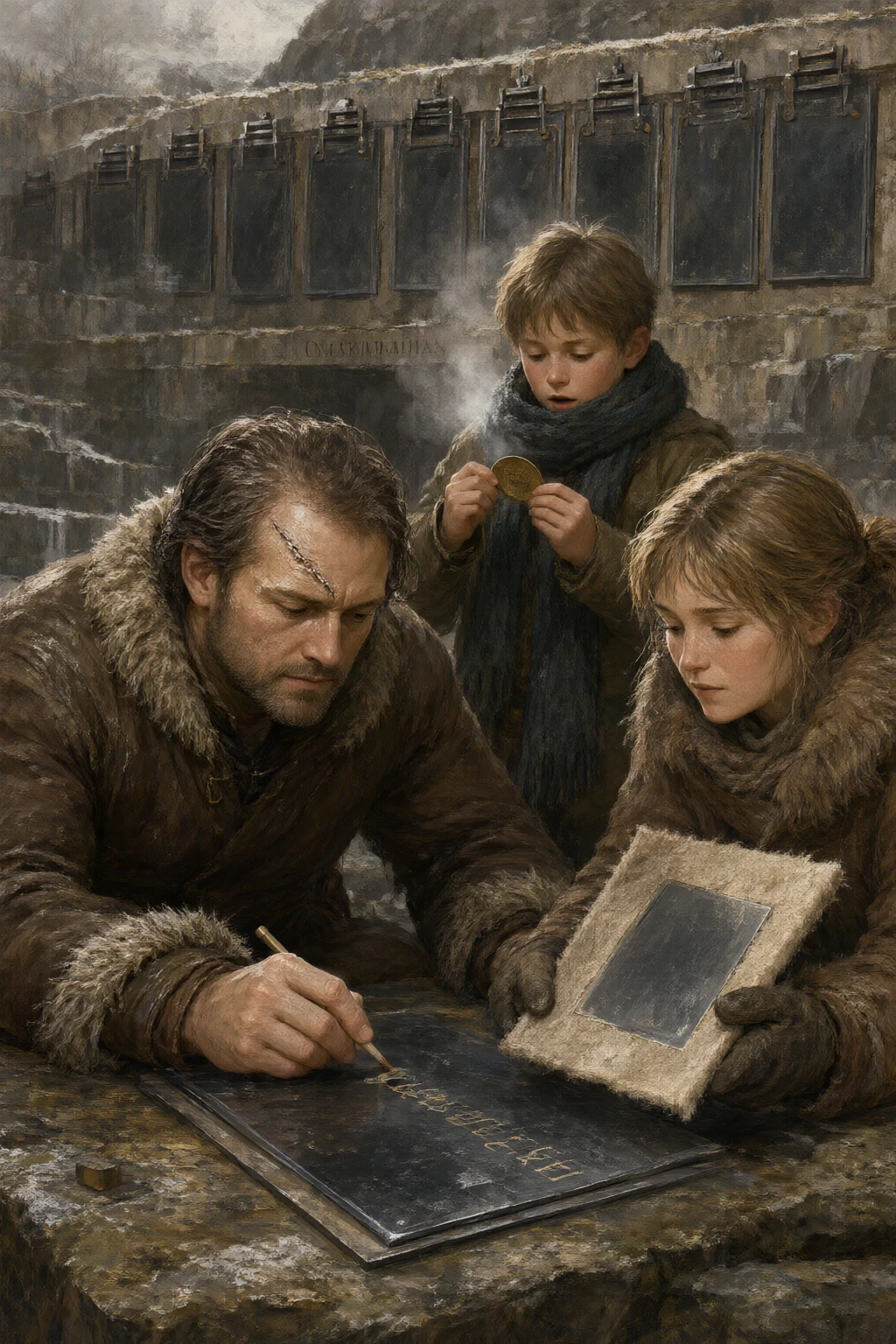
The charge sheet came down the line on a Monday in a tin tube with a strip of oiled paper wound round the neck of it, and that is how the sheets come down, because a sheet that comes off a sledge wet is a sheet nobody signs. Bram Ostmark took it out on the step of his hut and stood with his back to the door. He read the head first, because the head is the void and the bench and the season, and if the head is wrong you have the right sheet for the wrong line, and the desk will tell you so in front of the whole line. VOIDSTONE TERRACE. BENCH FOUR. OSTMARK LINE. SEASON MICHAELMAS TO CANDLEMAS. That was right. He turned it over. The body of it is a printed form with four ruled lines that belong to the desk — plate, charged, held, discharged — and one line at the top that the seamer fills in himself.
The line said SEEDING FIGURE, GRAINS PER YARD, and beside it, in the same small hand as the printing, a bracket: (see docket). Nothing was written against it yet. He had a number ready. He had had one ready since he was twenty-six, and it came up out of his hand the way a knot comes up out of your fingers, and he put it down. 41. Then he unhooked the docket from the pin behind the sheet, which he had not done in eight years. A docket is a narrow strip of the same paper with one corner torn off, and the torn corner is the store's way of saying the seed has left and will not be coming back. SEED SIGNED OUT, OSTMARK LINE. GRAINS PER YARD: 124. He read that once. Then he read the sheet. Forty-one against a hundred and twenty-four.
Bram Ostmark was thirty-four and had a fur-seam across his right eyebrow, healed the colour of a fish bone, from a charging furrow when he was nineteen, and both his palms carried the scoring a season of live stone leaves, a pale ridging like a rope burn. A carter's boy going past read it over his shoulder and said, “That is a void that takes it, that,” and was gone up the hill before Bram could ask him how he knew.
The assay office is held at minus nine from Michaelmas to Candlemas, and there is no arguing anywhere else in the Coldmark worth the walk, so people save things up all winter and do them in one room, standing, in fur coats, hands numb inside four minutes. Bram went down on the Tuesday with the sheet and the docket on a board under his arm, having already said the numbers to himself so often on the way that they came out worn smooth, like a step.
Halla Rimewright was at the long table in the railed alcove with the Book chained open on its frame, the brass assay disc lying in the gutter of the page like a paperweight, and a lamp on a swing-arm throwing a hot circle the size of a dinner plate onto the leaves. She was forty-seven. She kept the thumbnail of her right forefinger split on purpose, so that she could turn a page in a cold room without warming her hand, and there was a shallow groove across the pad of that finger. “Forty-one,” she said, before he had the board onto the rail. Bram put it down. “One hundred and twenty-four,” said Halla, “is what the Book has for your ground. And for the Sorne ground to your east. And for the Fell ground to your west. Eighty-three. That is a difference.” “I have not said anything yet.”
“You said the first one in the doorway. Half the room heard you. Now say the other one, and tell me why.” “Because forty-one is what the void takes,” said Bram. “Is it.” “It is what it has taken every year since I had the line.” “Forty-one is what you have written every year since you had the line. Those are two different sentences, and you are the only man in the Coldmark who confuses them.”
He measured the Ostmark ground on the Wednesday, because he is a man who answers with a measurement, and the ground was the only one of the two parties that could not argue. A thousand yards of drill, paced in his grandfather's method, which is to count the ridges by the boot and not by the eye, because the eye lies on a slope. The ridges stood a finger's width proud under the frost. The ground was not white yet. It would be. The Coldmark sift runs four thousand grains to the pound. He knew the weight of the seed he had used, because the store weighs every docket before it tears the corner, and because he had carried it up in four trips on his own back. Ten pounds and a quarter. That is forty-one thousand grains, and a thousand yards at forty-one to the yard is forty-one thousand grains. The ground had taken exactly what it was told to take.
One hundred and twenty-four thousand grains would have been thirty-one pounds. Twenty pounds and three quarters of a pound of rime-needle had come up that hill on his back, been signed out against his name, been weighed, had its corner torn off, and had never once been in a furrow. He stood in the drill with his hands hanging. The smell of a drilled field in the Coldmark is a dry mineral cold with no snow anywhere in it, and it is the smell of rime-needle in the earth. It is not a cold that fell on the world. It is a cold somebody put there. Then he went up to the store and asked for the last three seasons' dockets, which took some doing.
The dockets came down in a bundle tied with tarred twine, and he laid them out in the order they had been torn. Three seasons. The Ostmark line. One hundred and twenty-four grains the yard, every year, signed out, weighed, corner torn. And the sheets — his own sheets, which the desk does not throw away but sends back down the line folded in four and clipped — said forty-one, forty-one, forty-one, in his hand. He was not a man who forgets numbers. He could not remember writing three sheets. He remembered the drill, and the four trips, and the store man saying the load was light for that distance, and the figure being right.
He knew where the number had come from too, though he could not have named the day or the hand. It had the shape of something he was handed at nineteen, on a charging day, in front of a hissing plate, by a man with cold-burn fingers who had put a palm flat on a boy’s chest and said the thing the void takes, not the thing the ground grows, boy, and if you write the ground's number you will charge a fine plate with a charge it holds badly and it will bleed all winter, and they will write the loss against your name, because your name is the one nearest the plate. Bram sat with that for an hour. It was not a lie anybody had told him. It was a true thing, told at nineteen, by somebody with no reason to be wrong and every reason to be believed, and it had gone into him the way the scar went into his eyebrow: without a decision.
He went to the Iron Row of the Guildhall yard on the Thursday, where the frost-plates stand on their racks under the tarpaulin with their faces turned out for the season, and found Ilva Sorne doing what she does, which is looking at a plate. She is twenty-nine, burn-scarred from collar to wrist, and she holds anything cold in a folded square of oiled wool, never bare-handed. “Forty-one,” Bram said. Ilva did not look up. “That is not a crack, that is a plate.” “You brought the number. People bring the number when they want the plate to be at fault.” She turned the plate a quarter with two fingers inside the wool. “Which plate.” “Number four. Mine.” “Number four is the best cut on this hill and you know it is, which is why you keep sealing it through the thaw.” She said it flatly, the way you say a thing you have said before. “Show me the docket.”
He showed her. She read it the way you would hold something that belonged to a dead man. One hundred and twenty-four. That is what the store gave you. “Then the plate is not at fault, and it never was, and you have spent eight seasons sealing a thing correctly, in the thaw, for nothing, because there was never enough in it to bleed. Whoever taught you that was right about the sealing and wrong about the figure, and he would not have known, because the plate kept holding.” She squared the wool round it. “A cold that is never charged cannot be found wanting. That is not the same as being right.”
He went down to the Frostgate on the second market with nothing to sell and nothing to buy, which is the one way to see a market properly. A hundred barrows of sacking-wrapped cold stand in rows on the setts, and the whole business of the place is conducted by two people reading numbers off each other. He found the line for first grade without meaning to, because it is always the shortest line, and there was a boy in front of it reading the discs aloud as they came off the barrows, softly, to himself, in a wool scarf wound twice and tucked so long that its end had to be stepped on. “One-one-four. Ninety-one. One-hundred-and-two,” said Coen Halloway. “One-one-four. That is four today. It was nine last market.” Bram stood at the edge of the setts and did the arithmetic he had been not doing for three seasons.
Twenty pounds and three quarters of a pound of seed, at a yard of standing cold to the pound, is twenty yards and three quarters of a yard of cold his ground did not make. In three seasons that is sixty-two yards and a quarter. Sixty-two first-grade barrows the Coldmark sold in three winters and charged to the Ostmark line, and got out of the hill by taking it out of the void next along. He walked up the ditch path to Fell Row after dark and stood on the public edge of the Fell ground, looking for the standing cold the way a man looks for a crop. You cannot see cold. What you see is what cold has done to a thing. On good ground the frost comes up in a whorl, and the stones inside it are never hoar, because hoar melts in standing cold. It is a thing a wright's child is taught to look for at six.
The whorl was not there. Inside the ridge the stones were white and the drill ridges were flat and hard and the earth under them was ordinary earth, and it was the ninth of December. Three ordinary winters at Fell Row, on a line seeded at a hundred and twenty-four, drawn hard to make up a contract on a bench where one plate out of eleven was holding less than a third of what the sheet said it should.
The Guildhall has no seating, which is an accident of the build, except the Retirees Bench along the south wall out of the wind, where the old wrights sit in a line from noon. Bram sat down at the far end in the dark, then got up and sat at the near end instead, which four old men watched without comment. Ansel Rime is seventy-four, a white beard in a good coat, the tops of all ten fingers gone the blue shine of an old cold-burn. He was the last man to cut a void by hand. He was paid out. He sells nothing. They talked about the weather for a while, the way men do, meaning nothing. Then Bram said, “Where did I learn it.” “To write what the void takes. The forty-one,” said Bram. “You were on the bench the year I filled it.” Ansel drank, and was quiet long enough that two more old men sat down at the far end.
“Sit on this side,” he said at last. “The wind comes round the corner and takes the back of the neck, and I am not spending what I have left on that.” He moved his coat along the stone, and Bram moved with him, and their two sets of frozen hands hung a few inches apart in the dark.
“I will tell you how it started,” said Ansel Rime. “There were four of them cut the first winter, the first four voids, and one man with the assay, and he went out to see what the hill would take, because you cannot know that from a book. And he stood in front of the plates a whole day and wrote down what each plate took when he tried it, and not what the ground would grow, because that was not the question he had gone out there to answer. And then he came in and filled in the sheets from what the plates took, because that was the honest answer to the question he had actually asked. And somebody wrote it down as though it were the seeding rule, and after a while the two numbers were the same number in everybody’s head, and nobody could go back and find the day they stopped being two numbers, because on that day nobody thought anything was happening.”
He turned the cup round in his fingers, blue knuckles and all, and said that it had been nine ways to him and he had told it nine ways and he did not know which one happened, and that he did not think Bram did either. “But the numbers say the other thing,” he said, “and the numbers are never wrong.”
Bram walked home down the Voidstone line with the docket in his coat and did not sleep much. On the Friday he went to the assay office and asked for the amendment, and got one, because an amendment to a seeding figure is not a mystery, it is arithmetic, and the desk does three of them a season for seed gone into a wrong furrow. Halla wrote the new figure into the Book against the Ostmark line for the coming season. One hundred and twenty-four, in her own hand, initialled in the margin. She did not ask him for a reason, because there is no column for a reason. She said so, to be fair to her. She said, “I can put the number in. I cannot put the other thing in, and you should have known that before you came up here.” That was true. It was also the whole of what the Book was, and Bram had known it since he was fifteen.
Then he went down to the store and asked for thirty-one pounds of rime-needle, and the store man looked at the docket and then at him, because the store is not a place that gives out two and a half times what a man has carried up before without a word. “Signed out at one hundred and twenty-four last month.” “Yes.” “You carried ten up.” “Yes. So I want twenty and three quarters more, on the same docket, and I want the coupon cut twice. I have taken twenty and three quarters already and I did not put it in the ground, and I am signing for it in two places so that it cannot be argued about in the spring.” The store man cut the coupon without interest. It is a store, and the store's business is that the paper and the seed agree, and now they agreed in two places.
He carried the twenty pounds and three quarters up the hill in five trips, and he could not have told you afterward which trip was the worst. That is the price. The cold in a live furrow takes the feeling out of your face and your hands and gives it back some hours later out of the general reserve, and a season of it gives back about a decade less than it takes, and the guild has a pension fund for it, and the fund is late.
He sowed the Ostmark ground at a hundred and twenty-four to the yard himself, share and furrow and three feet deep, and it is a two-man job, and he did it with a boy off Fell Row because the ground would not wait for a third man. The furrows opened with a hiss like a plank walked on with a hammer, the heated share steamed where it touched the earth, and the smell came up off the field of that dry mineral cold with no snow in it. That was the last week in November. On the Sunday after, the Fell ground came up as it should. The whorl was in, the stones inside the boundary ridge were black and wet-looking in a way they had not been in three winters, and a woman from Fell Row stood at the ridge with a bucket and looked at it a long time, and then went to find the seamer.
She found him at the store, and asked what it was worth, and he told her, because telling her was the work. He told her that the extra twenty pounds and three quarters a season came off the Ostmark line and would keep coming off it as long as the Ostmark line was a line, and that he could not tell her in November what January would be like in that house. She looked at him a while. Then she said, “Right,” and asked whether she might take his barrow-run of seed up the hill in the spring, free, because he would be needing it, and he told her the number of trips it would save him, because it was the only thing he had. That week Halla was asked by a man from the committee why the Ostmark line had been returned at three-ninths for three seasons and why no amendment had been entered.
“Because nobody brought me a sheet that was wrong,” she said. “The degrees were measured. The degrees are never wrong. That is what degrees are.” She went back to the alcove and put the disc into the gutter of the page and turned the swing-arm, and after a moment she said out loud, to nobody, in a room at minus nine that holds no sound at all: “One hundred and twenty-four. Forty-one. Eighty-three. That is a difference, and it took eight years and a boy reading discs to find out who was standing at the end of it.” Then she wrote the day’s figures in the Book, because the Book does not care, and chained it shut, and went home with her right forefinger open in the cold, the way she has kept it open for twenty-two years.