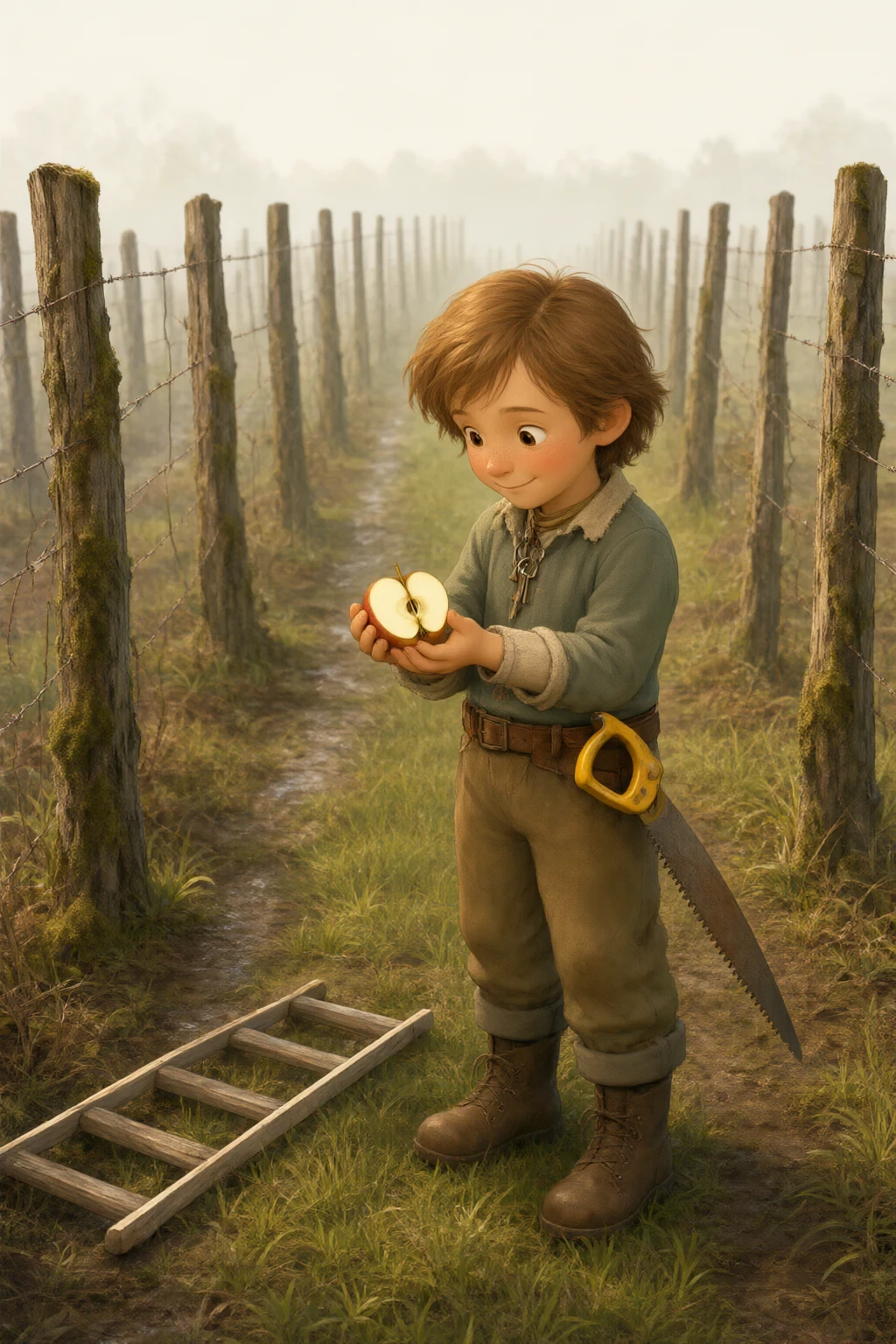
Hollis Bray counted the trees out loud, because that was the job, and because his mouth would not stay shut for it. “Seven. Eight. Low and leaning, this one. Eight.” The Fenrows ran east and downhill in long wet lines, and every tree leaned a little, because the ground had been water meadow before anybody planted an orchard. His mother came up the ditch line with her mitten on her left hand and her iron keys on the bootlace at her throat, and the keys counted with every step. “Finished?” she said. “Eight rows.”
“You will find it wet under the north row,” Sennet Bray said. “It is always wet under the north row.” “It is eight rows.” “It is eight rows,” she agreed, and went on up the slope. Hollis stayed where he was. He counted again from the ditch, slowly, the way you count when you are not sure of yourself. “Eight,” he said. And then he said, “Nine.”
There was a ninth row. It was at the bottom of the wet, past the last ditch, where his boots came up with a sucking sound. Nine old trees in a line, all leaning the same way, moss green on the north sides.
They were not on the chalk board in the schoolroom. The board had eight long lines on it and a number at the end of each one, and his grandmother had kept that board for fifty years, and if there was a ninth row in the Fenrows then she had been counting wrong since before he was born. He laid the ladder flat in the grass so that nobody would fall over it, walked to the far side of it, and started at the near end of the row.
“First tree. Old. Moss on the north. Fourth, wire round it, rusted, and the wire is not round the tree, it is round a post that is not there any more. Seventh, two branches cut off square, and not this year. Ninth, in leaf and not one blossom on it.” Then he wrote it down on the back of a feed sack. Nine trees, the wire, the square cuts. Ground that kept a bootprint, and old bootprints in it already, not his size.
Then he walked the row back the other way and wrote it down again, and the second list was not the same as the first, because looking at things the other way round showed different things. Both lists were true. That was the trouble. Near the eighth tree was an iron hoop the size of a cart wheel, and his boot went through the middle of it. Past the fourth tree a fence post, rotted through at the base. Past the sixth, another. Past the ninth, a third, all the same distance apart.
Under the ninth tree lay a windfall. Hollis cut it with his saw. The seed sat in a star of five with a pale ring around it, and the apple smelled like a cellar after rain. He tasted it. It was not sour and it was not sweet. It was cold. That was the only word he had. It tasted like cold stone with water standing behind it. He put the two halves in his pocket and went up the hill to the schoolroom.
His grandmother was at the board with a cloth, because she cleaned it every morning whether or not there was anything on it. “Eighty-one years old,” she said, before he had spoken. “And I have never once had a lie out of that board.” “Gran. If you have come about the north row, I know. I have not looked at it since the frost.” “It is not the north row.” She turned round. Wenna Bray was small and very straight, and her hands were too bad now to hold a chalk for a whole row.
Hollis put the two lists on the desk and read them out. The nine trees, the wire, the square cuts, the iron hoop, the posts, the blossomless tree, and last of all the taste of the apple, which he described badly. She read both lists again by herself, moving one finger down the lines. “There is no ninth row,” she said. “There is.” “There is not. I have looked at that wet every morning for fifty-one years, and there are eight.”
“Gran, I went down it twice. I wrote down everything I could see both times, and both times it was there, and both times I saw different things, and both of them are true.” She was quiet a while. The chapel bell went the hour out in the yard, and nobody went to it.
“My mother counted a ninth row once,” she said. “Nineteen hundred and four, in the fog. She told my father and he said she had had a drop and a wet head. She never went back to look. That is the whole of what happened to that row. It was counted once, out loud, by a frightened woman, and nobody wrote it down, and so it did not happen.” She picked up the chalk. Her hand shook, so the chalk squeaked on the slate. “You wrote it down,” she said. “That is the whole of it, and it is more than she did.”
Marren Ashlock came at four o’clock with his notebook lashed to his left wrist and his plumb bob swinging in his chest pocket. “There is no ninth row on the Ward Survey,” he said, and stopped, because that is a sentence a man says when he means to be right. “Look at the ground, then,” Sennet Bray said.
So he looked. He let the plumb bob hang at the bottom of the wet, and when it stopped swinging it was not over the ditch line. He wrote the distance from the first post to the second, and then the second to the third. “They are the same,” he said. “They are the same,” Hollis said. “Noted,” said Marren Ashlock. So he counted the trees, and wrote them down before he counted them, which is the only way anybody counts anything properly.
“Nine trees,” he said. “Nine posts. And a hoop of iron for a water butt, and there is no water butt. There is a cellar under the packing shed, and that is a long way west.” “Yes,” he said. “A long way west.” He came out of the wet with his knees brown to the thigh. “Nine is not on my plan,” he said. “And it is not on hers either.” He nodded at Sennet. “Write that down in that order.” He opened the notebook, and after a moment said, “Noted, corrected.”
Ottiline Vrey was in the Register Room with the grey archive glove on her right hand and the bone-white boxwood pin in her left ear. “Eleven ledgers,” she said, before Hollis had his boots off. “And who asked you to count?” “Master Ashlock said you should have the row.” “Master Ashlock says a great many things.” She turned to a fresh page. “Nine, then. Low east side, past the last ditch. Not planted by us. Not on either plan. Who is the parent?” “Nobody knows yet, Mistress Vrey.”
“Then the column where the fruit came from stays empty.” She ruled a line under the heading and wrote the docket number across it, then looked at the empty space at the right-hand side of the page. “There is no column for that,” she said, “and there will not be one, because a register is a document of descent and not a document of what is down there. I record the parent. I do not record the finding. If I recorded the finding, in fifty years somebody would think I had made it up.”
Hollis looked at the wide margin, where people had always written nothing. “Would that be a column,” he said, “if it was written in pencil?” “Once,” she said. “In pencil. Once. And it will be your hand and not mine, and I will not initial it, and if anybody asks me in thirty years whose hand that is I will say I was not in the room.” She ruled a narrow space up the margin, from the bottom of the page to the top.
Hollis set the two halves of the apple on the desk, cut face up, beside the ruled space. Then he copied out both of his lists, one above the other, in pencil, because they were both true and nobody had told him which one to throw away. The nine docket numbers went in the column that existed. The ninth row went in the margin, in a boy’s hand, where anybody could read it and stop pretending it was not there.