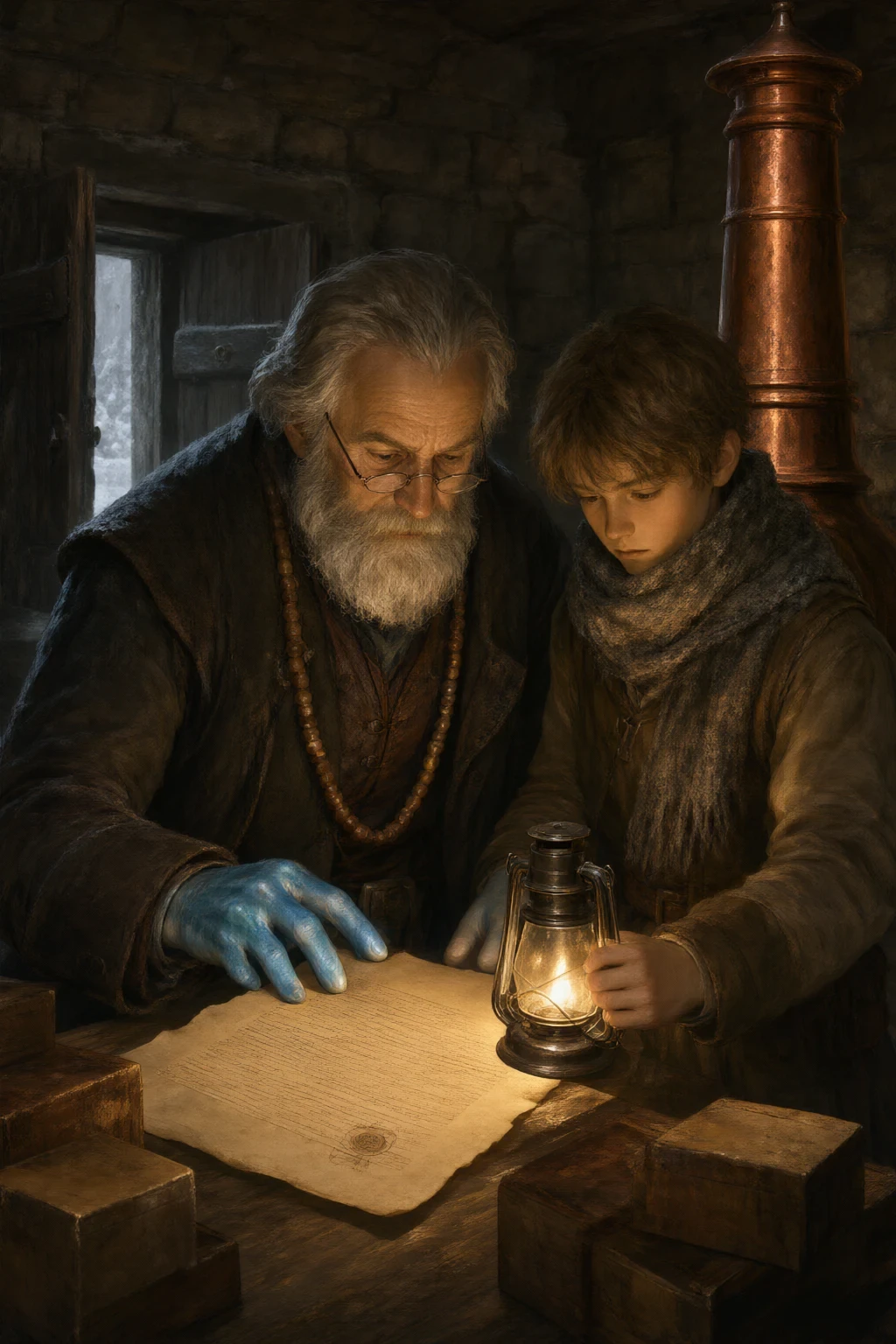
The first hundred leaves of the Assay Book had never been copied. Everything after them had, twice, and the second copies were kept in the strong room at the back of the Guildhall in a nailed box with a false bottom, because a copy of the Book is a thing the guild needs twice in a century and a thing it cannot afford to have wrong. Sura Vane was sixty-one and held the wrights’ pension book, and she had made a clean copy of everything the guild owned in nine years of clerkship except the first hundred leaves, which nobody had ever needed and which the committee had now asked for, in writing, in the twelfth month, with a date on the top of it. She did the work in the office, at the long table, under the swing-arm lamps, because the strong room had no lamp in it that worked and she was not copying ninety years of a pension schedule by guesswork. She ruled eleven sheets for the leaves, one to a leaf, and she ruled them in the cold with a straight edge and a steady hand, and she weighted each with a brass weight from the assay set so that the damp in the stone did not lift them.
Coen Halloway carried the sheets in and out and was not permitted to read what was on them, which was in his own way a larger insult than the rail had ever been. He was sixteen now, and had been a copy-clerk for ten months, and had learned the office’s second habit, which is that a copy is not a second Book. A copy is a document that will be believed in place of the Book by somebody who never sees the Book, and that is a heavier office than the one she had. “Twenty-eight of the ninth month,” she said, when he put the third sheet down. “That is today.” “That is what a date is,” said Sura Vane. “It is a way of not having to say when you meant.” The question had come up in the autumn and had not gone away, because the pension fund had been solvent, exactly, for the first time in eleven years, and the twelve oldest wrights had been paid in one go at Michaelmas, and the committee had discovered in the paying that it could not say when the guild began, and had discovered this in a way that embarrassed three of its members and delighted the other four.
Everybody knew the founding season. The season before the first autumn sowing, the winter the first void was cut, the year the assay stood at forty-one point two and every void on the hill has been short of it ever since. What the committee could not produce was a day. Not a season. A day. The Book itself could not produce one, and Sura Vane, who had answered more questions in her life than anybody else in the Coldmark and had answered every one of them with a date, found herself at the end of a corridor with nothing to put in a box.
The committee's paper was two lines long and Sura Vane could say both of them from memory, which is what a date is for. Leaf three is the basis of every pension in the Coldmark. A wright's pension is a fraction of the founding standing, apportioned by the schedule, accumulated by season; the fraction is struck when the wright is taken on and it does not change afterwards; the seasons are counted from the founding season and they cannot be counted off a page that has no day on it. Therefore the founding season must have a date in it, and it has not got one, and the guild has been running its pension book for one hundred and eleven years on a leaf that says Founding season and stops there. “The eleventh of the ninth month,” said Sura Vane, when the committee asked her for the founding date, “is the founding date the return uses, and the return uses it because the second season's clerk took it off the first frost.” “And the first frost?” “There was no first frost in the founding season. That is what a founding season is. It began before anybody had kept a record of the cold.” “Then the eleventh of the ninth month is a fiction.”
“It is the date we have used,” said Sura Vane. “It has been used for one hundred and eleven years and I have never heard of a wright ruined by it. I am not asking the committee to change it. I am telling you that it is a day we agreed upon and not a day that happened, and that when this Book is copied the copy will say so in my hand, and that will be the first time in the history of this office that anything on these leaves has been described out loud.”
She had a column of her own in the pension book. It was not a secret. Anybody who had ever audited the fund could have found it in an afternoon and nobody had, because it was kept in the manner of a thing that is not an irregularity but an understanding. For eleven years she had advanced small sums out of the fund to wrights who were ill, or old, or who came down off a season with a hand that would not close again, and she had entered every one of them in her own column with the date and the amount and the name and the reason, in a hand that was not the fund's hand. She could tell you without opening the book that the fund had been solvent for eleven years because of that column. The committee now believed the fund had been solvent for eleven years because she had managed it well. Both of those were true, and only one of them was hers. She was sixty-one years old, and one hand of hers was kept permanently in her coat because of an old plate burn, and she had never once in eleven years let that hand be the one that wrote a figure in the fund's own column.
Old Ansel Rime came up to the Guildhall on the second of the tenth month, on his own feet, in the last hour before the light went, and sat where the committee had told him to sit, which was a chair by the stove in the outer office with a blanket over the back of it that nobody had put there for him. He was seventy-four. His beard was white and his fingers were blue to the first joint and shiny, the way a thing is shiny that has been cold for fifty years and has given up on it. He held his hands in his lap under the blanket and looked at the stove. “You are going to ask me how it began,” he said. “I am going to ask you to tell me how it began,” said Sura Vane, “and then I am going to copy what you tell me, and then I am going to compare it with the first hundred leaves, and if the two disagree I am going to come back and ask you again. That is the whole method. It is not an interrogation. It is worse than an interrogation, because it goes on for four weeks.” “All right,” said the old man. “The first version is the one with the charter.” “There is a charter?”
“There is a charter in the strong room in a box with a false bottom, and it is a good charter, and it has a seal on it, and I have never in my life been able to make it do the work the story wants of it.” He told it. There were three brothers, or three men who are called brothers in every version including this one, and a bell, and the bell had been taken off a wreck on the river flats, and the three of them rang it on the first night on the terrace to say that the ground was theirs and anybody who came to argue could come to argue. “That is the good one,” he said. “I tell it that way because the bell is in it, and the bell is the part I can stand behind. It is a heavy bell. You do not invent a bell like that.”
He had nine versions, and over four weeks he told all of them, and Sura Vane wrote them all down, and none of them is the founding season as the Book keeps it. The second version had a wager. The three men had bet a year's catch off the river against a man who thought the hill was worthless, and the hill was worthless, and the bet was won by the third brother, who had walked out onto it in the dark and felt the stone go cold under his boot and come back warm, which was the first time anybody had ever felt that and the last time anybody understood it. The third version had a flood. The valley had come up in the founding winter and taken the low ground and put a foot of ice and salt over four acres of worked earth, and the three men had understood the hill that night, because everything else in the Coldmark had a price on it that night and the hill did not.
The fourth version was a bargain with a house that is not in the Book at all, a house downriver that put money into the founding and wanted the assay kept and Sura Vane said the record has no such house in it and has never had, and the old man said he knew that, and told it anyway, because it was the version the guild told at table when there was drink on the hill. The fifth version said the three of them were poor. The sixth said the three of them were thieves. The seventh had no three in it at all: two men and a woman with a lamp, which he said was his grandmother’s version and which he told with a shrug, as a thing you tell.
He told the sixth one properly, because it was the one the Coldmark liked, and the Coldmark liked it because it was the version in which somebody was answerable. Three men who took four acres of worked ground off a widow and paid for it out of a valuation, and the widow was not in the charter and was not in the schedule and had gone down to the lower farms within a year, and the three of them had never said her name again in any of the nine versions, and the sixth version was the only one in which there was anything to be sorry for at all. “My grandmother's people were the farmers she went down to,” he said. “That is not in the charter either. I have only my grandmother's word for it and she is forty years dead and she was not a woman who wrote things down. But she said a woman went down the valley with a barrow of seed and no deed, and I have believed her for seventy years, and it is the reason I have never once told the ninth version to a child without feeling the room change.”
He told the flood properly too, because it was the best of the nine and because it is the version that makes the hill the discovery rather than the theft, and he told it the way a man tells a thing he has verified: the ice coming up the valley in the founding winter and standing a foot deep over the lower ground in a single night, and the three of them out on the shoulder at four in the morning with a lamp and a scrap of iron, and the iron being cold, and then the iron being cold a second time. “That is the whole of it,” he said. “A piece of iron cannot get colder twice. I have asked four generations of wrights what that means and not one of them will tell me, and I have stopped asking, because I am the last man who can hold one to the stone and see it, and there is nobody coming.” The eighth version was a fight, and somebody died, and he would not say who. The ninth version was the one he told best and told most, and it was the shortest. Three men, a charter, a bell, a winter, and a hill that turned out to be the only thing in the country that could hold a winter, and eleven families who came up in the spring because there was a winter to sell. “All right,” he said, at the end of the ninth, and put his blue hands flat on his knees. “But the numbers say the other thing, and the numbers are never wrong.”
She began the copy on the fourth of the tenth month and did four leaves a day, and the first leaf is the hardest in the Book because it is the only one that had to be set rather than written. Founding season. Void one, Rime line. Assay 41.20. Grade first. Under it, three lines that describe the cut, in the founding clerk’s hand, and then nothing. No date. Sura Vane looked at that for a long time, and then she wrote on the head of her sheet, in her own hand, the date of the copy, because a copy is dated whether the original is or not, and then she stopped with the nib a finger above the paper. She had been copying the Book for nine years. She had a rule, which she had never had to write down because it had never been tested, that where the original is silent the copy is silent. You do not carry forward a figure the original has not got. You do not invent a day. You do not fill a blank, because a blank in a document is information and a filled blank is a lie, and there is no office in the Coldmark where a lie is cheaper than in a book of figures. She put the nib down.
Leaf two was the assay of the second void. Leaf three was the schedule, and the schedule was the reason the committee had asked, because every wright’s pension in the Coldmark is a number of seasons since the founding, and every number of seasons since the founding is computed off leaf three, and leaf three is the sheet that says who the guild was and what the guild had in the first season. It had eleven names. The three founders at the head, then eight names, then the last name, which was RIME, and after the eleven names a column of yardage, and the yardage was the guild’s founding standing, apportioned by agreement, and the total at the foot of the column was one thousand and ten. “One thousand and ten,” Sura Vane said, to the room, to the lamp, to the copy sheet. “The fourth of the tenth month. The founding standing is one thousand and ten yards, and that is the number every pension in this Coldmark is standing on.” Coen, who was permitted to bring the sheets and not to read them, said from the doorway: “That is a funny number.” “It is a number that somebody chose.” “It is not a round one.” “It is a number that somebody chose,” said Sura Vane, “and I would like you to notice what you have just noticed and to keep it for a week before you say it to anybody, because at present it is a thing you have noticed and at the end of a week it may be a thing you have understood.”
The gate returns were bound into the Book at the back of the first hundred leaves, one for each market of the founding season, sewn in on tapes because paper and ink were not the guild's to lose. The first market of the founding season invoiced three hundred and eighty yards. The second invoiced four hundred and ten. The fourth, which was the last that season, invoiced two hundred and twenty. Sura Vane added them twice, because she was tired, and then a third time, because the third time is the one that counts and she had been taught that by a man who had taught it to her with a strap. One thousand and ten. The sowing return was sewn in beside the gate returns, because the sowing is the truth and the gate is the arithmetic, and the guild had always bound the truth next to the arithmetic so that a clerk could see them disagree. The guild had sown, in the founding autumn, six hundred and forty pounds of rime-needle, on four acres of prepared ground, in furrows three feet deep.
And the Book's own rule, set out in the founding clerk's hand on the same page, in a sentence nobody has ever needed explained to a wright: one pound of seed stands one yard of cold. That is the yield. It has not changed in two hundred years and it will not change in the next two hundred, and it is the only conversion the Coldmark has. Six hundred and forty pounds. Six hundred and forty yards. “Three hundred and seventy,” said Sura Vane. It came out of her in a flat voice, and she wrote it on the corner of the copy sheet in pencil, and she looked at it for a while, and then she went and got the fourth leaf's neighbour, which was leaf eleven, and which is sewn in out of order because it is a marginal sheet, because the founding clerk ran out of room on leaf ten and cut the sheet off the back of his own hand and folded it in. It was in a different ink. It was in the same hand. Rime ground, one acre. Sown 240 lb. By consent. Advance against the standing of leaf twenty.
She went down to Rime Barrow Nine on the sixth of the eleventh month with a wright and a lantern, because a number that has been sitting in a column for two hundred years is a word until you have watched it come out of a field. Barrow Nine is four flat acres of ridged grey earth at the foot of the terraces, drilled in rows the width of a furrow, and it is the only ground in the Coldmark that has not been assigned to anybody. That is its whole office. Nothing is sown there against a name. It is the seed ground, and it is the place a person is permitted to stand on cold that has not yet been claimed, and once a year the guild puts a pound of rime-needle into a furrow on Barrow Nine and weighs what comes up, because the yield is the one figure in the Coldmark that has to be proved rather than argued.
The wright took the lantern and set the share into the ridging at the head of the plot, and the share is iron and it is heated, and the heating is a forge-fire burning in a box that is dragged behind the team all day, and the share is drawn hot because a cold share will not break three feet of worked granite ground in a day and a hot one will, and the three feet is not a figure of speech but a measurement, and the gauge is a mark on the handle. It smoked where it touched. The soil came up in slabs the colour of a stove and the frost came out of the slabs in a white line and was gone before you could look at it, and the smell was a dry mineral cold with no snow in it anywhere, the smell of ground that has been worked for a hundred years and has nothing living in it at all. “A pound in a yard of furrow,” the wright said, tipping the seed from a leather cup, “and a yard of standing cold for the pound, over a square yard of ground. That is the trade, and it is the only trade, and you cannot do it in a better field or a worse one.”
Sura Vane stood at the head of the furrow with the lantern beside her and watched the seed go into the cold, and she said: “Then a man in the founding season who had six hundred and forty pounds had six hundred and forty yards, and if he sold a thousand and ten he was selling something that was under a field at that moment or was nothing at all.” “Or was in his gate,” the wright said, “in a barrow, with a name on the disc, waiting for a sledge.” “Yes,” said Sura Vane. “That is what I was afraid of.”
Two hundred and forty pounds was two hundred and forty yards, and the guild needed three hundred and seventy of it, and a field sown at two hundred and forty when it needs three hundred and seventy comes up thin and warm, and the Book says so on leaf ten, in the founding clerk's own hand, in a sentence so plain that it has been read aloud to every apprentice in this office for two hundred years: sown ground will not lie, and a field short of its seed comes up short. Six hundred and forty, plus two hundred and forty, is eight hundred and eighty. The guild sold one thousand and ten. There were a hundred and thirty yards in the founding season's book that had not been in the ground, and there was no column for them, and there was no other way to make that number, because cold cannot be made. There is no lesser way, no cleverer way, no cheaper way. There is only how much was sown, and where, and whose. The guild had sold a hundred and thirty yards of cold in the ninth month of the founding season that would not be standing until the second month, out of a field it did not own, sown short, on a hill that could not hold a hundred and thirty more yards than it had been given. A void cannot be carried. Cold is fixed to the place it was cut. Every yard of that hundred and thirty was fixed to a place in the hill, and the gate had sold it, and the man who bought it took it away on a sledge.
She did not sleep on the night of the eleventh, and she did the only thing there was to do with a figure that will not sit still in a column, which was to find out what it weighed. A hundred and thirty yards of the founding standing, apportioned by the schedule over a hundred and eleven years, came to rather more than two parts in a thousand of every pension in the Coldmark. She worked it out twice with a pencil on the back of a spoiled copy sheet. The figure was small. It was the kind of figure that a committee can carry: it would have taken a little under nine marks a year off each of the twelve oldest wrights, at the founding assay, at the price the gate book gives for a first-grade yard in a season when the market is soft. Nine marks is the price of a month of seal oil and half a sack of turnip. The twelve had been paid in one go at Michaelmas. Sura Vane had signed that payment herself, in the fund's own column, in her own good hand, on the nineteenth, and had felt, for about as long as it takes to stop shaking, that eleven years of a private column had come out into the light at last and been the right thing. She put the spoiled sheet into the stove.
It was not hers to give and it was not hers to take and there is no column in that book for a hundred and thirty yards of founding ground. And a pension clerk who opens a two-hundred-year document in order to reduce twelve old men's pensions by nine marks, at the end of a year in which she has been told how well she has managed the fund, is not a clerk discovering an error. She is a clerk making one. The founding sheet was still wrong in the morning. Wrong things do not improve overnight merely because you have decided not to look at them; they go on being wrong in the same ink, at the same leaf, in the same hand, at the same size, and they will be there for whoever opens the book next, and the whole of the work is to make sure that whoever opens it next is not stopped by the same thing she was stopped by.
Nobody had asked for the deed. The Book was enough; the Book was what the committee had asked for. But a figure with no ground under it is exactly the figure she had spent four weeks in front of, and she was not going to carry a hundred and thirty yards up the stairs in her head to the committee without once going and looking at the ground. The strong room was at the back, under the assay chimney, and it was the warmest room in the Coldmark and had been for two hundred years, because the flue that made the Guildhall's chimney cap worth its copper also made the strong room a place where wax goes soft. There was one lamp and it was bad. There were eleven boxes, and the false-bottomed one, and in the false-bottomed one a charter with a good seal on it and a deed on vellum gone the colour of weak tea. The deed was a single sheet. It was signed at the foot, in a column, twelve times, and Sura Vane counted them under the bad lamp because she could not trust herself not to. Three founders. Eight of the first season’s families, who put their names in because they had cut ground for it and could not be left out. And a twelfth, at the foot, below the line, in a hand smaller and steadier than the eleven above it. B. RIME.
“Twelve,” said Sura Vane. “The eleventh of the eleventh month. There are twelve signatures on the deed and eleven names on the schedule.” She read the deed through twice, standing up, in a warm room, holding it at the corners because the wax had been soft for a very long time and she was not going to be the clerk who folded it. The ground was granted. The grant was of the shoulder of granite above the long frozen valley, the eleven benches, and the four acres on the lower bench, and the grantor was B. Rime, of the lower ground, and the consideration was set out in one line and Sura Vane read that line four times. The consideration was cold. A hundred and thirty yards, at the founding assay, delivered before the first market, and the deed said the guild had received them.
They went up to bench one on the fourteenth of the eleventh month in flat blue light with no sun in it at all, and Old Ansel Rime went up at his own speed and did not accept an arm, and the first plate on the first bench is the oldest worked iron in the Coldmark, four feet square, let into the granite face, and above it the lintel. RIM. Cut deep, filled with soot, and renewed so often, by some generation of wrights with a bucket and a piece of tar and no instruction from anybody, that the letters stand out further than the chisel ever made them, and there is a shallow ridge on the granite under the R where the soot has been applied a thousand times and has run. “A name in the lintel is the name of the ground,” said the old man. “That is the rule and it is the oldest rule on the hill and it is the only one that is about the stone. It is not the wright's name. It is not the guild's name. It is whose ground this is, cut in the stone over the plate, so that any man who comes at this hill with a charge knows whose cold he is standing on. You do not name a void after the man who cut it. You name it after the field.”
“Then the guild’s first void stands on Rime ground.” “It stands on Rime ground.” “And the guild is called the Rimewrights.” “It is.” “And the deed says the Rimes granted the ground, and the deed is signed by the Rime, and the schedule in the Book does not have her on it, and the Book has never had her on it, in two hundred years, and the guild has one hundred and thirty yards of her cold in its first season and a hundred and thirty yards of the cost of a season in every pension it has ever paid.” “The guild has her name in stone over its own first plate,” said Old Ansel Rime, “where the wrights go every year to charge a line, and they have not read it since the soot was last renewed, because you do not read a lintel, you read the Book.”
On the nineteenth of the eleventh month she asked him the question. They were on the Retirees Bench, which is a stone bench along the south wall of the Guildhall, out of the wind, where old wrights sit in a line from noon and are not asked to move; the Guildhall has no other seating, which was an accident of the build, and has been the most important room in the Coldmark for thirty years. “Ansel Rime. You have told me nine versions of how this guild began and I have written down all nine, and the Book agrees with none of them, and the deed agrees with a tenth, and the tenth is the one where three men are given a shoulder of granite by a woman who held four acres of the bottom land, and paid in cold that had not yet been grown.” “That is not my worst one.” “No,” she said. “It is not. So tell me your worst one, and then tell me the numbers, and I will decide which of the two to put in the copy.” “My worst one is that they took it from her. Nine years I have told it as a taking, because a taking is a thing you can be angry at, and my family can be angry at something.” The old man looked at his hands. “The numbers do not say a taking. The numbers say a hundred and thirty yards were sold before they were stood, and the deed says the hundred and thirty were delivered before the first market, and the deed was signed, and the Book's leaf eleven says by consent, in the founding clerk's own hand.” “You have three documents agreeing that she said yes.”
“I have two documents that say she said yes and one number that says somebody's field was sown a hundred and thirty yards short so that a hundred and thirty yards could be sold early.” He lifted one blue finger and put it on the stone of the bench. “You cannot deliver a hundred and thirty yards of cold that is not grown. One of those two things did not happen. Either she was not paid, and the deed lies, or the field was short, and the field was short, because a field does not lie. A field that is sown short comes up short, and the Book says that on leaf ten in the founding hand, and leaf ten was written by the man who wrote the deed. So the man who wrote the deed knew the field was short, and he wrote that she consented anyway.” The stove in the outer office ticked. Somewhere below them the flue was doing what it does. “Which makes it worse than a taking.” “It makes it worse than a taking,” said Old Ansel Rime. “A taking is one bad afternoon. This is a man writing down a woman's consent to the sale of a thing that did not exist yet, in his own hand, on his own leaf, and then a hundred and thirty yards going out of the gate on a sledge to a man who took it away, and the guild being named after the family of the woman whose name it is not allowed to write in the Book.”
She finished the first hundred leaves on the twenty-eighth of the eleventh month, and she ruled the hundred and first sheet, which is a clean sheet, and on it she wrote, exactly, in the founding clerk’s hand as she had learned to keep for ninety years of copying: Rime ground, one acre. Sown 240 lb. By consent. Advance against the standing of leaf twenty. And the numbers in the gutter, in her own hand, small: 240.00. Required 370.00. Short 130.00. Sold against, in the founding season, 1010.00. Stood, 880.00. And at the head of leaf one, where the founding season has no day on it at all, she wrote: No date is entered on the original. This copy was made on the twenty-eighth of the eleventh month. And in the margin of the schedule, beside the eleven names, where the widest part of the paper was and where a twelfth line would go if the schedule had been made for eleven and a half, she wrote the twelfth name. B. Rime.
No yardage against it, because she was not going to invent a credit, and because the guild had never entered one, and because the honest figure for a woman who was never admitted to the guild is nothing at all. She wrote the name, and then she wrote the date beside the name, because she was Sura Vane and it was the eleventh month and there was no other instrument she had ever owned. Coen Halloway copied the clean sheets out fair, one to a leaf, in the outer office, under the swing-arm lamps, and he was not permitted to read what was on them and read every one of them upside down from where he sat, which is a thing a boy can do for eleven weeks before anyone thinks to move him. The clean copy went into the false-bottomed box in the strong room on the second of the twelfth month, and the box was nailed, and the box was in a warm room with a working flue, and the Book itself lay on its frame in the office with the chain wound twice and the brass assay disc in the gutter of the page, unchanged, two hundred years old, and a hundred and thirteen yards lighter than it was in the founding season.