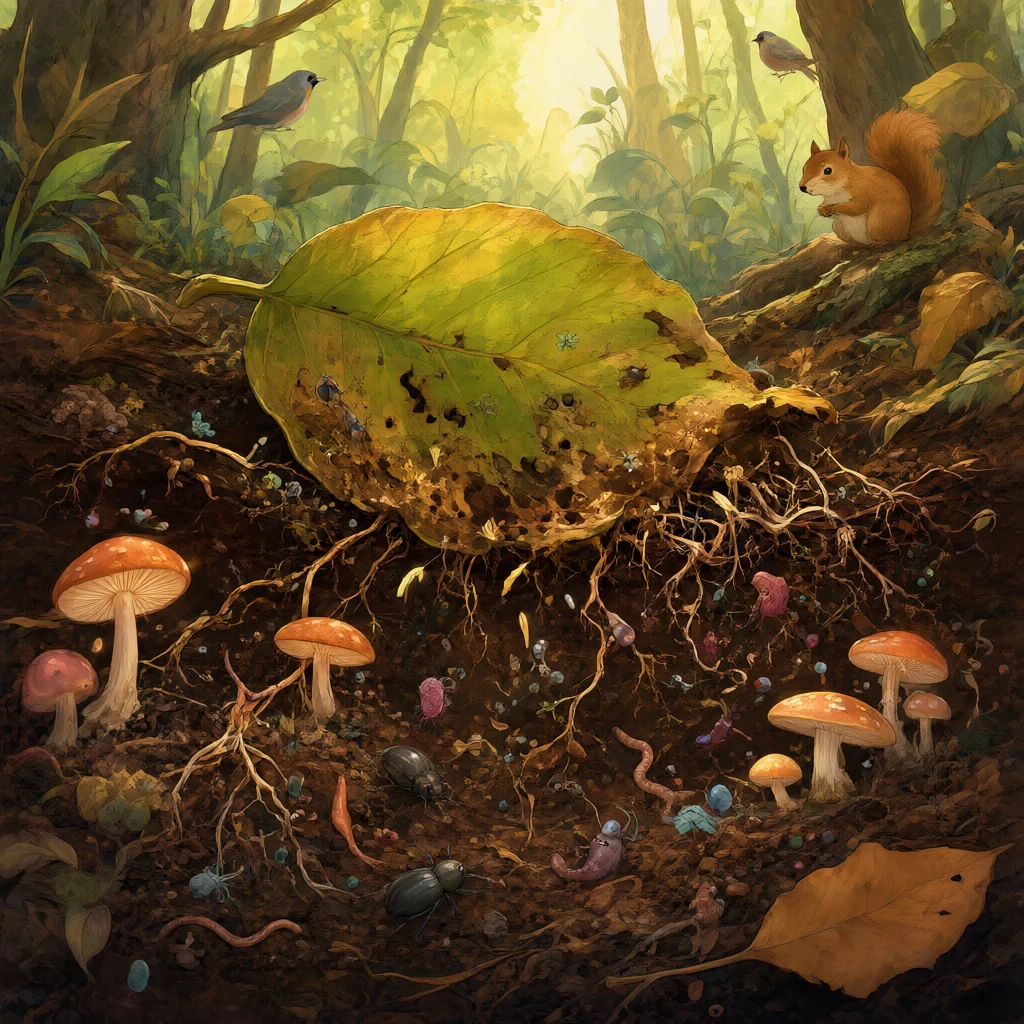
When the leaves of the oldest forest tree turned yellow in midsummer, the animals blamed the sky. A deer said the Sun had gone dim. A squirrel said the tree had stopped sharing. Even the beetles hurried from the roots as if the ground had become sour.
Mara, a young forest keeper, found one curled leaf beneath the tree. Its veins still held a soft green glow. She followed a thread of white fungus along the soil. The thread led to a fallen branch, a nest, and a burrow under a fern.
The old tree’s leaves were receiving too little light. A dense canopy of young trees had grown above them, so the tree was making less food. Animals were losing the leaves, seeds, and shelter they depended on. Mara asked, “Who eats what?”
She drew a map. Leaves fed caterpillars. Caterpillars fed birds. Birds left feathers and scraps. Fungi, bacteria, and small detritivores broke down dead material. Some animals ate the fungi, and fungi partnered with tree roots. Her map had many paths. It was a food web, not a single chain.
Mara invited the animals to help. The deer showed where it had browsed young saplings. Birds showed which caterpillars they ate. Worms moved through fallen leaves. Fungi opened their underground threads like tiny roads.
The children placed equal pieces of dead leaf, bark, and twig in shallow boxes. Some were kept moist and exposed to air. Another was covered. A third sat in darkness. After several days, fungi threaded through the leaf pieces. Bacteria and tiny detritivores softened them. Worms were present, but they were not the only decomposers.
Mara wrote carefully: fungi and bacteria are decomposers. Small detritivores help break down dead material. Worms are not the only decomposers, and fungi are neither plants nor animals.
The old fox asked how something so quiet could matter. Mara made two jars, each with the same dead leaf. One was sealed. The other had small air holes. The open jar supported more kinds of life. Air, moisture, fungi, bacteria, and detritivores worked together.
The forest floor was not a heap waiting for one creature. It was a busy neighborhood.
The canopy problem grew worse. Young trees crowded the old forest tree. It made less food, and deer wandered away. Without browsing, more young trees grew. Their roots took up water and minerals, and the old tree weakened.
Mara tried cutting every young tree, but the slope was steep. A storm could roll soil downhill. She tried carrying fertilizer, but its shaded leaves needed light, while its roots needed water, minerals, oxygen, and room. The fox pointed to the fungus threads. “The old tree is connected below ground.”
Mara placed a spade beside a root. The fungus traded with living roots: the tree provided sugars made in its leaves, while the fungal threads helped it reach water and minerals. Bacteria around the roots released nutrients from dead leaves.
Mara asked the deer to browse only some saplings. Birds ate caterpillars that chewed leaves. The fallen branch stayed as shelter for beetles and fungi. Dead branches were cut into small pieces and returned to the soil, where decomposers could work.
More leaves stayed green. Caterpillars climbed higher. A bird nested in the old tree. A mushroom ring spread in the damp shade.
Mara’s map filled with arrows. Sunlight to leaf. Leaf to caterpillar. Caterpillar to bird. Bird droppings and feathers to decomposers. Dead leaves to fungi and bacteria. Nutrients to roots. Roots to tree.
The arrows crossed. A rabbit ate seeds and grass. A fox ate rabbits and beetles. A hawk ate snakes. A beetle might eat a dead leaf or become food for a bird. A fungal thread might feed an animal or trade with a root. No single link could do every job.
One evening, heavy rain washed soil from the hill. A nest of seedlings disappeared beneath the flooded river. Mara and the fox built a raft from fallen branches. Beetles followed beneath the wood. It floated to a muddy ledge, where damp soil held the rootlets and fungal threads. The seedling opened its leaves the next morning.
When the dry season came, the old tree dropped seeds. Some were eaten by birds, some carried by wind, and some rolled into the river. Seeds that landed in damp soil had help from fungi and bacteria breaking down the leaf litter around them.
A child found Mara’s map in the forest school. “The forest is like one giant meal?” they asked. “It is more than a meal,” Mara said. “A meal has parts. A forest has many partners, and every partner changes the paths for the others.”
She placed a dead twig in a damp box and marked its place. The child watched a springtail and white fungal threads appear on the twig, then looked from the roots below the soil to a bird above it.
That evening, the old tree released another seed. It rested beneath a leaf through the night. In the morning, a green shoot lifted toward a patch of Sun. Mara drew an arrow from the old tree to the new one, through fungus, bacteria, detritivores, animals, water, and air. The forest under one leaf was a thousand places, all touching.