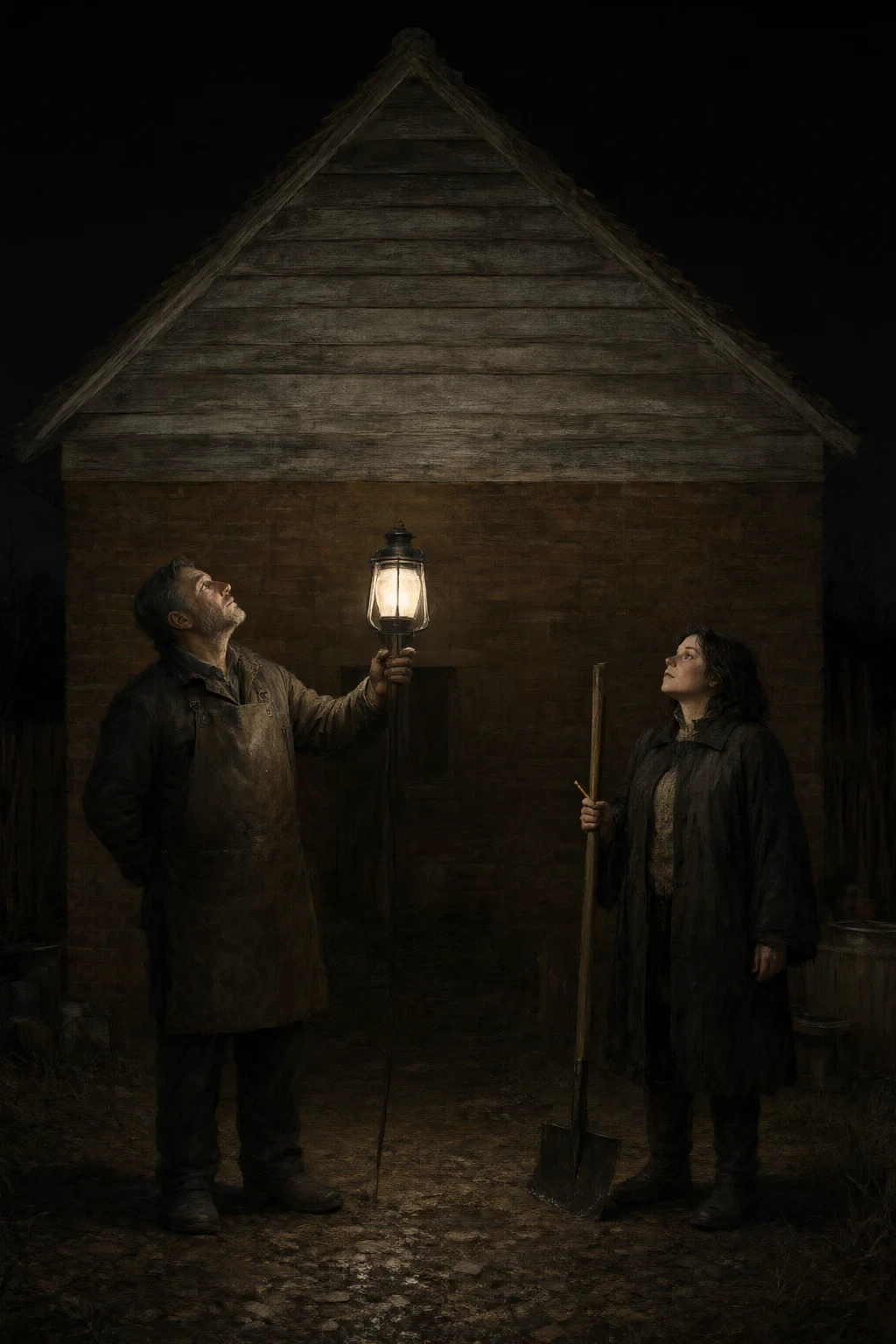
The notice was on the door of number two, the stick house, on the eleventh of November, and it was a printed card with a county number at the top and a line for the amount at the bottom, and the amount was three pounds fourteen shillings and sixpence, and it was the first notice of that kind ever nailed to that door in a hundred years. The stick house is the middle one of the three at the end of the furlong. Tarred oak frame, brick front, a brick nog at the foot of every course Marl can see from the road, eleven feet high, a door that has to be lifted over a sill. It is the only one of the three that has been remortgaged twice, and it is the reason the village has a queue. That is the third default at the end of the furlong in a hundred years, and Marl has never made a fuss about the others, because a default in Marl is not an event. It is a Tuesday at the bench. Mira Sedge read the notice and had a pound and two shillings in the house, and she did not go to the smithy until the Thursday, and on the Thursday she said she had four pounds of work in hand and would clear it in December, and Fennick Roke said the thing he says. “Not this year.”
He said it in nine seconds, as he says it, and then he did the other thing he does, which is to look at a man’s hands before his face, and found that the person in front of him had no hands in the cold, because they were in her sleeves. A house that has been remortgaged twice may not be sold, and the second creditor is not permitted to sell it either. That is the mechanism by which Marl has lost four houses in eighty years. This is the fifth, and it is being lost now, in the rain, by a man who has not slept properly since the middle of August. He declared it on the Monday. There is no court in Marl and there is no appeal. There is a licence, a queue and a ledger, and the first thing anybody has to do when a default is declared is write it down. In a hundred and fifty years nobody at that bench had ever written it down, because every default had been absorbed before it got cold: the first by a rebuild in nine days, the second by a remortgage, which is where Fennick Roke’s key came from, and the third by nothing, because it was December. He wrote it in the fifth book, on the left-hand page, under the head of the page, because that is where the new rules went in February and he had ruled a line under them himself. STICK HSE (TOP OF FURLONG). DEFAULT. 13 NOV. ARREARS 3 14 6. SECOND CREDITOR DECLARES. He wrote the date in the date column, which is the column he made in the winter for a boy with a wage docket, and eleven men were in the smithy by four o’clock, and the forge was lit. And then everybody waited for the roof to go, and it did not go.
Marl, and four counties after it, believes that a house falls when it is called. It is the story everybody knows: straw, stick, brick, and the wolf, and the wolf comes on the ninth day and there is nothing left. The stick house was standing at four o’clock on the thirteenth of November, and it was standing at eight that morning, and eleven men stood in a cold road looking at eleven feet of tarred oak with a brick front, and nothing happened to it at all. Tomas Peake was fourteen and he was on the lane above the furlong end with his hand flat on the west gable. He was the only person in Marl who could say why, and he could not say it for two hours, and when he said it he said it in the form in which a charge is written: the figure, the date and the promise, exactly.
The west gable has been chalked by nine hands in twenty-one years, and one mason’s hand comes back every time, because Marl has four masons and three of them are related to the men who live in the houses. The first line is at the height of a man’s shoulder and it is the oldest and it is the best, and it reads: PEAKE, A., 17. WILL PUT THIS UP IN NINE DAYS. IT WILL STAND WHILST I LOOK AT IT. APRIL. And under it, in the same hand, the figure. Two pounds three and six, which is the cost of nine days of timber, lime, nails and a man’s time at three-and-six a day. And under that a line, and the date again, because a mason who writes a total writes the date under the total. Under that there are twenty-one years of other men’s hands, in other chalks, in other months, each adding a figure and a date. The total on the sixth of November was nine pounds eighteen shillings and fourpence, and Tomas Peake said that number out loud in a road with eleven men in it, and it is the number the story is about. “Who’s Peake, A.?” said a man from the third field. “My mother,” said Tomas Peake.
She was seventeen and it was April and the kilns were cold, and she had no money and no licence and no trade, and there was no brick in Marl for anybody who did not already have standing, and a footing on wet clay is a footing that is charged to a house and never stops. She tells that April in the future tense. She has told it that way for twenty-one years and nobody in Marl has found it strange. “I will be nine days,” she says, standing in the yard of a house that has stood twenty-one years, with her right hand out and her fingers on the second course of the nogging, counting. “I will have the frame up on the fourth and the roof on the eighth and I will be out of the weather on the ninth.” “I know you will,” Tomas says. “I have heard it.” “It is a good nine days.” “It is a good nine days.” And in twenty-one years nobody has said to her: tell me whether it was the right thing to do. Not once. Not in the queue, not in the ledger, not on the four evenings when Marl’s Building Court sat in this smithy in February. It was Mira Sedge who asked for the fourth rule that week, and she said the words: a house is entered with the name of the person standing in it. Aline Peake is a person standing in it. She has been entered in a book in February. She has never been asked anything.
The queue went live on the Wednesday, for the first time in twenty-one years, and it had five names in it, and none of the five could build, and the reason none of the five could build is the entire content of the winter. Fennick Roke has the book open on the anvil bench and the order of it is the order of the charge, which he did not decide and has never decided, and he read the five names off the page in the order they had been in since 1889, because that is what the page says. A name is entered when the charge begins, and not when the man applies. A name is passed when no builder may be had, and the passing is entered with a figure, and the figure is charged to the house. A name is held when no builder has refused, and a held name is not a passing and is not a charge. The last sentence is the one he wrote in February, and there had been no sentence about holding anywhere in a hundred and fifty years, and it came out of a bricklayer standing in a cold smithy being told not this year. The first name was a bricklayer of forty-four called Wray Sallow, who had a licence and money and a house of his own in good order in the second field, and who had been on the page since he was nineteen.
The man on the page first could not build a brick house in December, and he said so himself, with his hat in his hand. “There is no brick,” said Wray Sallow. “There is no brick in this county between November and the eleventh of April, and there is no brick money in this village at any time of the year.” “Then a timber house,” said Mira Sedge, from the back of the room. “A timber house is not a house. It is a shed with a pantile roof and a standing, and I will not put my name to a timber promise at the end of the furlong.” “Then hold your place,” said Fennick Roke. “There is no such thing as holding a place.” “There is now. I wrote it in February. Read the column.” And Wray Sallow read the column twice, and put his hat on and went out, and did not go home, and stood in the road outside the smithy for about a minute and a half, which four people watched, and which is the only time in that winter that anybody in Marl hesitated about anything.
He was passed on the twenty-sixth of November, and the passing was entered with a figure, and the figure was twenty-two pounds six shillings, because that is what a brick promise at the end of the furlong costs and what he could not make, and the figure went onto the west gable, and the house paid it whether or not anybody came to blow. The second name came in on the second of December: a timber man of forty-one with a licence, a boy, a handcart and a price, the only man in Marl who could have put a house up in the middle of January. “I will do it in nine days. Tarred oak, the same line, and eleven pounds four shillings, and I will take it in three parts, the first in the spring.” “There is no money in it for you,” said Mira Sedge, “because the money in it is the second mortgage, and the second mortgage is the default, and every pound of it comes on your name in my book whether I am in it or not.” “That is the law.” “That is the law,” she agreed. “And I have never been able to be dishonest about it, because it is fair, and being fair is the reason I still have a house.” He was passed on the ninth of December at eleven pounds four shillings and went home up the furlong at a quarter past four in the dark, and did not come back, and there was no ill blood anywhere in it.
The third name had a licence and no money and came in on the fourteenth of December and offered to build it for nothing. He was forty-eight, and his own house was the sound brick one at the top of the furlong, and he had thought about it for a fortnight, and he said it in one sentence with no figures in it at all, and Mira Sedge made him sit down. “Sit down. You have not thought about what you have just said, and I am going to tell you what it is, and then you can decide, and it will take four minutes.” “Four minutes.” “If you promise that house, the cost goes on the house. Not on you. And the house already owes a second creditor who has declared a default on it, and the moment your promise is on the gable you are a creditor, and the second creditor keeps it, and the second creditor may not sell it.” The forge was going, and Mira Sedge put her hand into her sleeve and got the key out and put it on the bench beside the book, which is a thing nobody in Marl has ever done and which made four men look at the ceiling.
“I am the second creditor,” she said. “I have a key to the deeds of a man who cannot shift me and is not permitted to and does not want to. In eleven years he has not once asked me for money. He asked me on the thirteenth of November and has not asked me since. And I am thirty-one, and I have a house I am not permitted to sell.” She looked at him. “You would have the key,” she said. “Not this one. One the same. And you would keep it.” He put his hat on and said thank you and went out into the rain, and Mira Sedge did not cry and did not speak for about a minute, and Fennick Roke did not offer her anything, and that was correct. He was passed on the twenty-first of December at eleven pounds four shillings, and the figure went on the gable.
The fourth name was a girl of twelve who was not entered by herself. Her father had put her in the book the autumn before last, on the ordinary grounds that a man with a trade in hand may be wanted for a building in due course. She came to the bench on the second of January with a bricklayer’s glove on a string at her waist with no hand in it, and a licence application in her other hand, dated the sixth of April, with a box on it for the age. “I will be twenty in October,” said Wren Copse, who will be twenty in October in eighteen years, and then corrected herself in front of nine people, without embarrassment, as a person does when they have misstated a figure that matters. “I am twelve. That is not the year either.” “Put the glove on,” he said. Wren Copse put the glove on. There is no register of builders in Marl. There is a licence, made out at the weighbridge hut in April, and it does not survive the year. So the only evidence that a builder was ever in a room is the builder’s own glove, and a glove proves that a person was in a room, and does not prove that the person who promised in that room was that person.
“It is my father’s,” she said. “He is in the clay pits at Upwell and the address is good. He was in number eleven in nineteen thirty-four and put a promise on a gable with the chalk, and the assessor read it in the road in April and said the figure was the only part of it anybody could prove anybody meant. It fell in April and his house went with it, because the walls are the same wall, and the figure is in the certificate, and it is the only figure on that wall anybody in the Terrace can explain.” That was the whole of her case. It took ninety seconds and it was not a case at all. “A name is entered when the charge begins,” said Fennick Roke, “and not when the man applies, and you have no charge. And a child may not be a creditor at all, and I have not got a column for a person of twelve, and if I had one you could not be written in it.” “Then write nothing,” said Wren Copse. “That is allowed. You wrote a column for a passing with a figure of nothing in it in May, for a man at number nineteen, and nobody could say that was anything else.” He looked at her for a while. “No,” he said. “Not this year.”
The fifth name came in on the ninth of January, and Tomas Peake wrote it himself, in pencil, at the top of the page, above the head of the page, above the four rules. “The wall is being asked,” he said. “A house is entered with the name of the person standing in it, and the person standing in it is my mother, and she has not been asked what it is made of, and the assessor in April had to come to number eleven because a girl of twelve wrote brick on a form. This house is the same and worse, because it has a promise on it that is not a builder’s promise, and I am the only person in Marl who can read that wall, and if I stop walking up that furlong in the dark the wall stops being asked, and the wind found four houses in the Terrace in one night in April.” Fennick Roke read the four rules at the top of the page, and then the line in pencil above them. “Your mother made that promise,” he said. “A builder makes a promise and the cost goes to the house. Your mother was not a builder. So there is no promise on that wall, and if there is no promise there is no charge, and if there is no charge there is no house.”
“That is not what the wall says,” said Tomas Peake. “The wall says the total, and the total is nine pounds eighteen and four on the sixth of November, and I have read it every week since I was ten, and the wall has said the same thing every week for four years, and a wall does not keep adding a figure to a promise that is not there.” He was struck out, with a piece of blotting paper, and the ledger showed a ghost of it for about four months. That is what a ledger is. The winter of a default in Marl is not dramatic. The smithy is open from seven until the light goes, and the book is on the bench, and nobody can work, because Fennick Roke cannot work while a book is open on the anvil bench. The third of November: nine pounds eighteen and four. The twenty-sixth of November: thirty-two pounds four and four. Wray Sallow, passed, twenty-two pounds six. The ninth of December: forty-three pounds eight and four. Timber man, eleven pounds four. The twenty-first of December: fifty-four pounds twelve and four. Third man, eleven pounds four. The tenth of February: fifty-four pounds twelve and four. And on the tenth of February it stopped. Marl calls that a bill. Mira Sedge did not call it anything of the kind. She gave the figure in the smithy in January, to a room of eleven, in the way she gives every figure, which is to say she said that it was fair, and then proved it. “Three pounds fourteen and six a week,” she said. “That is my arrears again. Every week since the middle of November the same figure, and I have not had that in a week since August, and it is charged to my house and not to me, and I want it entered that I have said the system is fair.” “It is fair,” said Fennick Roke.
“It is fair, and it is charging me twenty-two pounds six for a man who said he would not build a timber house, when a brick house was the only thing I could have had. All three of those men were honest, and every one of them would have built it for nothing if the money had been there, and there was no money, so they are all on my gable at the rate the county says a house is worth, which is three pounds fourteen and six a week for a winter in which nobody could do anything.” The wolf came up in the second week of January, because a man in the smithy had the sense to ask whether a wolf would end it. The man was Obadiah Cressy, eighty-one, who had held a wolf’s licence for thirty years, had been the last man in Marl to be granted one, had refused a renewal and had not applied for another, had taught one son to be a wolf and one son to be an assessor and had never told either of them which, and who sat down with his back to the north wall and apologised to the wall of the smithy before he said anything. “Can a wolf end it,” said Fennick Roke. “No,” said Obadiah Cressy. “Say why, and then say what it can do.” His jaw clicked twice. “A wolf is a creditor’s man, and any creditor may apply. I took a door once in thirty years and I never took a wall, and I could not have taken a wall if the licence had said wall, because there was no wall in the promise. A wolf may not take a thing the debtor has not promised. If he takes outside the promise he is unlicensed, and unlicensed is a dog, and it is permanent, and they keep them, and I have kept two, and both of them were honest men in 1931 who did what I would have done.”
“So it cannot do anything to the house.” “There is nothing on the licence,” said Obadiah Cressy. “The licence states exactly what it may take, and I have never had a licence with less on it than that. And I have read what this house promises, because it is on the gable in a mason’s chalk the size of a hand and I can get up a ladder at eighty-one, and what it promises is that there will be somebody in it.” He put his hand on the table. “You cannot carry a somebody out of a door,” he said. “I have thought about it for a fortnight and that is the whole of what I have got, and I have been a wolf for thirty years and I have never had that before, and I would like it entered that I said it here and not at the time.”
What Marl did instead was blow it, on the twenty-eighth of January, at two in the afternoon, with nine people in the house and the door open, and the reason Marl can do it is the seventh rule: blowing is not permitted and blowing is an assessment, and any licensed assessor may assess, of which the wolf is one, and the sound is a sound the walls are obliged to report on. There were two men in Marl who could lawfully blow that house. One had refused a licence, was eighty-one, and said he would not. The other was his son, and the son who blows is the son who is the assessor, and Tomas Peake worked that out in about a minute and told the smithy, and the smithy did not want to know and had no choice. The note is a low note, on the A below the middle of the piano, and he blew it for four seconds, and the report came up out of the walls and it was in the book in a column before the people in the room had decided what they had heard.
Oak answers, and everybody in a timber village knows that oak answers, and what it answers is a note a fifth flatter than the one that went in, and it goes on about twice as long, and it does not stop. There is a standing in that, and Marl has known it since 1889 and has it in the head of its own book: timber is a standing material that will do what it was asked by somebody else. And the wall said, when it had finished: doing what it was asked. By whom. The assessor wrote it in the column, because he is a professional and is not permitted to want anything, and he wrote what the wall reported and nothing he had worked out, and then he turned the book round on the table. “It is not a material that will tell you,” he said. “That is what a timber wall reports. It will tell you it is doing what it was asked, and it will not tell you who is asking, and that is not a fault in the wall. That is in the wall.”
They did not blow the brick house or the straw heap. They blew the stick house, because the stick house is the one in default. And then Tomas Peake read the gable, because that is the other thing that is done, and he read it aloud in the road, because the road is where a figure is read. He read the line. PEAKE, A., 17. WILL PUT THIS UP IN NINE DAYS. IT WILL STAND WHILST I LOOK AT IT. APRIL. And the figure. Two pounds three and six. And then he said the thing that made the winter, in the flat voice he uses for a charge, to nine people and a smith and an assessor from Ely. “There is nobody in that line but the name,” he said. “And it is not a builder’s name. And the head of our book says that no house is entered but the builder’s own name, and my mother was not a builder, she was seventeen and had no trade, and the wall took the promise anyway, and has taken the money every month for twenty-one years. The law in Marl is that a builder may promise anything, and there is no sentence anywhere in five books that says what happens when a person who is not a builder promises a house something.”
Fennick Roke had the book open on the anvil bench. He did not close it. He turned round to the wall of the smithy and put his hand out and touched it, which he has never told anybody about, and he said: “Then it has been standing unlawful for twenty-one years.” “That is what I have been asking for since the ninth of January,” said Tomas Peake. “Not the money. The answer. Whether it is a house. Because if it is not a house there is nothing on the gable and we are all reading a wall that is not a wall. And if it is a house, then somebody has been asking it to stand for twenty-one years, and I would like to know by whom, because it is not the name on it.” By whom was not answered in January. The rate book came round in the first week of February, and that is how Marl found out what it thought a house was for, and nobody put the two documents side by side for another three weeks, and when somebody did, in the smithy, on a Tuesday, it was a boy of fourteen with a wage docket in his hand. The rate book is kept at the weighbridge hut and it is a book of columns, and the columns are: number, material, weight, value, rate. Marl’s rates are not levied on houses. They are levied on the weight of the material a house is made of, because a house is a promise, and a promise has to be something the county can weigh. Number eleven, the Terrace, a brick rebuild of April: BRICK, 22 cwt, £5 15 0. Rate, two shillings and fourpence. Top of the furlong, the brick house: BRICK, 41 cwt, £10 4 0. Rate, three shillings and elevenpence. Top of the furlong, the stick house: OAK AND TAR, 7 cwt, £1 19 4. Rate, elevenpence. Elevenpence.
A house charged fifty-four pounds twelve shillings and fourpence for promising to exist is worth one pound nineteen shillings and fourpence to Marl, and pays elevenpence in rates. The whole of Marl’s genius and Marl’s poverty and a hundred and fifty years of being right is in those two columns, and nobody chose it, and it is four inches long. “Elevenpence,” said Mira Sedge, on the Tuesday in the second week of February, when the book on the bench was the rate book and not the queue book. “That is fair. And it is a quarter of what the shed next door costs me, and I have lived in it eleven years and paid it every year, and the reason I can afford to pay it is that it is elevenpence.” Nobody disagreed with her and nobody answered her, and the forge had been out for five weeks, and Fennick Roke was sitting in the only warm room in Marl looking at two books.
What Fennick Roke did about it was not legal and is not a rule, and it is the only thing in this story that anybody did on purpose. He began to go up the furlong at night. From the twelfth of February, in the cold, with a lamp he did not need, he went up the end of the furlong at about eleven and came down again at half past, and he stood in the yard of the stick house for ten minutes, and he did the same at the brick house, and the same at the front of the Terrace, and he did it for eleven weeks, and he entered nothing, because there is no column for it. It is not in any of the books that a house stands because somebody is looking at it. That is the standard form of a promise, and it is on nine walls in the village, and it is a builder’s phrase. Timber is a standing material that will do what it was asked by somebody else, and the somebody else is not a name and not a party and not anybody who can be entered, or passed, or held, or charged, and the whole of the system at the end of the furlong has depended on that somebody else being there for a hundred and fifty years, and nobody has ever appointed him, and he has never been asked.
Mira Sedge found out on the seventh of March, on the Monday, because she was in the yard at eleven at night with a spade, and there was a man standing in front of her gable with his hands behind his back looking up at the chalk. “You have been doing this since the twelfth of February,” she said. “I have.” “The figures have not gone up since the tenth of February.” “No,” said Fennick Roke. “They have not.” “Then you know what you have been doing.” “I know what I have been doing,” he said. “I have not written it down and I am not going to. I cannot make it a sentence, and if I make it a sentence it is a rule, and a rule can be kept by anybody, and the day after I have written it there will be a man in this village who comes up this furlong at eleven at night because it is in the book and not because his house is at the end of it.”
“Your house is at the end of it,” she said, an hour later, in the smithy, with a lamp on the bench, to a man who had not slept. “That is the whole of the difference between you and me, and it is the whole of the winter. You have looked at a gable every night for eleven weeks and it has not cost you a penny, and the wind is north-east, and it does not care whose you are.” He said nothing. “I have been eleven years a woman who is owed money by a man who will not ask me for it,” she said. “And the reason I have stayed in this house is not the timber and not the children. It is that in this village a person standing in a house is entered in the book. Mira Sedge is in the book. I have been in it since February, in your hand, on the fourth rule, and I am the only person in that book who cannot be passed, because a passing is charged to a house, and I am the house.” “So you want to be in the book.” “I want to be in the book. I have wanted to be in the book for eleven years and I have had it four months, and I am not leaving this house while I am in it, and that is not sentiment. That is the book. And the wall has not gone up, and the reason is not that you were there. The reason is that in eleven weeks not one new promise has been made to that house, and every instrument this village owns is a promise, and every promise costs money, and there was no money, and so for the first time in twenty-one years nothing was promised, and a house that is promised nothing is not charged for anything, and it stands. That is the finding of the winter, and there is no other finding.”
The rule was written on the tenth of February at about eleven in the morning. It is the fourth rule in Fennick Roke’s hand at the top of the fifth book, and it is the shortest thing in Marl and the most expensive. A name is held when no builder has refused, and a held name is not a passing and is not a charge. He wrote it because Wray Sallow, forty-four, with a licence and money and a house in good order, had stood in the road outside the smithy for a minute and a half in November, and because on the seventh of February he had understood, at a bench in the cold, that the village had spent a hundred and fifty years deciding who was owed a building, and had never once decided that a man who cannot build is not a man who has refused. Nobody thanked him. It went in the book in about four minutes, and he read it out, which is the practice in Marl, and there was nobody in the smithy except the boy and the lamp, and he said the words out loud to a book and an empty room. Mira Sedge fought it for nine days and lost and was right the whole nine days, and she fought it because the system is fair and defending it is the only thing she has left that is worth doing.
She said: the moment the rule is written the machine is required to work, and the machine is a machine for spending money, and there is no money, and a machine required to work and unable to work does not stop, it writes. In April it will write against me. In May it will write against the Terrace. In June somebody will hold a place who should have been passed, and the man behind him in the life will be a man who owed for a year. And she said: you have written the only sentence in that book in a hundred and fifty years that makes Marl worse, and you have written it because a bricklayer stood in the road, and Marl does not need decent men. Marl needs the arithmetic. And Fennick Roke said: Marl has had the arithmetic for a hundred and fifty years. It is in the column. It is the rate on a wall. It is four inches long and it is on a wall in a brick hut at the end of the road, and nobody has read it out.
The kilns were lit on the twenty-second of March, which is late, and the season went forward five weeks, and Marl was lit up for eleven days. It is forty feet of brick at the third field with a mouth at the bottom the size of a door, and on the second night the orange comes out of it and lays a hundred and fifty yards of field and the ridge and the top of the smoke, and the six men of the gang stand in a line and do not talk, and every person in Marl who can stand up comes out to see it, because there is no other evening. Fennick Roke did not come. He was at the weighbridge hut with a lamp and a book, making out five licences on printed sheets for the April, and the fourth sheet was Tomas Peake’s. The rule is printed at the foot of the form, which is where county forms print their rules, and it is that a builder’s licence may not be issued to a person under the age of twenty years. It has been printed there since 1889. It is one line. It is absolute. Every rule about a child in Marl is one line and is absolute, and there are no exceptions and nobody has ever asked for one.
Tomas Peake read it out himself, standing up, with his finger on it, the way he reads a charge. “I will be twenty in October,” he said. “That is five years and seven months. The form is dated the sixth of April, so I will be twenty in the April after next, and the form says the licence is for the year in which it is made out, and the county have not got a form for the year after, because nobody has ever been twenty a year early.” The last week of March is when he asked her. He did it on the Sunday, in the yard, at about four, because he had worked out that she would answer in the future tense, and that he had better be somewhere with a wall in it. He put his hand flat on the gable at the height of a man’s shoulder, on the first line, in the first hand. “Mother. It was the right thing to do or it was not. I am not asking you about the nine days. I am asking you about the promise.” And Aline Peake stood in the yard of her own house with her right hand out and her fingers on the second course of the nogging, counting, because that is what she does, and she counted the whole course before she answered, and he waited for all of it. “I will tell you it was the right thing to do,” she said.
He did not write it down for eleven days, and when he did he did not write it as a charge, because a charge is entered by a mason on a wall, and there was no mason and no wall for it. He wrote it in the fifth book under a new column at the top of the page, in a boy’s pencil hand, and he headed the column REPORTED, and the only line in it in the whole history of Marl is the ninth rule, which is not Marl’s, and which he copied out of a certificate off a wall in the Terrace in April, because it is the only law in four counties that Marl has never had, and the only one anybody in Marl has ever used. A HOUSE ASKED AND ANSWERED HONESTLY IS SAFE FOR A YEAR. A HOUSE ASKED AND LIED TO IS NOT SAFE FOR A NIGHT. A HOUSE THAT HAS NEVER ONCE BEEN ASKED IS A HOUSE NOBODY IN THE VILLAGE CAN ANSWER FOR, AND THE WIND FINDS THOSE FIRST.
The last morning in March the sun came over the ridge hard and low and lit the furlong end in the way Marl is lit in March, which is to say it lit the east side of everything and left the west side in the blue shadow off the fen, and the chalk on the gable does not read in that light and has never read in that light. Tomas Peake read it in the road at eight in the morning with Mira Sedge standing at the gate, because she was there, and because she cannot read a wall and never has been able to and has never once pretended otherwise, and because a figure is a thing a person can be shown. “Fifty-four pounds twelve and four,” she said. “That is the last one, and it is the same one as the tenth of February, and it has been the same one for six weeks.” “Yes.” “Read me the top line.” He read her the top line, in the flat voice, from the beginning, including the age. Mira Sedge wrote the figure on the back of her left hand with a stub of pencil, because it is the only figure in Marl she has ever been able to keep, and she kept that one for six weeks and it did not wash off, and it is the only figure of the winter in the whole of the record, and there is nowhere in Marl to write down a thing about a person who is not a creditor, and she is one.