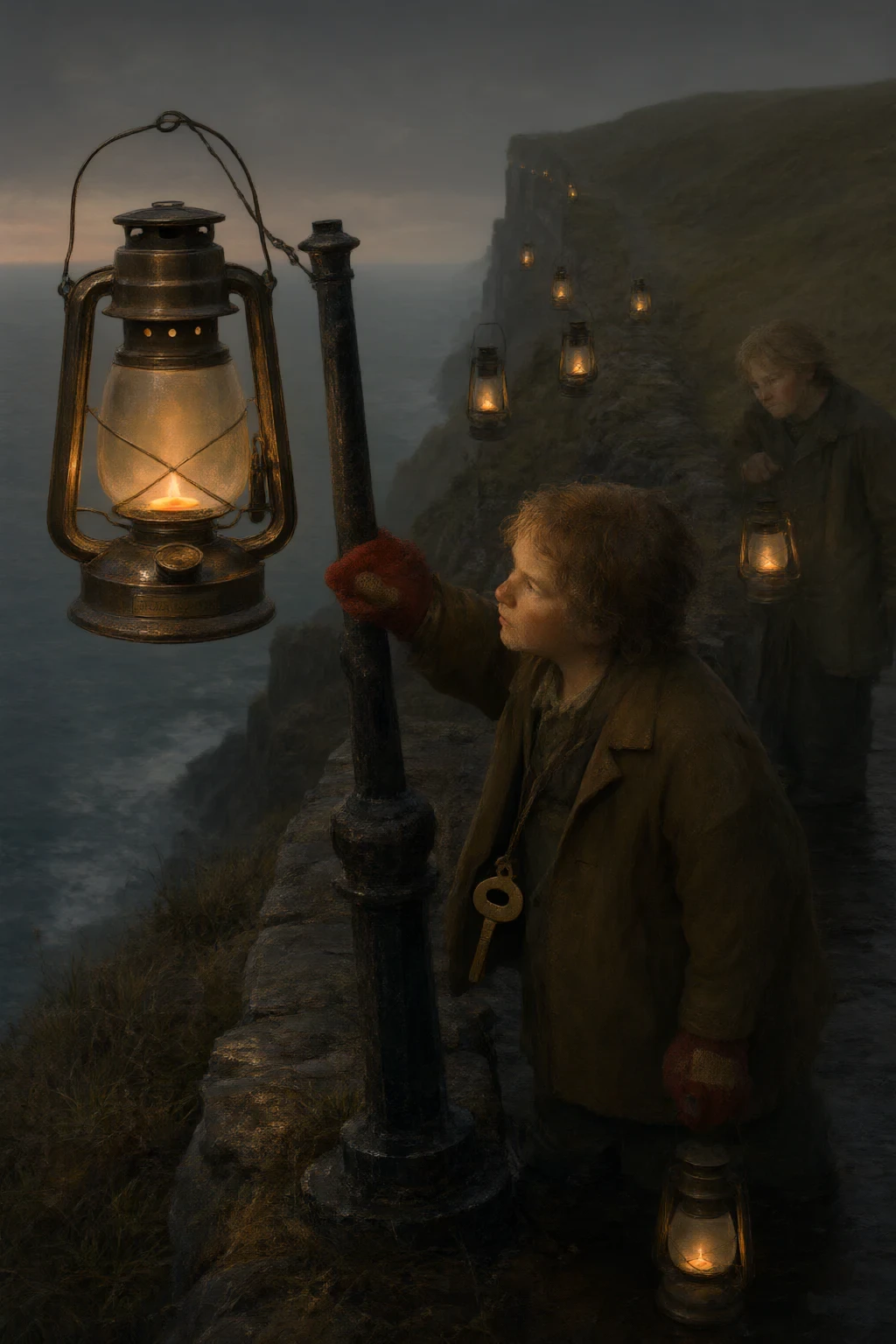
The First Lantern stands at the harbour end of the Ridge Line, on the black rock where the salt grass gives out and the path comes up off the shingle, and it is four feet high, and a child can put a hand on it. That is the only thing about it that has never changed. Four miles of salt grass and gorse run from it to Cormorant Head with the sea a hundred and forty feet below, and nine iron posts stand along that walk, and from Michaelmas to Candlemas a lamplighter walks it at dusk and gives an hour of their own life to each of the nine. On the evening of the twenty-fifth of October, nineteen hundred and one, Ansel Quance stood at the end of a pole with a trimmed wick in his left hand. He had the red mitten on the hand that held the wick, its thumb-end darned with a strip of sailcloth, and he kept the whole of the ritual in order between the two of them. “One. The name. Isobel Marrack. Two. The intention. Three. The piece.” He gave the third. What you see is not the wick, it is the plaque: the letters of ISOBEL MARRACK come up warm from the inside, the way a window comes up when the lamp behind it is right, and a boy of thirteen permits himself one small private feeling.
Then the flame lay down. Not guttered. A gutter is a thing that happens to a flame being asked for too much, and this flame was not. It spread across the wick in a thin orange wafer and lay there, and the letters went out of the plaque one at a time from the end of the word, and the brass was brass again. Flat and cold, in the two words Hadren Vole had for that condition. Ansel Quance did the thing he had been taught, which was to stop, and look, and go and get the Chief Lamplighter. He did not go. He put his thumb and forefinger into his coat and took out the jar. A stoppered jar the size of a gill, in that coat since the spring: an hour in April, eight minutes in June, a little under an hour in August. The most valuable object he owned, and the experiment he had never told anybody about was whether a man could hold light back and still be a man who lights lamps.
He unscrewed the stopper and held the jar out over the wick. The flame took a breath of it, and the letters came up, and he watched nine letters of a dead woman’s name fill with light out of a jar he had taken out of his own account, and he thought, in words: this is the one. Then the letters went out again, and the wick smoked. That is not a payment. That is a savings box. “How long have you had that,” said Hadren Vole from the path, in the voice he used for a lamp left untrimmed. “Since the spring.” “Since the spring.” He came up and turned the jar against the last of the daylight, the way you turn a bottle to see what is in it. “There is no intention in that. There never was. Light put away is not light held in trust. It is light taken out of the account and stood in a jar, and a jar is not a bearer, and the water does not know your name in it.” “I know my name in it.” “You know a thing you made in a coat. There is a difference, and tonight it is the whole of the difference.” He gave the jar back. “Put it on the ledge. And then go down the Row and tell Pim Sabiston to bring the First key to the Lamp House, and tell her not to sing on the way.”
Hadren Vole took the First Lantern off its bracket, carried it up the hundred steps to the Lamp House, and lit it on the bench under the window from a taper, to see by. The glass was the colour of a wet oyster inside. Not on the outside. The outside was clean, and the brass below it carried a black thumbprint in the crease of his thumb that no soap in this town will take out. The inside of the chimney was fogged with a fine grey bloom, hard, thin and even, the way a thing goes when it has been breathed on for thirty years by somebody who is not there. He turned the chimney on its axis and the bloom went round with it, so it was a deposit and not a scale, in a thickness a man could scratch with a thumbnail. “Corrosion,” said Ansel Quance. “It is not corrosion. It is the fat. Thirty years of a sweet fat boiled out of the drowned, burned in a closed glass night after night, and it has been eating the inside of this chimney the way a wood worm eats a door. It is the only lamp on this coast where you could stand in front of it with a taper and not read the name.” “Then trim it.” “I trimmed it in September and it took a flame in September.” “And now?”
“And now the glass will not stand a heat, and a lamp that will not stand a heat is not a lamp. It is a fire in a box with a name on it. Pay a debt with a fire in a box and the water counts zero.” The door went. Neel Ferrin came in with her hood up in a warm room and stayed near it, and behind her Halla Skerry, the plaque-keeper, with the Great Oweing Book, and behind Halla her apprentice Wren Adry with a pencil already out. “Thirty years of tallow on the First,” said Wren Adry, finishing it before Halla had the book open, “and the honest light has been running out underneath it for the same thirty years. Seventy-four thousand two hundred and fifty entered. Seventy thousand seven hundred and one delivered. Three thousand five hundred and forty-nine short, and only that.” “Three thousand five hundred and forty-nine,” said Halla Skerry, and squared the book on the bench. “Of which three thousand is the tallow: four thousand five hundred tallow-dusks rendered in eighteen seventy-one, every one entered as a full lamplight, every one delivering a third, so two thirds was never shown to anybody. And five hundred and forty-nine more, carried for the twenty-two that never had a post, at the rate of the nine.”
“It is the same hand,” said Wren. “The tallow line and the five hundred and forty-nine. Same afternoon. Same ink.” “It is the same hand,” said Halla Skerry, and did not say whose. Wren Adry put her pencil to it. “Chief, was the tallow entered as lamplights at the time, or entered as tallow?” “Cheaper.” “It is not an answer, Chief.” “It is the one I have,” said Hadren Vole, and did not look at anybody. “Write it on the board tomorrow in that order. It will not matter whose hand.” He stood with both hands on the bench. “Here is what matters. There is no bill. There is no letter. The sea does not write them, and there is nobody to dun and nobody to be shown an account. We did this. Whatever is in that glass got there because of a decision made in a room by people I sat with, and the getting away with it is the reason the honest light is finished. The First Lantern is not a candle count. The First Lantern is the arrears.” He stopped there. Neel Ferrin said, “Listen — is it a person, then, the thing that has been getting away with it,” and Hadren Vole looked at the floor.
They went down to the Council house, because Osa Kilbride was sixty-six and had been told, and a Harbour Council told a thing at ten o’clock at night sits at ten o’clock at night, in a cold room, with the tide boards on the wall. There was one board in that room anybody obeyed. It hung behind the chair, a slab of black shale the width of a hand, re-chalked by a Chief Lamplighter who had understood it the first time. Nine strokes at the top. Under them, in chalk gone soft as farina, four words. INSIDE TO OUT. FOUR NIGHTS. “There was a date under it that has gone,” said Tace Bewick, who was eighty, and had come from Black Spit in a cart, and had not been asked to. “I know the hand. He has been dead forty years, he was not a Vole, and he wrote it because it was true.” “It is true,” said Osa Kilbride, with her hands flat on the table. “The First holds the chain. If the First goes, the next goes inside a night, and then the next, and so out to Cormorant Head. Four nights. Three answers have been put to me since the twenty-third and I will take them in order.”
“The first is the honest one. We pay the three thousand five hundred and forty-nine. Properly, out of hours that are ours. I want it written that I said it first and that I would have liked it to be the answer.” “It cannot be the answer in four nights.” “It cannot.” “A season is a thousand three hundred and fifty lamplights, and fifty-five of them is seventy-four thousand two hundred and fifty entered against seventy thousand seven hundred and one delivered. It is twenty-five hours and ten minutes at a door across a hundred and forty-one doors, and over a hundred and fifty dusks that is ten minutes and change a night in every house on this coast, the same in every house. Three hundred and ninety-four nights and one hour at nine a dusk, and no more. You cannot pay it by Thursday. The remainder hour is the whole difference between a rota and a rate, and that is a thing somebody has to look at.” “The second is that we stop,” said Osa Kilbride. “Let the bay go cold. Let sixty-two years of it fall due at once and let the water have what it is owed.” “It is the kindest sentence anybody has spoken in this room in twenty years,” said Tace Bewick, “and I am the likeliest person on this coast to say so, because I carried light the winter the boats were lost.”
“It is also the sentence of somebody who has never been in the water off the Outer Stacks,” said Halla Skerry, “and there is one on this Council who has. The sea does not send a demand. It takes what it is given and it does not keep a second figure anywhere. But a debt underpaid is not a debt frozen. It comes due again, sooner and larger, and what it is paid with buys less. If we stop, the debt is not cancelled. It is called in whole, in one night, by a thing that has never dunned us.” “The third, and I am saying it because somebody in this room is thinking it and I would rather it died out loud. We light the Crown light. Ten fires instead of nine, and a tenth fire is more than nine, and that is the bargain.” “No,” said Hadren Vole, and it was the first thing he had said for a quarter of an hour.
“No,” said Halla Skerry. “A tenth lantern cannot be raised on this coast. There is no tenth place for it. And the Crown light has never carried a name, and a light with no name on it is not a lantern, and the water counts it at zero. While we are being tidy: no seventh name can be added to a lamp. Not one. If anybody here has been thinking of cutting the twenty-two names into the nine plaques, that is where it stops, and I have wanted to do it for eleven years.” “So that is three,” said Osa Kilbride. “The honest sum we cannot pay by Thursday. The cold bay, which is not a kindness. And the tenth light, which is zero with a better view. I have ruled.” And a sensible voice from the back said, “Then we gather it.” Nobody could afterwards agree who said it first. It was a sensible man with a sensible voice, and what he said was that a coast is a hundred and forty-one doors, and a hundred and forty-one doors could be asked, one hour apiece, in front of everybody, because nobody has ever handed the lamps a thing the whole town stood behind. That is what a town does. It is the shape a town has been taking since eighteen thirty-nine, and it is the reason Brinehold survived the Winter of Lost Boats at all. “All right,” said Osa Kilbride. “Door to door. In daylight, where the whole Row can see it. Six o’clock tomorrow. A muster is not a payment. Every person in this room knows the difference and will go home and forget I said it by morning.”
Sten Ollivant came up the Ridge from the harbour about two hours after that with his hair wet to the temples and a red scarf stiff with dried salt, and stood in the dark above the First Lantern before anybody heard him. He is forty-one, a diver, and the only man in Brinehold the sea has not yet collected. He put both hands round the cold iron of the First post and left them there, and Ansel Quance noticed that the man’s hands were blue at the knuckles. “You were in the water,” said Ansel Quance. “You take it out of them.” “Out of the warm ones, out of the ones who are not using it. I do not take a drop out of anybody who is called on a post, and I have never once been sorry.” He looked at his hands then and put them behind him, and it was the first time in a long while that he had looked at them at all. “Four nights a week, twelve years. And I am the only man in this town it has not had, and I have been waiting thirty years to say that in daylight. Still.” “Say your piece,” said Halla Skerry. “You have been standing on my steps a quarter of an hour working up to it.”
“There is not one of you,” said Sten Ollivant, “who has ever said her name.” “My sister was Maren Ollivant and she was twenty-one and she went off this coast in the gale of eighteen eighty-nine with a salvage boat and her father, and she is number twenty-three on the eighteen forty-one list of the lost. She is in that water asleep and warm, and she has been for twelve years, and I know her condition better than anybody on this coast knows the condition of a kettle. She is not in pain. That is the thing nobody here wants written down. She is asleep. “And the whole arrangement of this town is that thirty-one people in eighteen thirty-nine got buried or got found, and the town could not bear that, and made a bargain it did not understand with a thing that has never once asked for anything, and agreed to keep nine of them warm. Nine. Twenty-two never got a post. Twenty-two have never had anything except the water being a colour I recognise.
“And now nine of you want to go out and stand at nine posts and give away an hour of your own life each, and I am the only man on this coast allowed to say what the arrangement is actually for. You have not been keeping nine people warm for sixty-two years. You have been keeping the whole bay asleep, everybody in it. If you stop paying, some of them come up. “So I am not asking you to be worse than me. I have been taking it out of the water for twelve years, which is the same theft this town has been doing at nine posts a dusk for thirty years, except mine is honest about being a theft. I am asking you to stop. Let the debt come due. Let the cold come. There will be a bad week, and after it a colder bay and a few more people in it, and I have been in that cold bay and it is survivable.
“And I will say the other half, because I am not a liar. Ten minutes a night. That is what it comes to, and I have done the sum twice, and I am the only man in this room who can say it out loud without it being an argument for somebody. Twenty-five hours and ten minutes at a door, over a hundred and forty-one doors. It is the one thing this coast has never paid, and I know why, because I have watched every one of you walk past it.” He pulled the scarf over his mouth. “It was never too much. It was only ever too honest.” Tace Bewick, who had not moved, put both hands flat on the trestle table. “That is my line,” she said, “and he has had it off me, and it is true, and I said it first. And it does not help him. He has put the two halves of it in the wrong order and in the wrong room. The rate was not what we agreed to. The lamps were. We have been paying something ever since that nobody asked us for, and it does not make the water any warmer.”
“Sten Ollivant has made the best argument anybody has made in this room in my time,” said Osa Kilbride, “and I am going to record that, because in twenty years somebody will want to know whether it was heard. It is refused. A debt underpaid is called in whole, in one night. And if we stop, we do not stop owing, we stop being the ones who decide, and I would rather be dunned for sixty-two years by a thing that has never dunned anybody than hand the whole of this to the tide at midnight.” He said Maren’s name on the Ridge that night, and nothing happened. He said it at twenty past two in the morning on open grass above the harbour, and then he stood there the way a man stands at a station, and the sea went on doing what it was doing. That is the whole mechanism. That is all of it. No thunder, no cold wind off the water, no bell. A name on open ground, said by somebody who is not the lamplighter for it, and the coast hears it and holds it and files it. It is why people do it. A man who has lost somebody walks out onto the Ridge in the dark and says the name, and nothing happens, and it is not nothing that happens, because it is the only act in the whole of this arrangement that asks nothing of anybody. Halla Skerry was on the wall beside Ansel Quance and heard every word. “You know what that does.” “I know what that does.”
“You are the reason the honest light ran out. You, and the fat, and thirty years of a town looking the other way, and I am saying it because you will not hear it from anybody else. Every hour you take off the warm ones shortens their rest, and a shortened rest comes due sooner, and the sooner it comes due the bigger it is. The sea has never dunned this town. There is no bill. There is no letter. There is a woman called Maren Ollivant in a cold bay, and nine men in a Council house, and between them not one piece of paper. I am telling you that you are in it, because you would rather be in it than be told you are outside it.” Sten Ollivant looked at his hands. He had not noticed them going cold, and he noticed them now. “Still,” he said. The lintel of the Lamp House was gone by morning. Ansel Quance saw it first, on his way up with the first key at a quarter past six, and stood in the doorway and made a noise he did not know the name of. The slab over the door was slate, cut in eighteen forty-six with the words LAMP HOUSE and the initials of the Chief Lamplighter of the day beneath them, and on the morning of the twenty-sixth of October it was a smooth grey surface. No letters. No chisel-marks. Nothing at all, as though a mason had come in the night and dressed the face of it and gone away. Halla Skerry looked at it a long while. Then she went in, and the first of the day’s work was at the doors.
Pim Sabiston came down the steps at ten past six with the First key in her hand and the brass lantern on the cord at her throat, and got as far as the second landing before she understood what was happening, and came back up. “Master Trask, I have brought the key, and they are at the doors.” “There are sixty of them at the doors,” said Jory Trask, twenty-six years old, a lamplighter, no relation to any Adry in this town or any other, standing in the doorway with the smell of hot brass on him. “House to house, in a queue.” “I can do it too. I can give a piece. I have given a piece twice for the Fourth and you did not notice either time and my lamp is fine.” “That is not what that is.” “That is exactly what that is. I watched you do it, and I am eight, and my hour is the same hour as yours, and I have been counting since I was six and an hour is an hour.” Jory Trask put his lantern down on the flags, which is a thing no lamplighter does.
“No, it is,” he said. “That is the whole difficulty, and the rule about it is mine and four old men’s, and it goes: light given out of a child is not currency. It is taken. Not stolen, that is another word and I will not use it. Taken, out of a person too small to have said no, and the water will not have it, and it will not go into a lamp. A thing that was taken is not currency. A thing that was taken is theft, and theft cannot be spent. That is the arithmetic.” “Then why is the rule there? Somebody decided it. Somebody had to sit down and decide that I am not allowed, and then everybody says it was always so.” “Somebody decided it because a man on a pole at dusk cannot tell one thing from the other. I have watched a child give and I have watched a child be given out of, and from up there in the dark they are the same height and they make the same face, and there is no telling. So the lighters wrote the rule down, and it is a blunt thing, and it is right for every child in this town including you, and I am sorry about it.”
Pim Sabiston stood on the flags of the Lamp House and cried, which nobody had told her she was allowed to do and which nobody stopped. It was not because she had been refused. She was eight, and she had been refused something enormous on a Saturday morning. She was crying because of the shape of it. The rule had not said she was not allowed to be kind. It had said the kind thing she had to give was not the kind of thing that counts, and was not hers to give, and would be taken whether she gave it or not, and that the only honest position available to her was to be poorer than she was. Teo Ivers, nineteen, a lamp-runner, put his hand flat on the top of her head and said nothing for a while, which was correct, and then said, “They started at number one. They are doing about a door a minute. The whole Row is out and your mother is in the queue at nine.” “I have a rhyme,” said Pim Sabiston, wetly. “It is a bad one and I am going to say it anyway. It is, they are queuing by the door, and it is true, and I am saying it.”
The collection was magnificent. That is the word for it, and it is the correct word, and it is why this has to be told this way. They came out of a hundred and forty-one doors and they were in the street, and they were visible. That was the part that was genuinely new. Nobody on this coast had ever been asked to do anything in daylight, in front of their neighbours, with a slate on the door and a line in a book with their name at the end of it. Somebody’s wife brought a brazier out onto the steps and made tea for the people at the front of the queue, and everybody drank it. Halla Skerry wrote the lines with the book open on a trestle table in the middle of the Row, Neel Ferrin reading them out and Wren Adry checking. Her hand did not shake until the eightieth, and after the eightieth it did not stop shaking, and she kept writing. “One hour at a door,” said Wren Adry at the two hundredth hour. “You have a hundred and forty-one. The book says three thousand five hundred and forty-nine. You are most of four hundred nights of this coast’s nine short.” “Then we have not finished,” said a man in the queue, and the whole Row laughed, and it was not a bitter laugh, and that is the part that has to be written down. The lamps went on. The Second went inside a night of the First, on the twenty-sixth. The Third went on the twenty-seventh with the glass fogging inward faster than a man could watch it. By the twenty-eighth the Fourth, the Fifth and the Sixth had gone in the course of one morning, inward to outward. The Sixth was Hannah Sowerby, and Hadren Vole was fifty feet away and did not move.
The road went on the night of the twenty-seventh, and nobody noticed until the morning, and then everybody noticed at once. It is not a dramatic thing. A man of seventy got up in the dark for peat and came back four hours later having walked the Tar Kiln Steps twice in the rain, and could not say one word about why. A boy of nine went to the milk house and came in by the wrong door of the right house and said he did not know which way he had come, having walked a road he has walked since he was four that had stopped being a road he knew. “It has no name on it,” said Osa Kilbride when they brought it to the Council, in the voice of a woman confirming a sum. “The sign is first. The road is second. It is in the order. I would give a year of my life not to have learned the shape of it from a slate going blank above a door.”
The names went on the night of the twenty-eighth, and it went on the houses. There is no way to make that small. A woman went up to the door of her own house on the morning of the twenty-eighth and could not find her husband’s name on it. She knew the length of the name. She knew how many letters. She stood on her own step with her hand flat on the paint and could not say one of them, and she tried for most of a day, and in the evening her sister had to ask her what his name was, and the asking of it was the worst thing that happened that week. Neel Ferrin was sent to fetch her, and it was Neel who noticed that the woman could give the length and the number of letters and not one of them. “Listen — ” she began. She stopped. “Listen — ” she said again, and this time she did not change it, and she said it to the woman and not to the room, and what she said was: “I am not afraid of the dark. I have never been afraid of the dark, and everybody at home thinks I am and I have let them think it because it is easier. I am afraid of the water. I have been afraid of it since before I could walk, and I am not going to say a safer thing than that, and that is the whole of what I have.” The woman looked at her a while. “Norah,” she said. “It is Norah. It has been Norah since we were married and I have said it about ten thousand times.”
They carried the gathered light out to the ninth on the evening of the twenty-eighth, because the ninth was the last one standing, and every person on this coast wanted to be at the far end of four miles when it was tried. The whole of Brinehold walked out in a wind off the north-west and stood in a rough ring round the ninth post on Cormorant Head while Halla Skerry opened the lantern Teo Ivers had carried in a shuttered case. The sun was going into the water. The flame came up. That was the cruelty of it: it came up beautifully. And the letters of CASS WHITLOW came up warm from inside the plaque and filled the brass, and a hundred and forty people watched a name come up in light, and somebody at the back began to laugh, and it was a laugh of relief. Then it lay down, and the letters went out from the end of the word, and it was the same as the First, and the Fourth, and the Sixth, and the Eighth, and the ninth went dark on the twenty-eighth of October with all nine of them dark and four miles of coast behind Brinehold with nothing in it at all. They stood there a while. Then they went home, because there was nothing to stand there for, and they went home along a road some of them had to be shown.
On the twenty-seventh, in the Lamp House, alone, with the seventh door done and the eighth not started, Halla Skerry had turned back to eighteen seventy-one to check a figure against a tide board, and had found what the tide board was not for. The tallow line was in her husband’s hand. The five hundred and forty-nine was in the same hand, in the same ink, on the same afternoon, four lines under it, and in the margin a note: the twenty-two are carried at the rate of the nine. And beneath it, same ink, a second note. Several of these were never charged. Entered against ourselves on the Council’s own authority. Her husband had written a true thing and a false thing on the same afternoon in the same ink, and he had been dead seven months, and she had carried his book for eleven years and never once read down to the margins.
They put it to the Council in the Lamp House at nine o’clock, and the last lamp on this coast had been dark three hours, and Halla Skerry laid it out in four sentences. The line entered wrong in eighteen seventy-one and the line under it entered wrong the same afternoon are in the same ink, and that ink was her husband’s, and he died in March. And a payment is not a sum. A payment is a bearer standing at a post with their own light and the name said aloud and a named intention and their own expense, and there is exactly one of that in Brinehold tonight. He came in off the head with the wind still in his coat, and Wren Adry had already begun the sum out loud, and he stopped her, because he knew how it went and he knew how it ended. “It is not mine to give,” he said. “It is stolen. I take it four nights a week out of the warm ones and I have been doing it since I was twenty-nine, and a theft cannot be spent, and you all worked that out in September, and it applies to me in the mouth like everything else. Still.” Nobody argued with that, because it was correct, and because he had said it in front of his sister’s name, which is not a name on a plaque.
“You are not going to the ninth.” “No,” said Sten Ollivant. “And the rest of it is that it is not going to fix her, and I knew that on the way in, and I would do it anyway. She is number twenty-three. There is no post for number twenty-three and there never was, and I have known that since I was forty-one, and it was never the light. Still.” The Chief Lamplighter might have gone, and she said so to his face, which was the first honest thing anybody had said to Hadren Vole in thirty years. “You have given more hours to this line than any man alive, and the most recent ones,” she said. “You are sixty-one, and every hour you have left is worth more to you and worse for you, and I will not do it.” “You could not carry it,” said Hadren Vole. “Nine hours at thirty-four, and you have been coughing since Candlemas last year, and the last Adry died of his lungs in March and I was at that bed, and I am not sending you out on that.” “It is not nine hours of carrying,” said Halla Skerry. “Nobody feels it at the time. That is the arrangement. Nobody feels it at the time, and that is the whole reason the honest way was never chosen by anybody on this coast in sixty-two years, and I am fifty-one years late and I will not be late again in a way that can be put down to being afraid.” She wrote one line that night, dated the twenty-eighth of October, and ruled a line under it and left it empty, and said that in eleven years of keeping that book it was the first line she had entered that was not full of a lie or a sum, and that she would find out in the morning what a true line looked like.
It is four miles from the Lamp House to the ninth post, and the last mile of it is a climb through gorse, and a woman of thirty-four going out alone at dusk on the twenty-eighth of October, nineteen hundred and one, with a brass lantern in one hand and the Ninth key in the other, came to Cormorant Head in the dark. There was nothing on the ninth post but the key. Teo Ivers had hung it on the bracket in the afternoon and gone home, and the lamp under it was dark, and the bloom inside its chimney was grey and hard and even, exactly as it was on the First. She said the name. “Cass Whitlow.” And then she gave the intention, aloud, on open ground, with the name, because that is the whole of what a bearer has and there is no part of it that anybody else can do for her. Not for Cass Whitlow, who was thirty-one in eighteen thirty-nine. For the nine. And for the twenty-two, whom she has entered for eleven years, and who have no post and never had and cannot have one.
The glass did not want it. That is the part nobody writes down. Thirty years of that sweet fat will not let a clean hour into it; it holds the flame down the way a wet wick holds a flame, and the letters come up and go down and come up and go down, and a woman stands at a post in the dark on a cliff top for a long time with her hand on a brass plaque and says the name again, because the name is not optional, and the ninth lamp on the Ridge Line is the last light in Brinehold and it is not lit. Then it took. It did not go up. It went true, and there is no other word for it. The flame came straight off the wick and stood there, orange, and did not spread and did not lean, and the letters of CASS WHITLOW came up warm from inside the plaque and filled the brass, and Halla Skerry put her hand flat on the post, felt the bloom under her palm, left it, and went home down four miles of dark grass without a taper, because the whole coast was under her the whole way.
The chain came back inside out. That is the order. The First went first and the last went last, and the light in between came back the way it went, from the harbour, and the whole of it happened between two in the morning and the grey, and only four people on this coast saw any of it: the First key, the Second key, a lamp-runner, and a boy in a red mitten who counted every one of the nine on his fingers and ended the list where he always ended it. “One, two, three, and.” By seven the slate over the Lamp House door had LAMP HOUSE on it in new-cut letters, with the Chief Lamplighter’s initials underneath in a hand that took the chisel badly and did not care. By nine the road had its name again, and in a house in the middle of Brinehold Row a woman of forty-one put her hand on her own door and said her husband’s name out loud, twice. In the Lamp House, on the page for the twenty-eighth of October, there was one line and an empty ruled line under it, and every page after it was entered in the plain upright unhurried slope of a hand that had finally stopped being somebody else’s.
Sten Ollivant was on the Row at ten with his hands round a cup of tea he was not drinking, and his hands were as cold as they had been for twelve years, which is to say as cold as the Outer Stacks in February, and he noticed it, which he had not done in a long time. “I will not tell you it was not for her,” she said. “I will not tell you it was for you. She has no post. She never had a post and never will, and there is nothing in that book tonight that can be given to her, and I am telling you to your face so that you can never stand on this Row afterwards and say that nobody told you.” “No,” said Sten Ollivant. “Nobody has to tell me. There is no post for number twenty-three and there never was, and the lamps go out from the inside, and it was never the light. Still.” He drank the tea. He had not expected to be able to. And at the harbour end of the Row, in the doorway of the Lamp House, at a quarter to eleven on the morning of the twenty-ninth of October, a man of sixty-one stood with his thumb against the black print in the crease of it, and somebody asked him, gently, and meaning it kindly, what he had thought in September, up at the First. He opened his mouth to use the one word that had answered every question for thirty years, and it came out, and there was nothing behind it at all. “Cheaper,” said Hadren Vole. And the sea went on past the town, and from the water the nine little flames in a line looked exactly like what they were, which is the shape of a debt being paid, and the bell on Black Spit went, three slow notes, in still weather, and nobody on Brinehold Row heard it but a woman of eighty walking home up nine hundred steps, who did not turn round.