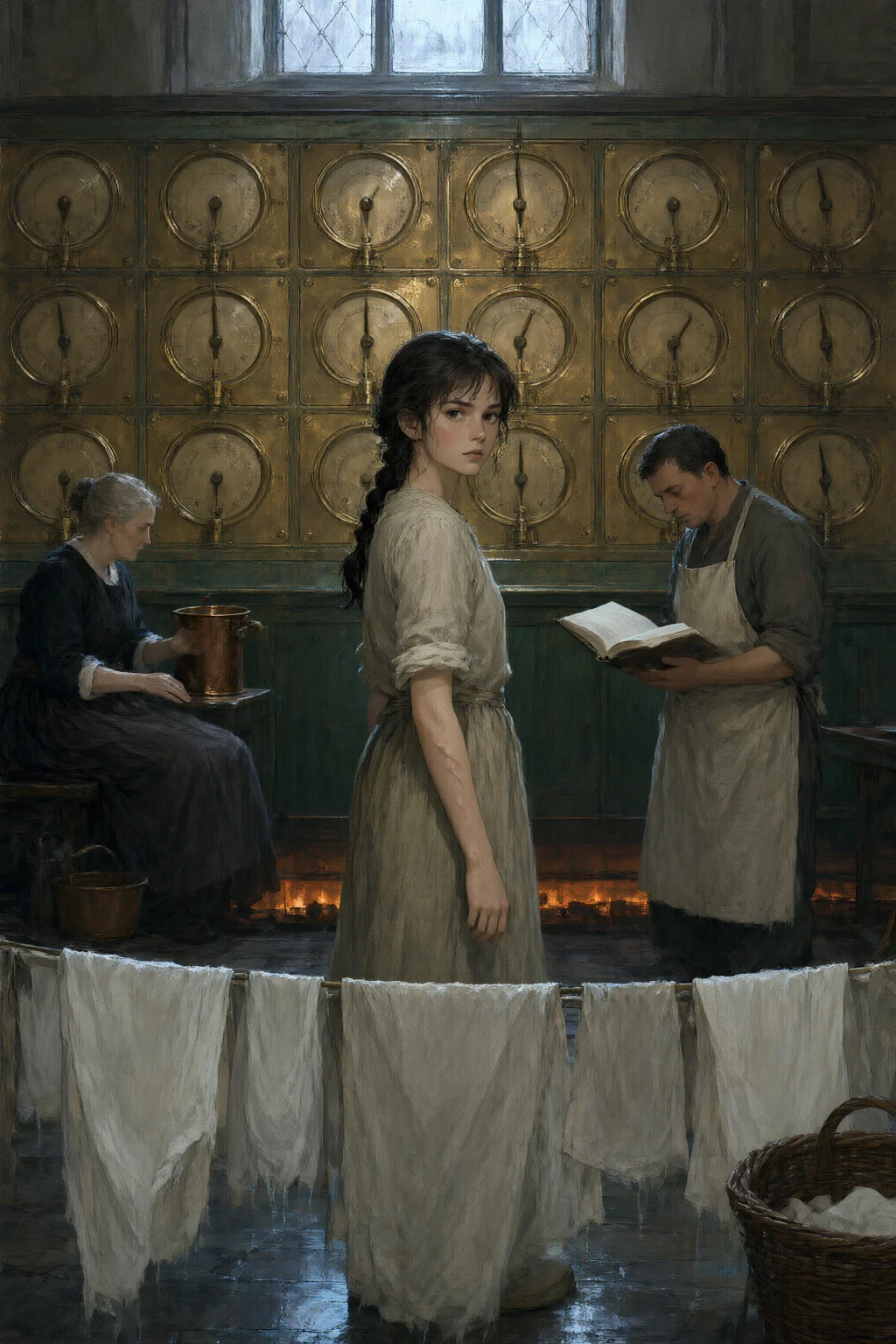
The Hall of Measures is a long room in the district of Torrens, built along the back of a laundry, and it contains two hundred and eleven dials. Nobody calls it that. The laundry calls it the mirror wall, because that is what the brass was for before anybody thought of keeping score. The public calls it the Queen's mirror, which has been true so long that it is probably the truer name. Each dial belongs to a household and reports the mending that household owes the trade, in hours, to the quarter. The needle rests at the bottom when the account is clean. The needle climbs. At the red line the hall stops washing, and a launderer is sent to the house, and he does not leave until he is paid in full, in coin, and has counted it himself. Sefa Bram was twelve, the youngest launderer in the city, and she had never once thought about any of it. The trade does not let you think about it. The trade is the wet, and the heat, and the count.
The seven who ran the Hall of Measures were not dwarfs. They were between four foot nine and five foot two, they had all started in the sorting trough at nine years old, and not one of them had ever been paid by the great houses in coin. Their names, in the order in which they sat along the wall, were Duffel, Nib, Spindle, Mote, Cob, Bramble, and Tallow. Tallow sat at the end nearest the door, because he was the one who went out, and the others sat along the wall, because they could not all fit in the trough. Cob kept the books. He was thirty-one and had a bad wrist and wrote with his left hand in a script so upright it looked like a fence.
"Learn the numbers," he said to Sefa, when she was thirteen and had the north row to herself. "Because the numbers do not have feelings, and everything else in this building has feelings and will use them." "I can already read them." "You can read them. You cannot weigh them. There is a difference, and it is the whole of the trade, and I will not be here when you find out which one you are."
The great house of Tarn sent more linen to the Hall of Measures than any other household in the city, and it had sent it for forty years, and it had paid in coin twice. The first payment was in the year the old queen died. It was large, it settled the whole account, and it was made by a man called Ansgar Rooke, who was the house factor, and it was celebrated. Thereafter, once a year, the house sent a cart to the gate with something in it. The something was never weighed. It went into the receiving bin with the rest of the oddments, and Nib wrote a receipt, because a receipt is a receipt. Duffel opened the packets in the sorting room, in front of the witnesses, because that is the whole law of it: what a house gives is opened where four men can see it.
They were mended things. Duffs in a queen's stitch, so fine you could not find the join. Cuffs turned inside out so the darning showed on the right side, which is what a professional does when she is not ashamed and is not asking. A child's smock, mended at the shoulder in silk of the original colour, though the original had been grey for four years. Seven thousand hours, said Cob, that year. Seven thousand hours of a woman's working time, sent to a laundry in a cart, once a year, without an invoice. "Put it in," said Tallow, every year. "It goes in."
It went in for thirty-nine years, valued by the yard at a ninth of its worth, and it was not valued at all in fact, because there was no form on which a house could enter its own labour as a payment, and nobody had ever asked for one. The trade is paid in coin. A great house is above the trade.
Sefa Bram was thirteen when she went out to the Tarn house with a cart. She went with Mote and Spindle on the Friday, with the quarter's washing, and the cart is a seven-mile round trip and takes a whole day. Mote rode on the shafts, Spindle rode on the wash, and Sefa walked, because she was the youngest and it was the rule. They were let in by a footman and taken up to the counting room. The quarter's account was on the desk, and it was correct, and the house paid it in coin, in full, without any argument. Then the footman said: "You will find the basket in the passage." The basket was in the passage. It was a wicker laundry basket, and it was full, and on the top of it was a folded sheet, and the sheet had been turned inside out.
Sefa stood in the passage and looked at the herringbone. "This is not anybody's," said Spindle. "It has not been through a washhouse in forty years. Look at the twist. Three-needle shuttle, and a person who was taught by somebody, and you do not learn that at a trough." "It is in the basket," said Mote. "It is in the basket and it is not a payment," said Sefa. "There is no column for it. If it goes in the pile it goes in as oddments at a ninth, and it has been going down that pile for thirty-nine years." "Then put it in the pile," said Spindle, "and let's go home."
They went home. Sefa rode on the shafts, which was not allowed, and did not speak for nine miles, and the basket of mended things went into the oddments bin with the ledgers and the lamp oil, and the bin was emptied in the morning.
The needle for the house of Tarn stood at the top of the arc. It had been climbing for thirty-nine years. There was no wall on which a dial could go higher, and the makers had stopped making the plate, so the needle rested against the brass stop, and had worn a shine on it. Tallow was the one who went out, and he went out to the Tarn house every quarter for eleven years, and he had a way of standing in a doorway that made the doorway look shut. He asked for the house factor, and set the book on the table, and turned round one page. And Ansgar Rooke's widow, who had run the house for nineteen years after him, looked at the number, and looked at Tallow, and said, "How much."
"That is what the hall is owed," said Tallow. "All of it, quarterly, with interest from the day it was left off, and it is what the red line says, and we do not wash for a house at the red line. You know the rule." "The rule is your rule." "It is the law of the city. It was written in a year when your house was arguing about the roof, so you will forgive me if I do not pretend it is ours." "Show me how it is reckoned." Tallow turned the page the way a man does a thing he has done a thousand times, without meaning to, and then he stopped, because the lady was not looking at the number. She was looking at the third column, which is the column of items received in payment. "That is not money," she said. "No, my lady."
"That is mending. Somebody has been mending for this house for thirty-nine years and putting it in the third column." "Yes, my lady." "And you have known that for thirty-nine years." "Yes, my lady," said Tallow, and for the first time in eleven years he did not know what else to do with his hands.
The house of Tarn stopped washing. That is what the red line means, and it means it for everybody at once, on the same morning, in every yard in the city. Nobody minded much. The great houses went to other laundries or to private women, and forty households went without boiling water for nine days, and the ward wrote a letter. On the ninth day the lady of the house came to Torrens. She came at the hour when the washing is turned, and she did not go up to the house. She came down to the drying ground and stood at the rail, and the yard went quiet the way a yard does, because seven men and eleven women all stopped at once. Sefa Bram was on a line with a wicker basket. "Which of you is Cob?" said the lady.
"I am," said Cob, from the bench, without getting up, because it was raining and he had a bad wrist. "Read me the third column. I have the whole quarter here." She had it in a tied leather case with a list of the payments, and there were nine years of them, and each year had a different name at the head of it. "From the year of the old queen's death," said Cob. "Yes." "There is one name on that list and it is not a household," he said. "It is written on the sheet the first time it was done, by an old man called Rooke, who was the house factor, and he is dead, and it says: by the work of the hands of A. T." Anselm Tarn. The house's own name, standing in a laundry book, valued by the yard.
The lady read it. She was fifty-odd, and she had signed her husband's debts, his roof and his coal, and she had never signed a laundry account in her life, because the account had never been wrong enough to require it. "My mother did the first cart," she said. "Before Rooke. I remember her at the long table at eleven at night, in the room behind the linen room, with a basket at her feet and a lamp, mending for the second house, so that the first house's money could go on the second house's improvements." She looked out at the drying ground. "Nobody ever told her it was free. She was quite clear about that. She used to say, a name is not a wage."
The hall did not strike. It had never struck in thirty-nine years and it was not going to start now, and Tallow, who was the one who went out, said so out loud, in front of the seven. "We will not put a shutter on ourselves, and we will not stand in that doorway again. But we will not wash for the house of Tarn either, and the needle is where it is, and it is not a coin, and I am fifty-one years old, and it is very likely the end of my trade." What happened instead was dull and slow and took the whole of a year.
The lady went to the ward. The ward went to the guild. The guild found, in the fourth book of its statutes, an article about labour given in lieu of coin, which permitted a house to discharge an accounted debt with the labour of a person on its rolls, at the guild's rate, on a form, entered by name, and valued. Not received. Valued. The difference between the two columns, Cob said, was the whole forty years, and it came to about four thousand marks, which was more money than the Hall of Measures had ever seen walk out of that gate. And it had to be entered by name, on a form, and the person whose work it was had to be alive, and willing, and consenting, and the entry had to name the years. Which meant the Hall of Measures had to go and ask.
They sent Tallow, because it was Tallow's doorway, and because he had stood in it eleven times with a book under his arm. She was called Vellisa Tarn, and she was sixty-eight, and she had a room over the still-room where the house kept its mending. There was a table, a lamp, three baskets, and a chair with the arms worn shiny. She was doing a sheet when he came in. She did not stop. "You are the one with the book." "I am." "You are not going to ask me for anything." "No, ma'am. I am going to read you a form, and then I am going to wait, and then I am going to do whatever you tell me to do, and it can take as long as you like." "You will want the years," she said, some time later. "Thirty-nine."
"Thirty-nine is not a number. It is a life. Enter it as one entry. One entry, or it is a bill, and I will not sign a bill." Cob's rule was that a form with an entry in it for every quarter is a bill, and Tallow had been told to bring one. "Ma'am," he said, "I am not here to argue. I am here because nobody ever wrote the form. The form exists now, and it wants a name. If the answer is no, I will take the no back down the hill, and we will all go on as we are." Vellisa Tarn turned the sheet over and looked at the back of it, which is what people do when they are not ready to say a thing and want their hands to be doing something.
"There is a girl at your hall," she said. "The small one. On the line this morning." "Sefa." "She stopped my work on my own ground, three years ago. She stood in front of forty pounds of my darning and told the man it was not a payment, and that she was sorry." Vellisa Tarn set the sheet down. "I have thought about that for three years, and I have decided I will not let the whole of my life be the answer to it. I will sign one entry. I will not sign a bill, and I will not be thanked."
The entry was made on the first of Midwinter, and the needle came off the stop all at once, the way a wound comes open when the stitches are out, and it did not go to the bottom. It went to a line a fifth of the way up and stopped there, and there it is, and there it was long after the boy who drew it had gone. What the district noticed was not the money. It was not that much by the standards of the great houses. What the district noticed was that the needle came off the stop. Cob's wrist got worse. He handed the books to Sefa in the autumn, and she kept them for nine years, and she wrote them the way he had written them, in a script so upright it looked like a fence.
She never mended. She was offered the work in four houses and said no each time, and in the end a young laundress asked her about it once, and thought she was being proud. "No," said Sefa Bram. "Somebody has to know what a good mend looks like, or you cannot tell what you are looking at. The woman at that house mended for thirty-nine years and nobody in the city was able to say so, and all of that was a waste, and not because she was unpaid. Because there was nobody in the trade to say it was good."
The last thing in the Hall of Measures that changed was the dials. Sefa had them all moved out in the spring, one at a time, down onto the sorting table, and she put a small brass plate in each well where the needle sat, and the plates were not marked, because a mark is a number and a number is a debt. She raised the same small rose in the same place on every one. The old lady of the house came down to look at the one for her household, which was the twenty-third from the door, and which had been off the wall for the first time since the plate was made. "It is not the same," she said. "It is not the same dial." "It is the same dial," said Sefa. "It is the same number. It is in a different hand."
She stood a while with her hand flat on the brass, on the little rose where the shine had been worn into the stop, and then she asked whether there was one for her and her mother. "There is one for every house in the city," said Sefa Bram. "Yours and your mother's are the same one. They are a hundred and nine years apart on the plate, and they are the same plate." The old lady nodded once and went out into the drying ground, where the rain had stopped and the lines were going up anyway, because the washing was in and the rain was not the washers' business. Sefa took her end of a wicker basket and swung it up onto the line, and the air came through the linen and the whole long yard smelled of soap and wet rope.