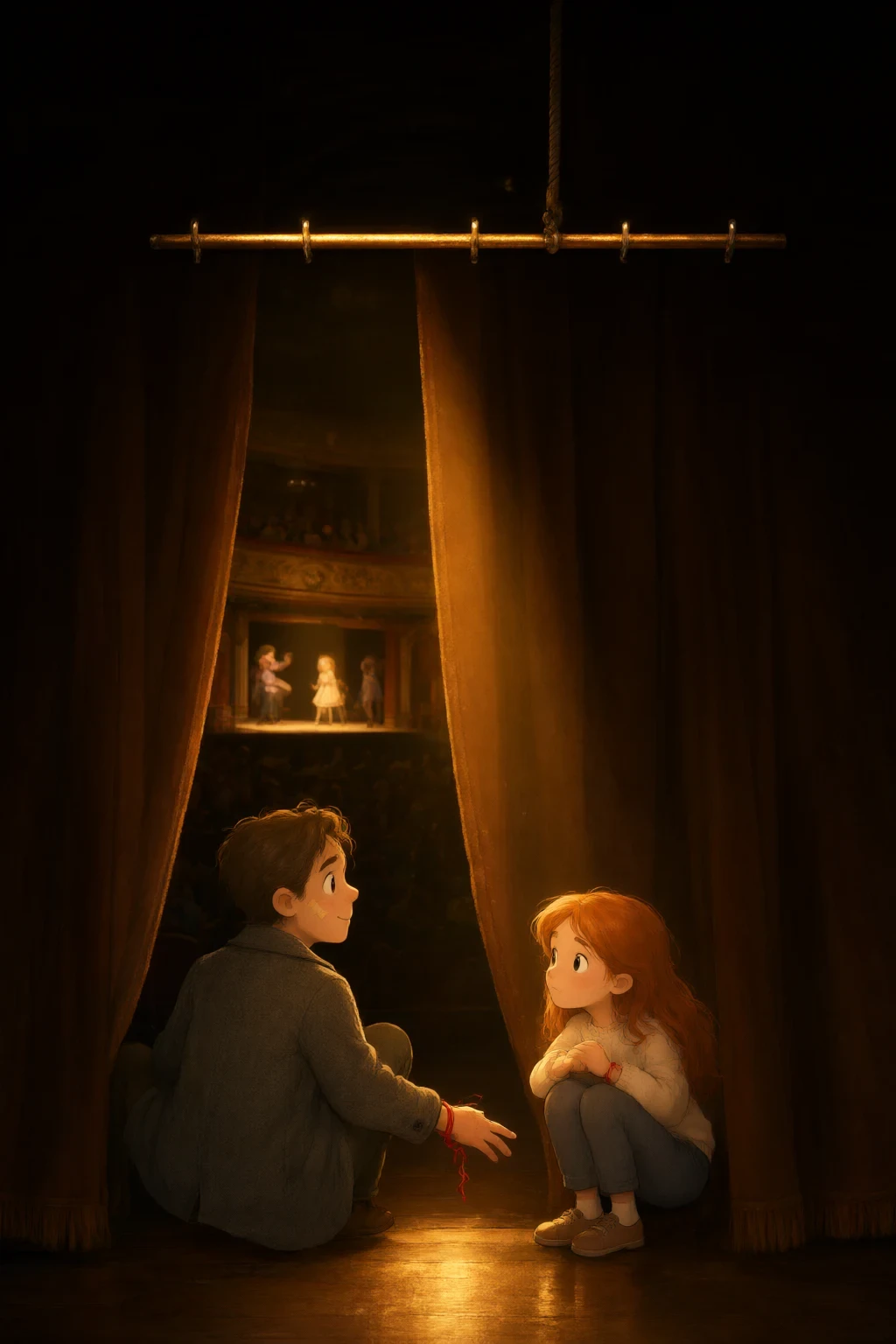
Half an hour before the curtain, eight people sat on two metres of bare board in the wings and did not talk, because there was nothing to say that had not been said on this bench in this order for nineteen years. The bench was stage left, in the dark, behind the heavy drape gone brown at the hems. Eight hooks above it. A hot pipe running underneath the whole length of it, so that in February you could sit on it for two hours and then stand up and feel the shape of the bench on your legs for a week. And twenty metres away, a crack of lit stage the width of a knife, amber from above and green-teal from the footlights, the only light in the world that was meant to be looked at.
Bram Sillet was on the second hook. He was forty-one. He had a tan that came out of greasepaint and never entirely washed out, and two small strips of flesh-coloured tape on his cheekbones where the Younger Brother’s paint had been laid on and taken off so many thousands of times that the skin underneath had given up and asked to be taped. He sat in his coat, because they all sat in their coats, and he took the coat off the second hook, put it on over the paint, and stood up.
It did not close. It had not closed since the spring, since a woman had opened it up in the green room at half past two in the morning and put it back the way it was written, and Bram had worn it every night since and never mentioned it again, because he was the Alternate of Record and the Alternate of Record did not have things. “He is early,” said Nell Tarrant, from the fifth hook. “He is early, and the coat is open, and he has not looked at the crack once.” “He is looking at it now,” said the woman on the seventh hook.
The number was the trouble. Nineteen hundred and six nights. Bram knew it the way a man knows the steps on a stair he has gone up and down in the dark for nineteen years, and he had never once said it out loud, and there was a reason for that which he had never examined, and the reason was that a number said out loud in a theatre is a cue for something.
He had a contract. Every member of the corps had a contract, and his was the oldest in the building, and in the last clause of it, in language so dry that the man who wrote it had clearly enjoyed himself, was a release. It said: on the closing of the run, the member is released, discharged, and paid to the close, on the terms already written here.
Twenty years he had carried that clause about in his coat pocket like a stone. His want was small and clean, the smallest a person can have: to walk out of the front door of the Thistlewire in the daylight, with the run closed behind him and the season’s wages in his hand, and never come back. He had never asked about it once. He had been in the building nineteen hundred and six nights and had not been outdoors in the day for one of them, and he believed the river was a rumour.
Above him, out of sight, over the boards and under the floor, the boy with the burnt black eyebrow stood in the lighting gallery with a strip of oiled silk wound round his forearm, looking down through the slot at four hundred and twelve faces, which from up there looked like one field. “Two minutes, no more,” said Amos Derwent to nobody, because the house was full and the fourth lamp wanted trimming and both of those were true at once.
The first act was perfect. Bram had always known it would be, because he had done it nineteen hundred and five times and there is nothing left to learn about a thing learned that far, and he stood on the fourth mark and took the tray left of the door, and he was late, and he meant to be late, and the house did not know that any of that was a choice. In the second act there was a pause.
It was eleven seconds long. Corvin had timed it, and Corvin gave the time out loud in the wings to nobody, every night, like a man reading the depth of a river: eleven seconds, two paces, third lamp is amber, do not touch it. It was the Younger Brother’s pause, the pause before he says the only thing in the play that he means. On the nineteenth hundred and fifth night it had been eleven seconds.
On the nineteenth hundred and sixth night, in the middle of it, with four hundred and twelve people holding their breath and not knowing they were doing it, Bram Sillet put the tray down on the table instead of in his hands, and turned, and walked off into the dark at the side, and the last thing the house saw of the Younger Brother was a man leaving at a walk, in the wrong direction, in the middle of a sentence.
The stage went on without him. That is what the terms do. The requirement is met by the description and not by the man, and the Younger Brother had eleven seconds of pause in him and then he said his line, and the line was given by the stage manager out of the prompter’s box in the dark left of the stage, in a voice nobody in the house had ever heard, because it was Corvin Ashby’s own voice, and Corvin had supplied lines so long that the theatre no longer knew where his inventing stopped.
Bram woke up on the bench with his coat over him and the hot pipe under him and the crack of stage light on his face, and for a moment he did not know which night it was, which was the first time in nineteen hundred and six nights. Nell was at the end of the bench with her knees up. “Off,” she said. “I am aware of it.”
“You cannot go off. Nothing in this building can go off.” Nell said it the way she said everything, by taking the last word she had heard and handing it back. “Off. You are off. And you were the only one who did it, and it has been four minutes, and the woman on the seventh hook has knotted her thread.” It went down the bench the way water goes down a gutter. Bram had always thought of the corps as eight numbers and a hot pipe, and it turned out to be eight people who could see each other’s wrists in the dark.
It went from the second hook to the fifth, and the fifth hook was Nell, and Nell had already done it, because she was the youngest and the first and the one who does not yet understand that a thing is contagious once it has been said out loud. It went to the seventh. It went to the third, who had been in the corps nine years and said nothing whatever, which was how you could tell. It did not go to the first hook.
The first hook had a woman on it who had been in the corps thirty-one years and who said, out loud, to the whole bench, in the voice of a woman reading out a bill: “Four wages. That is four wages, and my son is on the gas, and the gas does not care whose coat he is wearing.” That was the division. By half past nine the bench had quietly divided into the frightened and the certain, without anybody deciding to divide, and Bram lay in the middle of it and understood for the first time in nineteen years that he had a side.
Corvin came to the bench at the act break and crouched down in the aisle so that his face was level with it, and he had the thin black notebook in his hand and did not open it. “Here is the arithmetic,” he said, “and then I am going to go away and give you your two minutes.” The bruise-shadow under his right eye was the colour of the green-teal from the footlights.
“Four have not gone on. Four have gone on in their places, and the stage is full, and every Position in this play is standing in front of four hundred and twelve people at this moment, so there is no empty chair and the season is not closed, and none of you has cost the house a subscription. Four is not eight. The book wants eight, in one house, on one night, before the curtain, and that is the whole size of what you have done tonight.” The woman on the seventh hook said, into the dark: “So what happens.”
“Friday,” said Corvin. “The strike is the whole season’s wage, taken out of the book in the clerk’s hand, for every Position not completed before the curtain falls, and it does not care whose Position it was, and the four who did go on will be paid, because a Position completed before the curtain is paid, and I have watched men work for that money all evening.” Nobody said anything. On the stage a scene change went by that nobody in the corps had ever seen, because it had been cut nineteen years ago, and the light came up on an empty stage for the length of a breath and went away. “There is one more thing,” Corvin said, “and I have never once said a true thing at the curtain.” He held up the notebook.
“Tonight, four of you went on in the places of four who would not. Tomorrow, the four who went on may not hold the same Position two nights running without a rest day, and there is nobody to give the rest day to, because the rest of you said no. So tomorrow the four of you who are certain will be the only bodies in this building who can fill those four Positions, and the terms do not have a clause for a person who said no on Tuesday and goes on on Wednesday.” He stood up.
“Nobody may be fined, dismissed, blacklisted or remembered for refusing to go on. That is the good news and it is the whole of the good news. The bad news is that the theatre has no procedure for it, because the terms do it for you, every week, in the same three lines, and I am going to go and give two people a line that is not mine.”
Bram lay on the bench and did the arithmetic, which he was extremely good at, because it was the only kind of arithmetic he had ever been allowed to do. He had wanted, for twenty years, to be released. He had a clause in a coat pocket and a door at the front of a building he had not walked out of since he was twenty-two. Paid to the close. And the close was a Friday, and on the Friday the whole season’s wage came out of the book in one stroke of a clerk’s hand, and tonight, for the first time in nineteen years, somebody in this building had found out what a Friday could do.
The river was a rumour. He had said so that morning to the lamp-hand, out loud, in the middle of a conversation about a bucket, and the boy had looked at him as though he were joking and he had not been joking at all, and now here it was, under the bench, thirty feet away, in a pipe, in a coil, heating eight people’s legs all winter. He had a want. He had a door. And the door turned out not to be a door. It was a rest day. You could not walk through it once. You could only be let through it after the run, and only if the run finished, and the run finished on a Friday, and the Fridays in this building did not care in the slightest what anybody wanted.
Nell came back along the bench and sat down on the end of it near him, in the dark, with her knees up and the red thread round her wrist and one single knot in it. “Curtain in forty minutes,” she said. “Then I am not going on, and I have not gone on, and I am going to be certain about it out loud, and you can be frightened on your own, because I am not going to spend the rest of my life being the youngest person in a dark room.” “Nell.” “Do not.”
“I was going to say your name.” “I know what you were going to say, and I am going to say the thing I came to say, and then I am going to stand at the back of the stage where the Correspondent stands, which is the only place I have ever wanted to be.” She turned her face to him. He could not see it. He could hear it very well. “Will you go on.”
He had nineteen hundred and six nights of other people’s words in him. He had the Younger Brother’s pause, which was eleven seconds, and the Younger Brother’s tray, which he took in his left hand, and the Younger Brother’s line about the river that nobody in the house had ever believed. He had no line at all for a girl of seventeen asking him a question in the wings. “Ask me again in the second act,” he said, “and I will do it as the Younger Brother, and neither of us will ever know whether I said yes.”
They called the cue at twenty past ten. Corvin called it as distance and time, and it was not his invention, and the fourth lamp was amber and the fifth was the pale one nobody could name, and the first was green-teal and lay on everybody’s hands like cold water. The man on the eighth hook came to the edge of the crack of light and went on as the Elder Brother, and he had not wanted to, and he went on anyway, and the house made the noise four hundred and twelve people make, and the play went on.
Bram Sillet was the only person in the building who was not correct, and he was not on the stage. He was on the bench, in his coat, listening to a scene he had done nineteen hundred and five times, and there was nothing wrong with it and nothing missing from it, and the theatre had not noticed and was never going to notice, and that was the answer to the question he had carried in a coat pocket for twenty years. He got up. The woman on the first hook said, “You are going on, then.” “I am going on,” said Bram Sillet, “and I want it entered somewhere that I was asked.” “There is no column for that,” said Corvin Ashby. “There ought to be a column for that,” said Bram Sillet.
He went to the second hook and took the coat down, and it did not close, and he put it on, and he said, to the boy with the burnt black eyebrow coming down the rope with two minutes in hand: “If anybody in the house asks you what the water in the pipe under this bench is, you tell them it is the river, and you tell them you have seen it, and you do not tell them how.” Then he walked out of the dark, into the light, into the exact place the Younger Brother was standing, and he was asked.
On the Friday the clerk came at eleven with the ledger, and the strike went in against the season in a single line, and the whole corps lost the whole of the winter, and the woman on the first hook was right, and nobody said so to her face. Afterwards, in the wings, in the cold, in the dark behind the drape, eight people stood at eight hooks.
On three of the wrists there was a single knot in a length of bright red thread. On five there was the thread and no knot. On the second hook there was the thread and no knot, and Nell Tarrant looked at the second hook for a long time, and the only person in the building who knew why was the man beside her, who had gone off in the middle of the nineteenth hundred and sixth night and had been asked, and had not refused, and had been, for eleven seconds, nobody at all.