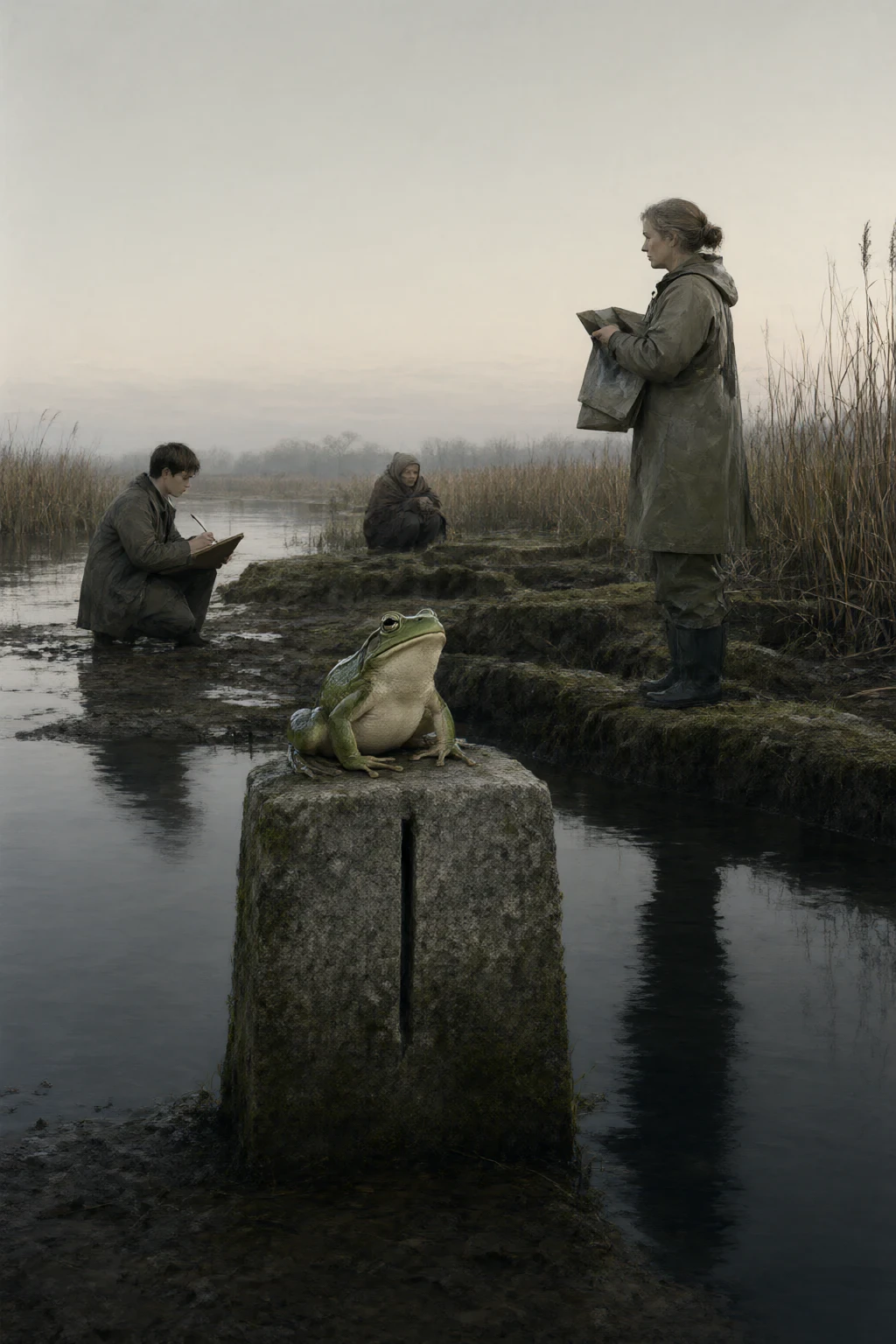
I have been king for one hundred and nine years, which is the joke, and I am not going to be making it. My name is Usk, which is not a name so much as the sound the water makes at the sluice, and I am the ninth of the line and the last two of the line, and I live in the fen at the mouth of the Ald which is written Ald on the land maps and Auld on ours, and the difference is a hundred years of argument about a letter. The court of the water meets at the third hour of the night when the tide is making, in the order, and by day I am a frog in a reed-bed with a clerk, which is to say I am a frog in a reed-bed, because there is no one else.
You will want to know why I am on a chair in your ballroom. I will tell you in the wrong order, on purpose, because the right order takes about four hours and I have nine inches of leg.
The ball is a seal. That is the first wrong thing the songs get. The ball is not a toy and it was never thrown for fun, and the girl who lost it and the frog who fetched it are the two oldest offices in the world doing the two oldest jobs. The court of the water has one seal. It is a sphere of gold, a little larger than a fist, with no device and no inscription, because water cannot read, and the whole of our law is that the holder of the sphere may take the water. When the sphere is out of the water the court is not dissolved; it is out of session. When it goes back in, the court is in session and the terms of the last compact are in force and may be enforced by whoever holds the seal. That is all.
It has kept a kingdom alive for eleven hundred years and it has never once been lost, which will interest your chancellor, because it means that when your Queen's mother threw the ball into the fen, she threw the water-court's session out of the water. She threw it on a dare. Your histories know that. They do not know that the dare came from her husband's table, that the remark was that the fen smelled, that the remark was true, and that she threw a sphere of gold into four feet of black water in front of nine witnesses to make a point about drainage, and that nine witnesses is not a legal number, and that a seal is not a seal unless it is recovered by a party with standing. I recovered it. That is the entire claim of the water-court, and it has stood for four years, and it is the reason I am here, and it is not a curse and nobody put anything on me.
Here is what a frog looks like arriving at a state occasion. We came up the Ald in the last of the night, on the flood, four of us, in a grain sack that had been a grain sack in the reign of your great-grandfather's great-grandfather, and we came up the ornamental bank because the ornamental bank is cut for the water and the water knows it. We came up the bank at two in the morning and we were in the lower rose walk by four and in the ballroom by five, and the ballroom floor is cold, and your Chancellor of the Household, a decent man who was extremely tired, came in at six to find us on the chairs. "That will not do," he said. "We are not doing anything," said my clerk, who is called Null and is a toad. "We are sitting on warm chairs." "The chairs are chairs. They are for sitting on by guests. You are guests. That is the difficulty."
"Then we are within the terms," I said, "and I would be obliged if nobody would move us, because the thigh bones do not take it kindly at my age." He looked at me for a long time. He was fifty-one and had a rule for everything, and I could see him trying to decide whether the water-court was entitled to the dignity of the chair, and I could see him understanding that this was not a question of dignity at all but of who was going to write the minutes, because if we stood on the floor the matter was an entertainment and if we sat on the chairs it was a delegation, and nobody in that room was going to write frog in the column headed DELEGATES. "There is a bench," he said. "There is a bench," I agreed. "The bench is nine feet from the wall, and I am a hundred and nine years old, and I have a seal in a bag at your table. Put it in the minutes as a bench." It went in the minutes as a bench. I have the page. It is one of nine hundred and forty of my reign, and I keep every one, because the seal is a sphere and a sphere cannot write.
The Queen came in at ten. She is fifty-one. She is small, she is a swimmer, and she has a way of coming into a room that is like a man going round a corner he knows is there. She looked at the bench. She looked at Null and the other three. She looked at me for slightly longer than anybody else, in a way I did not understand then and understood eleven days later. "You have the seal," she said. "I have the seal." "Then sit at my table, Usk, and not on a bench, and let us do this properly or let us not do it at all, and if you prefer the bench I will sit on the bench, so that we may both be ridiculous together." That was the first thing that went wrong with the plans of your Chancellor of the Household, who had spent five months preparing a protocol.
We did it properly. The Queen is the fourth sovereign I have negotiated with and she was the first to ask me a question before making a speech, and the question was what the seal weighed, and I said four pounds and a quarter, and she said that seems right, and I have thought about that exchange more than I would like to admit.
Then there is the matter of the compact, which your histories have garbled beyond recovery, and which I am going to state once, plainly, because somebody in the palace library has been drawing an illustration of it for the last hundred and forty years and the illustrator is wrong in three particulars and one of them is anatomical. The old compact between the court of the water and the crown is a holding. Not a marriage. Not even, in the strict sense, a treaty, though it has the force of one and is kept by the Crown's own officers, and the Crown's officers keep a great many things they would prefer not to.
The parties are the two sovereigns. The form is that one of them takes hold of the other, bare, with no cloth and no metal and no wax, at the turning tide and at the meeting-stone, and the holder's grip is read by the water and the holding takes effect. That is the whole of it. It has been done eleven times. The word in our own record is a holding, and yours is a kiss, and yours is wrong in a way that has had consequences, because a kiss is a thing you may decline privately, and a holding is a thing you may not.
I should explain that in our law the compact was written for two amphibians. That is not a joke. The succession at the meeting-stone runs through the water, and it has never run through a mammal, and it was drafted by the second of the Ald, who had watched the two of them come up out of the same shallows and did not think it remarkable. In four hundred years nobody has examined whether it would work on anything else. Your Chancellor has examined it and written a memorandum, establishing that the rite cannot be performed by the Queen because the Queen is not an amphibian, and concluding — I am told — that the compact is voidable. I found this extremely funny, and it is also the most dangerous document produced in this kingdom in my lifetime, and I advised against it in writing and was overruled by a woman who then overruled the overruling, which is the only reason we are all still employed.
We went down to the meeting-stone on the eleventh day, at the hour of the turning tide, because there is no other hour, and the Queen came out to the edge of the fen in waders with two guards and a clerk, and I went out with Null and the seal in the grain sack, and there was no lantern because a lantern frightens the water at the turning and the water has to be able to read. The meeting-stone is a flat block of granite, four feet square, set in the bank where the Ald cuts through the old boundary. It is old enough that nobody knows who set it. There are nine holes bored in it, one for each of the nine of me, and the last hole is the size of my fist, as it has been for a hundred and nine years, and it does not go in very far. The masons understood what they were doing. I have never told anyone that I know that.
The Queen read the terms out loud. That is in the compact and it is the one part your histories have right, though they have it as a prayer. She had them on a board in oilskin and read them slowly, and when she came to the part about the winter water she stopped for a moment and then went on, which I noticed, and she noticed me noticing.
I am nine inches, and I am not going to make a joke of it, but you will want to know how the rest of it was done, and it was done badly and slowly and with a certain amount of swearing from both sides. The terms provide that the holding be taken by the frog and not by the Queen, because the frog is the amphibian; Null had to lift me, which he is good at; and I had to get up her forearm, which is the wrong length for the purpose and was not designed by anybody. It took four minutes. In four minutes I climbed a great deal of a great deal of wader, and the clerk of the Crown wrote the amphibian ascended on the board, and the guards watched the fen, and the Queen watched me and did not help, because helping would have broken the form.
Then my hand closed on her wrist, over the wet cuff, and I felt the moment the water took it. It is not a feeling. It is a reading, the way a page is read: a cold going through from the inside of her arm outward, and the whole of the fen, four miles of black water and cut ditches and reed and silt, went quiet at once, the way a room goes quiet when the right person comes in. "Say it," I said. "The form requires the other party to name the thing, and it must be named in the hearing of the water, and if you are not certain, do not say it, because it will not take and we will be here at the next tide." Her Majesty looked at a hand on her wrist for some seconds.
"I hold the water of the Ald fen," she said, "in the terms of the old compact, and I will keep the winter water and the flood meadow and the eels, and I will shut the sluices in April and open them in September, and I will not take the meadow's water for any mill, any crop, or any meadow of my own, and I know there are men in this city who will say that is the end of the fen, and there are, and I have told them so myself, and it is." The fen went quiet a second time, further in, and the reeds on the far side of the water all lay over at once and came back, and the clerk of the Crown wrote for a long time, and then said, in a small voice, it has taken. "It has taken," I agreed. "I am sorry. It is always like that."
The Reclamation Society had four hundred members and a seat at the board of works by custom and influence by marriage, and the compact cost the Queen the northern mill-race, the best water in the county. She gave it up in a morning. The chancellor wanted it referred; the Queen told him the terms would not survive a reference, and that she had asked a frog to the meeting-stone at the turning tide and was not going to send the question back with a committee.
Your histories make the water-court a mystery. It is the least mysterious thing I have ever had to explain to anybody. It is not a spirit court. It is not an old magic. It is nine frogs and a clerk, and a set of terms, and a habit of holding the water the way a landlord holds a lease. There are four of us left. There were four hundred at the founding. We have no palace; we have a good reed-bed at the Auld and a dry stone, and the minutes are kept dry because the second of the Ald discovered that you cannot dry a document that has been in the water, so he had copies made, and the copies are why the water-court is a court at all.
I did not come up the Ald to be a marvel. I came because the reed-bed at the Auld is drying, and the court has one more generation in it, perhaps two, and a seal that has to be somewhere, and a clerk who is getting old, and I am the ninth of the line and have been king since I was two days old, which is to say I have been king longer than your Chancellor's grandmother and I have never once been asked to leave.
The reason the Queen had me at her table rather than on a bench, in the end, was a margin. Her drainage office has produced an annual report of the state of the fen for a hundred and thirty-one years, and every copy of it has to lie about the fen. That is the terms; the report may say the fen is dry, and may say the fen is wet, and may not say what the fen is, and the practice is to say wet. Every report since the year of my accession has had, in the right-hand margin, in a very small and extremely expert hand, a series of corrections. Your table of sluice-days is wrong in the third column. We keep the Ald a foot lower than you think we do. Cut the southern drain in April, not June, or you will take the eels and you will be sorry.
Eleven years of them. Dates, figures, water levels, the days the eels run, the days the water actually turns, and — this is the part that kept me on the bench at six in the morning for five full minutes — notes on the shape of the bank at the ornamental walk, which I have been climbing for a hundred and nine years, and which somebody had surveyed, correctly, within nine inches, from a fine surveyor's chain, which no one who had only ever seen the fen from a drawing would have done. The Queen had been arguing with them for eleven years. In the margin, in her own hand, in a large, impatient, beautiful script, she had written answers: no, as to that my lord has been misinformed by your clerk, and once, in the forty-fourth year, a single line I have never been able to stop thinking about. If you are right about the north channel, then the whole of the western scheme is wrong, and I have signed for it.
Eleven years. And two years ago she had stopped writing in the margins and begun to leave the reports unopened on the shelf in the map room, in their order, with the next one due. When I asked her about it, at the second sitting, she did not pretend. "Two years ago I had you traced," she said. "A man went down to the Auld with a chain in his cart to see who was writing in my reports. And it was you." "Yes."
"And I have known for two years that the water-court of the Ald is a frog, and that the frog has read the compact, and that the frog is the only living thing in this kingdom that has read the compact." She turned her board over. "I did not write back, because writing back would have been a communication with a foreign court, and the chancellor would have had it minuted, and then the Reclamation Society would have found out that the crown had been corresponding for eleven years with a frog in a grain sack, and I should have had to stand up in front of the county and explain why, and I have never found an explanation that does not sound ridiculous." "It would have sounded ridiculous," I said. "It has been ridiculous. I have been sitting in a sack." "Yes," said the Queen. "I know."
The compact took effect at the next turning tide and the water rose, and the fen filled in the winter of that year for the first time since your Queen's great-grandmother was a girl, and the difference was visible from the bank at eleven years old and I am told it was visible from a great deal further off. The mill-race was already gone by then. The sluices are shut in April and opened in September and they are shut because there are gates, and the gates are not new; my fourth predecessor had them built at his own cost in the eighth year of his reign, and the Crown took them into the works in the nineteenth, and they have been shut every April for sixty years because shutting them is cheap, and because nobody with a vote ever asked what the water did when it was not allowed to go where it wanted to go.
The gates work. They have always worked. That is the whole embarrassment of the fen. Nobody in the last sixty years has been able to explain, in any document, why the fen is dry, because the answer is that a frog asked. There is a commission now, of nine, of which the Crown appoints four and the water-court four, and the ninth seat is for a person who understands both, and has been unfilled for two years, and I am told the chancellor has a candidate.
I have a desk. That is what I want to say at the end of this, and I will say it plainly, because I am a frog and have never pretended otherwise. I have a desk in the map room at the palace, which is a real desk, and a stool, and a green inkwell, because the water-court does not use black and I have never explained why to anybody but Null, who says it is because black runs. There is a rain-gauge on the sill, which I put there myself, and which the palace's under-butler finds frankly insulting. Four hundred volumes of the water-court record are behind me and the Crown's drainage reports in front of me, and every year I now write in the margin, and every year the report is wet, and nobody has traced the frog since. And the Queen comes in on Thursdays, and we argue, and we are always both right.
On the fourth of April they shut the gates. I went down to the meeting-stone to read the gauge, because the reading is in the compact and it is mine, and Null came with me and carried the sack. The Queen came too, in waders, with a clerk, and we stood on the bank in the cold with the water going up the meadow ditches at the rate of a foot an hour, which is what the second of the Ald wrote down in the eleventh year of his reign and which has been wrong in every Crown report since. It came up the old ditches, all of them, in order. It came over the black silt of the fen and up into the reed and stopped, and the three of us watched it, and the clerk wrote, and the clerk's pen went through a hole in the board and he swore, and Null told him to wait for the water to settle before entering the figures, which is correct practice, and wrote it down.
Then the water reached the boundary. The boundary stones are set along the old line, nine of them, waist-high, cut with the mark of the compact on the west face, and the water came up to the fourth one and stood against it, and did not go over, because the land beyond the stones is four inches higher than the fen and always was, and every Crown engineer since the eleventh year has known that, and has not once said it in a report. The water came to the stone and stood at it, in the shape of the cutting, a foot and a bit above the black silt, and the reed came up through it, and the sky came down into it, and the eels came, and the whole four miles of it began to be a place again instead of a hole. The clerk finished the figure. Null closed the sack. The Queen and I stood on the bank in the cold, and she did not say anything for a while, and then she said:
"Ninety-two inches. Your book says ninety-two at the fourth stone in a normal April." "It says ninety-one and a half, and it is right, and you are reading the Crown book, which rounds, because it has been rounding for a hundred and thirty-one years and it is why I have to be in the room." I put the gauge back in its case. "It is a good number," I said. "It is the number we use." Down on the fen, the water stood at the fourth boundary stone, exactly at the height it had stood at a hundred and nine years ago when I was two days old and the ninth of the line came to the water, and the light went along the whole cut of the old ditches and the whole of the mark, and did not go over.