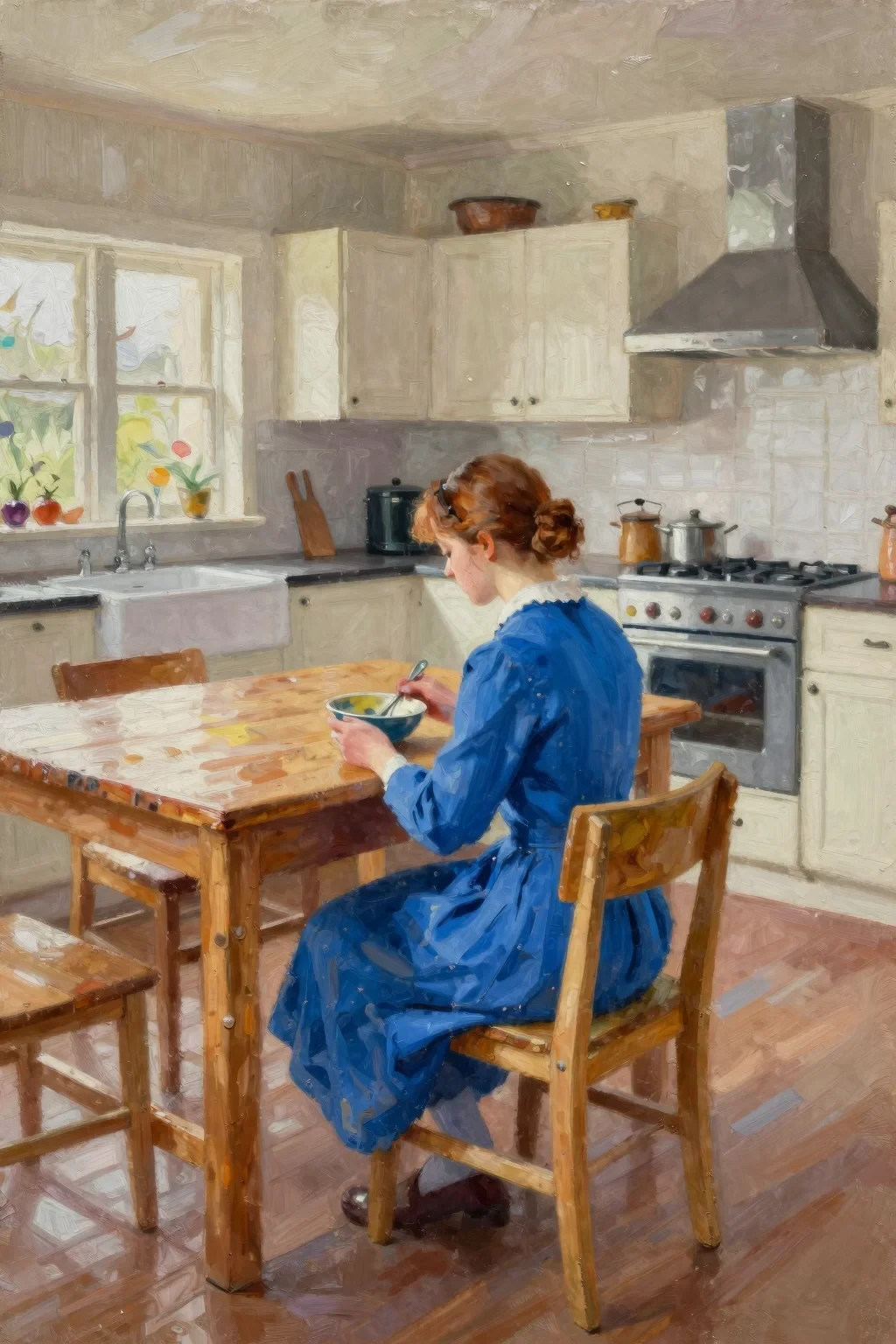
The long table in the mill house was for eleven people and there were four chairs at it. Elin had been at the mill on three Fridays and had not thought anything about that, because on the first Friday the chair had been an empty chair, and on the second Friday it had been an empty chair again, and on the third a girl of her own age had turned it out from the table and said, “That one is not for anybody. Do not sit there.”
Elin was twenty years old, and she had come in October from a town with a railway in it, where the school had forty-one children in it. Here there were nineteen, and the headman shook her hand on her first day and told her the school had been very good for a hundred years.
The mill was worked by a woman called Sorcha, who baked the school bread on Thursdays. Friday was the day the children came down and ate, because the oven was hot and there was no other day in that week when eleven children could be fed at that table. There was soup, and bread, and butter, and afterwards rice pudding, and the children got up and down. And there were four chairs at the long table. Sorcha sat at the head of it, and Elin sat beside her, and that was the two of them on that side. The far side had two more, and those were Ilma's and her mother's. That made four.
On the fourth Friday Elin was late, because the rain had come in on the wind after three o'clock and the ford was under water. The two chairs on her side were taken. Ilma was on the far side with her mother, and the milkman was eating off a barrel. The chair that was left was at the end of the far side, with a bowl and a spoon and a cup set at it like the rest. Elin sat down in it, because it was the only empty one. Nobody stopped her.
The soup came. Elin said something about the rain, and Sorcha said the ford would be down by morning and the race would want looking at, and a child said a boy at the next school had lost two shoes in the ford, and everybody laughed. Then all three chairs went back at once. Not a great deal. An inch and a half each, and the noise of three sets of feet, and the rice pudding arrived, and nobody in the room would look at Elin. She noticed it as a thing that has a shape to it. When she spoke, two faces came to her, the way you turn to a noise. When she stopped, they went somewhere else, and not to her.
Ilma did not eat the pudding. She pushed it into a low flat place with the spoon, and then she looked up, and Elin said, “I have had three helpings, you have had none. Take mine,” and Ilma took it and did not eat that either. She put it down to the mill, and to being a stranger, and to being sat at the end like a child.
She stayed for the washing up, which she had not done before, and while the room was full of steam she asked. “Is it something to do with the race?” Sorcha's hands went still in the water for half a second, and then went on. “You are quick,” she said. “Most people in the first month do not notice a chair.” “I noticed the chair. I did not know what the chair was.” “The chair is Wilf's.” Sorcha set a plate on the rack. “He was my brother's boy, and he was nine, and he went into the race at the sluice in the May before you came. He was not dead for an hour after that, which I would take as a kindness and cannot.”
His parents were out of the parish that year, so there was nobody at that table but me and the two of them. He had sat at that end for a year, and then he was gone. “I would not have it away now. I would not have it away for the whole winter it cost me.”
Elin did not say sorry, because the miller went quiet in a way that made sorry worse. “How long is it set?” “Every Friday. It was not set for a while.” Sorcha wrung the cloth out. “So a girl of fifteen set it one Friday, before the school came down, and put a bowl and a spoon and a cup at it, and told nobody. She did it because she said that a thing which is not said out loud is not at the table, it is under the table, and it is worse under the table.” “And the rule is that nobody sits in it.”
“The rule is that it is not for a guest.” Sorcha looked at her over the steam. “It is for the thing that has not happened yet. If somebody sits in it, they are that thing, and then we cannot look at them. Not because it frightens us. That is the whole of it.”
The wind got up again about eleven, and Elin walked back up the lane with the water over the ford, and she slept. She woke at one in the morning because somebody was knocking on the door of her room under the school. It was Ilma, in a coat over her nightgown, with her hair down, and she was not frightened and she was not crying. “Mill house,” she said. “Come now. Do not put your boots on.”
There was a lamp in the mill yard and the mill door was open, and the race was making its night noise, which is much louder than the day one. Sorcha had the kitchen door open and was standing in it in her shawl. Elin got as far as the step. There was a boy at the end of the long table, on the fourth chair, with his back to the door. He was about nine. His trousers were wet to the knee and his shirt was wet to the knee and his hair was flat on one side, the way hair is when it has dried once and been wet again. His feet were bare on the floor.
Sorcha went past Elin and got a towel, and she did not hurry in the way people hurry, and she put it round the boy's shoulders and turned the collar of his shirt down off his neck where it stood up wet. “Wilf, you are cold. Wilf, go and put your feet to the fire, that is all, that is all it is.” “I waited for somebody to sit down,” said the boy. “I have been setting it every Friday and nobody would sit in it, and I got tired of setting it.” “Yes,” said Sorcha. “You did.”
They gave him bread and warm milk, and he drank it too fast and had to be stopped, and then he asked whether the race was still as deep as it was, and Elin said that it was, and he said, “Right,” and put his feet up to the fire. Nothing in the room was frightening. That is the true thing about it. The stove drew. Ilma sat down on the end of the bench and fell asleep at half past two with her boots on. Wilf was let in, and was fed, and was sent home to a house two miles off with a neighbour and a lantern, in a way that two women who were both entirely sensible decided on together in four minutes.
Elin was back at the schoolhouse by four and did not sleep, and in the morning she asked Sorcha what was to be done about the chair. “We set it and we sit in it,” Sorcha said. “Every Friday, whichever of us, and not by accident either, because a thing done by accident is the way it was for a year and a half and none of us liked it.” “Does anybody have to?”
“Nobody has to. It is not a rule with a punishment on the end, or you would have heard about it.” She set the table for the day. “And it is not sad, because he came in hungry and he is let in. He has had four Fridays now and he asks after the race, and it can stand on that.” She put the fourth chair in against the wall to sweep under it, which she had never once done while Elin was there, and Elin understood that that was part of the table as well.
The rule of the place is that a table is not shorter because a person is not at it, and the village had known that a long while and had it in a chair, and nobody was to be blamed for not having said it out loud. Elin stayed four years and then went back to the town with the railway, and the last thing she did in the valley was to sit in the fourth chair on the last Friday of the April, and have the rice pudding, and hear Ilma ask her whether she was sure the race was still that deep.