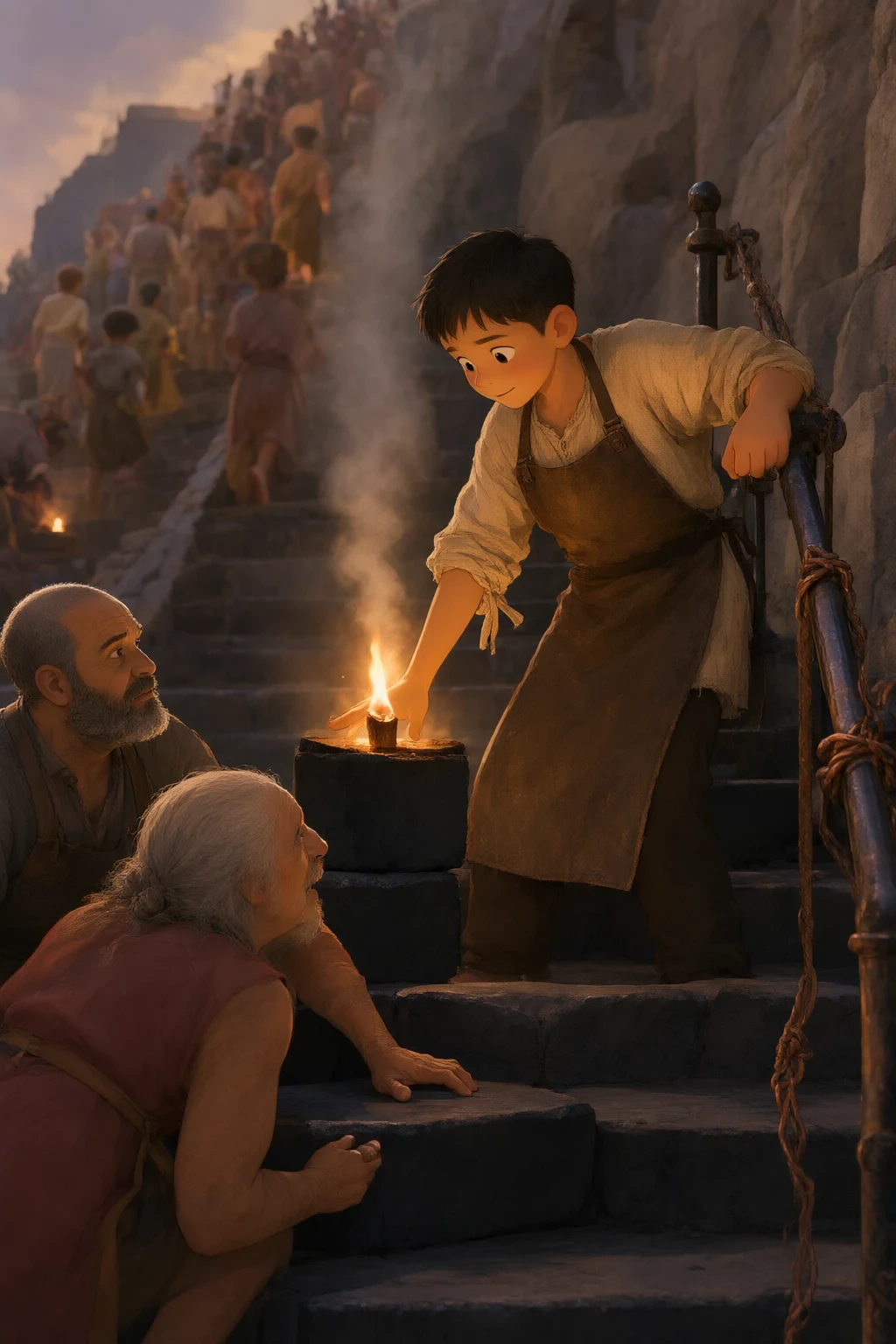
The Bonding Stair came down the face of the hill in nine hundred shallow steps, worn pale in the middle where the feet of the whole chain had gone up and down. Halfway up, one step was worn into a saddle: the Four-Fifty seat, where the first oath had been sworn. Bram Sedge was eleven years old and he had four stones to lay.
The landing at the top had gone soft in the night and was being made new. Nine courses of basalt, and at the front of every course the first stone of the run, and that stone was the one that had to be sworn. “The stair is the first thing a pilgrim puts a hand on,” Kel Rusk had said in the yard, over the barrow. “Not the city. The stair. So the first stone of the run is sworn to hold. Not to stand. To hold.” “And if it will not take?”
“Then you will have nine courses of good stone and a landing nobody trusts,” said his master, “and you will explain that to the old woman who comes up here every year of her life.”
Bram cleaned the bed, laid the mortar, and set the stone down level. Then he opened the flame-box. One small flame, a candle of first-fire glass no longer than a finger. He put his right hand flat on the stone, because that is the rule. “I set this stone to hold.” Nothing came. No mark, no heat, nothing under the skin of his palm. And Bram Sedge knelt on a step and began, very slowly, to panic.
Kel Rusk was sitting on a block at the foot of the stair, because by ten in the morning he could not climb and everybody knew it except the stair. His beard was burnt short on the left side and going grey. On a leather cord in his pocket was the bronze thumb-ring of a master-mason, which he never wore, because wearing it would mean he had given the work away. “The mark did not come.” “You said words,” said Kel Rusk. “How is the bed?” “Level. Square.”
“Then the stone is the only part of this that has behaved. Two hands in the oath, yours and a witness’s. And I cannot climb, so not me. Go up.”
Nedo Shill mixed the mortar and was nine years old. He put both hands round the flame-box and said, with enormous seriousness, “I witness this stone,” and nothing came. “You have to be turned,” he said. “Grown, and sworn once already. Otherwise your hands are just hands.” “That is not in the rules.” “It is in my grandmother’s rules,” said Nedo, “and she has been up this stair more times than you have had hot dinners.” And he went back to his tub.
Bram’s mother came up twice a day with water for the mortar, because her right wrist had been bent wrong since the ash-flood and had never come all the way back. She set down the yoke and offered both hands. Bram put the box in them, watched the right hand shake, and gave it back. “I am shaking because I have carried nine buckets up nine hundred steps since the bell. If I cannot hold a box after that, I will put my hand in the fire.” She wiped her forehead with the good wrist. “Say why not, Bram.”
“You are not a turned hand. You are the water.” “Aye,” she said. “The water. Go and ask somebody whose whole living is standing still.” And she took the yoke and went down past him without looking back.
The next man up the stair was one Bram knew the way everybody knew him: by the mark. It ran from the jaw to the collarbone, raised and silver all over where it had been treated and treated again, and black in the middle, the black of a coal that has gone out and will not come back. Ordwin Sparre, who spoke for the grey plain outside the chain, where nobody had ever sworn anything to anybody. He came up once a year and stopped below the landing, the way the wastes treat anybody who is not holding something.
“We hears you had trouble with a stone,” he said. “You want me to hold the flame-box.” “Child.” He turned his head so the black of his throat went into the light. “Nothing of mine has ever held anything. The day this stair was finished I was not born into it and I will not be in it, and no day will come where I stand under a roof that somebody swore. I am the one place on this hill where a flame has nothing to say. Ask a sworn man.”
Sister-Iven Carshal came up on the fourth day, slowly, one hand on the rail. Out of her left sleeve she brought a slate stylus, and held it like a knife. “I cannot witness it. Because it is not written.” She said it gently. “A mark comes when a word, a flame and a witness agree. A promise going into the earth in a stone has to be in the Quiet Ledger first, or nobody will be able to tell whose it was.” “How long?”
“The roll is three terraces down, and the last month is not entered. Nine days, and rain on the road.” “Nine days. I have four stones.” “This stair has four hundred years of steps in it already, which are entirely sound.” She capped the stylus. Then she said, “It is in the roll. I entered it on the eleventh.” “No, Sister. You said the last month is not entered.” “The eleventh is the last month.”
“The road is nine days in the wet, and the eleventh is the last month. Both are correct, and you may stop counting, child.” And she went down the stair again.
Ashara Venn offered before Bram could ask her. She had a linen cuff on her left arm and she forgot to keep it up, the way she always did, and at the landing she turned the forearm over without asking whether he wanted to look. The mark on it was a comma, pale, with a small coal living in the middle. “I am sworn to this stair already. Keeper’s apprentice, four months. So I know exactly what is wrong with you.”
“And before you tell me I am wrong — Ashara proposes that the stair be let into your oath for the space of one course, until the roll is entered. It is a small thing and it would cost you a day, and I am not telling you the second thing I have thought about, because you will go and do it.” “You cannot witness it. You told me yourself.” “I can be here. I cannot hold the box.” She pulled the cuff down at last, looked at him, and for once said nothing at all.
The next man came up the steps two at a time, in oilskin, with a satchel across his chest buckled eleven times. His feet were bare, and the heels of them were black the way a courier’s heels go. “I hear the Four-Fifty seat has a friend,” said Dain Callow, “and I have come to be useful, which is a thing I am extremely good at.” “You are a courier.”
“A courier of the Sixth Chain. This hill is the Twelve-Gate stair, and that step is the Four-Fifty seat.” He had the box out of Bram’s hands already. “Say the words. I witness your stone.” Bram said the words. Nothing came, and the grin went off Dain Callow from the bottom up. “You have to stand still. That is the whole of it. Two hands in the oath, and both of them still.”
He stood perfectly still for four seconds, which for him was a miracle. Then the relay whistle went at the bottom of the hill, three short and one long, and the Six-Gate post was calling for a bag. He had the box over his shoulder and down four steps before he stopped. “The Nine-Fifty swap is in four minutes, and I have to be in the dark on it. If I stood still you would have your mark and I would be a man late on a swap, and the Sixth Chain does not care about your stone, boy.” “So do not stand up there asking me to choose.” And he went down into the heat.
On the seventh day Bram set the course again, and this time he was sure of everything. At the end of the day he had a landing of hard black basalt with a pale line at the front of it where the new work showed, and it was the best work he had ever done in his life, and the stair was not holding it at all. Bram sat down on his own stone and put his face in his hands, because he had worked it out. Not in words. In his stomach.
He had put his hand on nine stones and said, I set this stone to hold, and there was nobody in the sentence. It was a thing a mason said, and a promise with nobody in it is a noise a man makes with his mouth, and the flame is not fooled by noise. Nobody had ever asked him who the promise was to.
On the eighth evening the stair filled up. That is when the pilgrims come, at dusk, because the day is heat, and all nine hundred steps were crowded with them going up barefoot, past the bread and the copper wire. Bram took the flame-box out and stood at the top of the new landing. When the stair was full he put his right hand flat on the first stone of the run and said it out loud, where four hundred people could hear.
“I swear this landing will hold every foot that is put on it while there is a stair here. I swear it to these people and to the people who come after them. It is a promise to protect, and it is not for me.” The flame went up all at once, and there was heat under his palm, and on the inside of his right wrist a mark came up under the skin and settled there, pale and hard, and it turned down at the end and hooked, because it was holding something back.
Bram Sedge sat down on his new landing very fast. Behind him somebody said, “There, that is the shape of a keeper’s work.” And another said, “Hold your mouth, Letta. That is a promise to protect, and you would not know one if it came up your own neck.” He put his hand over the mark. It was hot, and then warm, and then exactly as warm as the rest of him, and that was that.
Kel Rusk came up on the ninth morning, slowly and badly, with his hand on the rail. At the top he put his thumb on the pale line at the front of the first course and looked at it a long time. “Nine courses,” he said. “One span, three-quarters. Straight bed. And you have set your first stone a half-finger proud of the second.” “A half-finger proud is how the stair sheds water.”
“It is how the stair sheds water, and it is also how water gets under it, and in twenty years a man will put his heel in that crack and go down on his back.” He took the trowel out of the boy’s hand, which he did not need to do, and set the stone over. “There. Now it is yours, because now you did the work.” “How much did it cost me?” Bram asked, because his master was a man who always gave you the number.
“A day,” said Kel Rusk. “That is what a small oath costs, and you knew it before you said the words, so you will not go looking for a bill.” “That is nothing.” “That is nothing at your age. My hand has been stiff since I was thirty and I have never once been sorry for it.” He took the bronze ring out of his pocket, turned it over once, and put it back.
“Nine hundred steps,” he said, “and every one of them somebody came up holding on for something they had promised. That is the whole trade, Bram. It is not the stone. The stone is easy. The stone does not need anybody.” At the Four-Fifty seat, four hundred steps below, a woman with grey plaits coming up for the forty-first year put her hand out to the worn stone without looking down. And it held.