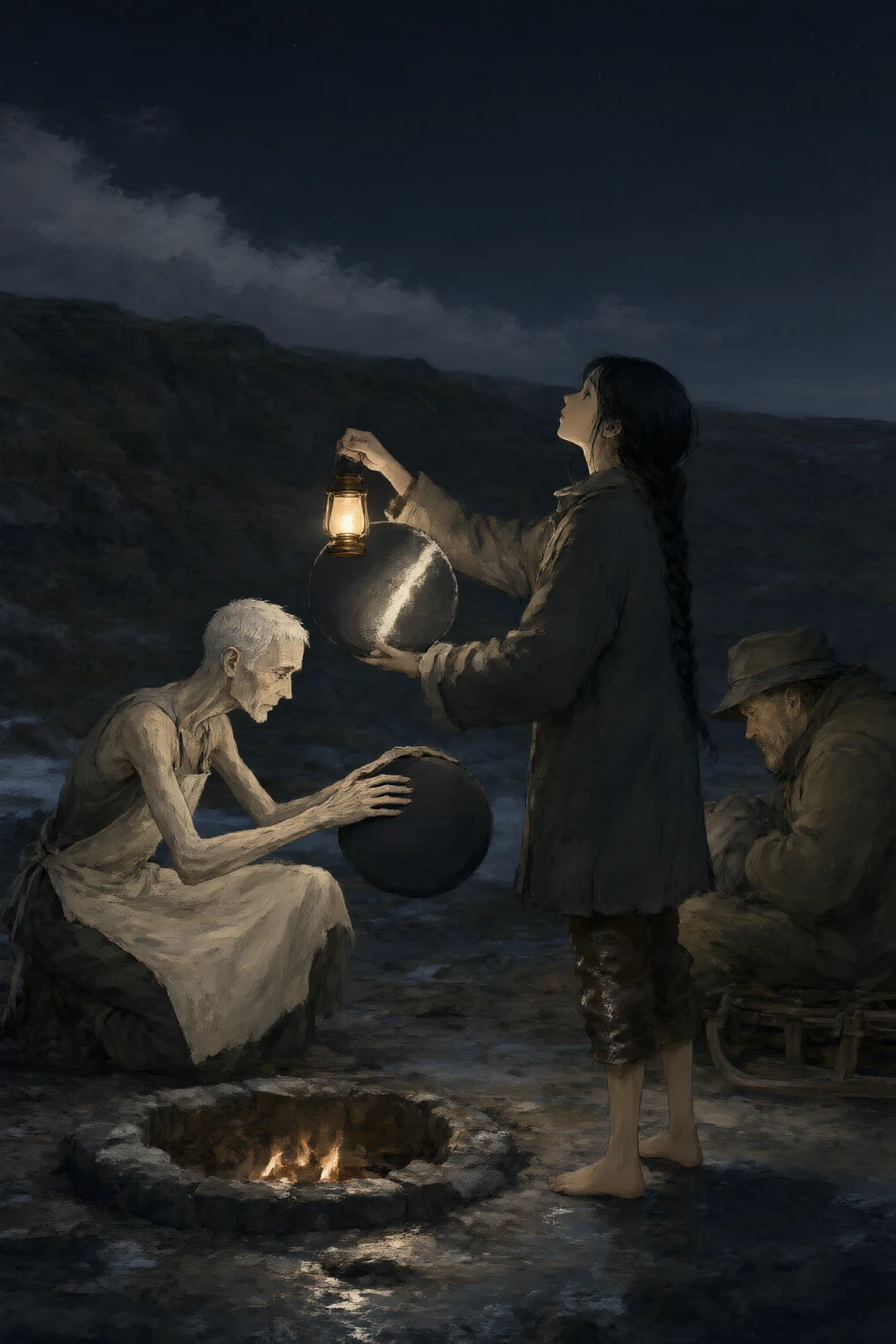
Every seventh winter, the people of the inlet keep the moon. That is not a saying. It is a job, divided the way a village divides any work that has outlasted the memory of who started it. There are those who dig the clay. There are those who render oil from the seals. There are those who mix, and those who press, and those who carry the finished shape up to the eel weir at the turn of the year, where the tide takes it and brings the new year in behind it. And there are those who count.
The apprentice was the counter. She was seventeen years old and the whole of her work was a long board of soft cedar on which the tally of rain was cut, one notch for every night of honest rain, and beside that, a second row cut deeper, for the number of nights the moon was whole. Her grandmother had kept the board before her, and her grandmother's mother before that, and the board was older than the three of them together, black with a century of notches, with one burned place near the top scarfed with a wedge of cedar that did not match. On the seventh evening of the seventh month, she came up to the counting house at low tide and stopped in the doorway. The moon had a seam in it.
Not a hairline. From the edge of the light, running down and around the face of it, a black gap three finger-widths wide, and the whole seaward side of the moon lit wrongly, the way a lamp looks when you press your thumb against the glass. She stood in the doorway and did not go inside. Then she turned and ran down the path to the water. The tide was three hours off its count. She knew it because her whole body knew it, the way a body knows its own breathing, and the water at the step was up to her knees when the noon low ought to have been at her ankles. Somewhere behind her a dog began to bark, and then four more dogs, in a village of eleven houses.
They met in the longhouse, and nobody raised their voice, which was itself the sign that everybody understood. "The moon is cracked," the speaker said. "The tide is wrong and will be wrong for a season. A man stayed out past the point in the fog, and his boat came back with the rail scraped and him no use for a week. The herring are spawning in the wrong water. If the light stays open like that, the fish will go somewhere we do not hold a right to, and there is no argument that will bring them back." The apprentice stood at the back with her hands behind her. "How long?" an old man said. "The seam is open to the sky," the speaker said. "Answer it tonight or do not answer it at all."
Three men in the room had held the mender's tools. All three were past seventy. One of them put his hand flat on the plank bench. "Only one man alive knows the mending," he said. "And he has not touched clay in twenty-four years." Nobody needed to say the name. The apprentice felt the room turn toward it, the way a boat turns.
The mender lived in the last house before the scree. He came out onto his step without a stick, though he had three in the corner of the room, and he was thin, and his hands were the hands of a man who had spent forty years kneading something dense. He listened to the whole account standing in the doorway, his own doorway, while the fog came up the path behind him. "I can mend it," he said. "Not tonight. My hands will take a week to remember." "Then you will do it," said the speaker. "We have no other." "You have another. He is twenty-six and he mixes well." "He mixes," the old man agreed. "He has never set a mend in his life. There is no one else alive who has."
They gave him the longhouse end, the dry end with the brazier, and the two apprentices to carry clay and to hold the lamp, and he asked for the chest. The chest is the heart of it. Under the boards of the counting house there is a stone-lined box, and in the box is the oil — rendered seal oil, poured flat into the shape of loaves and cooled, each loaf stamped with the notch of the year it was made. The clay sits beside it in a lined box, the good grey clay from the bank that lies three hours downriver on the far side, on land that is not this village's to dig. He wanted the chest opened.
It took the strength of three men and a bar of wood, and the apprentice was there with the lamp, and the first thing she saw was that the chest was lighter than the records said. She did not say anything. She was the counter. She counted.
She counted again the next morning, and then again, and then she took the ledger down from its shelf and sat on the step and went through forty years of it with a stick, marking each loaf-stamp as she found its line. The stamps in the chest were all there. Two hundred and nine loaves, more or less, some of them older, pressed down to the sides. The ledger said three hundred and eleven. Three hundred and eleven loaves of oil, rendered and given to the keeping of this village, in forty years. And the chest, which had never in its life been short on the night before a mending, was a hundred loaves light. She walked down to the firepit where the rendering crew worked and asked the oldest woman there what a loaf weighed. "Same as always." "And what do we call a gift?"
The old woman looked at her for a while. "Two loaves. Four in a bad year." She stopped. "You are asking about the barrel store." "Yes." The barrel store was the shelf behind the pit where the out-going oil was set until it was needed. It was a formality. The old woman sat down on the log and said, without any particular embarrassment, that the store was not a formality at all, and had not been for sixty years. "Once a year the old ones walked down to the bar and left oil," she said. "Not much. Enough that the boats coming round the point could see a light, and could see that somebody was thinking about them. It is not a trade. If you write it down, it stops being that." "And nobody wrote it down."
"Nobody wrote it down," said the old woman, "and the ones who came after us were told that the village was a hundred loaves short, which is a thing you can be frightened of, and they looked for somebody who was stealing." She did the arithmetic again. It came out the same. The village had not been robbed. The village had been generous, systematically, for sixty years, in a currency it insisted on never counting, and the cost of that generosity had been carried quietly forward and had now come due all at once, on a night in the seventh month, with a seam open in the moon.
The mender needed clay as well. He said it plainly on the second day, with his hands kneading air. "Clay from the bank. Not the beach clay. The bank clay, with the shells in it, because the shells are what hold the shape. Three hundredweight, and it must be cut in the month when the river is low, and it must be carried up by people, not by dogs." The speaker said, "The bank is not ours." "No." The speaker said, "In the old days the bank gave one load in a generation, and the giving was paid for with the first catch."
"It still is," said the mender. "You may not pay it with fish. Nothing in this room is worth what the bank takes. The bank takes what you are all about to miss, and then a little more, and if the offering is thin the clay comes up wrong and the mend cracks in a year, and then it cracks in a month, and then somebody in my position is very old and very tired." The room was quiet.
There was one way to do this that did not cost a day's food and every pair of hands in the village. It was written in the ledger, in a hand forty years dead, in the same year as the last properly made mend. Clay, oil, and the labour of the pressing, contributed by the settlement on the bar, for one mend of the shared moon, in perpetuity, on the condition that the returning tide use the fair way round the point. The apprentice had found that page on her second night and said nothing about it, because the ledger was her work, and because she wanted three days to be certain of what it meant. She read it out at the fourth evening.
The bar people came up in two boats, eight of them. Their speaker had a bad knee and an unhurried way of talking, and he sat down first and listened to the whole argument before he said anything at all. "We do not know it is broken there," he said at last. "We have no one counting. That is the honest answer." "We can show you," said the apprentice. They went out to the point at half tide and she showed them the moon the way she showed everybody: face up, hands behind her back, until you see it. The man with the knee was quiet a long time. "Ninety years," he said. "Somebody has been keeping our moon for ninety years and telling us about the herring."
"Two hundred and forty loaves," said the apprentice. "Sixty years. The ledger says two hundred and forty, and I have checked it against the other books, and the other books agree with it, and I have counted the oil that is actually in the box, and I will show you that too, and it is short by a hundred, and I can tell you exactly where it went." She said it in the plainest words she had, and the man with the knee listened to all of it, and at the end he said: "You have been given to for sixty years and never once written it down, because a gift that is written down is a payment, and a payment can be refused." "Yes," said the apprentice. "Somebody should have taught the counting to leave room."
"Yes," she said again, and did not say the rest, which was that nobody had, because the old ones had thought the room would be there for as long as they were. They went down to the bank the next morning with eleven people and the mender and two lamps.
The cutting took a full day. You cut the clay in slices, and the slices are lifted one at a time by two people, and set on the flat stones, and the person who sets them says nothing at all, because the offering is not said. The mender directed it from the bank in a voice nobody had heard before, flat and level, and when a slice came up wrong he made them cut another. He cut six wrong. The apprentice held the lamp through all of it, and by evening her arm had stopped being an arm and had become a thing that held a lamp. They carried the clay up in eleven loads. They arrived at the counting house at the third hour of the morning, and the mender went to bed, and told them to wake him at noon.
There was one more thing, and it took longer than the clay. The mend changes the shape of the tide. Everybody who has ever mended a moon knows this, and everybody has always pretended otherwise. A moon with a seam lets the water out of its authority. A mended moon, holding, will hold a harder range. The range on this inlet would come back, and would come back a foot stronger at the low water, and the strong low water would reach up the flats at the mouth of the inlet and take away the drying ground. The flats had been in the family of a man called by the day he died for four generations. He was in the room, and he was not a young man, and he was extremely polite about it.
"My great-grandfather took them from the river mouth," he said. "He made them his. They are the only good ground for the cod, and the cod is the whole of the winter." "They are on the list," said the apprentice. "There is a list." "There is a list from four hundred years ago," she said, "cut on the sea stack on the north side, and it is the only one there is. It has the tide marks from the year the stack was cut, and they are the tide marks you can still measure with a pole today at the north end. Four hundred years of them. And your great-grandfather's name is not on it, and neither is your father's, and neither is yours, and neither is mine, and my grandmother's name is on it, four times, because she cut flounder on that ground when she was eleven years old."
Nobody said anything. "They are common," said the apprentice. "The list says common. Common is not the same as yours. The only ground on this list that is anybody's is the two strips at the top of the stair, and they are the ones the sea took in the winter of the long drift, and I do not know anybody who will argue that with you now."
The pressing took four days and it was done in a shed with the doors open, because oil will not set in a closed room. The mender mixed it with his own hands for the first two days, which is a thing he had not done since he was forty-one years old, and which cost him more than the making of the mend. Then he let the apprentices in, and showed them, and made them do it, and sat on an upturned crate and watched them do it badly and then less badly.
On the third day the apprentice held the lamp while he set the mend. The mend goes on the inside of the face, in two pieces, and the join has to be exactly in the line of the old seam, because if it is not, the pull comes in the wrong place and the new mend takes it all. His hands were slow. They were not steady, and they were not supposed to be, and he did not pretend otherwise. He set the join in the seam, and pressed it, and held it, and told her to put the lamp lower. "Lower," he said. "There. Now stop talking." She had not been talking.
The last of the oil went on at dawn on the fourth day, and the mend went up to the weir at the turn, and the tide took it out, and they stood on the bank in the cold and watched the shape go over on its back and away up the channel, black against the sky, and then the water turned it, and the mend came back to them lit side up.
The moon was whole again in eleven days. There was a seam in it still — there would always be a seam in it now — but the seam was a pale line of light and the face was true, and the tide came back to the count that the board recorded, one notch for the night, one notch for the night, as it had gone for a hundred years.
The flats were made common at the eighth meeting, with a rota, four households to a week, written into the same ledger as the rain. The forty-year page about the bar was copied forward and the copy signed by two speakers. The bar people sent a carver, and in the spring there was a new cedar board over the counting house door, longer than the old one, because there were two villages to keep the moon for now, and it was cut with the old shipwright's adze by a man who had never been here before and who was told, first, what the board was for. The apprentice kept it.
The first line on the new board is the year. The second line is the number of nights of honest rain. The third is the two names of the two villages, side by side, the old one and the bar, cut by two different hands, and the grain does not match between them, because two different men cut them and neither asked what the other was doing. She hung the lamp on its hook by the door, and put the stick in the cup beside it, and went out to look once at the sky before she turned in. The tide was right. She could hear it, coming in over the flats, the sound it made four hundred years ago when the marks were cut on the stack.