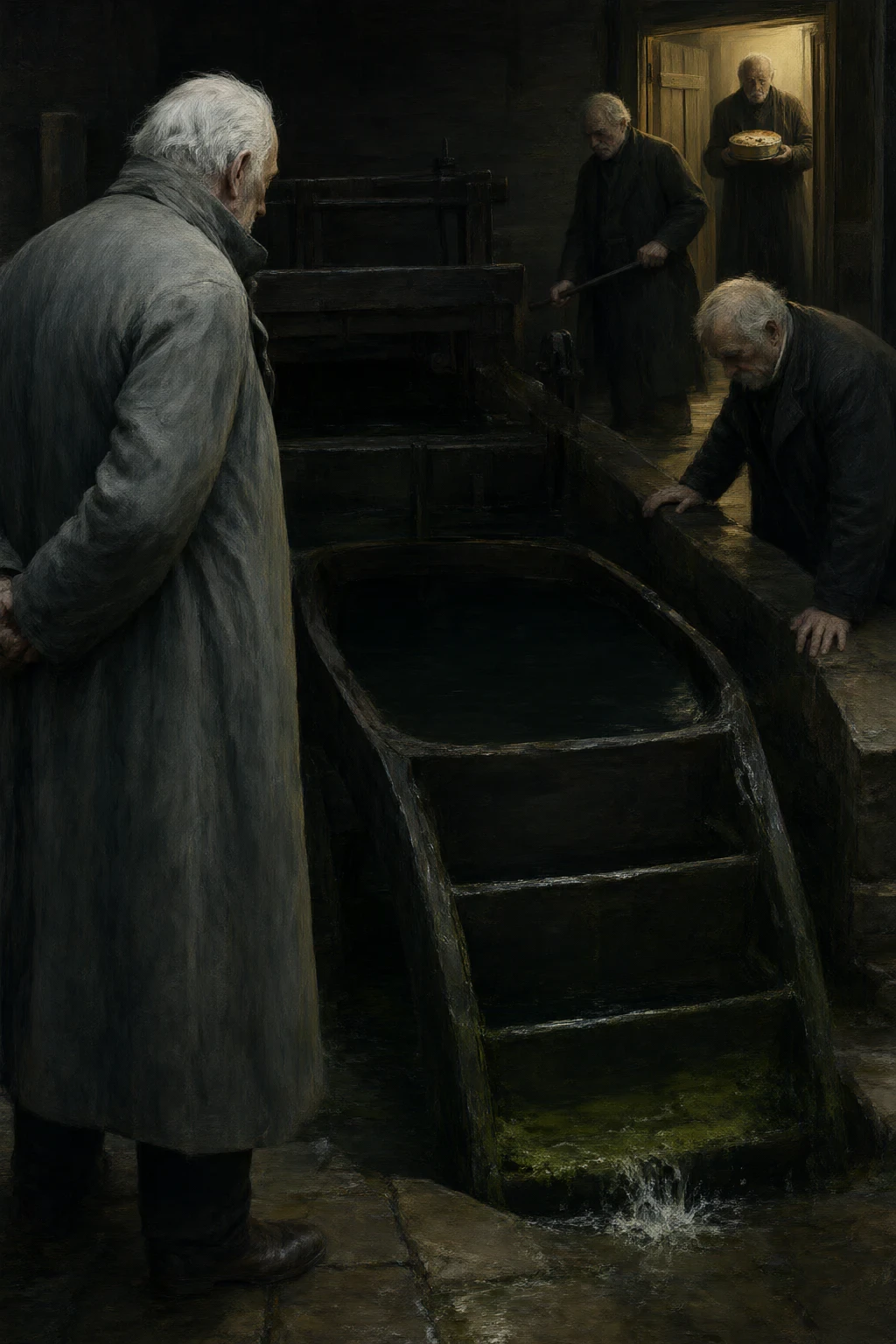
There were four brothers in Marbach and the town had a word for them that was not a compliment. It was practical, and it was used mainly by people with carts. When a load came up the hill from the Aa valley and a driver wanted to know whether the road was open, he asked whether the four were in town, and if the answer was yes the load went up, and if the answer was no the load waited, and nobody ever explained the reasoning, and the reasoning was correct. The four were the sons of Alwin Baumann, who had been the miller, and who in 1774 had taught them everything they could do, and who in 1775 had gone down the river road with a bag and not come back, and who had not left a word, which the sons at that point discussed for a long time and could not improve on. Their names, in the order of their ages, were Berthold, Jost, Konrad, and Tobias.
Berthold, who was fifty-four, could make water rise. Jost, fifty-one, could bind a man so that he could not move. Konrad, forty-nine, could strike rock and raise a castle out of it. Tobias, forty-six, had hands that closed a wound in the time it took to look at it, and had never in his life let anybody see them work. Any one of those is enough to make a name in a duchy. All four together make a different thing, and the different thing is the only one any of them cares about, and it is the reason the name was not a compliment, and it is the reason they were all four in the market square on the day this story is about, at eleven in the morning, being addressed by a bailiff.
Here is what four together can do, stated as their father stated it, in the mill loft, in 1774, to four boys between nine and fifteen, in a tone of voice that was not unkind and was not to be argued with. One of you can raise water. Alone, you raise it everywhere. You put your two hands flat on the floor and you call, and the water in the room comes up, and so does the water in the channel, and so does the water four fields off, and it is the same water, and it does not know that you only meant the one in the room. It comes up anyway. It goes where it wants, which is everywhere at once.
Jost can bind. Alone, Jost can bind a man so thoroughly that the man does not lose his senses, does not lose his voice, cannot lie down, cannot sit, cannot turn his head, and cannot be released by anybody, ever, except by Jost touching him and counting backwards from the number Jost used. Jost has done it once, in 1788, to a man who was going to be hanged in the market at noon for stealing a horse, and it took him two hours, and the man lived to be eighty-one, standing, in a house his family gave up. Konrad can raise rock. Alone, Konrad raises rock, and the rock is correct, and it stays. He raised a bastion on the Marbach side of the Aa, four metres of it, in 1806, because a mason was building a wall badly and Konrad was standing there. It is still there. It is not a castle. It is a lump, the ugliest object in the duchy, and the townspeople call it Konrad's stone and blame him for it and are entitled to.
Tobias closes wounds. Alone, he closes a wound, and then he cannot close that wound again. Not in that place, not on that person, not ever again. The four of them understood this at fourteen and understood the rest of it at twenty: that the four skills, alone, are not weaker versions of the whole. They are different trades, and three of them are trades that make wreckage. Their father then put them back to back, in the middle of the mill floor, all four, and told them to hold on to each other and to say the word together. "Once," he said, "we are one thing, and it is a different thing, and it is very large."
Berthold found out at fifteen, in the mill at the Aa, on an evening in September 1774, with a sluice and a joke gone wrong. He had been showing off. He put his hands on the floor and called the water up out of the race, and the whole race came up, and the wheel stopped dead, and the water went over the wall of the wheelhouse and into the miller's house and out into the yard, because there was nowhere for it to go that he had not said, being fifteen, and clever, and having said no direction at all. Then his brothers came into the wheelhouse, three of them, shouting, and put their hands on him because he was sitting in the water, and that was the mistake. Four backs touched.
The water went where it was told. It went through the wheel, which had been standing still, and through the wheelhouse wall, which was not a wheelhouse wall any more but a channel, and it took the miller's boy out of the wheelhouse through a hole in the plaster. He was in there because it was raining and he liked the noise the wheel made. He was nine. He lived, and was for the rest of his life a miller in Ostheim, and his name was Ansgar Baumann, and he was no relation to anybody, and the four brothers sent him money every year for forty years and he sent it back every year for forty years, and neither side would say why. The word had been said. It was what their father had told them to say, and it is the only word any of them has ever said in anger in a life that has otherwise been almost entirely civil.
It held for nine minutes. The one thing has no size and no limit and it did not stop when it was finished, and it stopped only because Berthold, who was the oldest, said the word backwards into his brother's shoulder while they were all four holding on and crying, and the circuit broke, and four boys who had been holding each other up in eight inches of water on a mill floor got up and went and stood in four different places of the yard and did not look at one another for eleven years.
Their father taught them for another six months. Then he left. There is no evidence that he left because of the boy. There is a great deal of evidence that he left because of what happened to the mill, and what happened to the mill was that it had a channel through it where the wheelhouse wall had been, and the miller had to have it rebuilt, and the cost of rebuilding it was eleven hundred gulden, which is the sum that appears, forty years later, as the principal on a forged document in a castle nine miles up the river.
After that there was a rule, and the rule held for forty-one years without a single breach, and it was the most impressive thing any of the four ever did. The rule was: no backs. It was made among the four of them in the mill loft one winter, without a father, at the ages of sixteen, thirteen, eleven, and eight, and it was made in a form that has been repeated since, by people who have never understood it, in the phrase that you do not do anything remarkable in Marbach. It meant, precisely: the four of them would not put their hands on one another again. Not in an emergency. Not with the water coming. Not with a man bound in the market square. It was the only vow any of them ever made, and it was the reason Marbach had a name for them, and it was scrupulously observed.
Berthold could not enter a room containing two of his brothers without the water in the room beginning to lift, which it did at the least provocation, and which is why the four of them, who had a common grandmother's house, did not use it, and why it eventually had no roof. Jost and Tobias had not spoken since 1788. Konrad stood in fields, at the edges of things, at a distance, and made rock, and could not stop, and each of his making had to be taken away by somebody else, and so he lived a life of making things that other people carried off in carts at night, which is the reason there is more good stonework in this duchy than in any duchy of comparable size, and which the duchy pays for in the small hours. And Tobias.
The story the town tells about Tobias is this. There is a hand in Marbach that comes in the night and closes what has been opened. A carter's wife had a leg crushed by a cartwheel in the ninth month of 1798 and was seen to be carried home, and by morning the leg was whole, and the physician said that is not possible, and the family said nothing. A cooper's apprentice put his hand through a lathe in 1804 and would not show it to anybody, and it was whole, and it is whole. A woman who had been bleeding since her child was born, in 1811, in a village four miles away, said that a man came, and that he was young, and that he did not look at her, and that she asked him who he was, and that he said there was no name, and then his hands were on her, and then there was no bleeding.
The town calls him the warm hand. The story has a hundred variants and in all of them he is young, and unable to say his name, and never looking at the face. There is a song about him, badly constructed, that the children sing at Michaelmas, with a verse about a man who cannot look at you and can close what is opened and will not be back. It is Tobias. It has been Tobias for forty-one years. The four of them have each of them been, in their separate and degraded ways, in use their entire adult lives, in the one manner available to a man who is not permitted to touch his brothers: Berthold in the flood of 1809 at Ostheim that is still called the standing water and is still there, and Jost in the matter of the poacher, and Konrad in the stone, and Tobias, forty-one times, in the dark, to people who have all told each other about it and none of whom could be found. The rule held. The rule held perfectly, and it cost them everything, and it accomplished nothing whatever, because a thing that can be done badly by one man, alone, at night, once, to one person, forever, is not a substitute for a thing that can be done well by four.
The bailiff was called Kettelhuth and he was apologetic, which is the detail everybody in the market square remembers afterwards. The document that governed Marbach was signed in 1785 by three trustees of the duchy, and it provided that the town should provide, in each year, "one maiden of good report, to be delivered at the castle of Aschlar by the sixth day of Michaelmas, to remain in the household of the lord, in health, for the term of one year." In the thirty-two years since, thirty-two girls had gone up the hill in the last week of September and come down in the last week of September of the next year, and the town had asked no questions, because a town that cannot pay is a town that does not look at the schedule.
The year of this story is 1816, and the maiden to be delivered was Hanna Rettenmaier, seventeen, the daughter of a carter who had lost a leg in 1798 and had never spoken about it, and she was standing in the square when the bailiff said her name, and the bailiff said it kindly. "There is no law for what happens after she goes up," he said. "The law ends at the sixth day of Michaelmas. She goes up the hill, and the gate shuts, and it is eleven miles of road, and the man who has the paper is a very large man and has never once been asked for the original. My office is the court of the duchy and I have read every instrument in it, and there is nothing in it that gives that man the right to a girl, and there is nothing in it that stops him having one." "And the arrears?" said the miller's widow, who had been the miller's wife and was now the miller, and who had buried three and buried none of them by her own hand. "There are no arrears," said Kettelhuth. "That is the difficulty. He has been paid."
It was the youngest who spoke first, which is not what anybody expected, and it is the reason the town still tells the story. Tobias said: "Is the paper in the castle?" Kettelhuth said that it was, and that it had been seen, and that the man had shown it once, to the priest, and had then put it away in a case, and that the case was locked and the key was on the man's belt. "Then he has a forgery," said Tobias, "and we can break it in a minute." "Break it how?" The market square went quiet in the specific way a market square goes quiet when a person has said a true thing at the same volume as everything else. "We would have to touch one another," said Tobias.
They tried for four hours, in the mill loft, with the doors shut, and this is the whole of what happened, and it is duller and more horrible than anything the town has ever invented. Berthold put his back against Jost's, and the water under the floor lifted an inch, and stopped, and would not go further, and Berthold began to sweat in a way that had nothing to do with the water, and said, "I can't find the rest of it." Jost said, "You are not touching me properly." Konrad stood in the corner with his hands behind his back and said he had not come up here to do that again, and he meant it, and he was not being dramatic, and Berthold, who was bigger than all of them, did not make him. And Tobias, who had been the one to say it was possible, sat down on a sack and said: "It isn't the backs." The three of them looked at him. "He used to make us hold on," Tobias said. "Hands on each other. He said the word out loud. It is not the backs. I have spent forty-one years finding that out with a completely different pair of hands."
They did it at two in the morning on the fourth of September, on the mill floor at the Aa, in the rain, in the last eleven days before Michaelmas. The four of them had not stood back to back since 1774. Berthold was fifty-four and had a chest. Jost had not spoken to Tobias for twenty-eight years, and when he came into the loft he said, "Tobias," once, and Tobias said, "Jost," once, and that was the entire conversation of the evening. Konrad brought a lamp, put it down, stood with his back against the wall for a while, and then came over and put his shoulder in without saying anything. Berthold had a plan. It took them two hours to make it, and the plan was Berthold's and it was as good as anything a man could make who has had fifty-four years.
The paper was the whole of it. Not the man. The man was large and had a case and a key on his belt and would have to be dealt with anyway; the man was the smallest part. The paper was the thing that made the girl go up the hill every year, and it was a piece of paper with three signatures on it, and if the signatures were the lie, then the lie could be unmade the way any lie can be unmade, by being held up to the light of the thing itself. "I can make a castle," said Konrad. "I can make a hall. He has a hall; I have seen it from the river. If I strike the rock inside the hill and the circuit is closed, the hall is not there, because I will not be putting it there, and the paper will be a piece of paper with three signatures on it, and the man will be a large man in a building." "There will be a hole in the hill," said Jost.
"There will be a hole in the hill," said Berthold, "and there will be no hall in it, and in four hundred years there will be a story about a hole in the hill, and the story will be wrong." They held on. Berthold said the word. It held for nine minutes, and the four of them heard, in the ninth minute, the one sound none of them had expected, which was not water and was not rock and was not anything in the mill: it was the sound of three hundred people in Marbach waking up. It was not desire. It was the water in the race at the Aa, and the water in the millpond, and the water four fields off that had never heard of any of this, all of it arriving at once in a body, and it was not a flood.
It came down the channel that the four of them had made in 1774, because that channel was still there and was still the path of least resistance, and it came through the wheel, which turned, and it did what it was told. At the castle, the rock of the hall stopped being a hall.
The circuit did not release. Their father had told them it was a thing you did and a thing you stopped doing, and it was not, and there was nobody in the duchy who could tell them otherwise, because there was nobody else alive who had closed it. The four of them stood on the mill floor holding one another and the water came and went and came, correctly, for eleven hours, and at some point on the afternoon of the fifth of September Tobias said, "I have to come off," and Jost said, "No," and Berthold said, "No," and Tobias said, "You cannot hold a thing open by a man deciding to stay in it. Somebody has to be the one who is let go."
There is no account of the eleven seconds that follow. Hanna Rettenmaier, who was seventeen and asleep on the top stair at the castle that night and who came down the hill the next day, was asked about it in 1849 by a curate making notes, and reported, in the only sentence she is on record for: "It was as though the whole river turned over."
What is certain is this. At the mill at the Aa there is, today, a well that is not a well, full every morning and empty every evening, and nobody in the parish drinks from it. There is a stone outcrop in the meadow below the mill, four metres of it, smooth, that grows no lichen, that the sheep go around. And in the long grass by the millpond, on the nights when the water is up, there is a fog that stands in one place and does not move and cannot be walked into, and the villagers call it the cold, and they do not go near it, and the parson will not go near it, and the schoolmaster's children are told not to.
And if a person goes up to the mill in September and stands at the edge of the fog and calls, in an ordinary voice, the name Jost, then something in the fog answers, in Jost's voice, and it says, in a voice that is Jost's and is not Jost's: "Wait. It is not the time."
There are three of them now. They are the three most capable men in the duchy, and they cannot be in a room together. Berthold makes the water stand up. It is not aimed and it is not certain, and there is a square of Marbach where a man has to be met with a step and a shout, and the square is named for him and he hates it. Jost can bind, and does, twice in forty years, and cannot unbind, and keeps a list. Konrad makes stone, and it stays, and there is now a second lump, and the third, and the bargemen on the Aa take whatever comes, and the duchy has a reputation for good foundations and a bad conscience. They are courteous to one another at a distance, in the way of men who are being paid, and they dine together twice a year, at Michaelmas, in the miller's parlour, at opposite ends of a table, and the conversation is about prices.
Hanna Rettenmaier lives in Ostheim. She married in 1819 and has a son who is a forester, and in 1841, when Kettelhuth was dead and the old bailiff's office had gone to a young man who had never seen the case on the belt, she sent for a lawyer and got a copy, and the copy is in the parish record, and the two signatures on it are the signatures of two men who died in 1762, which is a thing the young man has never been able to explain to himself and has stopped trying to explain.
Tobias comes up the road once a year, in September, on the fourth, and he is fifty-eight and he looks thirty-one and he has never once been asked to look at a face. He brings a cake. They eat it in the mill loft because the parlour is the miller's and the miller is careful. It takes them an hour and nobody says anything of consequence, and afterwards Tobias walks down to the millpond and stands in the grass a while, and the three of them come out to the door and wait, and do not go down to him, and cannot. On the fourth of September 1851, at nine in the morning, Berthold and Jost and Konrad are in the yard with an iron bar, trying to turn a wheel. There is plenty of water. The race is full, the millpond is full, the wheel is wet to the third spoke, and four men in this duchy have known for four years that it is not the water that turns the wheel, and the wheel does not turn. "Well," says Jost. And Berthold, who is eighty-nine, and who has been standing at the sluice since seven with his hands behind his back, says: "He will be back in September."