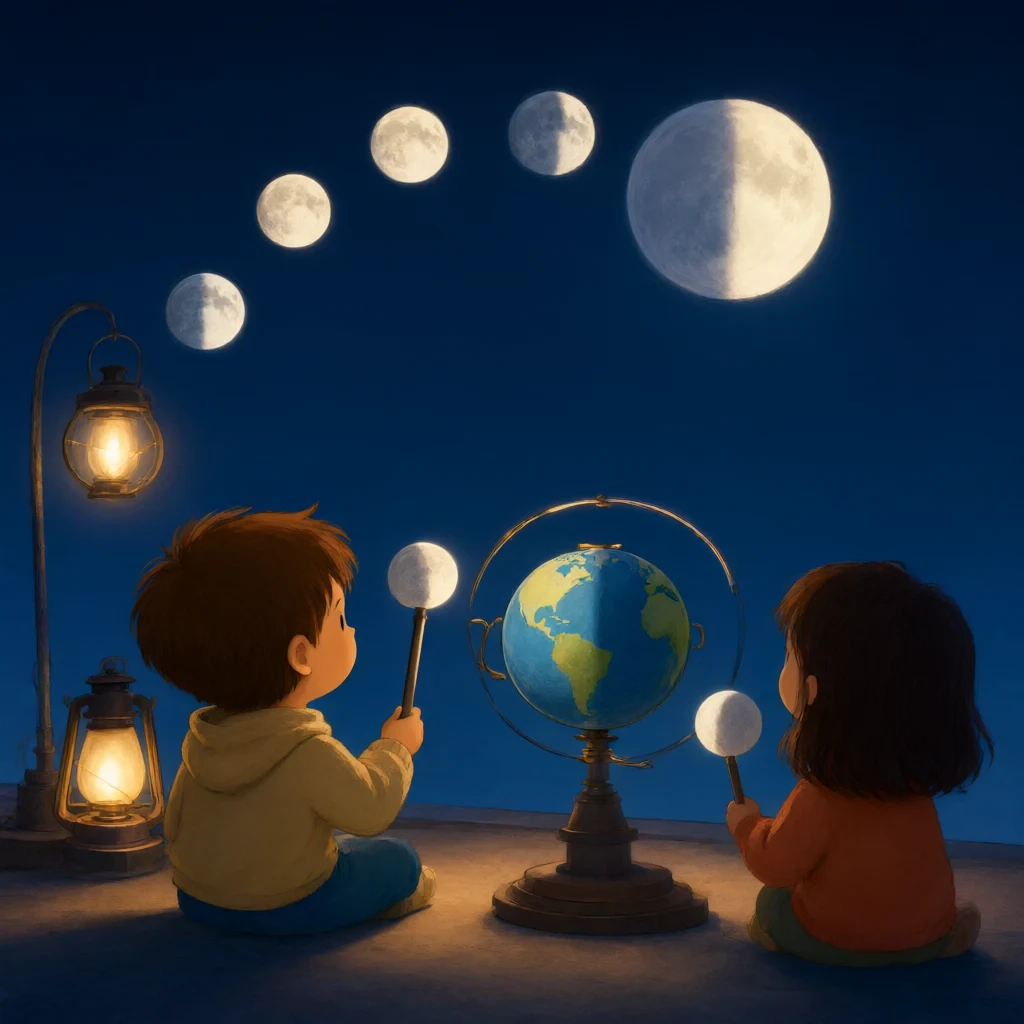
On the night the moon failed to arrive, a small brass moon hung above the school playground. No one remembered hanging it. It waited behind the clouds while Lira counted the stars. Auntie Mero brought a yellow Sun-lamp, a blue Earth-ball, and a white Moon-ball. “The moon is still moving,” she said. “Watch the machine.”
She placed the Sun-lamp in the middle, Earth on one side, and the Moon on a circular track around it. When Lira moved the Moon-ball behind Earth, the lamp’s light was blocked and the face vanished. “I made an eclipse,” Mero said.
Lira rolled the Moon-ball once around the track. As it moved just beyond the position between the Sun and Earth, she saw a thin white slice. The slice grew into a half circle, then a bulging shape, and finally a full circle on the side of Earth facing away from the Sun.
“The Moon is not losing pieces,” Mero said. “The Sun keeps nearly half of it lit. Orbit changes how much of that lit half we see from Earth. Ordinary phases are not Earth’s shadow. A lunar eclipse happens when Earth’s shadow falls on the Moon.”
Lira tried the model beside a window. Sunlight crossed the room and lit one side of a white ball. She moved her head without moving the ball. The bright part seemed larger, then smaller, and then disappeared. Her view had changed. “The dark part is not missing,” she said.
Mero drew a long ribbon around the table. They marked new moon, crescent, half moon, gibbous moon, and full moon, then returned to new moon. “The cycle averages about twenty-nine and a half days,” she said. “The Moon keeps moving while we count calendar days.”
For several weeks Lira recorded the sky in a notebook. Clouds hid it sometimes, but the shapes returned in order. She added the dates and circled the twenty-nine and a half day average.
A child named Tav wanted to catch a crescent in a jar. Lira handed him the white ball. “The jar cannot hold sunlight. We can only make a model.”
Tav rolled the Moon-ball along its track. Beside the Sun-lamp, he saw a bright edge. When the ball reached the far side of Earth, it became a full circle. The light was not produced by the Moon itself; the Moon reflected sunlight.
Mero asked Tav to look at a dark patch on his model. “That is the side facing away from the Sun,” he said. “It is dark, but it is not gone.”
The children practiced until they could explain the model without using the word magic. Their drawings showed the Sun at one end, Earth, the Moon’s orbit, one bright half, and a small shadow that appeared only when Earth blocked the light.
At school, the wall clock stopped. Mr. Nill set it in the yard beside the lamp and Moon-ball. When the clock pointed to twelve, the model showed only a sliver. Lira moved the ball until the face looked fullest, then marked the place on the sand. “Does the clock lie?” she asked.
“The clock is not a moon,” Mero said. “A civil clock keeps standardized time for people and places. A sundial uses the Sun’s apparent position to give local solar time. The two can differ.”
The children set a stick in the ground and watched its shadow. It pointed long in the morning, shortened toward the middle of the day, and lengthened again afterward. Earth’s daily rotation changes the Sun’s apparent position, so the shadow moves even though the stick stands still. “Shadows generally shorten toward solar noon,” Lira said, “then grow longer.”
Mero nodded. “They do not change at exactly the same rate every season. The schoolyard’s place and the year matter too.” That evening, clouds returned. The children could not see the real Moon, but the model waited under the hall lights. Lira moved the Moon-ball through one circuit and placed a mark for each shape.
On lantern night, the clouds opened. A thin crescent appeared above the hill. Lira held up the model, and the bright edge matched what the children could see. A boy pointed to a dark circle painted on a card. “Is that an eclipse?” he asked.
Mero shook her head. “Not unless Earth’s shadow falls on the Moon. An ordinary crescent is the visible part of the Moon’s sunlit half as we see it from a moving orbit.”
They walked home beneath the crescent. Lira knew most of the Moon was still sunlit, even though only a small piece was visible. She also knew the phase would not stay still. The Moon would orbit Earth, and the views would change again.
The next morning, Lira drew the Sun, Earth, and Moon on a card. She marked one half of the Moon as bright, the orbit as a dotted loop, and wrote “about 29.5 days.” She did not draw Earth’s shadow on every phase.
At breakfast, the brass moon still hung in the school hall. The real Moon was beyond the clouds, following its own path. Lira had learned that no spell or jar was needed to understand it: sunlight, a moving view, and patient observations made the shape machine clear.