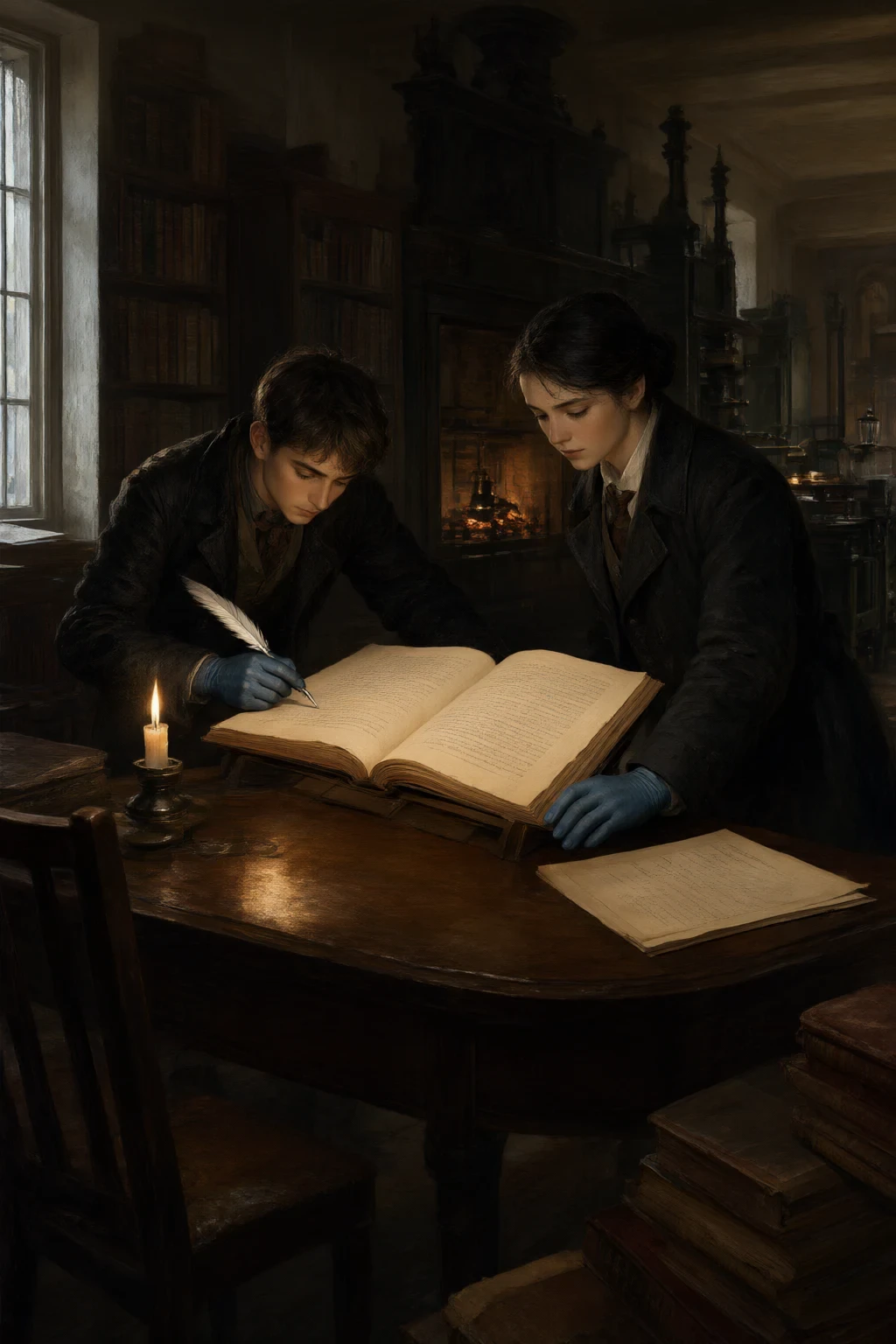
The audit of the register of Ninehook was ordered in the second week of August and was to be finished before the winter lettings opened, which put the last day of it on the twenty-second of November. There were fourteen weeks between the two dates. The office shuts for two days at the start of the lettings and will not have a volume out of the press for anybody, including the commissioners who ordered the audit, who were told so and did not argue, because it is true. Hettie Rowntree was given the work because there was work, and because she was the only clerk in the room who could read the hand of 1841, and because the man who gave it to her said the first three words of it in a way that told her the rest of it. “Four thousand entries.” “There are nine.” “There are four thousand we can show. The audit is of what we can show.” She had been copying leases into the big book for nineteen years, and she knew the figure was nearer nine thousand than eight, and the office’s printed matter says nine thousand and has said so since her first year.
She was told that a clerk would be lent to her for the reading, and that the ward books were to be brought into the office and not consulted in the wards, because a ward book is kept in wet hands and takes a wet hand badly. She was told that she was not to alter anything in the register while the audit was running, and that a fault was to be written on a separate sheet and handed to the examiner, and that the examiner was in the county until the ninth of October. She asked the last question, which was the one she had wanted to ask, and it came out in her usual form, which is to read an instruction back exactly as it stands. “Then a fault found in the register is not a fault of the register. It is a fault of the audit, if the audit does not find it.” “Yes.” “That is not the same as saying it does not exist.” “No,” said the man. “It is the same as saying it does not exist.”
The lease of a lamp in Ninehook is written in five particulars and kept in five columns, and it is the only form in Ninehook that has never been altered, because the form is the lease. Lamp. The number of the lamp, one to four hundred and eleven, and no lamp has ever had two numbers. Leased. The date, and the hour, to the bell. Holder. A name. Term. One of four things: for life; for a number of years; for a number of months; or for so long as a condition named in the fourth column stands. Conditions. Anything else, at length, including the parts that are struck through, which are entered in the register with the strike and are read by clerks as standing. A sixth particular is entered in the margin in ink and initials, and there are eleven volumes and a day book. It is not one of the five and it is not on any printed form, and it is the one the office is proudest of and the one that is in nobody’s memory. The margin reads: read, in the presence of a clerk, who witnesses the face of the signer. And under it two sets of initials, the clerk’s and the reader’s, or one if the reader is the clerk. A man who does not know what the lamp is cannot hold it. That is not a rule anybody voted for. It is what a lease is.
She began on the eighth of August with volume one, a stool, and a slate. The method was settled in her first week. She read every entry aloud, in the room, to nobody, including the struck-through parts, because a clerk who reads only the words that count will not see a fault, and a fault in this office is always in a word that somebody wished had not been written. She read at the rate of the register, which is slower than the rate of a person. Better than two hundred entries a day on a good week. The days were short because the office is cold at the top and hot at the bottom, and by four o’clock in November the top of the room is cold enough that a man cannot hold a pen in it. The clerks work in their coats indoors. It is a rule made for the room and not for the men.
On the eleventh day she had the ward books. There are nine, one for each of the nine lamp-wards, and they are not registers. They are the record of the round: the hour, the standard, the state of the glass, and the name of the man who walked it. The ring ward book is the only one that has ever carried a column of names for anything but the round, because the ring is where a man takes a ring off a standard and puts it into another hand, and a handing-on not written down did not happen in the ring ward, ever. The cliff path has two hundred and eleven lamps. There is no lease on any of them and there never has been. The round is lit by hand. The register carries each of the two hundred and eleven standards as unlet, with the date of the establishment of the round, and the date is the same for all of them, and it is the eleventh of October 1861. Which makes the cliff path two hundred and eleven flames with no lease, and a flame with no lease is an accident, and an accident in Ninehook is put out within the quarter hour by whoever gets there.
Whoever gets there on the cliff path is a lamplighter’s boy with a taper-pole, at the hour, two hundred and eleven times a night, all winter, in whatever the weather is doing. That is not a scandal. That is a round. And the reason the register says unlet and says nothing else is that the register records and does not adjudicate, and there was nothing to adjudicate, because the boy puts it out and lights it again, and the quarter hour has never once been exceeded, and nobody in this town has ever been frightened by it, because the boy is there before the flame is.
She did the ring ward on the nineteenth of August, against volume three and the first half of volume two. The ring ward is the harbour wall: two hundred yards of iron standards and the worst wind in Ninehook, and a hard walk, because the wind comes off the water there and takes the glass out, and a man walking it in February carries a taper-pole and a box of matches. The ring ward carried a hundred and forty-one entries in the register. It is six standards out of the two hundred that are leased in this town, because the ring is where men hand on. She compared the two in the register’s order, and then again in the ward book’s order, because an audit that goes in one direction only finds the faults that lie in that direction. The differences were the ordinary ones between a round and a register: a standard chalked at the eighth hour against a lease made at seven, a name spelled the way the man signs it. Sixty did not match, and the sixty fell into a shape. The ward book had the attendance. The register had the letting. They were not the same event, and the sixty were all the same kind, and the kind was a night in the winter on the wall. So she went to the margin.
She took the register’s five columns and the ward book’s four and laid them side by side for the ring ward alone, and then went down the margin, entry by entry, looking for the word read and the two sets of initials. Forty-three ring-ward lettings had a holder, a date, a term and conditions, and had no marginal entry at all. Not a blank. A blank in this office is ruled and numbered and left, and can be seen from across the room, and every one of these had been ruled and numbered and left. And the initials were the thing. A clerk’s initials are two letters and a date, in the same ink, at the foot of the entry in a space left for them. In sixty-six years they had gone brown in one volume, black in another, and in the third volume a man who could not read where the space was had written them at the top of the entry. Forty-three was a Tuesday, and she went home at four because the office goes cold.
On the second of September she started the whole thing again from volume one, and this time she did not stop at the ring ward. The reading took eleven weeks and it went to nine thousand odd lines, and the reason the commission had said four thousand was not a reason. It was a number said out loud in a room in 1871, when the last audit stopped, and copied forward ever since. By the end of the first week of October she had the class. One hundred and six leases, in eleven volumes and the day book, executed in a form the register cannot express. The register can express a letting made in the office in the presence of a clerk. It cannot express a letting made on a round, at a standard, in the dark, by two men in wet coats. Every one of the hundred and six was in the ring ward. Every one of the hundred and six was signed at the standard. And every one of the hundred and six had the margin ruled, numbered, and empty.
The question a clerk asks next, and it is the right one, is not how many. It is why nobody noticed. Nobody noticed because nobody was hurt. The lamps burn. The light comes back to the ring. The man who signed did not read the entry, and the ring does nothing in the hand of a man who has not read it, and so he has a ring in his hand and no flame at all, which is why the light on those hundred and six standards is thin, and why the men who walk the wall have always said the sixth and the seventh and the eighth are bad lamps, and nobody ever goes to look. That is the whole of the harm, and it is thirty years of men walking half a mile of wall in the dark to a light that gives them a quarter of what it gives two streets inland, and every one of them has assumed it is the weather. The second harm is worse and it is not a harm anybody can see.
A holder under a life interest cannot consent to the flame going out. A lamp under a life interest cannot be ended by anybody. All of the hundred and six are for life, because the only form a lamplighter has to hand on the wall at midnight is a life, and nobody on the wall has ever written a term of years, because a lamplighter does not expect to be there in ten years. So each of the hundred and six runs to the death of a man who does not know that he has it. And the dead hold leases. And the wishes of a man who has been dead since 1881 take effect tonight, on behalf of whoever has the ring in his hand, which is not a joke and is in the book in rule six in a hand of 1853, and rule six is the rule the office has never had cause to read out loud.
There is a standing minute of this office, minute fourteen of 1855, which says: that no lease shall be signed upon a round, and that every lease shall be signed in the office or in the presence of a clerk, and that the clerk shall witness the face of the signer and enter his initials in the margin. Minute fourteen is quoted in this office more often than any other minute in the book of minutes. It has never once been enforced. The reason it was not enforced is on page sixty-one of the ring ward book, in the fourth week of January 1855, in the hand of a lamplighter who was not a clerk: Mr Hale was a commissioner in 1855. He was dead by 1861. Nobody in this office has ever known what he said, and a lamplighter’s note is a lamplighter’s note, and it has been read by four generations of clerks and has never been treated as authority, because it is in the ward book and not in the register. It is authority. It is the only record that a commissioner construed his own minute, and the day book says in Hettie Rowntree’s hand on the ninth of October that the ring ward book was read in full against the register and that the comparison closed.
She counted the hundred and six against the parish register of the town, kept in the vestry of the church on the cliff by one family since 1841. Sixty-one of the hundred and six are dead. Forty-five are living. Nine of the forty-five are in the almshouse on the Cliff Road and can be spoken to. Two are in the glass yard on the point. One is the second man in the harbour office, a man of fifty-one who came in on the audit’s business and said that if a lease of his came up in the finding he should be told nothing about it, and she wrote that down, because she writes down what people say. A man who knows what the lamp is cannot be harmed by knowing. But she wrote it down, and she did not argue, and she thought about the unlet corner at third quay, where a lamp has been burning for six years with no lease three streets from this desk, and she did not go and look at that either, because it was not in the audit.
Aubry Vell came in on the fourth of September with a sheet of ground glass in her hand, because she is thirteen and a chimney-glazier’s girl and she does not put a thing down when she walks into a room. “That was a hard one,” she said. “It is a number four and it has gone twice on the pipe and I can have it Thursday and I have to have the ninth lamp’s or the wall is short one.” “I have read for the ring ward,” said Hettie. “I have not read for a glass order.” “Then read for the glass order,” said Aubry Vell. “It is a fortnight. It is a Thursday. It is the ninth lamp’s chimney, and my father put his mark to it in 1898, and he does not know he is under it.” Hettie Rowntree wrote the word under on the slate and did not correct it. She had done that for nineteen years and it was the only punctuation in the room. “There is no office power to release a lease,” she said. “The office can read, and the office can copy, and the office can enter. A release is a wish. A wish is an entry, and the entry is made by the holder.” “He is the holder.”
“He is the holder,” she agreed, “and he has never read it, and he cannot give an entry he does not know exists, and he cannot be made to, and he does not know it is asked of him, and he is a good man and he is perfectly happy.” “Then tell him.” “Not by me,” said Hettie Rowntree. “He is not a clerk. He does not know the word lease, and if I put a form in front of him in the ordinary way he will want to know what it is worth, and when I tell him it is worth a light on the wall he will ask me to take it back, and he will be right to ask, and I will have to do it in front of him.” Aubry Vell turned the glass over once in her hand and put it down on the edge of the desk, which she was not supposed to do. “Then what do you want me to do.” “I want you to go back to the yard and blow the chimney,” said Hettie, “because the ninth lamp is on the corner at the bottom of Wharf Street and there are forty-one names against it, and if it is out on Thursday there will be a hundred and forty people on that corner in the dark, and none of them will be writing anything down.”
The certificate is nine sheets and it does not have words on it in the ordinary sense. Sheet one is the count: four hundred and eleven lamps, of which two hundred are leased, of which one hundred and eighty-seven are held by a living person, and two hundred and eleven on the cliff path unlet and lit by hand, and the unlet column is the same in 1861 and is correct. Sheets two to six are the working, ward by ward: the figure, the number of entries read, the number of the volume they were read from, the name of the ward book, and the date the book came into the office. Sheet seven is minute fourteen of 1855 and page sixty-one of the ring ward book, and the two are set one above the other with no comment, because a comment would be an adjudication and the register does not adjudicate and neither does the examiner. Sheet eight is the class. One hundred and six. All ring ward. All signed at the standard. Margin ruled, numbered, empty. All for life. Sixty-one dead. Forty-five living. Sheet nine is the term column, and it is the one she wrote last, and it is four lines long, and it is the finding.
It reads: the hundred and six cannot be ended. Not by the office, not by the holder, not by any person now living, since every one of them is a life interest, and a life interest is not surrendered except by the holder with the entry open before him, and in sixty-six years no man has come in and asked for that. And then a second paragraph, which is the one the commissioners will read, and which is: this is a class of lease that was executed in a form this register cannot express, and the register does not prevent it, and the register was not designed to prevent it, and every one of the hundred and six is still live.
The count of the entries is four thousand and the count of lines on the certificate is not that, and the arithmetic did not close. The office states nine thousand. The office has stated nine thousand in its printed matter since her first year. She read the whole of it, all nine thousand odd lines, in eleven volumes and the day book, and the number of entries is nine thousand and four. Four entries do not exist in the register. She sat with that for most of a day and then she went and looked at it properly, because she is a clerk and there are two possible reasons and one of them is arithmetic and one of them is not. The four are not in the register because she has not entered them. There are four pages of this register that are missing, and the office does not keep missing pages; it keeps a press for them. They are the four leaves that carry the last entry of the four volumes in which they fall, and the last entry of every volume in this office is the same word. It is not a name. It is the word this city uses for the next person. There are four pages in the register where it is written out in full, and every one of the four is in the press under glass.
She has been completing the other four out of her own head since the spring of her thirty-fifth year, which is six years, at night, at this desk, after the last of the day book is signed, and she has never entered one of them. She has done it from memory. That is the whole of the difficulty and she has known it for six years. A clerk who is a woman of forty-one in a town of four hundred and eleven lamps has a perfectly good memory for a word she has read, and this is not a word she has read. It is a word she has been asked for, and never given, by a person who said they would give it, and then did not.
She wrote nine thousand and four on the last line of sheet one, ruled a line under it, and sat with the pen above the line for a beat too long, and then did the thing she has done six years ago and every night since, which is to close the certificate and go out at four and walk down the quay to where the wind comes round the corner of the building and puts its shoulder into a person. Wren Alsop was in the office until the last of the reading on the ninth of October, because he brought the cliff-path book in and set it on the desk, four pounds of it, and then did not go, because Hettie Rowntree had the 1841 volume open on a stand, and a boy of sixteen will look at an open book. She did not send him away. She wanted a second pair of eyes on the second column, and there is no rule against a lamplighter’s boy standing in an office. “Read me the sixth,” she said. “That is 1853 and you have it in your own hand.” “Read it to me, and watch the word at the end, and tell me when the last man crossed it out.” He read it. He reads aloud slowly, because a boy who counts as he reads stops at every standard and gives the time.
At the fourth hour the room had gone cold at the top and the second candle wanted trimming, and she put the 1841 volume on the stand in front of him, because that is a clerk’s method: dictate, and have it read back. “Read the first leaf,” she said. “All of it. Including the strike.” “You will want it slower than that.” “I want it exactly that slow.” He read the first leaf of the first volume, which is the oldest lease in Ninehook and the lamp at the bottom of Wharf Street on the corner, the ninth lamp, the one with forty-one names against it. The 1841 hand is not the hand of 1841; the first volume was recopied in 1853 by a man who wrote every lease in the town in a hand of his own, which was the practice until 1861. He read the particular of the lamp and the date and the hour. He read the name in the third column, and the third column of the oldest lease in Ninehook is not a name. Then he read the term, and then the conditions, at the speed she had asked for, and he did not stop, and she did not stop him, because there is no rule against a clerk hearing a leaf read by a boy who was not asked to understand it.
“There is a thing in there about the man who is not already holding,” he said, at the end. “There is.” “That is a funny way to let a lamp.” “It is 1853,” said Hettie Rowntree, “and there is a strike after it that the man did not read either, and it is the oldest line in the book and it is on page one, and nobody has read it out loud in this room for fifty-four years until now.” “He read it to me and he read it slow,” said Wren Alsop, sixteen, of the cliff-path round, one of nine, who gives the time in bells and the ward number before anything else and cannot be stopped.
The certificate went to the examiner on the fourteenth of October and the examiner came on the twenty-eighth and read nine sheets in a morning and said one thing. “Nine thousand and four.” “Yes.” “The office states nine thousand.” “The office states nine thousand,” said Hettie Rowntree, “since my first year, and it states it in print, on the cover of the eleventh volume, and the number on the cover of the eleventh volume is wrong by four.” The examiner put the sheets down in a stack and squared them, which he does. “Whose four?” “Mine, sir. They are not entered. I read the register and they are not in it, and I have been writing them for six years out of my own head, and if you will look at the end of sheet eight you will see the finding in a form you cannot express, and at the top of sheet nine a number I cannot support.” “That is a very long way round a complaint.” “It is the shortest way round it that I have,” she said.
He squared the sheets, and he read the word at the end of the eighth, and he did not say it, and nobody in the room said it, because a word that has not been entered in this office is not a word that gets said in it, and the rule about that is older than minute fourteen and is in no minute at all. “Write nine thousand,” he said. “Write the correct count on your working sheet and write nine thousand on the return, and enter your four when you have them from a source that is not you, and the office will not print a number it cannot stand behind.” “Yes, sir.” “And you will tell the harbour board that the ninth lamp is held by the man whose name stands in the last letting upon it, and that the name is a man who handed the ring on in 1889 and did not read it, and that the ring is in the hollow of the standard, and that the office has no power to end it and never has had.” “Yes, sir.” “Then that is the ninth of November,” said the examiner, “and the winter lettings open on the nineteenth, and I will have the return by the sixteenth.” Hettie Rowntree wrote the return in her right hand, which is ink to the second joint, and ruled a line under the total, and put the pen down. At the foot of the page, in the hand of the man who recopied the register in 1853, the last entry of the volume stood where it has stood for fifty-four years, and she did not go on to the fresh page, because it was the sixteenth of November and the winter lettings opened on the nineteenth, and there is no rule against going home.