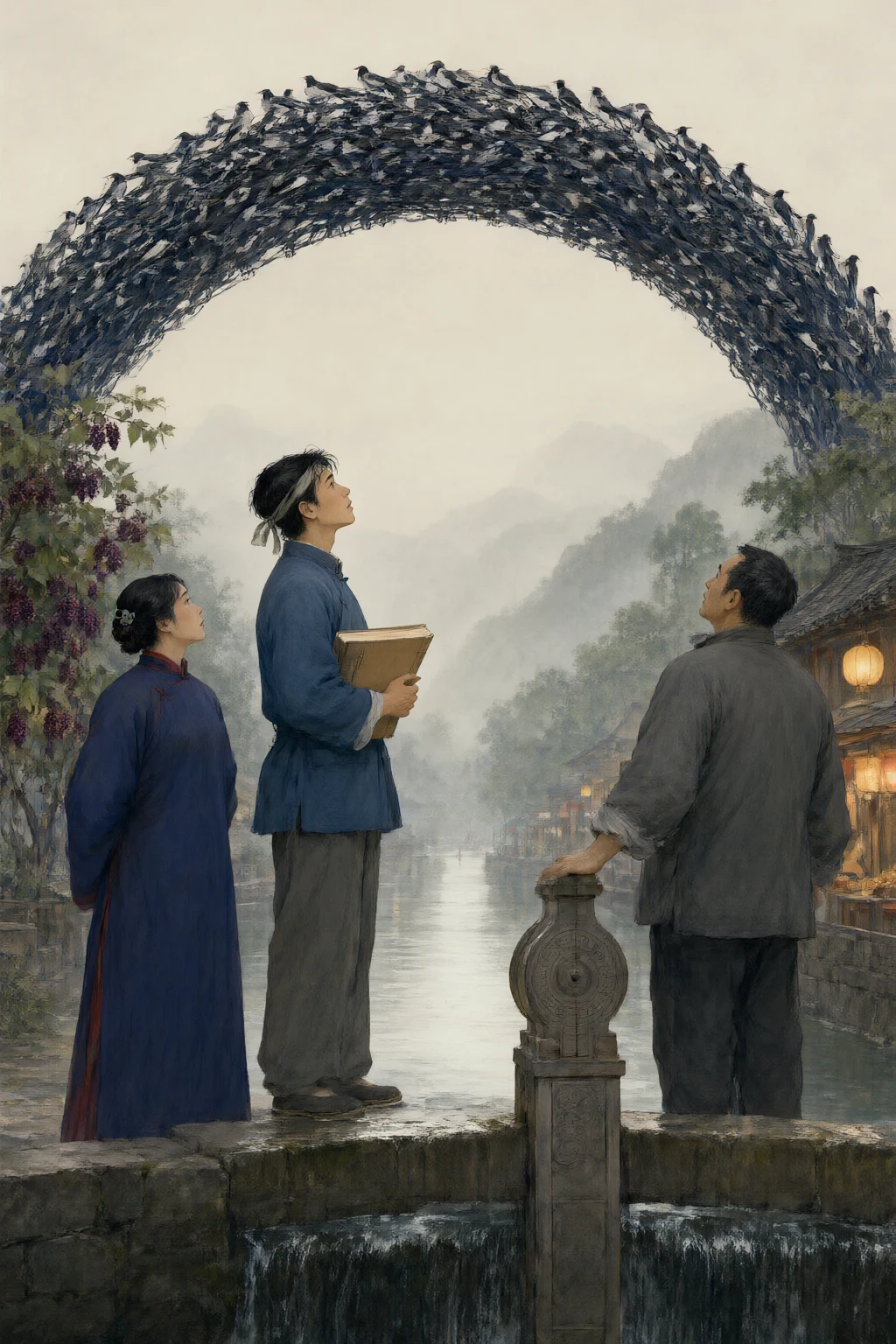
The river at Xiatang is not wide. In the dry months you can throw a stone from the north bank to the sluice on the south and hit the water both times, and the elders used to say that this was the reason the place was settled: because a stone could be thrown.
Above the village the river was trained. Two hundred years ago somebody had put a weir across it at the narrows, and above the weir a stone channel ran to the north fields and another ran to the south fields, and at the head of each channel was a division gate, a plank sluice that a man could stand on and pull up or push down, and beside each gate was a gauge post with a notch cut in it, and the mark of the water on the notch was the only argument anybody in the valley had ever needed. The Water Society kept the book.
Chao was nineteen and he was the copyist. He had been the copyist for two years, which meant that when the steward of the Water Society died in the autumn, Chao inherited not the position but the pen. Twice a year the numbers in the book were read aloud at the shrine, in the open, with both banks' people standing there, and the reading was a thing people did not enjoy and did not skip.
The north bank was cattle. The Wei valley, north, four hundred head and rising; the herds went up the grazing slope in May and came down in the ninth month. The south bank was silk. The loom-houses of Xiatang worked eleven hundred shuttles and the water did not turn the looms, but the water fed the mulberry, and the mulberry fed the worm, and a dry channel meant a bad year for about nine hundred people and a very good year for about four hundred, which is a division of a valley that has produced a lawsuit in every century since the weir went in.
The book recorded, month by month, the depth at each notch, the days the gate was open, the number of beasts watered, the number of bolts of cloth finished. Chao copied it fair. The original was a decade older than the flood that got into the shrine and started the whole argument.
They had been married for forty years when Chao started copying, and the whole valley had been married to it for a hundred and thirty. Niulang was the fourth man of that name on the north bank. He was fifty-one and had a way of standing that came from twenty-eight years of leaning over a water trough, and he read a gauge post the way other men read a face. Zhinnu was the daughter of the elder of the loom-houses, and her mother had woven, and Zhinnu had been at the great loom from the time she was six, and the thing about Zhinnu was that she could hear when a loom in a house four rooms away had a warp fault, and she could name which thread. Their marriage was a document, and the document is still in the book.
The north bank gives the south bank the winter grazing on the Wei slope, for eleven weeks, from the first tenth-day of the eleventh month. The south bank gives the north bank the right of first refusal on every bolt of raw silk, at the fixed price of the year, before it is offered at market. The herds drink at the north channel between the first and the fifteenth day of each month. The looms draw from the south channel between the sixteenth and the thirtieth. Neither bank shall raise its own gate above the fifth notch without a witness from the other bank.
Both signatures are on it. Both families' seals. It is nine lines long and it is the reason nobody in Xiatang has gone hungry in forty years, and both parties can recite it, and both parties can recite it with the correct amount of boredom, which is what a working document is supposed to sound like. "You are copying it again," said Niulang, at the weir, in the fourth month. "Twice a year." "Twice a year for two years, and you have not once asked me a question about it." "I did not think you would want to be asked anything," said Chao. "You are difficult about being asked." Niulang laughed. "Ask me something." Chao thought about it, and then said: "The month of the second. Your notch mark was low for a wet month. Was the gate closed?" "It was open the whole month." "Then somebody wrote a wrong number in the book." "Somebody wrote a right number," said Niulang, "in a book that a man on the south bank also reads."
The trouble did not come in a bad year. It came in a series of ordinary ones. The herds on the north bank went from four hundred to nine hundred in fifteen years, because the grazing at Wei had been opened to two more villages, and the men who opened it were not liars, they were four men from a valley upstream who needed the grass more than they needed to be liked. Nine hundred beasts drink roughly twice what four hundred drink, and the book, which recorded the beasts faithfully, recorded them getting fatter, and everybody could see the arithmetic and nobody had said it. On the south bank, the looms went from four hundred shuttles to eleven hundred, and every one of them was somebody's whole life, and the county had wanted it, and the water had not been asked.
The water had not been asked. That was the phrase in the valley by the autumn of the reading, and it was accurate. In the eighth month of that year the weir was at its lowest since the year before the flood, and the total water available above the gates was less than the sum of what the two banks were entitled to by a distance that everybody could compute, and had computed privately, and had not brought to the shrine. The Water Society had to issue an allocation. An allocation requires a rule, and there was no rule, and the custom was that when there was no rule the two elders went in to the county magistrate, and he cut it, and both sides were angry for a year and then got used to it. This year they did not want to.
The dispute reached the capital in a way disputes reach the capital, which is slowly, on somebody's back, over two years. The magistrate wrote a report. The report went up. What came back down was not a judgement. It was a document, and it was very short, and it was the single most efficient piece of paper Chao had ever copied. It concerned the household of Niulang of the north bank. The household drew from both channels. A household that draws from two jurisdictions can be assessed for water in one pass, and the revenue from that assessment is a matter of record, and the record for the Wei valley showed an assessment which could not be reconciled with the water that had actually passed the weir. A household with two mouths in two jurisdictions is therefore dissolved.
Zhinnu was drawn up to the heavenly loom. Niulang was sent to the celestial pastures above. They are there. They are not dead, and it is not a punishment, and that is the difficulty with it. They are up there, in offices, one over the herds of the four quarters and one at the great loom that turns the seasons, and they go to their work in the morning and they come home, and they are forty years into a thing that was signed by a clerk in the capital on the strength of a reconciliation that was, at its foundation, not true.
The document gave them nine days a year. The bridge is made on the first day of the seventh month and it goes out of the water on the morning of the tenth, and for those nine days the two banks can talk, which is the only conversation in the valley that is not about water, and which is also about water.
The reading of the allocation happens on the seventh day of the seventh month, when the two banks stand on either side of the weir and the gauges are read and the year's water is divided on the spot. It is the one day in the year when both banks must be represented at the weir by the person who signs, and it is the one day in the year that the two banks cannot argue a figure, because the gauges are read in front of everyone and the water does not care whose turn it is.
The heavenly clerks have to file the tally too. So the clerks cross as well, and the clerks go up and down, and on those nine days the magpies come out of the hills in a black and white noise and build the bridge over the river at the narrows, and everybody in the valley knows it, and the girls of Xiatang go down to the water on that night with a knot in a reed and float it, and they do not ask the magpies for anything in particular, because the magpies are not listening.
Chao was at the weir on the seventh day with the book, because that is where the copyist is. He had watched the bridge go up on the first day, at the fourth hour, and had gone home and eaten and come back on the seventh because the book was his to carry. Zhinnu came down the sky to the south gate and Niulang came down to the north gate, and they stood on either side of the weir with the clerks between them, exactly as the document requires, and it was the ninth consecutive year. The gauges were read. The allocation was announced. The number was the number it had been for four years, and both banks looked at it, and it was short, and everybody had known it would be short. Then Zhinnu did a thing that was not in any document.
"Before it is entered," she said to the clerk of the celestial Bureau, "read the two books." The clerk said that the book had been read. "Read the two books," she said, "and then read the book in your own hand." There is a third book. There is a book in the Bureau at the capital that records, in a summary, the water of every jurisdiction, and it is the book the assessment was made from, and it is not the book of either bank. Niulang had not known. He said so, standing on the north gate in his working coat, at the age of fifty-five, in front of eleven people: "I have never seen that book."
The water was reconciled in three days. Chao did it, because it is what he was for. It took him three days and two nights and the hands of eleven people, and it was the dullest work of his life.
The north bank had been measuring the herds with a short cord, and had been doing it since before Chao was born, and every man who did it believed that a cow is a cow. The south bank had been measuring the bolts with a narrow width rule, and the narrow rule was the one in Zhinnu's mother's house, and the loom-houses had used it for four generations because it was the one that made the count come out right. The two errors had been running in opposite directions since before the marriage, which meant that for forty years the north bank had been drawing more than it thought and the south less, and the two wrongs had been very nearly cancelling, and the number in the Bureau's summary had been almost correct, and almost correct was what the Bureau had assessed.
The day Chao finished, there were two hundred and eleven beasts too many in the north book, and a little under nine hundred bolts too few in the south, and the water for both, taken correctly, came to within one part in eleven of what the weir had actually let through. He wrote the reconciliation out longhand in eleven copies, one for each bank and one for the capital and one for the shrine, and the ninth copy he kept.
He drafted the amendment himself. The Bureau's clerk told him it was not possible to amend a heavenly document, and Chao said, quite politely, that it was possible to amend the schedule, because the schedule was a domestic matter, and the Bureau had no jurisdiction over a domestic matter, and the clerk agreed that this was true and then waited a long time before he agreed to the rest of it. Four clauses. That Niulang and Zhinnu are two parties and not one household, and that the household is struck from the roll, and that each party answers only to the water of one bank. That the cord, the width rule, and the gauge posts are kept at the weir in a locked box, under the seal of both banks, and that neither bank shall alter them.
That the allocation is read from the weir gauge in the presence of a clerk of each bank, and that no figure is entered into the book that has not been read off a post in front of two banks. That a representative of each party shall be at the weir for the reading on the seventh day, and the bridge be kept the nine days, and the ninth day given to the gauge. The clerk read it twice. "You understand," he said, "that I cannot return them." "I have not asked you to return them," said Chao. "They will still cross on the seventh day. Nine days, as before." "I have not asked you that either." "Then what have you asked?" Chao put the four clauses down flat on the stone. "That they both have to be in the room," he said.
The amendment was entered on the sixth day of the seventh month, in the eighth year. They did not understand it at the time and most of the valley still does not. It is a water amendment. It is about a cord and a width rule and a locked box on a weir. Nobody in Xiatang thinks of it as a love story, and if you say that at the weir you will get an argument. What it did was smaller than that and it is the only thing the story can honestly claim for itself: it made the ninth day necessary.
The book for the ninth month of that year has two columns, north and south, and beside the columns a narrow third one that Chao ruled himself, headed, in his own careful hand, for the crossings. In the first four years the third column was empty. In the fifth year there is a single line, and the clerk at the capital, who had by then been assigned to the valley and did not want to be there, wrote it in the margin and then struck out half of it and left the half that was true.
It says that on the seventh day the gauges were read from the weir by both clerks together, and the figures were entered, and the figures were the figures, and that on the morning of the tenth day the bridge went out of the water above the narrows and went up the river, and the magpies went with it, and there is no record in any book of the year of what any of them said. Chao's copy of the ninth book is the one in the shrine, and it has been copied four times since. In the spring of this year the county sent a boy down from the school to ask whether the shrine would lend it for a day. "Yes," said Chao, and did not go with it.
The boy came back on the Thursday with the book under his arm and a question he had plainly been carrying the length of the valley. "Which two are in the third column?" he said. "Ask in the village." "I did," said the boy. "They told me. And they told me the north bank has been short on the gauge for forty years." "They have not." "My uncle says you said so yourself, at the shrine, in the third month, in front of everybody." Chao took the book from him, squared it to the edge of the shelf, and set it into the gap where the flood got in, which is where the shrine's copy has always stood, and shut the door, and went down to the weir to see what the water was doing.