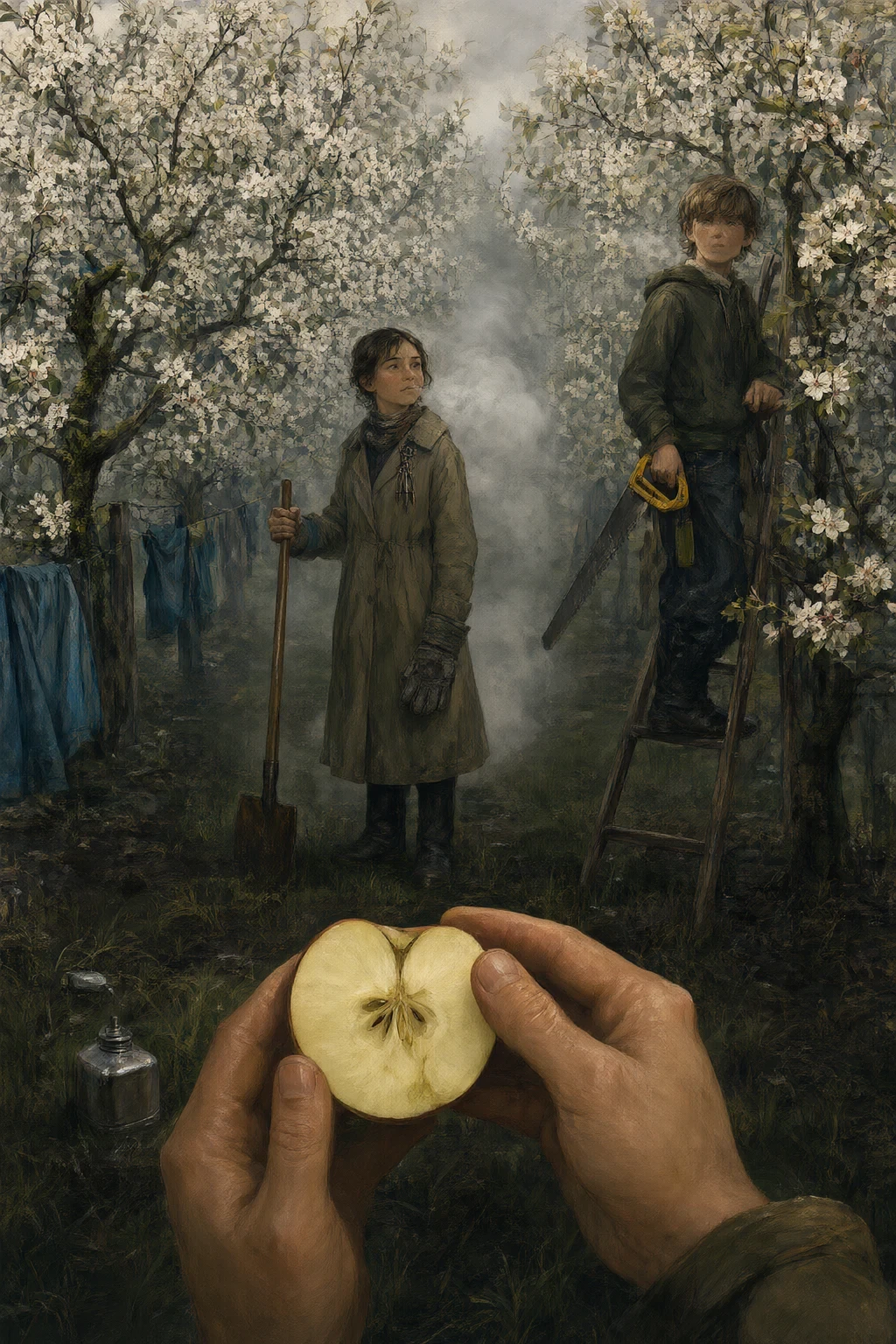
The eighth block of the Fenrows came into flower in a cold rain on the twenty-ninth of April, and every year it had done so, and for thirty-one years it had never once borne a crop, and in the last week of April it was the most beautiful thing in the Rootwork. Four rows of Ribston on the low ground, eleven trees a row, in a bloom so total and so even that from the lane you could not see where the block stopped. The rain came down through it and stood on the petals in beads. The grass under it was black. The fenrows smell of wet bark and windfall going to cider-sour, and in the last week of April they smell of something else, which is the cold green smell of a great deal of blossom doing nothing.
Sennet Bray stood at the head of the block with her back to the rain and looked at it the way a woman looks at a fire she has walked back into. “It is a full bloom,” she said. “It is the fullest it has been.” “It is always the fullest it has been,” said Hollis, who was fourteen and in a new pair of boots and had already decided that the whole subject was interesting. “Because it is spending everything. That is what you told me. A tree answers to whoever holds the saw.” “Your father’s saying,” said his mother. “It is a good saying.” “It is a true saying,” said Sennet Bray, “in the way that most true sayings are true. It is true the way the weather is true.” And then she told him the rest of it, in the rain, at the head of her own block, which she had never done to anybody in twenty-five years.
Here is what the eighth block is. It was planted as a seedling block in the year the Fenrows were replanted, four rows of a good Ribston on the best of the low ground, and for six years it was the best thing her husband had ever put in. Then came the wet year, the one the district still calls the Drowned Summer, when the water table came up eleven feet in nine weeks and the eighth block went yellow from the fourth row in and did not come back. Sennet Bray was thirty-one years old. Millward was in his last winter. The district had nothing to give her. The Ward would not sell her rootstock. Every nursery within forty miles was raising on the same Fenrow seedling and had none to spare, and by the time Millward died in March there were eleven trees in that block with a summer between them and no root under any of them that could survive it.
And there was one tree in this whole valley that had not gone yellow in the Drowned Summer, and it did not go yellow in the nineteen eighties, and it has never gone yellow at all, and it bore fruit in the Drowned Summer, which was the thing that really frightened people about it. It stands in the Middle Orchard, the strip of unlisted ground between the two families' blocks where no seedling was ever put, in the middle of a ring of fence posts that are rotted through at the base, all of them, at an exactly regular spacing. The ring is a hundred and six feet across. No fence was ever seen there by anybody living, and nobody has worked out what it is for. She cut her scion wood from the top two rows of her own block. She cut the rootstock from the tree in the middle of the ring.
She did it in a week in the fourth month of that year, with the water still high, alone, in the rain, because the tree in the ring is on common ground and common ground is not theft, and because she had a wheel and a saw and no time. She cut with a grafting knife of her own that had been on the bench since Millward's grandfather's day, and the edge went blunt on the ring posts on a wet day on a wheel that would not turn, and she cut the wood ragged and did not think about it again for twenty-five years. The union took. The block lived. The eighth block of the Fenrows is alive today and is twenty-five years older than it should be and owes its entire existence to a tree in the middle of a ring of rotted posts on ground that belongs to nobody.
What Sennet Bray has never said to anybody, including her son, including the register, including the man who came last winter and asked her questions for two hours, is that she did not enter it. Not wrongly. Not in the wrong column. She did not enter it at all. There is no line for the eighth block in the Grafting Register for that April, and there is no docket number issued, and no tree label was written, and no wax cloth strip was wrapped, because there was nobody to write one and she was alone and it rained.
A graft that is in the register holds for the life of the tree, the way a nailed board holds. A graft that is not is what the trade calls a stranger's graft: it holds for a growing number of years and then comes apart in a single night, all at once, and everything it was holding goes into the soil of that night and is not there any more. Nobody in the district has ever known why the unrecorded grafts are so old. Everybody in the district knows the answer and will not say it in a room with the ledgers in it. The reason the block never bears is this, and Sennet Bray worked it out in her own head over about four years and told nobody.
A graft is a survey. When a union takes, the two root systems are continuous, and the grafted tree reads both locations at once. It is not two trees with a seam. It is one tree with two addresses, and it spends its whole life answering to both of them. The first is good Ribston ground on the best of the low land, forty feet of loam over gravel over the pipe-gallery, which is the most productive ground in the district and has never failed anybody. The second is whatever is under the Middle Orchard, which nobody has ever surveyed, and which cannot ripen anything, and which has never once brought a fruit to seed.
A fruit can only be one place. That is the whole law of it, and it is why a Rootwork fruit is a document when you cut it open. You cannot ripen a Ribston on the Eighth Block because the Ribston is in the ground and so is the other address, and the two have never agreed on anything, and every year the tree solves the problem by being magnificent at flowering and doing nothing else.
And every year the bloom is fuller. That is the part nobody can get used to. The two root systems are both healthy, and both are generous, and they agree, for the eleven days of the blossom, on absolutely everything, and the agreement is total, and the agreement is the failure. A tree that has drifted clean over to its new ground gives up its own variety and becomes a pure function of where it was grafted to, and it flowers modestly and sets hard. The eighth block does the opposite. It flowers like a champion and sets nothing, because it is two places at once and no fruit exists that is both. Marren Ashlock came out to the block on the Friday, on the Ward side of the lane, and stood at the gate of the fenrows and looked at the bloom through it for twenty minutes without crossing. “We have never had one of these,” he said.
“You have never had a block grafted off your own ground onto common ground that nobody will admit to owning,” said Sennet Bray. “You graft from your own nursery, you enter it, and it is a tree for ever, and I have watched your people wonder for sixty years why your block beats mine.” “I am not wondering. I came to give you a figure. The far two trees of row four, which you have marked for cutting, are inside the Ward chainage. The hedge crosses the block in 1884 and everything east of it has been ours by chainage since the road moved, and your own survey says the same, because my chainage and yours have agreed about that hedge for a hundred and forty years without anybody ever having to be wrong about it.” “Then I can cut them.”
“You can cut them,” said Marren Ashlock. “That is the only thing I came out here to say. Noted, and good luck to you, and I am going back up to the shed, because the hundredth year ends in the frost and I have not got the volume closed.” It took eleven minutes and most of it was about a hedge, and Hollis, who stood behind the gate the whole time, afterwards said that this was how grown-ups did things, and his mother said it was how grown-ups did that one thing.
On the second of May, Dellory Fenn came out to the block with his tin of drawing pins and a folding rule he never separates, and stood in the wet grass at the south end where the graft had been made twenty-five years ago, and looked at the bloom for a long time. The south end of the block is where it all began, at the fourth tree of the first row, which is the tree nearest the lane and therefore the tree nearest the middles. A tin tag was screwed into that trunk, and the tag was blank, and it had been blank since the year it was put there by a man who had come from the town to inventory the block and had not known what to write.
“I put that tag on in 1971,” Dellory Fenn said. “I came out with a list of every block and every row and I got as far as the eighth block and I stopped. I had a number. I did not have a parentage. And there is no way to enter a number in that book.” He took a folded sheet out of his inside pocket. Folded in eighths, soft along the folds, covered in pencil. It was a drawing of the Middle Orchard from the north, with the tree in the middle of the ring in the middle of it, drawn much larger than it should have been, and beneath it a note in a small even hand running on for the better part of a page.
“I have had that since the March after the Drowned Summer,” he said. “Thirty-one years. It has never been in the district record and it will never be in the district record, because the district record has no place for a thing that I think I have found, and the district record cannot be wrong, and a drawing by me in pencil in a coat pocket can be wrong, and can be wrong at forty years old by being wrong at thirty-one.” “Nobody asked you to find it,” said Sennet Bray. “Nobody asked me to find it,” Dellory Fenn agreed, “and I would like to say, on the record, that I did not stop working.”
The frost came on the night of the fourth of May, as it does, with a clear sky and no wind, which is the worst combination there is, because a still night lets the cold settle down off the ground and lie in the low places and stay there until the sun is high enough to argue with it. The eighth block is in the lowest ground in the Rootwork. The frost would have taken it entirely. Not the top. The bottom two rows would have been black by five in the morning and there would have been nothing to argue about, because the whole of the block's reason for existing is eleven days in the last week of April.
The labour of saving a bloom against a radiation frost is not a mystery and nobody has ever wanted to watch it done. You have paraffin, wet sacking and about nine hours. You light smudge fires down the windward side so the smoke lies over the block, and you keep them going, and you water the ground so that it gives up its heat to the air all night instead of taking it out of the air, and you hang sacking on the north side where the cold comes from, and you go round, and you go round again, and you do not sleep, and at some point in the small hours somebody's boots come apart at the heel and somebody has to go to the house for sack ties, and that takes twenty minutes you do not have.
Sennet Bray put eleven people on it and pulled every one of them off the ninth block, which was at its own thinning week, and which bears every year of its life, and which pays for the winter. Hollis told the whole night afterwards, and told it well, and would not be stopped. He started with the fires, four along the lane and three at the south end, and the paraffin going in at four in the afternoon, and the sacking wet, and you wring a sheet till it stops dripping and then you wring it some more, because a sheet that drips is a sheet that is not wet enough. He did the north side. He said the north side twice, because the north side was where the cold came from and where the sacking kept sliding off the wires in the wet, and a boy going up a ladder in the dark, over and over, on a ladder laid flat in the grass in the morning and stood up again at four the next afternoon.
He said the water going on the ground at half past two, and the second filling, and the third, and the light going, and the fires down and needing feeding, and the sound the whole thing made, which was a lot of water and a lot of small fire and one man shouting across a block. He got faster after four. He got faster the way he always does. At five in the morning Hollis Bray was narrating at a rate that Sennet Bray had to shout over twice, and the second time she did not shout, because she had worked out what it meant, because she had watched him do it since he was small, and because a boy talking that fast on a night like that is a boy who wants to be somewhere else and has decided that the fastest way there is through the middle of the story.
They held it until the sun was over the hedge. Then they went round the block row by row, in the grey, with a lantern, and the bottom two rows were white. Not black. White. And that was the whole of the reward, and it was enough, and the ninth block had lost the fingers off both hands for it.
The eighth block set in the second week of May. It held on the two lower rows and let go on the top, which is the opposite of what the frost would have done, and Sennet Bray said that was the drift talking and not the cold, and would not be argued out of it. Nine barrels, in the last week of September, picked in fog by lantern. It was the first fruit off that block in thirty-one years and the district came and looked at it. It looked like fruit. It was not much of a thing, and it sold at market for almost nothing, because the district knows what the eighth block is and buys the ninth block instead. But that is not what the nine barrels were for.
Sennet Bray had one block's worth of drift to measure before the winter, and the graft season was six weeks off, and the only instrument in the world that measures drift is a fruit cut open and tasted, and a tree has to be bearing for you to have a fruit to cut. Keeping nine barrels alive through a frost on the fourth of May had bought the district nine barrels of ruler. They cut them row by row. Forty-four trees, one fruit from each where the tree had borne, every fruit cut in two and every half turned in two hands and every seed counted out loud by a boy with a bad cold. The drift is a gradient and it is not a guess. It runs down the rows away from the fourth tree of the first row at a rate you can put a number on, and the number is the number of years since the union took, and every grafted tree on this ground is somewhere on that gradient and always will be.
Row one, the north end: six carpels, and six is not a Ribston number, but six is a Ribston number that has been here a while, and the taste under it was the taste of the Fenrows and nothing else. Row one, third tree: eight, and under the eight there was a cold wet mineral note like a cellar with a stone floor. Row one, eighth tree: nine, and the nine was pure, and cut across the whole section like a road. Row four, south end, the far end of the block: five carpels. Five. A Ribston, an honest Ribston, on the good low ground of the district, twenty-five years grafted and still able to say what it was.
And that was the finding. The district had one now, and it was that the far end of row four could still be cut for scions, and that to give the eighth block back its own ground you would have to do it in one winter, in the dormant season, with wood taken from two trees at the south end of the fourth row and worked onto clean Fenrow seedling rootstock, before the gradient reached them and took the last of it.
The ninth block came in at forty-one barrels against a five-year figure of eighty-two. That is the documented failure. It is the only number in this whole business that anybody would call a failure, and it is the number that was not caused by weather. They had thinned that block by hand in the last week of April to keep eight alive in the first week of May, and the fruit on the ninth block went back into the June drop for want of hands, and the district would eat short in February, and there were four families in the Fenrows for whom February was the month that mattered.
Ottiline Vrey wrote the number in the stock book, because the stock book was the one book in the Register Room that was allowed to know how much fruit came in. Forty-one. And she wrote the five-year figure beside it, and the gap, and she did all of it in ink, and it was true, and it would still be true in a hundred years. And then, because she is the keeper of a register and not a clerk, she wrote one more thing, in pencil, in the margin, in a small hand. “9th block thinned by hand to 8th, night of 4 May.”
“There,” she said, to the two people in the room who were not her. “That is a decision, written down, in the district, in a book, in a place where somebody will find it in ninety years. And it is in pencil, in a hand that is not my hand, in a column nobody has ruled, on a page that is about pears. And anybody in ninety years who is honest will read it, and anybody in ninety years who is in a hurry will rub it out with a sleeve, because pencil comes out of a book, that is the one thing everybody knows about pencil.”
“Then what do you want me to do?” said Sennet Bray. “I have not signed anything since my husband died. You know I do not sign things. If you want it kept, it has to be kept in a hand of yours, and if it is kept in a hand of yours then it is your decision in ninety years, and that is a heavy thing to hand a person for a night of frost and a block of pears.” “I want it kept,” said Ottiline Vrey. “Eleven, and I am the one who will have to decide about the pencil. Write your son’s name under it, Hollis, and do not make it a lesson, I have watched you two all morning.” Hollis wrote his name. It took him a long time, because he is left-handed and it was a bad pencil.
The grafting knife went to the grindstone on the Thursday of the following week, which Sennet Bray had not planned and could not now stop. It had to be sharp, because the work at the south end of row four would be done in six weeks and there is only one season and no second attempt, and a ragged scion cut on a blunt edge is a scion that will not take on a clean root.
The edge had been blunt since the Drowned Summer, and it had been blunted by a wet day and a wheel that would not turn, and the block had lived anyway, because the tree in the middle of the ring grows over anything you hand it. Twenty-five years of carrying that in a coat pocket, and no reason on earth to keep it dull. She kept it because it was the last object in this district that knew what she had done, and she was going to take it off the stone in the morning, and there was nobody alive she could tell that to. Outside, in the fog, the eighth block stood in the dark with a scatter of windfalls going to cider-sour on the wet grass, and a boy with a bad cold and a barked palm on each hand, and eleven trees at the south end of the fourth row that were, for the first time in thirty-one years, worth cutting.