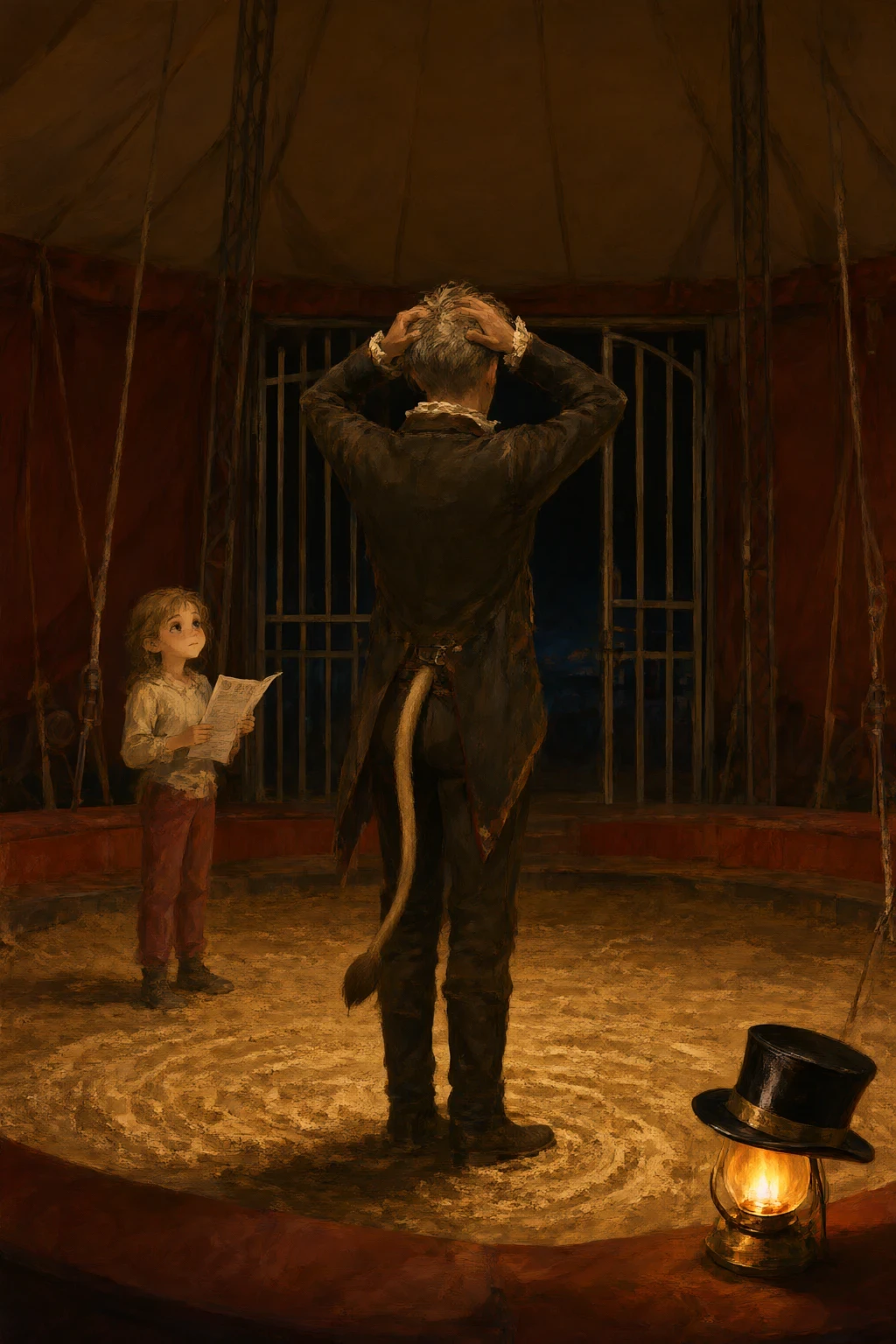
Nine Elms had one tree. It was ninety years old and it stood in the middle of the fairground like a man who had come early and been made a great deal of fuss over. The town was chalk-white and thirsty and proud of being both. It had a fair, a river and nine elms, of which eight had died of the drought and one had not, and the survivors had been renamed. Everything in Nine Elms was arranged around that tree, and on the last night of the fair they hung the chalk sack from it, as they had for thirty years, with whoever had been judged the best act of the week inside it. The Gilded Menagerie came in on the Tuesday, in dry weather, for three nights, and put the Ivory Tent up on the green behind the fairground, and the whole town came out to look, because that is what you do when a lit hill stops outside your houses.
The licence made the morning possible. Nine Elms had held the same fair licence for thirty years and the same clause, and the clause said that the tent was not to be used empty. Not rehearsed in, not dressed in. No performance without an audience, and an audience means an audience, and it is not a committee. It had been put in by a town clerk who did not like the circus and liked a fight in the council chamber more. It had never been discussed since, and it had saved a great many performers from being watched too closely. And it meant that on the Wednesday morning, with the show to open that night, the company had to rehearse in a chalk field outside the fairground, in the open, in the sun, in front of nobody at all.
The chalk ring was forty feet, raked by two men with wooden rakes, white and round on the trodden grass, and the whole company stood round it in the heat with a look on their faces that people who have not seen it can only imagine. Nine years. The same show, in the same order, at the same speed, the same jokes at the same minute, because a joke is only a joke if it arrives at the same minute. August Vane had the running order on a card the size of a man’s palm, pinned in the ringmaster’s box, in his own fair hand, and went along the edge of the chalk with his thumb on it. “All right. One. Grand Entry. Chorus and company.”
The band played it. The company walked it. The wagon came round with the painted Salt Line on it and the six of the team on the traces, and the clowns came through the arch and got their laugh eleven seconds early, as they always had. “Two. The Clown Fight.” It was the same fight. The same bucket, the same stool, the same trousers. Two thousand people a night, twice a night, for nine years, and the audience never once noticed that the trousers gag was also a running argument about the company chest. “Three. Miss Vrain, bareback.” Odette came round the ring on a grey mare at a walk, and cantered, and stood up with one arm in the air, and the band played the six bars, and the applause in the field was six people and Nadia Ferrule. “Four. Miss Sparrow, quick changes. Four changes in ninety seconds.” Junie Sparrow went through the Widow’s Pew doors at a run and came out in a striped jersey in eleven seconds and a spangled bird in nineteen and a Pierrot in thirty-one and a bareback rider in forty, and the fourth change got the biggest noise and always had. “Five,” said August Vane, and lifted his chin, and his voice came up out of the place it comes up out of. “The Gilded Menagerie’s own. Mateo Brill.”
That was when the Director arrived. She came in on a hired chair with a footman carrying a rug and sat at the edge of the chalk in the sun, and she had not been on the field in the daytime in twenty years, and everybody looked at her, and two of the rakes stopped. “Mateo,” she said. “Do the gate.” The gate had been struck off its wagon and set up at the edge of the chalk, because a lion that comes out of a canvas arch in a field is not a lion. Eight feet of iron, a double door painted black, a bolt, and a ring in each door, and the bolt you can hear from the front row. Mateo Brill took his belt in both hands and did up the buckle, which he did at the top of every act, because the tail goes through the back of it and if the buckle is wrong the tail catches. “Mmm,” he said, and went in.
The bolt went over. The bolt always went over. Twenty minutes later it came off, and the doors opened, and the lion came out into the sun. It was Mateo. It had always been Mateo: the grey mane shaved short at the sides, the walk that was not a man’s walk, the shoulders. The field knew that, and had always known it. A child of Nine Elms would have told you the lion was a man with a tail, and not thought twice. He came four steps out and stopped, and turned his head, and the whole field watched a man look for something he had lost. “Mateo,” said the Director, from her chair. “What day is it.” He put his head down. That was not the act. And then she said, quite gently, over the band warming up: “No. I am not asking for the act. I am asking you.”
“No, madam,” said Mateo Brill. “No, madam,” said the Director. Then she looked at the field, at all of them, and said: “There is one more piece of business this morning, and it is not in August’s hand.” She had thought about it for a long time, in the manner of a woman who does nothing at all for a great many years and then does one thing exactly. “A contract needs a witness,” she said. “That is the rule, and the rule is why I cannot sign anybody in a wagon. There has not been a public contract read in this company for two months and there is to be one before the season ends, and it cannot be read to an empty field, and there is no public in Nine Elms at ten in the morning.” “That,” said August Vane, “is the most beautiful thing I have ever heard my aunt say.”
“Do not be charming at me, August, I am doing an exercise.” She stood up off the rug. “So somebody is going to sit in the middle of that ring and watch the show, and somebody who is not us, and since there is nobody else, it is going to be the ticket girl.” Nell Ferrule did not want it. She said so three times, in the three different ways a thirteen-year-old says no, and the third was a count of the boards of the platform she would have to cross to get there. Then Halloran Quill, who had been sitting on a folding stool at the ring edge with the Contract Ledger open on his knees, because the Bookkeeper is forbidden the Lantern Works and must be somewhere, said, “Strictly speaking, madam, a witness has to be a paying member of the public.” “Thank you, Halloran.” “And the ticket girl is not a paying member of the public.” “Then sell her a ticket,” said the Director, and went back to her chair.
They sold her a ticket. This is the part the company remembered afterwards, all of them at once, and not one of them could say at the time that it was the moment. A girl of thirteen, in her own booth, ruled a line and wrote out a ticket in a hand that had been practising for a year and a half, and the bookkeeper countersigned it in green-black ink, and she folded it in four, put it in her pocket and did not look at anybody. And then she sat down in the middle of the chalk ring on a chair off the back of a wagon, in the sun, with her knees together, and looked at the company. Nine years. The same show, in the same order, at the same speed. And it came apart inside of four minutes.
The first thing that changed was the Clown Fight. Nell Ferrule was forty feet away and the only person in the field paying attention, and the bucket came up and the business went in, and the second clown said his line, which was the line he had said for nine years, which was the line he had said in Harrow’s Landing in February in a shed, to a man who came to say the lanternists had not been paid. And the child in the chair said, in a small clear voice, very loudly, in the way of somebody who needs a whole field to hear them: “That is not what you are paid.” The field went quiet. “That is not what you are paid,” said Nell Ferrule, for the second time, and the clowns stood in the sun in their paint and did not move, and the older one, whose name was Fett, said, without any character at all, in a flat voice: “No, my lady. That is not.”
They took the tent down in the night before the last show and put it up again in the dark, which they had never done, and it took four hours and every man on the road, and the town woke at two to see the shape of it going up against the sky with a hundred lamps on the ladders, and thought it was a fire for four minutes, and then thought better of it. Nobody could afterwards say who had given the order. The tent was up and the fairground was full by seven and the weather had held, dry and warm, and the elm stood in the middle of it with the last light on it, and there were four thousand people in Nine Elms, and the queue at the ticket wagon went from the gate round the shooting gallery and back and had to be turned. The last night of the fair. The chalk sack went up at midnight with whoever was judged best, and by ten the town was in the seats, a third of them standing in the aisles. In the ringmaster’s box, pinned where it had been pinned for nine years, there was a card the size of a man’s palm with the running order on it in August Vane’s own fair hand. There was nothing on it.
“Ladies and gentlemen of the Gilded Menagerie,” said August Vane. He was in the black hat with the worn brass band and the one white glove, its cuff threaded with red, and he had the empty card in his inside pocket and had had it there since Saturday morning. “August has brought you a show, and August has not got a list of it, and could not make one, and is going to tell you honestly why, and then get on with it.” “Tell them, then,” said the Director, from the second seat of the front row, in a plain grey coat, hands in her lap. “Because a list,” said August Vane, “is a promise that nothing will happen that is not written down. And there is somebody in this field who has spent the summer finding out that everything in this company is written down and almost none of it is read.” He took the hat off, which he did not do. “So whatever this is, it is the first time anybody has seen it. If you have come for the lion, it is on at a quarter to eleven and not one minute sooner, and I cannot tell you what it will do, because I do not know, and neither does he.”
One. The Grand Entry came on, and it was the same, and it was good, and then it stopped being the same in the middle of it, because Fett came through the arch on his hands and said, to two thousand people, in the voice of a man reading a delivery note: “The band have not been paid since March and they are owed eleven weeks, and if anybody in this field would like to buy a bowler hat off a man who has one, the money goes straight to the band, and I will stand here all night and take the money.” Two. The Clown Fight became the Clown Fight, and it was funnier than it had ever been, and at four minutes in the older clown said, to the ring, “I am not the stupid one. I am the one who said nothing for nine years, and I have been asked about it twice now, and the second time I did not say nothing, so there will be a bill for that as well,” and the house fell over, and a man in the third row put his hat on the seat in front of him for the second time in nine years and roared.
Three. The team. Not the painted wagon: the six of them, on the traces, walked the ring while a boy from the stables read the halters aloud, because that is what the halters are for. Six file-names off six pieces of cardboard. Six ordinary names, and the sixth was a girl’s name, and a child in the eleventh row wrote it on the back of a programme, and Nine Elms is a fairground town with a hundred and forty horses in it, and a hundred and forty horses is not a hiding place for anything. Three. Miss Vrain, bareback. Odette Vrain came round the ring at a walk on a grey mare in a scarlet-and-gold coat, cantered, and stood up with one arm in the air, and the band played the six bars, and the entire fairground of Nine Elms sang the six bars, which they could now do without the band. And then she did not come off.
She rode the mare out through the gap in the east canvas, off the chalk, across forty yards of grass, up through the fairground and up the street to the elm, and every person in the lane got out of her way, the programme sellers and the toffee man included, because a mare at a walk through a crowded fairground is the most frightening beautiful thing there is. She came back down the lane at a canter. August Vane, alone in the ring, with his card in his pocket and nothing in it, said the only sentence he had for it, which he had not known he had until that moment: “Miss Vrain, returning from the market.”
Four. Miss Sparrow, quick changes, four changes in ninety seconds. Eleven seconds, and a striped jersey. Nineteen seconds, and a spangled bird. Thirty-one seconds, and a Pierrot. Forty seconds, and a bareback rider. And then, at fifty-eight seconds, Junie Sparrow came out of the Widow’s Pew doors as Junie Sparrow, in a grey pinafore and stockings with a hole in one heel, and stopped in the middle of the ring with her arms down at her sides. Two thousand two hundred people looked at a child standing still. “Is it fine?” said Junie Sparrow. “Is it fine? Is it fine?” And there was no bird, and no Pierrot, and no rider, and there was a girl in a pinafore in a circus ring at the age of ten, asking a room. And then she said, to the room, in the voice of somebody who has decided: “It isn’t. So I’m going to do the fifth one now, and nobody knows what it is, and I’m frightened.”
She did the fifth one. It took her forty-one seconds. It is not in any ledger and nobody who saw it has ever described it, because by the end two thousand two hundred people were shouting, and that is not a sound anybody can describe afterwards. The Bookkeeper of the Contract Ledger, on a chair against the wagon at the ring edge, wrote nothing down. He has said that he could not find a column for it. Five. The Gilded Menagerie’s own. That is what the card called it, when there was a card, and that is what August Vane called it, from the ring, at a quarter to eleven, and the town of Nine Elms was already standing up. “The Gilded Menagerie’s own,” he said. “Mateo Brill.” The gate was up at the east side of the ring, eight feet of painted iron, and the bolt was off it and lying on the boards, and the band stopped. “Mateo Brill goes in the gate,” said August, “and the lion comes out. That has been the act for nine years and I have been paid to stand at this end of it for nine years.” He took the hat off again.
“Mr Brill has agreed to something else. He is the best act on this road and everybody here knows it, and nobody has ever asked him a question in the ring, and I am not going to ask him one. The wager was made on the green this afternoon and you all know it, and I am going to say it out loud so that the animals can hear it.” The field laughed. “The wager is chalk. The sack, and the elm, and the beer. If the lion comes out of that gate and says the day of the week, the sack is his. If he cannot say it, the sack is mine, and August Vane hangs off an elm tree for the rest of the night, and I have every reason in the world to want you to bet against me.” He put the hat back on. “No more talking. Mateo Brill, go and be a lion.”
He went. The doors shut. The bolt went over with the sound the bolt always made, and the crowd made the crowd sound, and a boy with a lantern and a pole stood by the ring edge where the lanternists stand, and did not light anything. Four minutes. Nine. Twelve. A family in the second row put their coats on. At nineteen minutes August Vane looked at the Bookkeeper, and Halloran Quill looked at the book on his knee, and did not nod, because there was nothing to nod about. At twenty-one minutes the bolt came off. The doors opened, and what came out into the sawdust was a man. Not a lion in a lion’s way. A man in a lion’s way, which is what it looks like when a body that has been going one way for eleven years turns round in a doorway and does not know which way to go.
He got four steps into the ring and stopped and put his head up, and two thousand two hundred people who had been told this was the draw came to their feet to see a lion that was not a lion. The band came in on the wrong note and the cornetist, who was a decent man, stopped playing and put the instrument down. Nobody in the ring said anything. “Ladies and gentlemen,” said August Vane, into four feet of dead air, “the lion has come out of the gate early, and Mr Brill has the floor, and I am going to be honest with you, I do not know what he is going to do.”
Mateo Brill stood in the middle of the ring and looked at the house, and the lion was not there, and he could not think what to say, because there is no act for this and there never has been one, and it has happened twice before in the history of this company and neither time is in the book. He had a lion’s mouth and a man’s hands, and eleven years behind his eyes of which about four thousand were still his own. Mmm, he said. It came out the way it always came out, the low sound before an answer, as if the answer were worth weighing twice, and two thousand two hundred people heard it and did not know what it was. “Saturday,” said a voice in the fourth row. It was a girl of eleven in the front of the fourth row, on the aisle, with a programme in her hand and a box of them at her feet, and everybody in that row turned round.
“Saturday,” said the girl. “I sell the programmes and I stand at the gate, and I have done it every night since Tuesday, and the last night is always Saturday, and it is ten o’clock on a Saturday night in Nine Elms, and the sack goes up at midnight.” There was a silence of about two seconds. Then Mateo Brill said, in a voice with a lion in it, to a child of eleven: “No.” “No,” the girl agreed. “It isn’t yours. That is the whole point, and I am going to say the rest of it and you are not going to like it.” The field had stopped. Two thousand two hundred people stood in a canvas tent in the dark and listened to two people have a conversation, which is the one thing a circus audience has never in the history of the world been able to do.
“You do not get it back by saying it,” said Saskia Bray. “You said the day about nineteen years ago, didn’t you. You said it, and somebody wrote it in a book, and then you did a night as a lion and the day went. That is what happens every night: you come out, and you are all right, and you have got one less day than you had, and no clue at all what you have lost, and you have lost it so often that you cannot remember what losing feels like. That is the saddest thing I have ever heard of, and I am eleven, so take it from me that it is a bit much.” Nobody in the ring breathed.
“And you cannot get it back tonight,” said the girl. “You will not know it tomorrow either. But you can have my Saturday. You cannot have mine, because I have not lost it, and that is the difference between us, and that is why you are in the gate and I am in the fourth row, and I would like somebody to write that down somewhere, because I have been trying to say it to somebody since Whitsun.” Mateo Brill stood in the sawdust of his own ring in a circus that had fed him for eleven years and taken a day at a time off him for every one of the four thousand nights he could remember, and he had never once in his life asked anybody for anything, and there was a child of eleven giving him a Saturday in front of two thousand two hundred people and a Bookkeeper with an open book.
He said, “Mmm,” and then he said, in the low careful voice of a man putting something down: “No, miss. I will not take it. But I will say what I can, and I will say it out loud, and you will all have heard it, and that is not nothing.” He turned round to the house. “Eleven years,” he said. “Nine hundred and ninety-seven nights. I have not the days. Not one, and you cannot have them, and the company knows, and the company has known longer than I have.”
And then a voice in the front row, small and clear and not at all a show voice, said: “Twenty-two.” The whole field turned. Nell Ferrule was standing in the second seat with a red thread knotted round her left wrist into a small knotted cuff, a programme in her hands, and she was thirteen years old. “Twenty-two,” she said again. “Miss Ferrule,” said August Vane, coming down off the platform, “the floor is the lion’s.” “The floor is yours,” said Mateo Brill. “Go on. What have I got.” And Nell Ferrule, who had been the audience since ten o’clock on Wednesday morning in a chalk field, and who had sold herself a ticket out of her own booth and put it in her pocket, looked at the running order card that was not in August Vane’s pocket at all because it said nothing, and said: “Twenty-two, that she can be certain of.”
The band came in on the right note. Mateo Brill, forty-one years old, thirty per cent lion, and not a man who can be got out of a cage, stood in the middle of the ring in the amber pool of a single gas jet with the rest of the tent in deep oxblood shadow, and put his hands up and gave the house a lion’s roar, which is not a roar at all, which is a noise a man makes with his chest. The house lost the roof off the Ivory Tent, and Halloran Quill wrote the number down.
The last act of the night was not announced. August Vane came out alone at half past eleven with his hat off, and did not say “ladies and gentlemen,” and did not say the number of the act, and there was no line on the card because there was nothing on the card. “There is one more thing,” he said, “and it is the elephant.” “Mr Vane,” said Odette Vrain, from the wings, “there is no elephant.” “There is no elephant,” agreed August Vane, to four thousand people at the end of the best night of his life, “but there was an elephant at Kemble’s in ’eighty-one and I have wanted to say so since I was eight. And the Company is not my aunt, and my aunt is the Company, and the Company is the people on this ground.” He put the hat on.
“Nine years, and I have been billed in smaller type than I deserve, and I have deserved it, and I have said so in this ring to my aunt twice a week, and it has been a compliment, and she has let me do it, and that is the arrangement. And I would like to say one other thing in this ring before we light the boiler for the last time this season, and then I am going to hang in a sack off an elm tree.” “Nobody is hanging in a sack,” said the Director. “Everybody is hanging in a sack,” said August Vane, “and the judge is the town, and the town is honest, and if I am in it at midnight it will be because a boy of nine in the second row has decided the elephant was the best act, and it will be the correct decision, and I shall be furious.”
The sack went up at midnight, and the man in it was not the ringmaster. He was Fett, the older clown, who had told two thousand two hundred people the truth about his wages and had not been able to think of anything else to do with himself since, and Nine Elms hung him off its tree for the fourth time in nine years, and the band played until two, and the elm held. In the ringmaster’s box there was a card the size of a man’s palm, pinned where it had been pinned for nine years. There was nothing on it. August Vane had written nothing on it, and the nothing was the card, and it was the best thing he ever put in his hand.