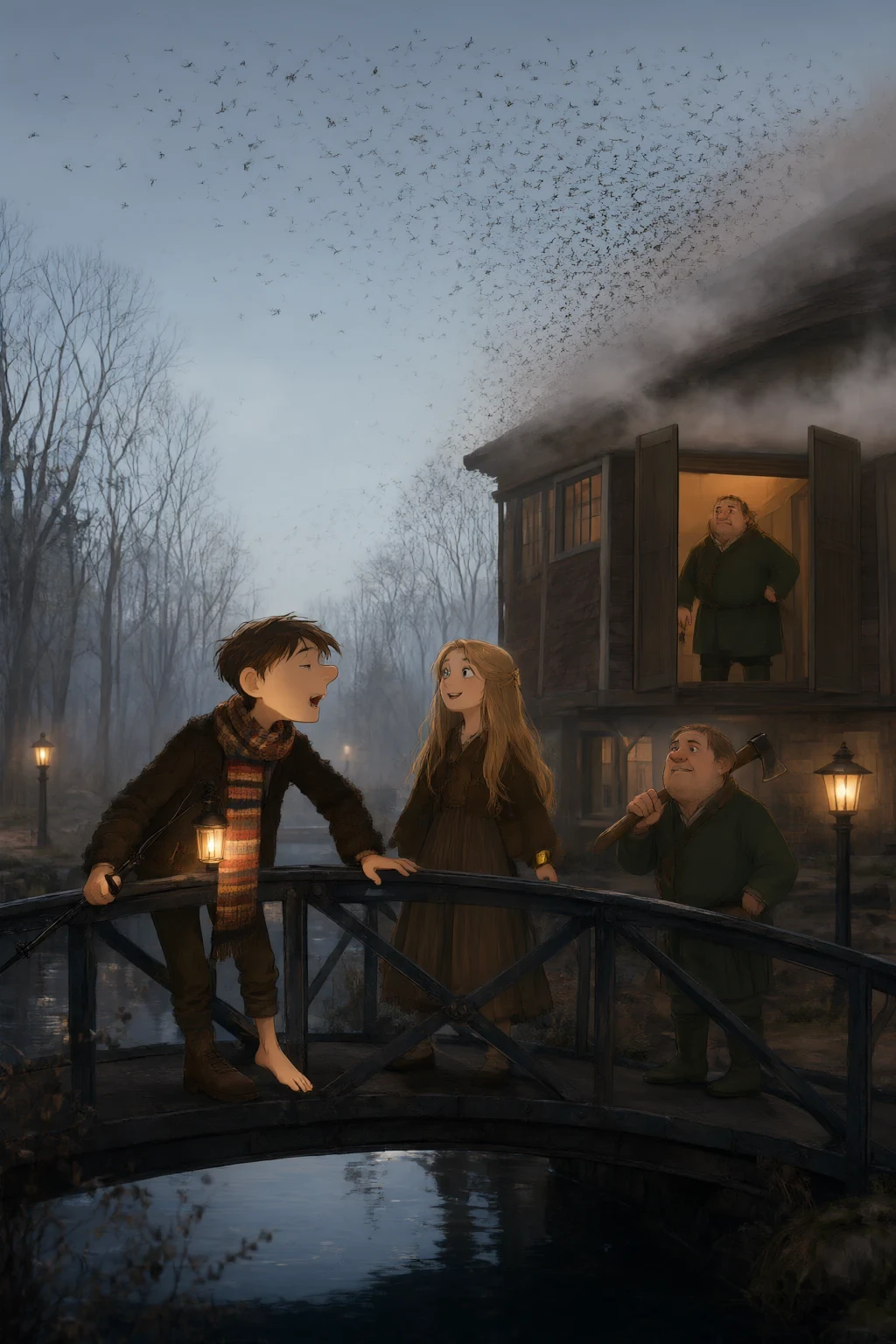
The day did not turn over. Teasel Sillet noticed it at noon, on the Lamp Service stairs, and he noticed it because of the numbers. The fen mist comes up the drains around noon, every noon, all year, so that at noon the air in Candleford is wet and grey and you can taste it. That noon it was dry. The mist stopped coming up about eleven, and after that the streets did not move at all. The light came down onto the city the colour of new brass, and it did not change.
He said it out loud to the lamp-rail on the stairs, because that is where he said things. “One o’clock. No grey.” Then he counted the moths on the landing tray, because counting was what he had instead of worrying, and got the same number twice, and wrote it inside his wrist in pencil. At half past four the bargemen on the Sallow stopped unloading, because their arms were tired and it was not their fault. At five the swallows went up and stayed up over the Loft, and did not come down. At ten past five the first grey came, grey-green and low off the water, and the great lamps went on along Bridge Nine the way they always do, amber to the end of the street. And then the first grey went away again.
It was still there. Nothing got darker. It was simply the same, minute after minute, the way a held breath is the same. On the stairs of the Releasing Loft, Nell Ashgrove stood with her hand on the great lever and did not pull it. “First lamp’s on,” she said. “First grey isn’t.” “Nell.” “I know what you’re going to say.” They waited until seven, and then Halvard Tace came up the stairs and made them wait until nine. He was fifty-two years old and wore black kid gloves, the right one cut from a different and browner leather, and did not sit down, because there was nowhere on the Loft to sit.
“Nobody flies into a light sky,” he said. “That is not caution. That is the Pattern and the weather together, and I will not have it said that I let a swarm go into a light sky. Bell at nine. If the sky has not greened by nine, we write the line and we do not fly, and tomorrow night we try again.” “Tomorrow night Row Nine gets nothing,” said Nell. “Tomorrow night Row Nine gets nothing and it still has the harvest it already has,” said Mr Tace. “Who paid for the moths in cradle six?”
“Who paid for the moths in cradle six?” said Nell. “You did. The Concord did. It is written down in Bridge Nine.” And Orla Vessey was on the stairs behind him, and she said, before anybody had asked her anything at all, “It is eleven hundred moths, and the party is the Loft under Nell Ashgrove, and the weather mark is clear, warm, no wind, first grey did not deepen.” Mr Tace said, “That is not a weather mark.” “It is what happened,” said Orla Vessey. “I will write what happened.”
Her spectacles had the right lens ground from oiled horn, so the lamp in the Loft doubled in the left one and stayed single in the right. She wrote it on her knee in a hand that had not changed since she was twenty-two, and then put the pencil away, which she had not done in a line before. At six floors below them, in the Comparator Vault, Ansel Reyne read the message they sent down and sent one back up. It was four words. That is to Pattern.
Teasel found out what Row Nine was going to lose from a bargeman’s boy who had heard it at the Kilnfield. “A swarm feeds about two miles of Row a night,” the boy said. “Row Nine’s four miles. Two nights of flying in a season, and then the trees set seed in the autumn all by themselves and the Concord writes it up as a record harvest.” “So one night is half a Row,” said Teasel. “Two miles out of four,” said the boy. “That’s the half nobody puts in the book.”
At eleven o’clock the Loft had nine cradles turning on their brass arms with eleven hundred moths in them, and the doors were shut, and the light outside the shutters was exactly the colour it had been at five. Nell sat down on the step with her back against the stair rail, which she had never done in three years of standing on those stairs. “On the count of three,” she said, “somebody open the doors.” “It is not the count of three,” said Teasel. “It is the count of nine hundred, and that is the number on the tray.” “It is the count of three and I have said it, so somebody had better do it.”
Here is what Teasel Sillet had, and what he did with it, and it was not much. He had a hand-lamp, a striped wool scarf, one bare foot, and an idea that turned out to be the right one, and he got it because he was the sort of boy who stands on a stair, says a number out loud, and then stands there a while longer.
“Shut the doors,” he said. “All of them. Every house in Candleford, both shutters, and no lamp lit in a window facing up. And turn the great lamps down to a bead, and the Bridge Nine lamps, and the lamps on the Sounding Bridge. The moths don’t want a dark sky. They want no light underneath them.” “That is the whole of the city’s gas,” said Nell. “That is the whole of the city’s gas at a bead at once,” said Teasel, “which we have never done, which is why nobody has ever done it, and I worked it out a minute ago and I would like somebody to be pleased about it.” Mr Tace said, “Who paid for that?” Nobody answered, which is the answer.
Then Orla Vessey took out her pencil again and said, “Two hours and forty minutes of lamp oil in the whole city at a bead. Forty thousand sheets in Bridge Nine, and the windows of this room are shuttered and were always shuttered. If every lamp on the canal comes down to a bead at half past nine, the sky over the Rows is as dark at eleven as it is now. That is a number. I can put the number on the slate.”
They rang the Loft bell, which is the bell on a wire that rings over the water. Nobody in Candleford had ever heard it rung at nine at night in autumn. The great lamps on Bridge Nine went down to a bead one after another, and the men who turned them down did it by hand, because there was nothing to turn them down with.
Shutters went to all over the city. Men went along the Rows with their reels and put a hand on every shutter and made it stay shut. A woman in Marrow Lane tied her linden’s ribbons down out of the wind. The people on the Sounding Bridge went home and took their lamps, and a man who had stood on it every evening for forty years said, to nobody, that you could not stop doing it just because it was useful. By ten there was no light in Candleford except firelight in doorways.
The sky over the Rows did not change colour. But the light under it went out, and at half past ten Teasel stood halfway up the Loft stairs and looked east, and the mist off the Sallow had stopped being white. “Still light,” he said. “But it isn’t coming from anywhere.” Fennim Sallowe came up the Kilnfield road at eleven with a lamp he did not need, because he had worked in the dark for twenty-two years, and stood at the yard gate among the six squat brick ovens and looked at the sky. “You want warm,” he said. Nobody had said anything about warm.
“The moth is a warm thing,” said Fennim. “Wing-plate, pin joint, mainspring, bobbin, and the coat in the bobbin, and none of it works in a cold dark. That is not a guild rule. It is a fact about wings. You can take the light out of the sky. You cannot warm it from below, and if you try, you will freeze them coming off the water and have nine hundred dead moths and one line that says NIGHT: NO FLY.” “The canal mist is cold,” said Nell. “I have felt it.”
“Cold, and on the wrong side of the water,” said Fennim. “But there are six ovens in this yard hot enough to take the skin off your arm, and not a breath of air tonight to carry anything anywhere, so whatever I raise goes straight up and stands still.” “Steam off hot brick, in still air, at night, makes a roof,” he said. “And a roof is what you are after. A roof over the Rows will hold the light off them while the swarm is over the ground, and a moth under a roof can go in a light that would kill it in the open.” Stoking six ovens takes sixteen people and it takes most of a night.
The Rendering Yard had been the warmest place in the city in the worst month, beautiful and a little obscene, with the smoke lying along the ground like a floor. That night it was something else. By midnight the first hot steam had gone over the north wall and stopped dead in the air, exactly where Fennim said it would: a low grey lid about the height of the Loft, lying over the Kilnfield and the two miles of Row Nine nearest to it, and not one inch further.
There was no wind to take it east. A moth will not fly in wind. The only fuel in the yard was brush and spent sapwood, and Fennim Sallowe went out to the edge of the feeder-grove at midnight with an axe and a lamp and six men, and cut.
He said it out loud first, to the tree, with the axe down at his side. “I am sorry. You have done nothing. I am going to take you and burn you, because nine hundred moths are sitting in a wooden room waiting for the sky, and you are what we have got.” They burned from midnight until two. And the whole while, in Ledger Hall in Bridge Nine, every window shuttered and every radiator going, a woman of thirty-nine sat with a lamp and a pencil and the weather mark ready, and did not write, because the swarm had not gone out.
Ansel Reyne did not come up. He stayed in the Comparator Vault, six floors down, at ninety-four degrees, with black walls and a scored floor, and he put eleven hundred moths through the machine one at a time between midnight and two, stopping each one to look at the nine coil-holes with a lens, and said the same four words to each of them in an empty room. That is to Pattern.
Twice the machine gave a tick he did not like, and he stopped the run and sent a boy up with a number. Nell put that tray aside and did not argue, and neither did anybody else, because he was the only man in Candleford who could say. At two o’clock the Loft doors opened on the strangest dark Candleford had ever had. Teasel was on the Sounding Bridge before it was light enough to see, with his lamp off. Along the Row line there was a moth-keeper in every hundred yards, and every one had been told to shutter his lamp, so the shuttered lamps made a faint dotted line east into the fog.
The wings came over the canal as a soft continuous hiss, and the water kept the sound a half-second longer than the air did, and the whole bridge was black with people standing still and saying nothing, because saying anything is what people do at the Sounding Bridge and tonight they had better not.
The swarm went up over the water and east under the roof of the warm fog, and the fog took the light off them the way a hand takes a lid off a lamp, and they went over the Rows in a long black river you could not see the end or the beginning of, or see at all. The first grey came at fourteen minutes past three in the morning, and the sky went cold blue-grey above the fog, and the fog began, very slowly, to go out.
They counted what came home at first light, on the bridge, in a fog that had gone thin and white by eight o’clock. Teasel counted three times, on the rail, in the way he did, and then said it out loud so that the people on the bridge would stop talking. “One hundred and ninety-seven came back,” he said. “So nine hundred and three flew the whole way.”
Nine hundred and three moths, over a warm dark, under a roof, in still air, went the length of Row Nine as far as the old Boundary Stone, two miles from the Kilnfield wall. Past the stone the Row goes on for two miles more. Nine hundred and three moths is a great many moths. It is also, very nearly, half of Row Nine. The sacks came in at nine, and the moths in them were put out separately, because a moth that comes down in the light is not a spent moth and cannot go to the ash. They were counted, wound, and put in a tin, and Mr Reyne looked at the hundred and ninety-seven in the Vault and said what he says. That is to Pattern.
Orla Vessey wrote the line at half past nine, in the long cream room over the canal, with the shutters open a hand’s width. Row Nine. One thousand one hundred released. Hour, two o’clock. Party, the Loft under Nell Ashgrove. Weather, clear, warm, no wind, fog, first grey four minutes past three. She read it twice. It was right. It was exactly the sort of line she had written four or five times a fortnight for twenty years, and not one word in it that anybody could quarrel with. Then she sat with the pencil down, for a while.
“Can I put the other number in?” she said. The rule is that the question on a line is fixed when the line is written, and can never be widened afterward. She had known that since she was twenty-two. She had said it out loud to two hundred clerks and forty thousand sheets, and it was the one piece of arithmetic in the city that had never once been wrong.
Nine hundred and three is not release. It is not weather. It is not a party. There is no column for a moth that flew, and there never was, and there could not be one now, because a column cannot be added to a line that has already been written, and there are forty thousand of those. “No,” said Orla Vessey, out loud, to an empty room. “There is no column for it.” And then she picked up the pencil and wrote the hour a second time under the first one, in the same ink, because the hour was a thing the line did have, and because no other line in forty thousand had an hour on it like that.
Teasel Sillet went down to the Releasing Loft stairs after that and put his hand on the cold iron rail, where he put things. “Nineteen hundred and— ” He stopped, and did it again, properly. “One hundred and ninety-seven came back. Nine hundred and three flew the whole way. Two miles of four. And the other two miles will be next week, if next week is a Thursday and not a warm wrong-coloured Monday.” The rail took it and kept it.
Then he reached into his coat, which he never took off, and took out a grey feather-down the size of a fingernail, which he had found caught in the latch of the Loft door that morning, and put it on the rail too, because the numbers were safe and the down might not be. On Bridge Nine the lamps went up again, one after another, amber to the end of the street, and the fog came off the Rows until you could see the whole of the Pale Hundreds standing out of the mist in their hard pale lines, bare as ever, and to the north of them the six chimneys of the Kilnfield were still smoking, and would be smoking at noon, and would be smoking tomorrow.