The gutter on the sunny side of the Warp House had been letting water in since the winter before, and in March the town decided that this was an expense. By April it was an expense of about sixty-two pounds, and the guild’s committee discovered that it had no way of raising it. The Great Hall commission had no land, no dues and one asset, and the asset was eight lengths of wool on a north wall in a room the public walked into for free. You cannot sell a thing nailed to the wall of a public room, or insure it, or borrow against it, and there was no instrument in Sparable that said what the eight cloths were worth. The stamp in the Assay Room said complete, four hundred times a year, and complete was worth nothing on earth.
So Corin Slee filled in the tenth return of goods manufactured and offered for entry in the Register of Manufactures, which was the only door anybody could think of, and which required, at item six, a full, true and particular description of the pattern, device, figure, colour or ornament upon the goods, or of their entire absence. Or of their entire absence. He read that clause eleven times on the eleventh of April with the gas turned low, because the window would not open and the indigo had come in on the south wind, and the lino was the colour of a wet slate with a shine worn into it where forty years of boots had gone. Then he wrote the rest of the form, which was easy, and left item six empty, and signed the declaration at the foot, and sent it to the capital by the Tuesday post with a note asking how soon an examiner could attend. The answer came on the Thursday. An examiner would attend on the Thursday of the week following, the examiner would be a person of the Board of Description, whose business was the making of particulars, and the Board had asked that the goods be unrolled where they were kept.
She came on the bicycle and left it against the wall by the guildhall door where every visitor had left it since the yard was paved, and she was called Petronel Gask, and she was forty-four, and she had been an examiner of descriptions for nineteen years, and she said so in the first minute, because there was no sense in either party pretending.
She was good at it, which is all Corin Slee thought of her for the first hour, and it did not change. She asked for the north light before she asked for the goods, and would not look at a length of cloth in the afternoon, and said that a description made in the afternoon was a description made about a cloth and not of one. She carried a folding rule of brass and a pencil sharpened at both ends, and erased with the flat of her hand rather than a rubber, which took the pencil off the paper and left the tooth of it. The capital liked a legible erasure and did not like a clean one, she said, because a clean one meant the clerk had managed it and a toothed one meant the clerk had done it. Then she sent for the Great Hall.
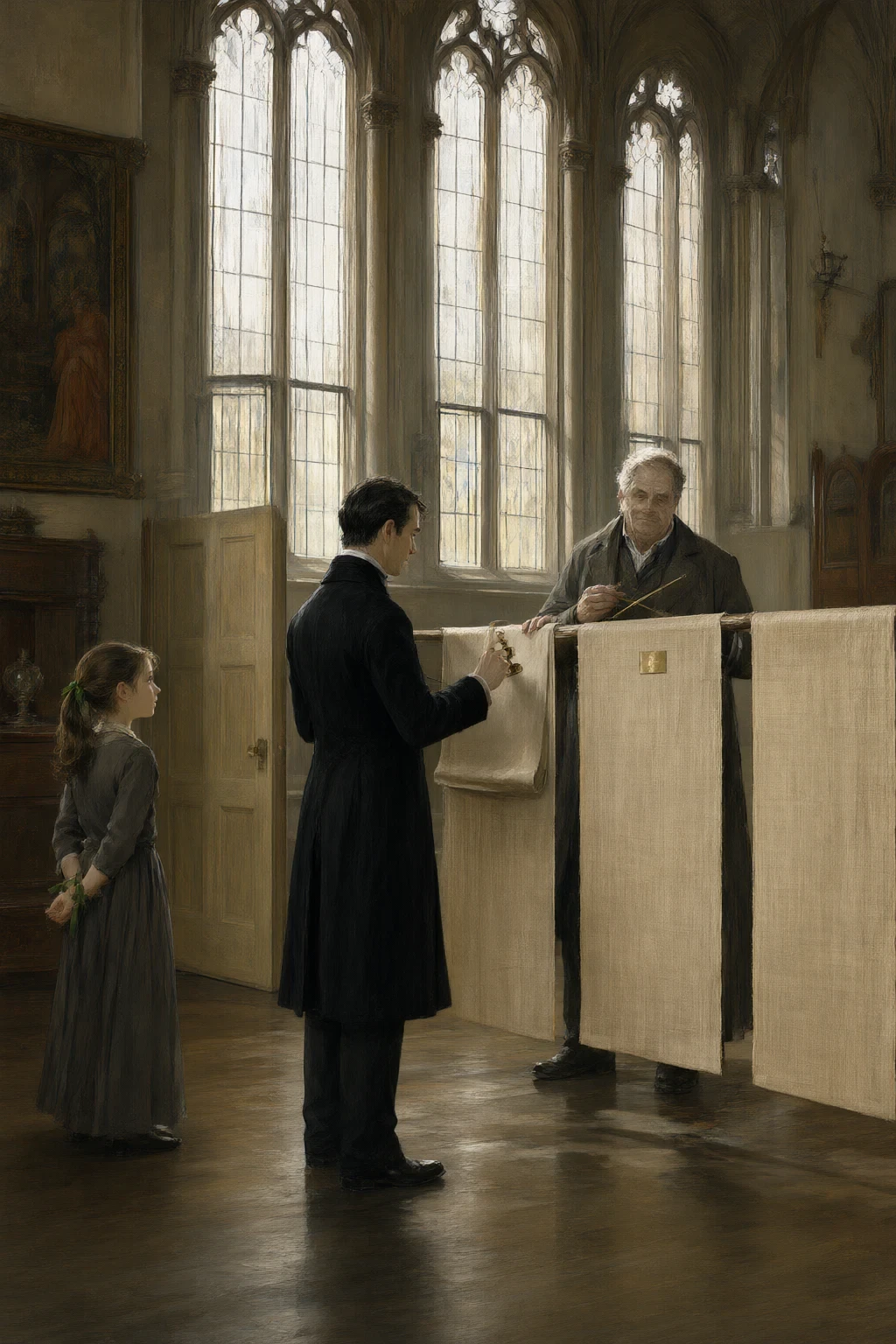
They hung them in order, and the hall had eight tall north windows and nothing else for light, and the cloths were five yards by three yards six inches, from a rail eleven feet six inches up to within a foot of the floor, and between the fifth and the sixth there was a place where nothing hung at all. In that place there was a length of unhemmed raw warp on the same rail with a small brass label nailed at the top of it, and the label gave a date and nothing else. Ilse Barrowe was in the room because the inspection brings children. It was one of two regulations everybody knew and nobody could explain: any child present is a witness to completeness, and the witness may not leave the room.
She was nine, and she had a green ribbon on her wrist which was the guild’s mark of an authorised child-inspector, and she had worn it since she was seven, and she stood with her hands behind her back in a way that four adults found difficult to be in the same room with. Petronel Gask asked for the cloths one at a time, with the form on a board. She began with the first, and Corin Slee stood at the wall end holding plans of the Warp House that he did not need, and the questions went the way the questions go. How long was it. Five yards, two inches off the loom. How wide. Three yards six inches. What was it of. Wool off the downland, spun in the town, the last of the spinning done in 1788, which he knew because the box of the last hundredweight stood in the corridor with a card nailed to it. Warp and weft to the inch. Forty and thirty-eight.
Colour. Undyed ground, madder at the head, woad at the foot, iron between them, and a saffron line in the second panel which was the only saffron in the room. Defects. None that the town had ever found. And then item six, and Petronel Gask wrote a heading and put a space under it and looked at the cloth for a while. The hall was quiet in the way that hall is quiet. Old Mab Ostry, who had come down from the Warp House on the strength of the hand bell and had not been asked to, put her hand flat on the rail. Ilse Barrowe said, “It has not got a—” “Miss Barrowe,” said Corin Slee.
He had not shouted. He had used the voice the guild uses in the Warp House, which is the voice you use to somebody standing in a warp, and he had used it before the girl had the fourth syllable out, and she stopped, and she looked round at him, and then she went and stood by the door with her hands behind her back and her face shut like a box. Nobody went near her for the rest of the day. She was keeping to the regulation. Petronel Gask wrote for forty-one minutes. She read it back twice, and a third time with her head on one side, and she asked two questions of the weaver she was given, and the answers were nine words and four words. At the end she said, “That is a full particular,” and turned the board round for Corin Slee to initial, and he initialled it, and there was a small sound in the hall like a cupboard closing. Nothing happened, which is what he was told afterwards by four separate people, and none of them believed it when they said it.
Nothing happened to the cloth. That is the hard part. It hung where it had hung for two hundred and two years, and the hall was cold at the top of the north windows. What happened is that it became complete. It had been woven in 1691 on the third loom of that shed, and it had hung in the dark of this room through four floods and a fire in 1804, and for two hundred and two years it had been worth more than the roof of the Warp House, and at eleven minutes past eleven on the fourteenth of April, 1893, it became honest, and whole, and worth nothing. “It’s wool now,” said Ilse Barrowe, from the door.
The rest of the day went as afternoons go. Corin Slee went down to the Assay Room and stood in the middle of the floor with the stamp on its lanyard going against his chest, and worked out what he had done in the order in which he had done it, because he was a man who did that. He had not lied. Every word on the board was true, and had been true all along, and the cloth had been a genuine weave with a decision in it that somebody had taken two hundred and two years before he was born, and he had put that decision into words in a cold room with a brass rule.
The stamp, in fact, was the trade. Where the cloth is whole, a certificate of wholeness is a true thing worth having, and the clerk is the only person in the trade who is paid to say that a thing is all there. The only cloths in Sparable for which that word is a lie are the cloths he stamps. And every bolt he stamps in a year is described before it is stamped. He describes it in the assay sheet: the yardage, the count, the colour, the condition, the weight to the ounce. Eleven sheets a week, fifty weeks a year. A sheet is a description, and a sheet is cloth, and the capital’s item six was the only line on the form that asked him for the part of it he was not to have.
He had stamped four hundred and eleven bolts in 1892 and he could not think of a single instrument in the guildhall, the Warp House, the Dye Yards, the Mending House or the Spindle Yard that could have told him which of them he had done that to. The only instrument he could think of was nine years old and had gone home for the day.
On the Thursday morning she unrolled the fourth, and the fifth, and the sixth. He had decided by seven that he would not certify a return that was not complete. That is not a large decision. It is what an assay clerk is for. A return with an empty item is a return that says something the clerk will not stand behind, and the seal of the guild is on the foot of it, and he had stamped beneath that seal for eleven years without once thinking about where the seal came from. There is one clause for what he wanted. He looked. An incomplete return may be certified as incomplete, the examiner shall note the deficiency, and the entry shall thereupon be refused. “I cannot certify it,” he said. “You will want the rest.”
“Of course I want the rest. I have come for the rest. I am sorry about the first one. It is not your fault and it is not mine, and neither of us will be able to say that afterwards, and here is the other half of it.” She unrolled the fourth at twenty past nine and the fifth at eleven and the sixth at noon, and every word she wrote of the fourth was true, and it was a particular with a beginning, a middle and an end, and the beginning was where the thing was not, and the middle was how wide it was not, and the end was what it was not instead. The hall emptied down to six people without anyone noticing, because a hall with a description being made in it empties the way a room empties when a dog is in it.
The six were Corin Slee, Petronel Gask, Old Mab Ostry, the weaver who had been answering questions for forty-one minutes, Wenna Pike, who had come up from the Dye Yards in her outdoor coat, and Vaughn Ostry, who had come because the hand bell had been rung and the commoner of a guild is rung for. “Right,” said Petronel Gask, and put the board down on the rail. Three items filled, five empty. “Item six. Full, true and particular, or of the entire absence. And here is the sentence from the standing instruction.” She read it. An entry of absence shall be made with the same particularity as an entry of presence, and a merchant who states his absence generally, in the words without ornament or unfigured, is to have his entry refused and is to be reported.
“General statements of absence are how a man hides a flaw in a warp,” she said. “That is what the rule is for. It was made in 1861 by a man called Quillet who had been beaten twice by a flax seller in this county.” She looked at the five cloths she had not done. “I am telling you now that I will not be able to write your five. I do not mean that I do not know how. I mean that I have done the third and read it back, and if I unroll it again I will do it properly, because I was trained to. That is a Tuesday morning difficulty and not a moral one.” Nobody said anything for a while. The hall is quiet at midday with the sun on the chalk outside. “Mr Slee,” she said. “You are the clerk. Say the thing you are thinking. I can see three of you preparing to say it and none of you saying it.”
Corin Slee said, “Item four of the standing orders. A commission is written in the negative, all the way down.” “Yes. I have read the orders. Twice, on the train.” “Then the absence may be stated as a refusal and not as a particular. A negative that goes as far as a particular is a positive with a courtesy in front of it. A man who says he has not got a two-inch madder selvedge has told me what he has not got, and the dye, and the place. A man who says he has not got a selvedge has refused me nothing that I did not have to look for myself.” “That is the difficulty,” said Corin Slee. “It is not the Board. It is the instruction of 1861. Your Board is right about warps and wrong about this, and we cannot get at the Board in less than three months, and I have not got three months for a gutter.”
They worked it out in the room over four hours with the doors shut, and not by the people who argued but by the two in the room who could not describe anything. Old Mab Ostry had been at the seventh loom in that shed for forty-nine years and had not opened her mouth once, and at half past three Fenn Roke asked her whether a cloth could be denied a thing in words. “It can,” she said. “You say what you left out and you say nothing else, and there is a great deal of not saying in it.” “That is not an answer to Mr Gask.”
“It is the only answer there is and I have been giving it since you were both in short coats.” She turned her head to the wall. “Ask the child. She has it in her head whole, and if we do this without her we shall write five lines and get four of them wrong and not know it, and the fourth will be the one that costs us.” They sent for Ilse Barrowe at four o’clock and did not ask her to look at the wall, and Corin Slee said so to her in the doorway, in eleven words, and she listened to all eleven. They gave her the eight lines on a single sheet in the guild’s hand, in the negative, as far as a refusal and no further, and the rule: read each line and say whether the thing it denied was there. It took her nine minutes. “Two is wrong,” she said. “Two hasn’t got a thing.” “What thing?”
She would not say it. She stood with her hands behind her back and looked at the second cloth for a long time, and then she said, “I can’t say it. If I say it, you’ve got to write it down, and then it’s been said.” And then she went along the rest of the lines and found two more that were wrong, and one that had gone further than a refusal and must be cut back to the bare denial, and Petronel Gask cut it back with the flat of her hand and left the tooth of it, and Ilse Barrowe said, “That’s better.”
It was Vaughn Ostry who found the way round item six, at five o’clock, by saying the sentence that a roomful of adults had been circling since eleven in the morning. He had been standing by the door with his hands behind his back for most of the afternoon in the posture of a man at a sale. “A return isn’t a description if nobody signs it as one,” he said. Petronel Gask looked at him. “The commoner of the guild countersigns a refusal. That is all the form needs. It does not need a particular. It needs somebody to stand under it and say that a particular has been refused, and that the refusal is made in the terms of the order, and that the guild of Sparable will not be argued with on the point. And I can sign that, because I have not seen the cloths, and I could not describe the first one if a man put a knife to me.”
They were on the road in five weeks. The return went back with item six marked absence stated in the negative and by refusal, and a countersignature at the foot in a large unhurried hand, and the capital returned a valuation in eleven days, and it was fourpence a yard, which is the standing tariff upon goods entered by refusal, and one hundred and forty yards at fourpence is two pounds six shillings and eightpence, with a shilling for the entry, and the whole of the Nine Omissions of Sparable was entered in the Register of Manufactures at two pounds seven shillings and eightpence on the nineteenth of May. Corin Slee recommended the gutter in six sections and did not say why, and the recommendation was minuted, and the committee adopted it, and it was carried out in the autumn.
Petronel Gask asked, on the last morning, whether she might keep the three sheets she had made. The town had no objection and could not see what use they were to her, and she said they were her work, and that an examiner who kept nothing was an examiner who had not been paid. Then she filled in the remaining five items of her own copy, and she wrote two words in each, and the two words were not stated, and she signed the sheet at the foot where a certificate of completeness would have gone, and dated it the fourteenth of April, and Corin Slee initialled the margin, because it was the custom of the office and it was not his job.
Her train was at twenty past ten from the junction below the shoulder, and the bicycle went on the train with her. In the register of the Board of Description for 1893 there are two entries for the parish of Sparable: one of the thirteenth of April, and one of the nineteenth of May, and both of them are true, and there is no third.