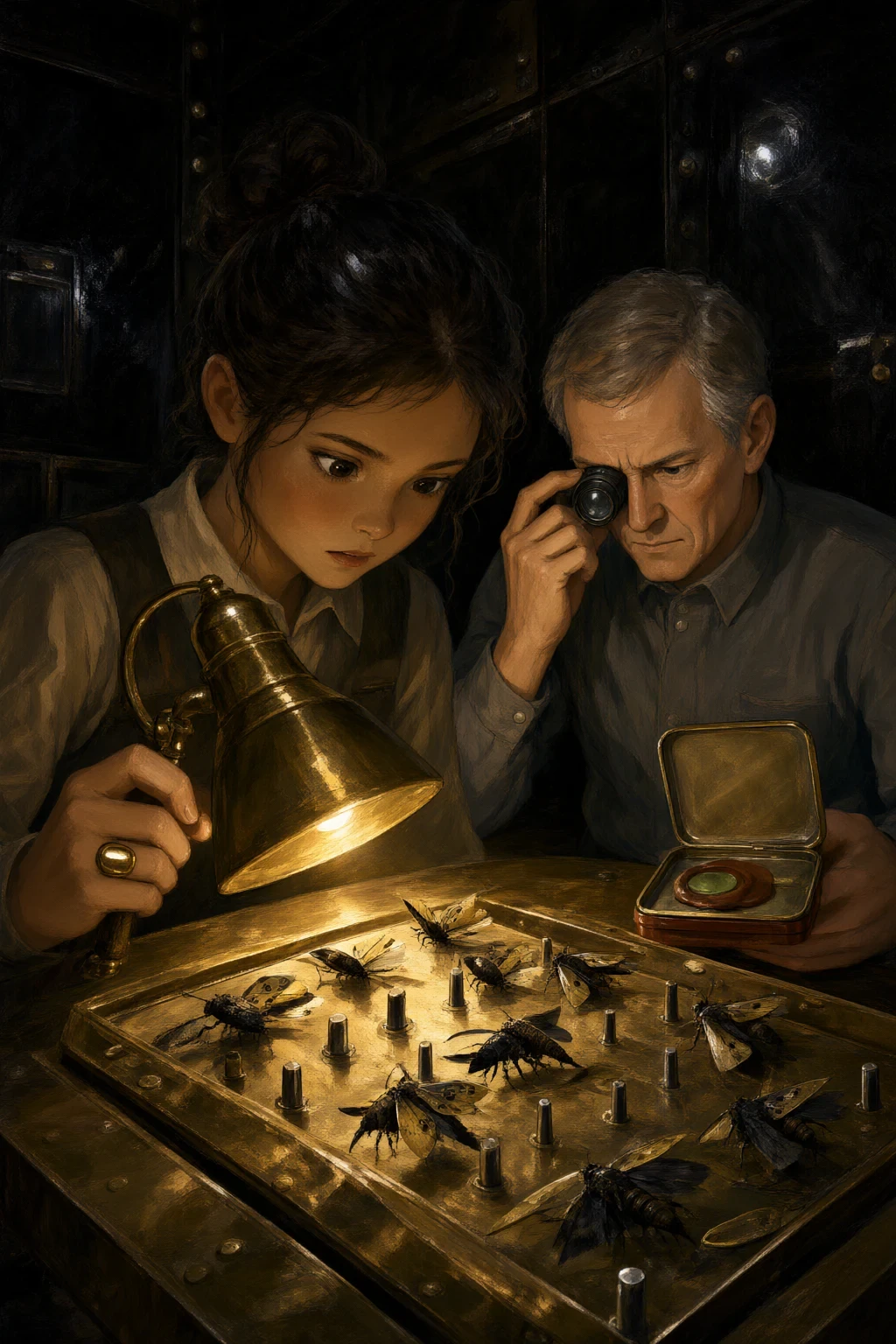
The fog came up off the Sallow at half past three and the Releasing Loft filled with it, so that the nine cradles stood in a grey room like the inside of a lung. Nell Ashgrove had been in the Loft since noon. She had counted forty crates, oiled the pin-joints, and been told twice by Skell that the wire on the lamp-bell wanted oiling, and once by Teasel Sillet that it did not. She was fifteen, and she had a scorched brass thumb-guard worn bright at the very tip, and the guard was the only thing about her the Loft had ever marked. A junior got the wrapping bench, the lift, and the tin. Everything else was for the loftmen, and Nell had learned the difference by standing very still. At six she rang the last crate of assay tins down into the vault lift. On the count of three she counted them, and there were forty-one, and she counted them again, and there were forty.
The Comparator Vault was six floors under Ledger Hall and ninety-four degrees in July, which was the point of it. The comparator drifts in the cold; the whole city knew that. The room had no window. Its walls were black with twenty years of lampblack worked into the plaster by shoulders, and on a brass bench down the middle of it stood a machine the size of a bread slicer with nine steel pins in an arc above a slot. Ansel Reyne worked it with two fingers and a jeweller’s lens and did not look up when the lift came. “Tin.” “Tin.” She set the crate down. Her right thumb went to the guard and stopped, because the guard is for hot work and this was not hot work, and she caught herself doing it.
He unwrapped the first tin. The moths came out in a row on oiled paper, brass wing-plates up, black and neat as a row of little coats. He put them in one at a time. The machine made a sound Nell had never got used to, a small dry click underneath a hiss, and each moth came out the far end onto a tray, and the tray filled. Thirty-nine. He put the fortieth in and did not take it out. The room was very quiet after the hiss. Ninety-four degrees, and Nell could hear the pin-joint of the last one ticking as it cooled. “That,” said Ansel Reyne, “is not to Pattern.” She had heard him say the other one perhaps two thousand times. That is to Pattern. He said it about a moth, a plate, a fog, a boy with a burnt thumb. He said it the way a man says that the tide is out. “Is it broken? A pin?”
“No.” He had not moved the lens. “Put the lamp here.” She moved the lamp. This was closer to the Pattern than she had ever been. It was a moth like the others, except that the right wing-plate had nine coil-holes drilled through it in a fine arc, and the arc was a hole too wide. “A coil-width,” Ansel said. “A full one. Not a hair. Somebody’s plate is a coil-width out.” “Because it is,” he said, before she had asked. He set the lens aside. “A moth that differs in any measurable part is not a moth. It is a fault. There is no other case.” “Whose moth?” He turned it over with a pin and read the paper label gummed under the left wing-plate. “Hobben and Marsh. Bellwright Lane.” Nell knew the name. It had stood in the second column of the Sallow Returns for forty years, small, always at the bottom. Four hands and a boy.
“They’ll be struck.” “They will.” “Off the Roll.” “Off the Roll,” said Ansel Reyne. “And the moth rendered, and the tray emptied, and the tin returned, and the line written. That is to Pattern.” He had not said that it was wrong. He had said the sentence that is in the book, about the book, in the room where the book was kept. “Four hands,” Nell said. “Four hands and a boy.” “Do you want to tell them first?” She heard how it sounded and did not unsay it. “There’s a way. If a house hears it from its own man it can —”
“I do not want to do anything.” He was already wrapping the moth in oiled paper, which he did not do to a fault, which told her he had not decided. “I have four hundred and eleven moths in this crate and an hour and a half, and then they are either faults or they are not, and there is no third thing I can do with the time.” At the second landing Teasel Sillet was whispering nine hundred and forty to the lamp-rail, and it was the only number in the building that Nell believed.
She went back down at the second bell and looked at the tin, because she could not make herself not look at it. The Loft sealed every tin with a thumb of guild wax, warm when it went on, hard by morning. There was wax on this tin. Nell held the lamp side-on to it, the way you hold a cup up to find the milk in it, and under the wax, at one corner, there was more wax. A second colour under the first. The old seal had been broken and the tin closed again, and the new lay over the scar of the old, and only the difference in the shine gave it away. Somebody had opened it tonight, after it was sealed, and put something in.
She stood in ninety-four degrees and understood that if she said nothing, then in the morning the fault would be certified against Hobben and Marsh, and Hobben and Marsh would be struck from the Roll, and the line would be written by Orla Vessey in a hand that had not changed since she was twenty-two, and every part of it would be correct. She also understood, and it came as a cold place rather than a thought, that if she said something she would be saying it about a person, and she did not know whether the person deserved it.
Under the hotplate rail on the wrapping bench was the fault tin, a shallow brass tray for bent pins, cracked plates, and anything anybody was not sure about. It went down to the Kilnfield with the Rendering Yard’s sack on the first of the month, and it came back empty. Nell looked into it in the hot light. There were nine or ten dead things in it, duller than living ones, the brass gone the colour of a wet coin. She did not touch it. A junior did not put a hand in the fault tin. But she looked at it long enough to see that the moths in it were not the same shape as the moths on the tray in the vault. One of these came out of her crate tonight, and somebody had put it there and sealed it over.
And then the harder thought arrived. Nobody plants a fault. Whoever did this had taken a fault out of that tray and put it into a live tin at the end of a shift, where a seal had to be broken, and had then broken a seal and re-made one — which is a skill, which takes practice, which means it had happened before. Which meant somebody had been in a worse hurry.
The man who came through with a lamp at that hour wanted something, and it was Fennim Sallowe, forty-four, black beard re-braided that morning as it had been every morning of his working life, green boots stiff enough to stand up in. “Sap’s in,” he said. “Four hundredweight off the line. It’s all from Row Eleven.” “You want to tell me what the silk is.” “Lampblack, wound on the bobbin with a warm sap bled out of a living tree four miles north, and the bleeding is the part that costs.” He picked the lamp back up. “I don’t say it to people. I say it to trees.” On the sixth landing, where the stair turns under the window that looks east over the fen, he stopped, which he did not do for anybody.
She found Osma Reeve still at the bench at eleven, and the hotplate had been off an hour and the wax had gone the colour of a bruise. “I need to ask you about a tin,” Nell said, “and I need you not to lie, because I will be able to tell, and because I don’t want to be lied to, and I will be extremely boring about it if you do.” Osma put the seal down.
“Forty came in on the third lift. Numbered H and M forty. One had a bent pin-joint, the long arm, snapped about halfway. That isn’t your fault, that happens in the cradles, but damage in the loft is charged to the house that made it and comes out of their quarter, and there are four of them. So you put it in the fault tin so it would not be theirs, and you put something in the tray to make the number forty, and you broke the seal and did the wax again, because you had to.” Osma did not answer for a while. Downstairs and far off the lamp-bell rang, and the whole city stopped for a minute and a half to listen to nine thousand wings go out over the water. “Yes,” said Osma Reeve. “Then we have to tell.” “I know.”
“Not me. I’m a junior.” Nell heard her own voice go thin and did not stop. “You have to tell Coll Bracken before he does the morning count, because the morning count is when anybody would look. If you go to him now, tonight, it’s a girl made a mistake on a Tuesday in the fog. If you wait until morning, it’s a girl hid a fault in a certified tin. Same girl. Different book.” “Coll will strike me off the roll.” “No. Coll Bracken isn’t a factor. There is no rule for a Loft hand. Halvard Tace can strike a house. There is no column anywhere in the world where he can put an eighteen-year-old.” Osma looked at the wax, and then at her, and said, “You’re going to go and ask Ansel.”
“He’s going to certify it anyway, he hasn’t got a choice. But he has to certify it true, and he can’t do that without knowing where it came from. And the minute he knows, it isn’t Hobben and Marsh’s moth any more. It’s a fault out of a cage with somebody’s hand on it, and then the Roll takes H and M’s name off for a thing a stranger did to it.” “Will that work?” “I don’t know,” said Nell. “I know that nobody has ever tried it.”
Ansel Reyne was still at the bench at eleven o’clock with four hundred and eleven moths gone and nineteen in the tray and the fault in the fault glass under his lamp. He listened to the whole of it without moving. When she had finished he did not look up. “You have thought about this for three hours,” he said, “and you have not once thought about what I am going to ask you at the end of it.” “Ask me.” “If I certify this fault as it stands, it goes to H and M. If I certify it as a fault sampled from the fault cage, then the fault is unattributed, the cage is emptied into the Rendering Yard on the first, and I have no means of knowing which house that moth came from, and neither does anybody. Therefore no house can be struck on the strength of it.” Nell put both hands flat on the brass.
“Then the fault is real and nobody’s fault, and H and M keeps the Roll.” “That is a thing that has never been certified in the hundred and forty years of the Roll.” “Then it’s the first.” “That is precisely the difficulty,” said Ansel Reyne. “A thing that has never been certified has no precedent, and a precedent is what I certify. I do not certify. I measure. The Pattern is nine holes in a piece of brass, and if the brass is wrong then the Pattern is wrong, and I cannot tell you which of the two is which.” He set the lens down. “Bring Halvard Tace.”
The factor’s office was a warm room over the canal with the shutter left open a hand’s width, and Halvard Tace was at his desk in black kid gloves, of which the right was cut from a different and browner leather. “Who paid for that?” he said. “Forty moths came up on the third lift from Hobben and Marsh, and thirty-nine are to Pattern. The fortieth has a coil-hole arc a full coil-width wide. A girl on the wrapping bench took a moth out of the fault tin and put it in to make the number forty, because one of the real forty had a snapped pin and she did not want to charge the house for damage done in the loft. The fault is genuine. It is not their moth. Nobody can say whose moth it is, and the cage goes to the Kilnfield empty on the first.”
Halvard Tace did not move for some time. He turned one glove over and looked at the palm of it, which is not what a man does when he is thinking and is exactly what a man does when he would like three more seconds. “The tin is sealed in the Loft, by the Loft. That seal is Concord property, and it was broken and remade by an uncertified junior, in her own hand, on a night when the fog was up. You have come to me and asked me to destroy the only proof in the world of what passed over a cradle.” “I asked you to say whose moth it was.”
“That is not a question a seal can be asked.” He closed the folio. “Miss Ashgrove. Four hands have stood in the second column of the Sallow Returns every year for forty years and no clerk has ever asked me to strike them, because there has never been anything to strike. If I rule the fault unattributed, the fault tin becomes a place where a mistake can be put and nobody is charged for it.” He said it without heat. Nell understood that it was the most frightening thing she had ever heard a grown person say, and that it was correct.
“The Roll is not a punishment. You all think it is. It is a list of who may be trusted with a document. Four people lose a trade and go and do another one, and one of them is my sister’s husband. And the seal stays as it is, because it is the one thing we have that cannot be argued with, and this city is about to need it very badly.” He put the folio face down, which was the end. “Who paid for that?” Nobody had paid for anything. It was only the way he opened a conversation.
The fault was certified at twenty past midnight in the Comparator Vault by Ansel Reyne alone, with the vault door propped and a lamp on the landing, because the Assay had to be witnessed and there was nobody left in the building to witness it. It went down the wire on its line: PLATE FAULT, WIDTH, COIL ONE, ARC OUT, TIN H AND M FORTY, SOURCE CAGE, UNATTRIBUTED. Every word of that was true. The fault moth went into the Rendering Yard’s sack in the morning. The Roll in Ledger Hall gained one line in a hundred and forty years, and the line was read by a pigeon and by nobody else. Nobody was struck. Hobben and Marsh came down the Mallow Road that spring with their benches, their forty years of work and their new address, and their neighbours put a wreath on a bench and told them the city was ashamed, and it was, in the way that a thing is ashamed of itself.
Osma Reeve was not struck off anything, because there was nothing to strike her off. Her indent was not countersigned, and no house would take an indent, and in the autumn she worked the winter as a mate on the Lamp Service at the Sounding Bridge. Teasel Sillet told her, every time she passed, that he had put nine hundred and forty in the rail. She never once told him to stop.
Nell Ashgrove got into the Vault at the end of May and asked Ansel Reyne to show her the Pattern plate. He took it out of its case. It was a small brass rectangle with nine drilled coil-holes in a precise arc, and the brass had gone the colour of a thumbprint at one end from sixty years of being picked up by frightened people. “This is the Pattern,” he said. “Nine. And a number. That is all it has ever been.” “What does each of the nine do?”
“Nothing, separately.” He turned the plate over. On the back was a maker’s mark and a date and a Concord assay stamp he did not read every day. “A coil is one turning of the bobbin. One turning is one measure of how far a moth carries, and how much it puts down. Nine is what a night will hold. The Pattern says nine because nine is what the ash has always made, and because in a hundred and forty years nobody has ever stood here with a good reason and made me change it.” “Whose moth was it? Somebody’s bench cut nine holes a coil too wide. That person has four hands and a name and they are on the Roll this morning and they do not know.” “No,” said Ansel Reyne. “There is no instrument in Candleford that will ever find out.” Then he said the other thing, in the way he said everything, as a report of the weather.
“I have signed eleven thousand and one lines that say how many went out, and not one of them says how far they got. That is not a fault in the machine. That is the machine working.” He shut the case. “You asked me what the nine coils do. That is what they do. They are the only place in Candleford where the size of the work is written down, and there are nine of them, and I have been reading the wrong end of the line for thirty years.” Nell asked him, in the corridor, what the fault had been made of, and he said: “Lampblack silk. Which is ash. Which is a tree.” And when she asked which tree, he said: “That is the second column. The second column is not mine.”