The Long Table was laid for nine, and there was bread, and salt, and a stew you could see the bottom of. “There are no turnips,” said Grist Bellweather. He said it to the table and not to anybody, the way you say a thing you have said to yourself for weeks. Then he hitched his flour-white apron at the elbow and looked at the floor, where the mill was. “Grist.” “I have counted the sacks. Have you eaten? No. Sit. Sit, there is broth.”
The working purse came open on the sideboard, and Tallow Merrick shook out every coin in it. The Vault was shut and three floors down, so this was what the Court had to spend, and this was all of it. “Six hundred and two, dreadful,” she said, flicking it aside. “Four hundred and six, dull. Very dull. Two hundred and eleven, dreadful. This one, dreadful. This one, a waste of good metal.” “They are all husks,” said Nim.
“They are all husks,” said Tallow, “and a husk spends as water and tastes of chalk. Offer one to a woman at the Upper Gate and she will not sell you turnips. She will sell you the news that the Court is eating its own dead.” So they needed one good coin, and there was only one way in the world to make one: stand in the disc of light and say something true out loud, with somebody in the dark who could contradict you. “It is a turnip,” said Marrow. “That is all it has to be. Turnips have not failed anybody.”
“Cresset does not light a lamp for a vegetable,” she said, her brass forearm up at the ring of it, steady as a post, the skin inside her cuff scorched brown. “If you are going to waste the flame, waste it quickly. Nothing in this palace is generous.” “You may only say true things. You may only say them once. And everybody here can contradict you, so do not bother with the tall ones.”
“Marrow Ollowan,” he said, “has told the story of the Duke of the Salt Cellar four thousand two hundred and six times, and nobody in this palace has ever once laughed at the part where the boat is upside down. That is not a story, that is a public service. And that is a coin in somebody else’s pocket.” The tray on the deal table stayed empty. Not a dull ring. Not a pale one. Nothing at all, because there was nothing true in it.
“Six hundred and two,” she said. “That is a turnip. Two hundred and eleven, that is a turnip. And this one is a very small turnip, and I have given it nine out of ten.” The tray rang once, softly, and Cresset put her brass hand over it and looked. “It mints,” Tallow said. “It mints,” Cresset agreed. “It weighs about as much as a bad breath, and it will not go across the rim of that table, because it is a true story about nothing at all. A turnip is not a story. Nobody has ever had one.” “Have you had a turnip?” said Marrow. “Have I had a turnip,” said Tallow, “six hundred and two times, and I will thank you not to do the arithmetic out loud.”
Then the Queen tried, and everybody was quiet, because you did not say no to the Queen. Ysandre the Long-Waited stood in the light in her crown of hollow gold ringlets, the circlet of split coins she had worn for six hundred years, with fingertips so pale she could read print through them.
“Once,” she said, in the formal beautiful voice she used for everything, “a turnip was asked to be a king. It was found alone in a cold field at the edge of the world, and it was told that it could rule, and it was frightened, and it said no. And because a vegetable is the only honest thing in the world, all that is good in this palace began. And then it was— well. It was something.” “Your Majesty,” said Cresset, “it is lovely, and there is not a word of it true.”
“I know,” said the Queen, and went and stood in the dark, and looked pleased about it, which was worse. The whole afternoon went like that. Turnips, always turnips. A turnip that was a star. A turnip somebody had loved very much and thrown away. All of them husks, because all of them were things people had already said a thousand times, and a thing said a thousand times in the same words is worth exactly nothing.
By the time the light outside went the colour of a knife they had six husks and no coin at all, and the market at the Upper Gate was about to shut.
Grist Bellweather put down the sack he had been holding for an hour and said, “I will.” “Have you eaten?” said Marrow. “No. Sit. Sit, there is broth.” “There is not any broth,” said Grist. “That was the broth. That was all of it, and I gave it to you lot, and I have been eating sifted flour out of the cracks by the millstone since the frost set, and I have not had a bowl of anything for eleven weeks, and I am the hungriest person in this palace and I have been since Michaelmas.”
“Cresset, I have been grinding the good tales,” said the miller. “The ones with the boats in. I have ground them up small and called it flour, and the truth is that it was easier than saying the barn is empty. I have been asking you myself for a month and nobody has ever said the words out loud.” Nim Ollowan stood up so fast her knee hit the table. “And then—” she said, “—and then you have been hungry on purpose.”
“Nobody may coin a story about him while he is standing in the Hall,” said Cresset. “He knows.” “I know it,” said Grist. “I have been standing here for nine minutes waiting for one of you to say a kind thing about me, and none of you has. I would rather be hungry than be told a thing that is only nearly true.” He wiped his hands down his flour-white apron. “Ask me properly. Out loud, in front of all of them, so I cannot go back on it.”
“Grist Bellweather,” said Ysandre the Long-Waited. “I, your Queen, am asking you now, and you may say no.” “I cannot say no to you,” he said, “and that is exactly why I want you to make me say yes, so that it counts.” “I do,” said the Queen. “Say yes.” “Yes,” said Grist Bellweather, and walked into the light.
He was not a good speaker. He spoke the way a man talks who has spent his life listening to stones. “My name is Grist Bellweather,” he said, “and I have run the mill under this palace for nineteen years, and I have never once told the truth about what is in the hopper.
“The barn has been empty since the first frost. Not nearly empty. Empty. No barley, no rye, no oat, and none since the turn of the autumn, and I have stood at the top of those stairs every morning of this winter telling the Court the mill was running fine.
“This is the bread. This is the flour it is made from. This is the stew, and the grey comes from the grey, and I have ground the last of the good tales into it, the ones with the boats and the fox and the long staircase, and I ground them because ground tales still make flour when nothing is left in them but the shape.
“That is the whole winter. That is what is in this Hall. And everybody at this table has eaten it and gone away, and I have said nothing, because a man who says nothing can still be trusted tomorrow.” The Hall went cold, and then it did not.
There was a small sound in the brass tray, and there was a coin in it, and it was heavy for its size. It was warm. And raised up out of the silver the way a thing comes up out of water was one turnip, small and plain, with the dirt still on the root. Then Grist Bellweather could not breathe.
He stood in the middle of the disc of light and could not draw air in for nine whole minutes, and while he could not, everything he had ever tasted came back at him in order: cold water out of the trough, the sifted flour off the millstone floor, his own broth gone, and last of all the grey bread. The bread is always the last thing.
When it was over he sat down on the floor of the Hall of Telling, which nobody had ever done in the history of the palace, and Cresset put her brass hand on his shoulder and he shook his head. “Nine minutes,” Tallow said. “I counted them. One hundred and forty-one, one hundred and forty-two—” “Thank you, Tallow.” “Eleven. What have you eaten today, Grist?” “Sifted flour,” said the miller. “Have you eaten? Sit. Sit, there is—” He stopped. He laughed at nothing at all, out loud, in the dark.
The Upper Gate was shut by the time they got there, and the mud had frozen over in ridges, and above the arch the old lintel was worn so smooth you could not read one of the stories carved into it. The guards had inked thumbs, and there was no market left to speak of, only the last two carts in the wind and a dog that would not go home. “Coin,” said the guard. “And a good one, if you have it.” “We have one good one,” said Tallow. “It is the whole of what we brought.”
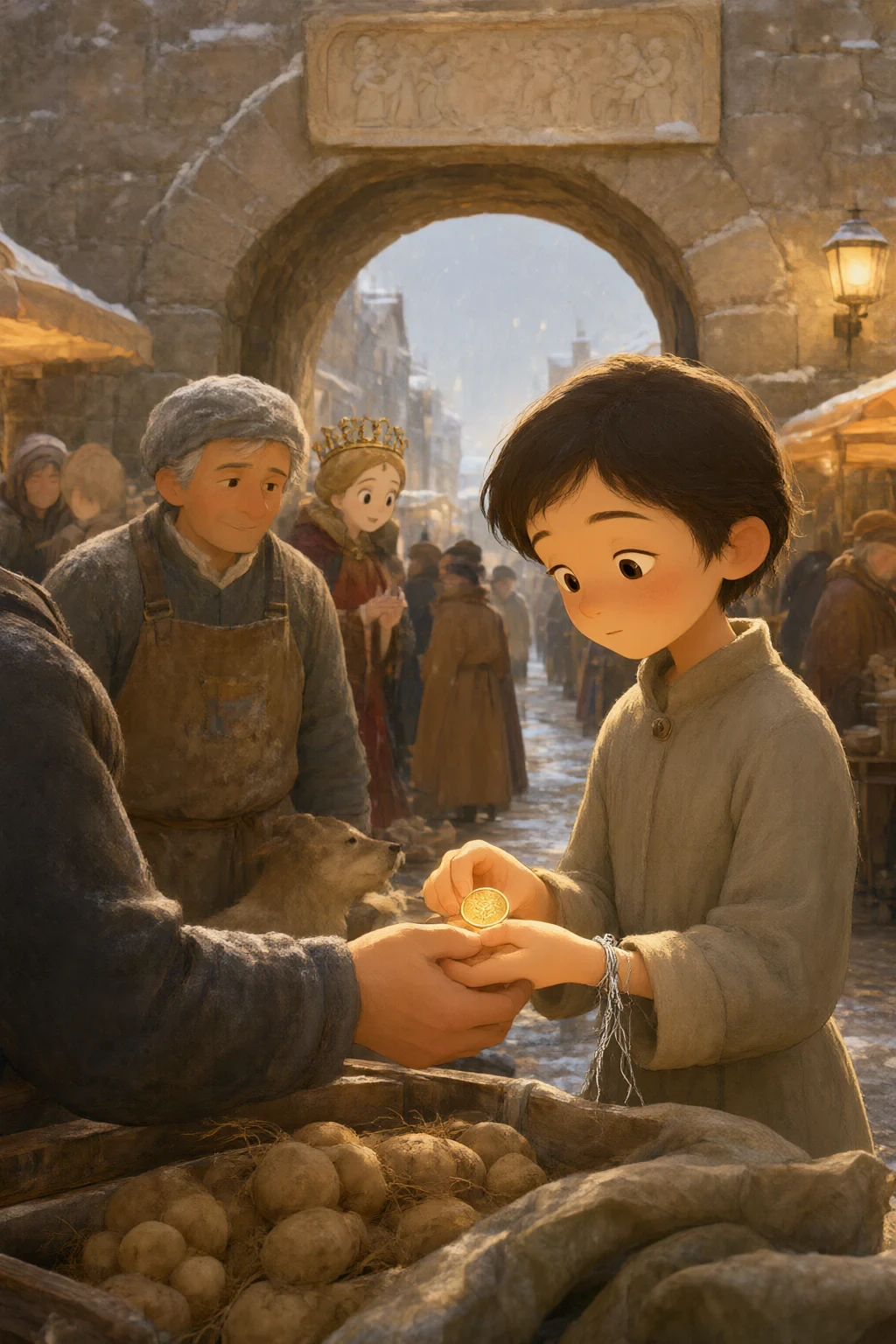
The cart belonged to a woman called Brill Oakes, who had been standing in the cold for six hours with her turnips under a wet sacking and a bad-tempered mule. “I am not selling to a court,” she said. “I am selling to people who have money, and that is the whole of the difference.” “Six hundred and two turnips,” said Marrow. “That is all the palace has had since Michaelmas, and I am not a liar, so check the arithmetic.” She looked at the mule instead of him, which was a mistake, because the mule agreed with him.
Then Nim stepped forward and put the coin in the woman’s hand, and shut the woman’s fingers over it. “This is what we had to sell to buy your turnips,” she said. “We did not have one true thing to say about a turnip. We tried all afternoon. This coin is a man telling everybody that he has been lying about our bread for nineteen years, and he ground it himself, and he has not eaten a bowl since the frost set. One true thing about a man, sold, and you cannot have it back.”
Brill Oakes stood in the frozen mud and looked at the coin for a while. “Aye,” she said at last. “Well, that is a fair price for turnips, and it is a filthy price for them, and I am sorry you paid it.” And she gave them the cart.
They counted the turnips at the gate, because nobody was going to stop Tallow doing that, and the guards held the sacking open and were patient about it. Nobody could buy a turnip with story. Story only bought the turnips. They came up the road in the dark behind a cart of mud and wet sacking, and there was no coin left anywhere in the world, because the one good coin in the purse of the Court of the Hollow was on a nail on a post outside the Upper Gate, and every coin that leaves is gone for good.
Tallow wrote it in the book that night. One good coin out, and gone, and then she wrote out the count of everything else in the pouch, because she could not help herself. And at the Long Table, with all nine places laid, Grist Bellweather cooked an actual turnip, and Ysandre the Long-Waited ate every bite of it, and looked up, astonished, with her pale thin fingers still on the knife. “Grist,” she said. “In all the years of my reign, in this court, at this table, in this— well. It was a turnip.” “It is still only a turnip, Your Majesty,” said the miller. “It was not a turnip five minutes ago,” said the Queen.