The inventory order from the Bureau of Vowed Obligations was four pages long and arrived at the Shrine of the Fifth Water on a Tuesday, and the first sentence of it was the sentence that ruined the spring. The clerk is to produce, for each shrine upon the pass, a complete and dated inventory of every living vow sworn there, distinguishing such as are held by persons now living from such as are held by persons deceased, and reconciling the same against the tally-sticks in the Reliquary of Set Terms. Marda Osk read the first sentence eleven times on the stair and then put the four pages inside her coat against her chest, where they stayed for the rest of her time on the mountain, because there is nowhere on a mountain to put a thing like that. She had been at the Fifth eleven days when Ruard Toke, the keeper, asked her to help him lift the desk board. “It is not the board,” he said. “It is what is under the board.” “It is a board.” “It is a board on three books,” said Ruard Toke, “and two of them are mine.”
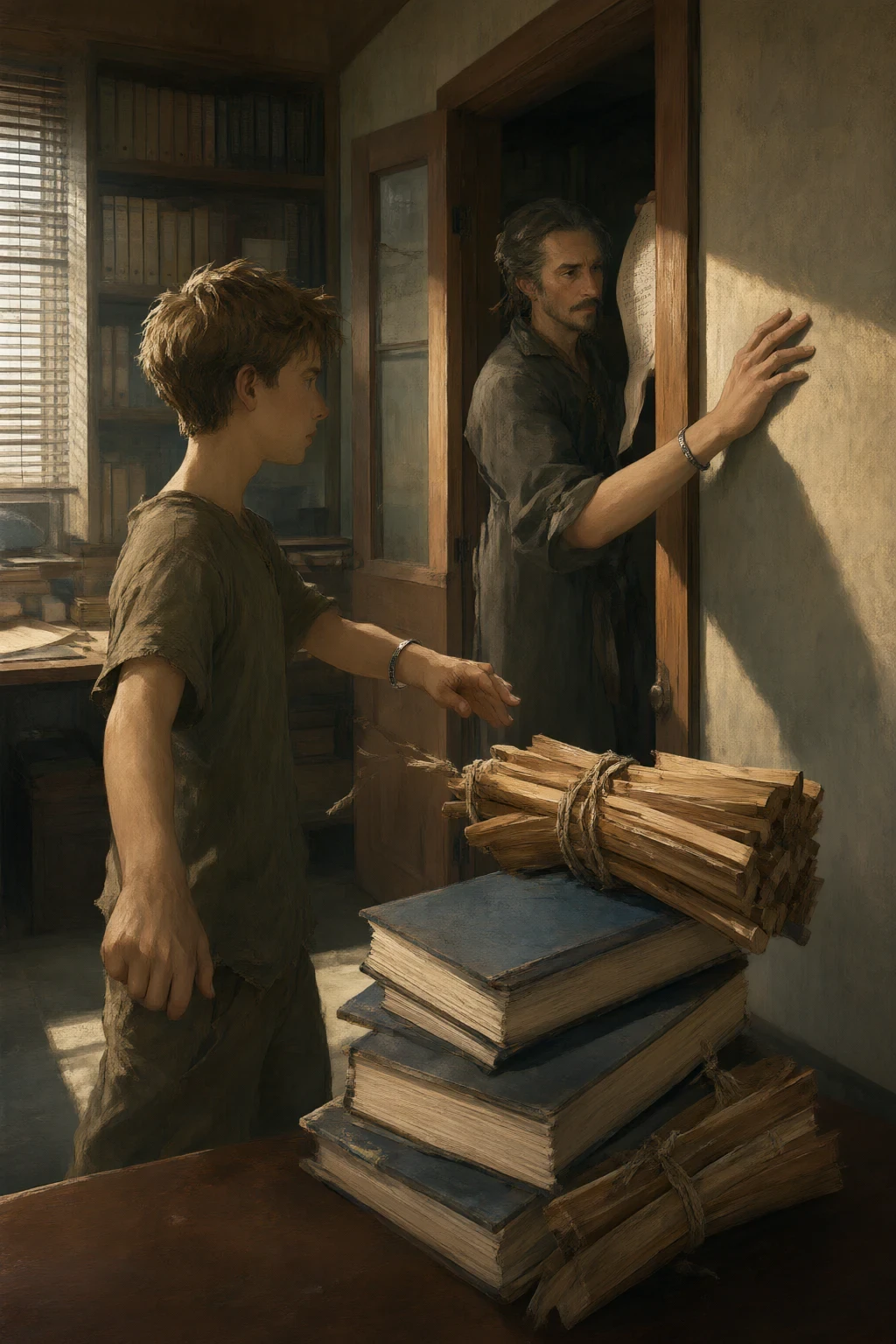
They took the desk apart on the floor of the copy room, which is the only warm room at the Fifth, and which smells of ink, tallow and old sheepskin, and which has a slate shelf of ledgers along one wall and a lectern and three stools. The board came up on one corner first, because the far corner had been screwed down by somebody in a hurry about forty years ago, and out from under it came, in order, a great deal of grit. Three books. The top one was the working register of the Fifth Water, begun in the year eighteen hundred and ninety-four, and it was a good clean book with a fair round hand in it and a hundred and six leaves used. The second was also a working register, also of the Fifth Water, begun in the year eighteen fifty-one, and it was in a different hand, and it had a hundred and four leaves used.
The third was the same again, begun in eighteen twenty-two, in a hand nobody in the room could read except Tovan Rell, and it had been cut short at the fortieth leaf and the sewing had gone. “There is only one register,” said Marda Osk. “There has only ever been one register,” said Ruard Toke. “The second one is the one I have been copying out of for nineteen years, because I inherited it and my predecessor inherited it and his predecessor inherited it, and the top one is the fair copy of the second one, and the fair copy is what the pass reads. The third one is the first. It is the original. It is not in the same sequence and it does not follow the same years, and I have never had it out of that press in my life.” “Then you have three registers.” “I have had three registers,” said Ruard Toke, “for as long as I have been able to stand up.”
Marda Osk made a plan on the back of the fourth page of the order, which was the only blank paper she had, and the plan had four lines on it and it took eleven days to carry out the first one. The pass keeps eleven thousand tally-sticks in the Reliquary of Set Terms, in bundles by year, and every one of them is notched once for every year of the term, and they are the only record anybody has of when anything ends. Four hundred ledgers survive from six hundred years of the shrines. Three of the four hundred are on the floor of the copy room at the Fifth Water, and they run into one another, because every keeper for a century began a new book when the old one filled and went on writing in the old one for a while longer, and then went on writing in the new one, and no keeper ever in the history of the world has been willing to say out loud which of the two is the register.
Nineteen days after the desk board came up, Tovan Rell came down off the top shrine and said he would read the third book, and would do it in the cold, because the light in it is not the light in this room, and because he was sixty-eight and did not intend to attempt the older hand in an afternoon. “You will want to be exact,” Marda Osk said. “I am going to need a number and not an impression.” “I have never in my life given anybody an impression,” said Tovan Rell, “and I have been sorry of it twice.” He set the book down, squared it, and put his magnifying glass on the table, which he had not needed in some years and would have carried out of the pass in a cart. “I will give you a number,” he said, “and I will give it to you with the words attached. If I have it right, and if I have it right.”
She hired two counters on the fourth day, because the Bureau did not pay for counters and she paid for them out of her own money and told nobody that, and both of them were found within a mile of the shrine. Ansel Dun was fifteen and had a burn on his hip from sleeping on the flat in sheep smoke, and split dirty fingernails, and a hand that was always already reaching for a wall. He had wanted to swear something at the Third Water and had not sworn it, and had come down the stair instead, and had been in the mule yard at the Second Water for nine days looking for anything at all to do with his hands. “Is it honest work?” he said. “Yes, right, yes, I will do it, is it honest work, because I will not do it twice.”
“It is counting,” said Marda Osk. “You will read a number out loud and another person will write it down, and if the two ever disagree you will do it again. That is all. It is the whole of the job.” “That I can do,” said Ansel Dun, with enormous relief. Brother Seat was the other one, and she hired him for the reason that he had been hiring himself for some months now, which was that he was the only man on the pass who had spent a winter in a cold room reading notches off wood by touch.
He came in and stood in the copy room with his hands behind his back, and the left shoulder was an inch higher than the right in the way it had been since a wall in the Vell mouth when he was twenty-one, and he had grown a full iron-grey beard for the first time in his life in the last eighteen months, and it made him look forty years older and ten years more certain. “You have a stick in your bundle,” Marda Osk said. “I can see the shape of it.” “I have had a stick in my bundle since the spring,” said Brother Seat. “Then you will not be a counter.” “I have not said I would be.”
“You would be one. You would be counting other people’s terms, and a person who is doing that has to be a person whose own number nobody is arguing about.” She said it gently, and she said it in front of Ansel, and she did not soften it afterwards, and that was the single thing she did on the whole mountain that she would take back if she could. “I am sorry. You are the best hand I have and I cannot use you.” “Eleven years,” said Brother Seat. “Nine of them are the ones I did. That is what I would be counting.” He finished somebody else’s sentence in his own head and got it wrong, as he finished everybody else’s, and went down to the Second Water.
They worked eleven weeks. The method was Ansel’s, and it was better than hers. Two people at a table, facing each other, with the entry between them. The reader read the term aloud in the plain sense and the writer wrote it in a column. Every hundred entries the writer read the column back and the reader said yes or no against his own memory of the page. Entries that could not be resolved went into a third pile and were not guessed at. Anything entered in a different ink, or with a different term, or with a term that disagreed with the term in the bundle for the same name, went into the fourth pile, and the fourth pile filled faster than the other three together.
There were eleven days of flat blue shadowless light. The sun came over the ridge in the morning, hit the far wall, did not move, and went, and the afternoons were the colour of a slate. They worked with the door shut and the window open and the Registrar coming through the open window all night in one long unbroken push, so that the pages had to be weighted with stones or they went. The stones were the stones of the Fifth Water, and by the end of the fourth week Ansel had begun to know them by shape the way he had once known the sheep of the flat under the pass. Ruard Toke came in every morning, read a page out of the third book with the older hand in it, said how many leaves were left, and went out again without saying anything else. On the last morning he stood in the doorway for a quarter of an hour and watched four people say numbers at each other across a table. “It is the quietest room on the pass,” he said afterwards, “and I have been thirty-two years getting into it.”
They stopped for two days in the seventh week, because the second week of the eighth month came round, and the pilgrimage market filled the terrace above the Ninth Step from the first light, and a pilgrimage market puts its own work into the only warm room on the mountain. There is no second room. A vow to be written goes to the copy-desk, because that is where the Register is, and the Register is a slate shelf along a wall and cannot be carried down a stair and up another one. So for two days the collation of the fifth shrine stood in a corner of a room with the door propped open, and the counting stopped, and a hundred and forty pilgrims came through in a slow queue, and Marda Osk stood at a lectern in a grey coat and wrote other people’s vows into the fair round hand at ninety seconds apiece, for a fee, because that is the fee, because somebody has to charge.
Ansel Dun was put on the desk beside her, because he had never in his life held a pen for this and because she wanted to see what he would do with it. He wrote well. He wrote quickly. He initialled in the four shrine colours — ochre, undyed grey, madder red, and undyed white — the way every hand on this pass does, at the cuff, the sash, the hatband, the boot-lace, and in the margin of a page for the sake of the record. “Say it back to me,” Marda Osk said to the queue, on the third afternoon, when a young man with a miller’s hands had got as far as a term of years and could not get past it. “Read it back to me exactly as you have said it, and I will write what you say, and not what I think you meant.” The young man said it back. Marda Osk wrote it. It took fifty seconds.
“Yes, right, yes,” Ansel said, under his breath, to nobody, and then stopped with the pen in his hand, and Marda Osk said, without turning round, “Do not say that at them. That is a sound people make to be agreed with. It is not an answer.” “Where did you learn that?” “On a stair, off a woman of seventy-four, eleven days ago,” said Marda Osk, “and I have thought about it every day since.” Tovan Rell stood at the back of the room for both days and did not write a word. He watched the queue, and he watched the hands, and on the second afternoon a woman of sixty went up to the desk and swore a vow of return, term of years, and the number of years was a small one, and Tovan Rell put his hand over his mouth and did not move for a full minute, and Ansel Dun, who was watching him because he had nothing else to do, noticed, and did not understand, and did not ask, and carried on writing in a fair round hand, which is what the fair round hand is for. “It is the quietest room on the pass,” he said afterwards, “and I have been thirty-two years getting into it.”
The complications did not arrive one at a time. They arrived the way hail does, sideways, twice a day, and they were all in the books before anybody on the mountain knew they were in the books. The first of them was a number nobody on the pass had ever put in a sentence. A term of for life is a term, and the mountain reads it, and there are four hundred and ninety-one of them in the three books of the Fifth Water alone. Not a hundred. Not forty. Four hundred and ninety-one people in living memory, on one shrine out of eleven, who went into a room and said the words and were made unable to do the one thing they swore not to do, until they died. The pass has been busy and prosperous for a century.
Marda Osk wrote that number down in a column by itself and ruled the column a full inch wide, and then sat looking at it for a long time, because a term of for life has no end in the book, and the book has no way of asking whether the person is still alive, and there is no column on this mountain for that question and there is not going to be one. The second was that the second book, the one the Fifth Water had been copying out of for a hundred and forty years, was not a copy of the first. It was a parallel register, begun because a keeper in eighteen fifty-two had decided the book he was working in was itself a copy, and had started again from the day-book, and had been quite right, and the two books then ran side by side for forty years with entirely different terms in them and not one keeper on this pass ever once comparing them.
The third was that the third book, the original, stops in eighteen forty-six, in the middle of a leaf, with no warning, and the last entry in it is complete, and the next one is the first entry of the second book, and between them there are eleven years that exist only in the day-books, and the day-books at the Fifth Water for those eleven years were burned by a woman making ash for a dye vat in eighteen forty-eight, who has been forgiven and has not been forgiven, and whose name is in none of the books.
The fourth was that a person may swear twice. The rules say the body will not hold a silence and a fasting in the same term. The rules say nothing about a labour sworn twice in one year, and it turns out the body will hold that perfectly well, and there are four people on the Fifth roll who are in twice, on two different leaves, in two different books, with two different terms, and who will go on being in twice until somebody can say which of the two they are. “We are not going to decide that,” Marda Osk said, when Ansel put his hand on the fourth pile. “We are going to put it down. There is a difference between finding out and deciding.” “There is not a difference if somebody has to go home tonight and not know,” said Ansel Dun. “There is exactly that difference,” said Marda Osk, “and I have been unable to find it in eleven weeks, and I am going to stop looking for it this evening.”
The nineteenth of them came out of the second pile, and nobody noticed them for six weeks, because the second pile is the pile of things you cannot read, and a person whose stick is simply not in the bundle is not a thing you cannot read. She found them by doing the thing she had sworn to herself she would not do, which was to go back through the second pile at the end and ask, of every name in it, one question: is there a bundle, and is there a stick in the bundle, for the year this person swore. She had been putting the second pile aside for six weeks on the grounds that a person who cannot be read is a person you must not guess about, and on the seventh morning she guessed about all two hundred and six of them, out loud, in an hour, in a bad temper, with Ansel reading the years off the slate-list and Ruard Toke going down to the reliquary in person to fetch bundles off the shelf and coming back up four hundred steps with them under his arm. It is a very stupid thing to do. Tovan Rell said so twice, and then went and helped.
Marda Osk put her own name in the fourth column of her sheet, which said why a thing had gone into the fourth pile, and she found nineteen entries in the working register of the Fifth Water, and nineteen names, for which there was no bundle, no stick, no burn, and no trace of any kind in the Reliquary of Set Terms, and the years in which those nineteen people swore were not lost years. They were ordinary years. In six of those years the bundle exists and is tied with the ordinary twine and is the ordinary weight. Either the sticks were never cut, or they were cut and were not put in the bundle, and in either case there is now no object in the world that knows what those nineteen people swore or for how long.
“Do not tell me what you think happened,” Marda Osk said to Ruard Toke, in front of Ansel and Brother Seat and Tovan Rell, all of whom had come, “because there are eleven answers to that question and every one of them is a guess, and I have spent my life not guessing.” “Then what do you want me to do?” said Ruard Toke. “I want nineteen names on a piece of paper in four colours, and I want them initialled, and I want somebody from the Bureau to be told that there are nineteen people on this pass whose terms cannot be read by anybody living, ever, by any means, including a keeper opening a door.” Nobody said anything for some time. “Then they are still in it,” said Brother Seat. “They are still in it,” said Marda Osk, “and they will be still in it, and that is not an opinion, that is the only possible position, because the mountain has what it has and it does not take corrections.”
The number arrived on a Thursday in the eighth week, in the second-light of an afternoon so flat and blue that Brother Seat said it looked like the inside of a bottle. There were four hundred and six surviving entries in the three books of the Fifth Water. Of these, one hundred and sixty-three are held by people now living whose terms can be stated and are stated. Nineteen are held by people now living whose terms cannot be stated by anybody. Four are held by people who are in twice. The remainder, two hundred and twenty, are held by people who are dead, and the terms of the dead run on in the books exactly as the terms of the living do, and will run on until the books are burned.
When Marda Osk had the number she went out of the door and looked at the sky, which was the wrong thing to do, and which four people followed her out to do, and they all stood on the flags outside the copy room in the enormous bright silence and looked up at it, and Ansel Dun said, “Is that it, then,” and nobody answered him. “All of that,” said Marda Osk, “is a thing I can write on a piece of paper.” “Yes,” said Ruard Toke. “It is true, and it is checked twice, and I have had it read back to me by a man who has not wanted it to be a different number.” She put her hands in the sleeves of her grey coat, which after eleven weeks was no longer clean at the shoulder and never would be again. “And there is not one single thing anybody can do with it.” “Come inside,” said Brother Seat, “before you say the rest of that in a doorway.”
The Bureau wanted every living vow dated, and there was no way on earth to date them. That was the finding, and it took five weeks to establish and it was the only thing Marda Osk had gone up the pass to find out. A term cannot be dated by asking the holder, because a holder does not know the date and the body does not tell them and has never once been asked to. A term cannot be dated by the stick, because a stick has notches and no name. A term cannot be dated by the register, because the register records the term and not the day, and never recorded the day, because a vow was not supposed to be about the end. And it cannot be dated by the Reliquary, because the Reliquary has eleven thousand sticks tied by year, and the tying by year was done by eleven different men in eleven different centuries, and the only cross-reference that has ever existed between a name and a stick is a keeper’s memory, and keepers do not write their memories down.
The whole of what the Bureau had asked for, in four pages, could not be produced by any instrument on the mountain, and the reason it could not be produced was not a shortage of clerks. “It is the same as if you sent me to count the hairs on a goat,” said Marda Osk. “It is a hard thing to put in a letter,” said Ruard Toke. “It is the only true thing anybody has said on this mountain in eleven weeks,” said Marda Osk, “and I am going to put it in the letter, and it will be read in a city by a person who has never been cold, and it will make no difference to that person whatsoever.”
Brother Seat counted for six weeks and never once counted himself, because Brother Seat was not on the Fifth roll. He was at the Ninth, and the Ninth had its own three books over its own hundred years, and nobody had unstacked the Ninth desk board, and there was a year on the pass with no bundle in it and a chest in a top room that had not been opened since before Tovan Rell came up the stair. “I have been one of those four hundred and six,” he said, on the last morning, standing at the flags in the enormous bright silence with a slate of numbers under his arm. “I have been standing in this room for six weeks reading other people’s terms out loud in the plain sense, and every single one of them knew the term, and about a third of them were astonished by it.” “So were you,” said Marda Osk.
“Yes,” said Brother Seat. “But I have been one of them since the spring, and you have been upstairs for eleven days, and there are three of you in this building who have not been out of it, and I would like somebody to come upstairs with me and take a board off a desk and look at what is underneath it, because I have now got a number for the fifth shrine and I have not got a number for myself, and I have discovered that those are the same feeling.” Then he went up the stair, which took him a long time, and Tovan Rell went with him, because Tovan Rell had nothing to do for a fortnight and had said so twice.
Marda Osk went in and wrote her report. It ran to nine pages. The first four pages were the number. The fifth page explained how the number had been arrived at and how it had been checked and by whom, and the checking is what she was proudest of, because it was real: two readers, two columns, a read-back at every hundred, a third pile for what could not be read, a fourth pile for what could be read two ways, and a refusal, twice, to resolve anything on the fourth pile at eleven o’clock at night. The sixth page was the nineteen. The seventh, eighth and ninth were an account of why a complete and dated inventory of the living vows of this pass cannot be produced by any person using any record that exists, set out in eleven numbered paragraphs, without complaint, and ending with a sentence she had rewritten four times.
A thing that is recorded properly is not a thing that has been dealt with. She had believed that at the bottom of the stair in the low country when she was twenty-two and had a new coat. She did not believe it now, and she had the nineteen to thank for it, and she wrote a fourth version of the sentence, and initialled it in four colours, and dated it, and put it in the envelope, and carried it down four thousand feet of stair in a spring that had not once been warm, and handed it at the terrace to a man with a grey coat who took it without looking at the length of it.
The tenth page, which there was no room for in the envelope, was the one she wrote last, and it was four lines long, and it read, in full: I have been on this mountain sixteen weeks and I have established a number. I have not been able to establish a single date. I have established that the establishing of a date is not possible with the instruments this mountain possesses, and that no further quantity of clerks will alter that. I was sent here to bring the pass into compliance. It is not possible. I do not know what is to be done instead, and I have not been able to find anybody on four hundred miles of stair who does, and I have stopped asking, because every one of them told me a story about a door. She had a great many pages still in the notebook when she got to the bottom, and she did not write them, and she left the notebook on the copy-room shelf. Ansel Dun found it in the autumn, after the snow, with the stove unlit and the three books of the Fifth Water standing in a row on the desk in a light that was the same every day.