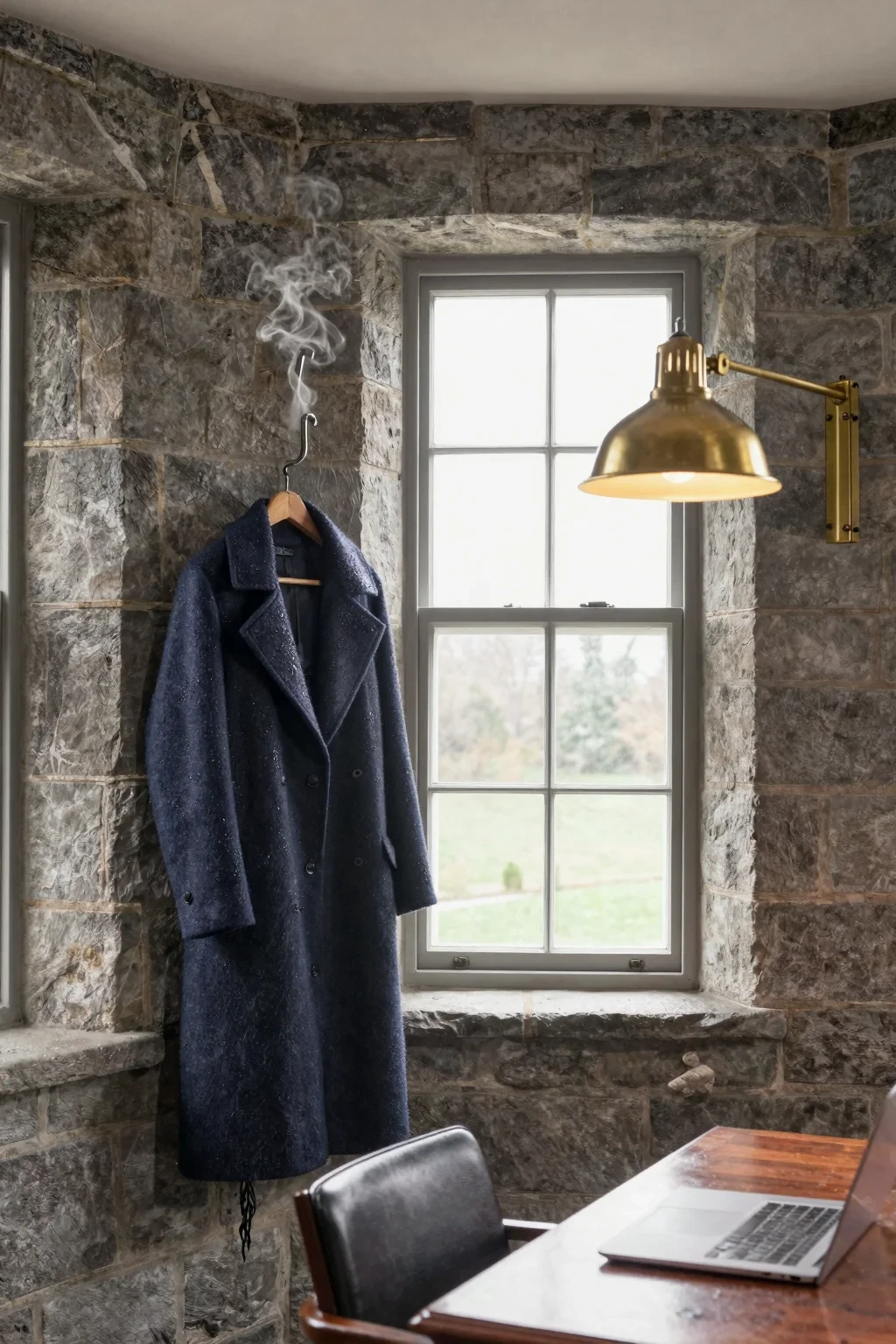
The consent book lay open on the desk in the office with a lead weight at each corner, because the windows of that room face north and the wind comes off the water and gets into anything left loose. It is one volume in calfskin, four hundred pages, begun in 1889, and it is ruled in three columns. A name, a date, and the line the name lives on. Nothing else, because nothing else is what it is for. Bronwen Vasey had it open at the spring of 1936, with her ruled notebook squared to the edge of the desk and her spectacles off the cord and onto her nose, which she did only for a thing within a foot of her eye. The tin tube lay along the edge of the desk where it had lain for six years, with nothing in it, because nothing ever went into it that was worth the trouble of unrolling. She had audited the line eleven times since 1931, one in every quarter, and every one of them had cleared it.
The light comes off the water at two in the afternoon in March and comes in flat, and that desk is the only place in the building where a north window throws a clean edge across a page. She moved the lamp out of it and looked along the leaf instead of down into it. The three head rules are fine and upright and close together, and they stop two lines short of the head margin, because the man who ruled them in 1889 ruled to a hand and not to a frame. The fourth rule is not one of the three. It is the same ink, or near enough, and the same nib, or near enough, a blunter stroke sitting a hair to the right of where that fine hand would have put it. But it does not begin in the head of the page. It begins at the level of the first written line, and it runs down the leaf, and it stops.
It stops eleven lines short of the foot margin. It is not an erasure, and that was the first thing she checked, and the checking took a quarter of an hour with a glass and a breath held. No scraping. No bleach. No pouncing, and no pale place where ink had been taken off and the paper left tired. It is a rule that was never in the head of the page. Somebody ruled it, and nobody took it out. She wrote in the notebook: fourth rule, vertical, begins at first written line, ends eleven lines short of foot. No erasure. One ink. Then she went back through the quire leaf by leaf, and it was on all of them, and on none of the leaves before the spring of 1896.
Before she wrote the years down she checked the thing that would have been serious, which was whether the column had any bearing on consent. She went back through eleven springs of leaves with a glass and read the names, and beside the names there were figures, and the figures said nothing whatever about whether a name had been spoken at the pan, in one sentence, out loud, with the grip-man hearing it. A name stands or it does not stand. That is the whole of the law, and a figure set to the right of a name cannot put it there and cannot take it out, and the cable knows the difference as well as the clerk does. And the line has run on these pages since 1889 without once stopping for want of a balance, which is a thing you may check from the brake tally and which she meant to check. So it was not a column of consent. It was a column of something else, and the something else would be named by whoever ruled the rule.
Ivo Trant came in at half past two with the wind figures, because he brings the wind figures before anything else and everything else after. “Twenty-six at the mast and gusting thirty-one,” he said. “She'll hold. I've her on the drum and I'll not have her up before four.” The red woollen mitten was on the left hand and the right one was bare and white to the second joint. He came in counting in fours under his breath, which he does on stairs and does not know he does. “And the record of crossings,” she said. “Where is it.” “Chalk on the board in the office. Every crossing, both ends, and the number turned and rubbed out at Candlemas. And the year-books, in a tin, with Gwilym. From 1905.” “Before 1905.” “There's no paper before me,” he said. “There's the chalk, and then there's nothing. And the chalk's not been on the wall since I papered it in 1921.” She let him go, and wrote on the same page: figures present 1896 to 1910. Figures present and empty 1911 to 1918. Figures present and filled 1919 to date. Then she began at the beginning, which is the only place an audit of a page can begin.
The port book was the instrument. The clerks of the winding house kept the harbour's port book as well as the consent book, because the harbour company paid them, and the port book is dated every day and has never once been interrupted. It is the same men. She laid the two open side by side, the consent book on the left turned to a quarter, the port book on the right turned to the same quarter, and read the hands across the gutter. Then she took the harbour wages book off the shelf behind her, where it has sat since before she was in the office, and read the engagements off it. Hywel Bevan, Michaelmas 1889 to Candlemas 1890, eighteen shillings a week. Dafydd Prothero, 1890 to 1893, one pound. Gwilym Trefnant, 1893 to 1896, one pound two shillings. Evan Cadwallader, 1896 to 1904, one pound four. Rhydderch Pritchard, 1904 to 1911, one pound five. Morgan Ellis, 1911 to 1919, one pound six.
Ifan Wynne, 1919 to 1931, one pound eight. Llewelyn Morgan, 1931 to 1933, two pounds. Caradoc Vaughan, 1933 to 1934, two pounds two. Emrys Bevan, 1934 to 1936, two pounds four. Idris Pritchard, from Candlemas 1936, two pounds six. Eleven clerks. The book had been kept by eleven hands and the hands changed and never changed back, and now the book could be read against the wages book the way you read a tide table against the moon. The figures in the fourth column begin on the leaf for the spring of 1896, which was Cadwallader's first April. They are in Cadwallader's hand. But they are set a little further from the rule than his names are, so that they sit in the middle of the column instead of against its edge. A man writing to himself. She wrote that down too, because it was a thing she could not prove and did not want to lose.
The figures stop. The leaves for 1911 through 1918 are ruled and the column is empty on all eight, not a figure, not a dash, nothing. Then the leaf for 1919 has a figure in it. 110,275. And the figure for 1910, the last figure anyone wrote in that column before the eight blank leaves, is 110,275. The same figure to the digit, nine years apart. A running total of crossings cannot stand still for nine years. There is a ferry and a mill and three slate headings and two churches and a market, and in nine years the town made some thousands of crossings, and if you cannot remember what they were you may write nothing at all, but you may not write the same figure twice. So the 1919 figure is not a count. It is a copy.
And she could tell it was a copy and not an odd coincidence of arithmetic because of the ruling. Every quire in that book is ruled in the hand of the clerk who came to it. In the quire for 1919 the fourth rule is drawn twice: once in the lighter stroke of the earlier clerks, and once by Wynne, straighter and heavier, a sixteenth of an inch to the right of the other. Nobody rules a column a second time unless he means to put it back to use. Nobody had asked him for anything.
The winding house committee's minutes came into the harbour office in 1904 with the deeds, when the company bought the line, the millpond and eleven acres of poor moor off the mine. Bronwen had a hand on them, because the harbour is the freeport and the deeds are kept with the port papers, and she had never once opened that parcel. Item six of the fourteenth of November 1904. That the return be discontinued from Candlemas next, the column to remain ruled, and the figure standing at that date to be carried against the name of the clerk in each successive volume. Carried against the name of the clerk. So it was not abolished. It was put on paper and handed to a clerk as a duty with no form to fill it in and no office to send it to. Eleven times signed. Evan Cadwallader signed it, and was dead before Christmas.
She read it four times. Not because it was difficult. Because it said the figure standing at that date, and the figure standing at that date was the figure for 1904, which was 88,914. And the column went on being filled to 1910. So for six years after the meeting that created the duty, somebody kept the duty, in the same ink, in the same sort of hand, with no minute and no instruction and nobody to hand it to. That is how a duty dies. It is also how a duty is kept alive. Neither is a story. Both are only what a clerk does with a piece of paper he has been handed.
Gwilym Ore had the tin. Thirty-one year-books, one a year from 1905, and he brought them out onto the mess-room table, and took the pencil from behind his ear and put it down, and then put it behind the other ear. The book for 1905 opened with a single carried line. Brought forward from the year of opening, 88,914. Bronwen read it twice. 88,914 was the figure Cadwallader had carried to the end of 1904, computed off the daily chalk on the office wall by a man copying it twice, because the chalk was rubbed out every Candlemas and the copy book was not. The chalk and the drum had never differed by a crossing. Not once in nine years.
The sum had to be built forward from 1905, because the drum's books begin in 1905, and the only common ground the two records had was the figure standing at the end of 1904, where they agreed to the digit. Thirty-one years was the whole of what there was to reconcile, and she did it a quarter at a time, four pages a day, and she did every sum in the notebook and not one of them in her head, because the figures go back forty years and a woman of thirty-eight is not going to carry them. For two days she brought the drum's year totals up into the notebook and set them under the column's, and she could not state either figure as exact and said so on the page: the column's totals are read off eleven hands and the drum's are read off a man writing up from memory in January. At Candlemas she wrote them side by side. Consent book, running total: 331,895.
Drum, year-books brought forward and summed: 331,884. Eleven. Gwilym read the two figures over her shoulder. “Eleven,” he said. “Eleven journeys the town paid for and did not get,” she said. “The drum's never been wrong by a crossing,” he said. “It stops. It holds. It does what it is and it does it the same every time. That's not a machine that miscounts.” “No,” she said. “It is exact. Those are two different things and I have spent five years trying to make them into one.”
She went up to the cabin for the brake tally, which is not a book but a sheaf of the backs of the day's chalk boards, and Ivo Trant gave her the eleven without looking at them. The ninth of February, 1919. Gusting forty-four at the mast, nine minutes on the brake above the second trestle. The third of January, 1923. Ice on the drum housing, fifty-one minutes. The twenty-eighth of November, 1928. Not completed. The rest the same shape: a date, a wind, a time on the brake, and in his hand two words, not completed. “A crossing that stops in the span is not a crossing,” Ivo said. “It begins and it does not arrive. The car comes back down in the same hour or the passengers walk. Nobody has ever been hurt on that score and I have written the word twice because I write everything twice.” “The column counts them,” she said.
“The column counts them because the column counts what people paid for and the drum counts what the drum did. They are two good books about two different questions and neither of them is a lie.” He put the red mitten in his pocket. “You have been auditing this book since 1931,” he said, “and you have never once found anything in it.” “I found a column.” “A column's not a mistake, Bronwen.” “No,” she said. “It's eleven.”
She went to the school on the Friday because Aldith Marner keeps a tally and had kept one since 1927, the whole school on a Friday, in a ruled copy book, because she is a schoolmistress and a schoolmistress keeps records. The tally is her own arithmetic and has no connection to the winding house, and when Bronwen laid the column beside it she found the same two holes in it. Three Fridays in 1927 and then the ink changes, because Aldith had been ill, and then nine months of nothing. One Friday in 1931 in a different ink, because it was a whole-school day and the last day of term. Two records made by two people for two reasons entirely their own, with no reason whatever to agree with each other, agreeing in the same two places. Aldith turned the pages to the end and looked at them for a while. “Then what is the fourth column,” she said. “At present it is a figure that does not change.” “That is not an answer,” Aldith Marner said. “That is a description of where you have got to.” And she waited, in the way she waits, which is the whole of her method and takes longer than anybody can stand.
Teofil Rownt came on the Monday with the brass token on its chain worn through at the edge and a lease in his hand, and shoes that had never seen the loading stage. The mineral rights beneath the lower line came up for re-leasing in the autumn, and he wanted to be able to say the line is run in his interest, which would have been true, and which he had never been able to say out loud. “How many crossings,” he said. “The Grip. Since it was built.” “Three hundred and thirty-one thousand, eight hundred and ninety-five, to Candlemas,” Bronwen said. “Give or take the leaf I have not audited.” “And how many of them are mine.” She had been waiting nine days for the question and she had known the answer to it before she found the column.
“The column is the whole line,” she said. “Both sections. Both directions. It does not separate the lower line from the mill line, and it never did, because in 1896 nobody thought there would ever be a day when somebody wanted to know. And that division was not written down in 1896 and it is not written down now, so I cannot give you a figure and I cannot make one up, and if I gave you half of it you would be quoting half of it in a lease.” Teofil Rownt put the lease down on the office desk and did not finish the sentence, which is his habit, and which on that afternoon was the correct thing to do.
She ruled the heading on the Thursday. JOURNEYS, LINE, TO DATE, above the fourth column, on every leaf of the book that carries it, in her own hand, which is not any of the eleven, with the date and her initials in the margin beside it. And under the 1919 leaf she wrote four words that had never been in that book: nine years ruled and not used. That was the whole of the amendment. The twelfth audit was the first that had found anything, and what it found was a column. She signed it, and then she wrote the letter she has wanted to write since 1931, to a man in Liverpool who had audited cable ways and had since retired, asking him to come and audit the arithmetic of the line by somebody from outside the town. And she asked Gwilym Ore whether he would sit in the room while the outside man was in it, and bring the tin.
“Yes,” he said, “if you'll tell me what eleven is for.” “It's for the arithmetic,” she said, “and for whoever signs the next one.” He looked at her a moment. “That's not a number.” “No,” she said. “It is the answer to one.” At four she put Ivo on the drum. The wind had gone round to the south-east and eased to eighteen, and the crossing went up with the pans heavy and Nell Cardew standing in the shallow one with her lunch in her hand, facing the drum, as she does. Bronwen watched it from the office window with the book shut and a lead weight at each corner, and then she went in and chalked four hundred and six on the board, both ends, and turned the number, and rubbed it out, because that is the arrangement, and the number went with her up the hill in her head instead.