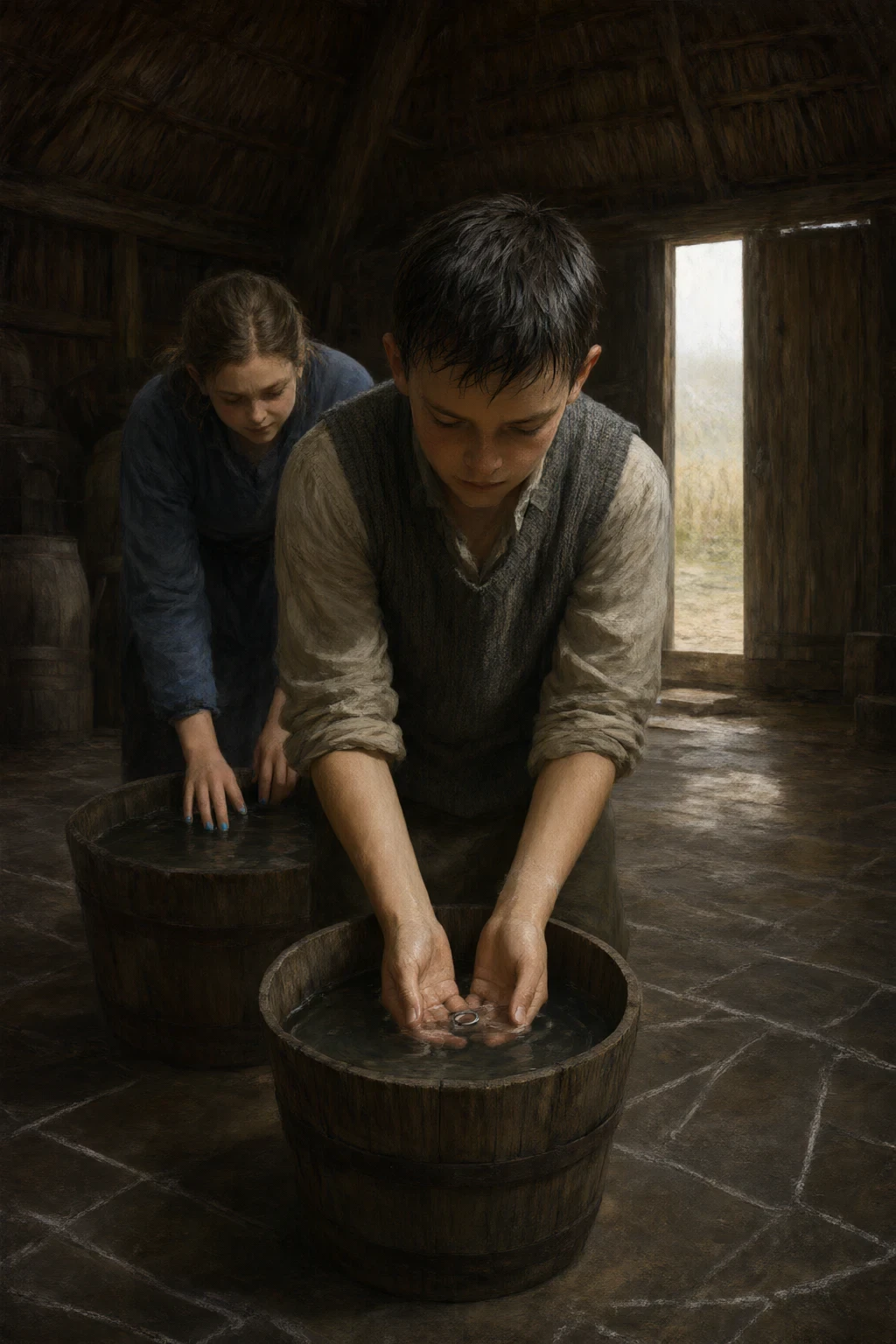
At twenty past four on the Thursday in the third week of November, Elias Gollop set his lamp on the coping of the west drain and looked down sixty feet of new-cut channel at a stretch where the channel had been cut full to the lip on Tuesday, because Tuesday had been the wettest Tuesday anybody in Coldwick-under-Fen could put a date to, and because a drain cut full in November is a drain that will be cutting a hole in something by Christmas. There was a boy asleep in it. He was up to his chest with a hoop-net of eels across his knees and his head tipped back against the reeds so that his nose was the only part of him above the water, and he was eleven, and he had been in that channel since about midnight because he had been asked for the eels and had chosen the water. Elias Gollop had walked the parish drains for nineteen years and had a rule about them. You report a person and you do not ask them questions you would have to remember. He called down. The boy did not stir. He called again, louder, and then he said the only thing a man says to a person in a drain at four in the morning, which is that it is cold, and the boy opened his eyes. “Say it again,” Micken said. Elias Gollop said it again.
“You are shouting,” the boy said. “You do not have to shout, it is only water.” And then he said, without any preamble at all, in the flat voice of a boy stating a fact about a bucket: “Fourteen year.” “That is nothing to do with—” “That is the water in here,” Micken said. “That is a person, though. That is a person in here and it is not a big one. There is a bigger one further up and it has been in the water longer.” He worked his hands under the hoop-net and turned it over. “There. That is the one you are asking about.” “You do not know what I was going to ask.” “You were going to ask what you owe,” the boy said. “That is a year and a bit.” Elias Gollop put his hand on the coping and found that it had started to rain again, fine and cold, the kind that does not fall so much as arrive. He was bonded to the Cold One since the February of 1885, nine years, for a winter’s fuel, and the parish had a clear idea that the Gollops of the low cottage were the deepest in Coldwick and would be the deepest for two winters yet, and a boy in a drain putting a number on it was not a thing he had prepared for at four in the morning in the rain.
“A year and a bit,” he said. “About that.” “That is a great deal less than nine years.” “It is,” the boy agreed. He let his head go back against the reeds. “It is not a long one, that is.” And then, after a while, without opening his eyes, in a tone of complete calm: “That is not you.” “That is what I asked about.” “That is the ditch,” Micken said. “That is everybody in the ditch. That is your year and a bit and the little one and the big one and the two women that went through on Tuesday with pails and did not stop, and it does not know whose is whose. If you take it off me and put it in a book as yours, you will be short by a bit, and somebody else in there will be long by a bit and does not know it.” The channel made a small business of itself, and eighty yards up the fen the Cold One had its windlass going and the sound of it came over the flat ground the way it always did, like a thing being turned in another room. “All right,” he said. He went back up the bank and wrote it down on the back of his hand in his own shorthand, which was how the parish found out about it, because the back of a hand is not a record.
The Tithe Barn holds ninety people and forty came to that Thursday, and the stove in the middle of it was the only warm thing within two miles, and the reason anybody comes. Elias Gollop told it standing up, in the middle, in the way a man tells a thing he is not sure of. He gave the hour and the place and the words as near as he had them, and then said: “And the boy read the water. I am not saying it wrong. I am saying he did read it.” Nell Drury wrote it in. She is sixty-six and has been clerk of this court for forty years, and the book goes back to 1841, and she writes with the book shut, which she says is not a superstition but a way of not being asked to look at a thing while writing it. She read the entry back when she had written it, exactly, including the spelling of his shorthand. “A year and a bit,” she said. “And then: that is not you.” “That is what he said.”
“That is what you wrote. I do not know that it is what he said.” She put the pen down. “It is in the book as what you wrote, which is the way, and I am not going to have it read out as what the boy said, because in nine years somebody will quote it as the boy said it, and the boy will have said something else.”
Gideon Sparre came up the aisle with his hat still on, which nobody in Coldwick had ever done, and asked to be entered as an observer. He is the bailiff’s clerk from the Sluice House, he has been in the parish four days, and in those four days he has produced a great deal of paper and the parish has produced almost none, and that difference is the whole reason he is in the barn. He put one question to Elias Gollop, standing, in the middle of the floor, pitched for forty people in a thatched room. “Mr Gollop. In the February of 1885, at the Cold One, you spoke a bond. It is in the parish book at page nine hundred and four. That is nine years and nine months ago. If the figure given to you in the drain this morning is a year and a bit, then either the boy is a liar, or the book is wrong, or the figure is not a figure of money. Which of the three?” Nobody in the barn had put it that way. Elias Gollop said: “The book is not wrong.” “Then the figure is not money,” said Gideon Sparre. “That is all I want. I will withdraw the objection.” Hester Colm, who had been standing at the back with her coat on and had not sat down, said: “It is a figure of what is owed.” “Madam, with respect, water is not coin and I have to carry it to the sluice as coin.” “It is a figure of what is owed,” Hester Colm said, “and it is not yours to carry, and it is not mine to explain, and that is not mine to say.” She sat down, which she had not done, and Nell Drury looked at her over the top of the closed book and wrote nothing, which she sometimes does.
They brought the boy at the second hour, in the pail from the back of the cottage, the one with a split in the staves that Bess Brack will not have a leak out of. Forty people in coats looked at a boy in a tub. He looked back at them with his head tilted and said nothing for a minute and a half. Bess Brack tilted her own head, which is her habit: she looks at a surface before she looks at a face. She was looking at the water in the pail, and then she said, in a voice that carried, because the barn is thatched and carries: “That is six year.” “Micken.” “Six on the top and four beneath it, and the four came in on Tuesday, and there is a newer one on the far side that is a fortnight.” She straightened up. “And the six and the four came out of the same pail, and that is not a person, that is a pail.” He agreed with the whole of it and added that the fortnight one was a dog, which nobody argued with, because a boy in a tub in a tithe barn is not going to be improved upon by forty people in coats. Nell Drury asked him, from the table, whether he could tell them what a person owed. “Yes,” said Micken. “From what?” “Off it.” “Off what is off?” Micken looked at her. He answers to any name given, immediately, and cannot be talked out of it, and there are eleven of them at the Third and he has never been asked which one he uses. “Off the water they have stood in,” he said. “Then say it for this room.” “They have not stood in anything,” the boy said. “That is the trouble. There is no water in here.”
That is the whole of it, and it took the rest of that Thursday and the following day to say. The proposition before the court was not a boy with a gift, and Gideon Sparre said so before anybody else had finished making the tea, flatly and without unkindness, and it was the reason the parish did what it did. A gift is not evidence. In a room where a man from the sluice is going to ask for figures, a gift is worth nothing, because anybody who can squint can have one, and it cannot be entered, repeated, checked, or done again in front of a second person on a second morning. If a boy in a tub can say what a man owes, so can a man who has been owed. The court had one reading, made in a drain by a person with no stake in it who could not be brought back. Unless. Unless it could be made into a thing with conditions on it, written down, such that anybody could carry them out, and the boy could be required to satisfy them or fail in front of witnesses. Nell Drury put it that way and the court accepted it, and that acceptance was the whole of the law that Coldwick-under-Fen made that day, and most of the forty people in the room did not find out until the following week.
The test was set for the Friday because the Friday was a dry one, and the conditions were four, and the fourth one caused the argument. One. The reading is to be taken from the water of the well the person is bonded to, and from no other water. Two. The water is to be drawn by the person named, into a clean vessel, at the collar, and the person is to stand in it. Three. The person is to be alone. Not unwatched. Alone. No second person in the vessel, no second person standing in the ditch, no second person’s water in the same vessel, and the vessel is to be rinsed out of the well itself before it is filled, which is the condition that everybody thought was a joke until the third collar. Four. The reading is to be spoken aloud, in figures, before a witness, and the witness is to enter it in the book as it was spoken, including the spelling. “Four is not a condition,” said Gideon Sparre. “Four is a ceremony.” “It is the difference between a reading and an account of a reading,” said Nell Drury.
“It is the difference between a reading and a reading that may be relied upon. If the figure cannot get into a book in a form that will survive being quoted back at you by a man who was not in the room, it is nothing at all, and you have had your morning and I have had my four days.” He put his hat on the table, which was the first unkind thing he did. “I am telling you what will happen in August.” “Then have it written down,” said Nell Drury, “and the spelling will be right.” Gideon Sparre considered this for longer than he needed to. “Write it down,” he said.
The third condition is where the fen turned out to be against itself, and the clerk from the sluice was the one who said so, and he was right. They began at the Blind at seven in the morning and it took nine wells and one whole day, and by noon a hundred and thirty people in a parish of four hundred had stood in somebody else’s water. What nobody had understood, and what a thing nobody had designed taught them in a quarter of an hour on the first morning, is that the fen is a place where a person is never alone in water. Not a puddle, not a ditch, not a pail that has been somebody else’s pail. The country is raised four feet above the water table so that the wells go down sixty feet, and every household has a butt behind the door that is filled from the well and never emptied but topped, so that the water in a butt in Coldwick is a mixture of that household and of every household the pail has been to. The boy read the pail of the first household in eleven seconds and gave a figure, and the household was not bonded at all. “A duck,” he said. “A what?”
“It is a duck. It went in the butt in August and the weather took it and the weather gave it back and it is still going round. That is what a duck is.” After that they rinsed the vessels out of the wells. Nine wells, twenty-seven vessels, the rinsing took until eleven o’clock, and Bess Brack did most of it, and by one o’clock the parish had a method. A reading taken from a well’s own water, drawn and stood in by that person alone, at that person’s own well, gave the amount outstanding at that well, in days, to the day. Four of the nine, converted to money at the sluice rate, agreed with the parish book to within fourpence, and the book had held no figure for those bonds in thirty years because there had been no column for it. Two of the nine were wrong, and both the same way: the vessel had not been rinsed, and the reader had to do it twice. One, the Long, could not be read at all. The person bonded there was a woman of eighty-one who had been in a chair since the March and could not be got to a collar or made to stand in anything, and the court stood about that collar for some time and adjourned the reading and substituted nothing for it, which Gideon Sparre put in writing as correct. And the fifth reading, at the Cold One, at four in the afternoon, is why the book has a column in it now.
Hester Colm had been in the court since ten and had not sat down since the first hour. She stood in the pail one hand on the collar, her sleeve pushed to the elbow, and the boy read the water and looked at the long way and then said, in a voice with nothing in it at all: “That is a small one.” “I am aware of it,” said Hester Colm. “No, I mean that is a small one. That is a fortnight. That is eleven days and a bit of a fourteenth.” The barn made a sound. Most of it had followed the business out to the Cold One, because the afternoon was cold. Hester Colm did not move. “Nineteen eighty-eight,” she said. “Thirty years. Thirty years of other people’s fields.” “Yes,” said Micken. “That is the whole of it?” “That is what is left of it.” Bess Brack, at the boy’s shoulder, said it before she could stop herself, in the flat way she says a thing she has measured: “That is a month of eels, that is. Not a year. A month.” And then put her hand over her mouth, because her numbers are the numbers of the fen, and the fen is the pails, and there is no eel in the pails, and a month is what the fen says about a thing that has stopped being enormous. Hester Colm looked at the girl. “A month,” she said. “A month and a bit. Eleven days.” The woman put her hand on the collar, dressed chalk blocks worn round and bright in one horseshoe where four hundred years of hands have gone down, and said nothing at all, and afterwards washed her hands in the pail although they were clean, which is what she does, and she went on doing at the back of the barn while the court wrote.
Here is what the court made, and it is a very small thing for the size of the country it was made in. A reading of a surface is good evidence of one fact and of that fact only: that a named person stands indebted to a named well, to the amount the water gives, in days, at the hour it was read. It is not evidence of a holder. The water does not say. There is nothing in it and there has never been anything in it, and the boy said so twice, unprompted, and looked offended about it, because they had asked him twice. It is not evidence of money, and may not be converted to money for any rate, and this was Gideon Sparre’s clause, and he was right to want it, and the court gave it to him, and he was thanked, and the thanking was at the stove, and it was cold. It is a reading of the balance, not of the whole. That is why a man who has been drawing and applying for nine years shows a year and a bit and not nine, and it is a strange thing to look at, because it is the smallest number in a man’s life and it is going down. And the blank.
The book has, for every bond, a column for the well and a column for the holder, and now a third for the figure, and beside the third Nell Drury ruled a fourth, narrower, and in it she wrote one word on the first day and left it there for the next thirty years. “not readable” Because the water tells you who owes, to which well, and how much, and will not tell you whom the well owes it to, and the only record of that in Coldwick is a book one woman has kept shut in her hand for forty years, with no second copy. Everybody in the room understood that if the book burned there would be no other account of the parish, and nobody said so, because it was the first Thursday in a hundred and eighty-four years on which anybody but Nell Drury had put the question, and she was the one person in Coldwick who could not be seen to be frightened of it.
And then there was the witness, and it took the rest of the afternoon, and it was the harder half by a long way. A reading is only evidence if there is a person to give it, and the parish book has no column for a boy. It has columns for wells, holders, witnesses and debtors, and everybody in them has had a name in it since 1841, and Nell Drury had been clerk forty years and had never been asked to enter a person who could not give a name for himself. “He gives eleven,” she said. “He has given me eleven this year alone. He gives whichever one you ask. Ask him for his name in the open and you will get whichever one is nearest.” “Then he is not a witness.” “Then he is not a witness, and I have written so, and it is in the book in your hearing, and it is the correct finding and I will not have it softened after I am dead.” And there it was, and every person in the barn had seen it coming for two days, and it was the first cold thing in four hundred years that nobody had prepared a box for.
Because a witness cannot be had in this country without giving him a name, and names in Coldwick are not given out of the air. A name is a thing you say at a collar. That is where a bond is spoken and that is where a bond is witnessed, and it is the only place in Coldwick-under-Fen where a word spoken by a person acquires a force it has nowhere else. Nobody alive can tell you when it started and everybody knows where it ends. Which left the court a question it had to answer on the day, in public: is a name spoken at a table a name? And Nell Drury answered it out of the book, with the book shut, in a voice nobody in the barn had heard her use before.
“Rule one,” she said. “A bond is spoken once at a wellhead, is witnessed, cannot be withdrawn, and binds the speaker’s draw from that well for as long as it is unpaid. Every word of that is about a promise, and a bond is a promise to owe. Give a name at a collar and promise nothing, and you have spoken, and the well has heard you, and there is no debt, and nothing in that water this afternoon was not there yesterday.” She opened the book, which she did not do, and shut it again. “So it goes in. Any name, given in the open, read back once. Not at a collar. Anywhere.” “Then say it, and say it once, and I shall write the one you say last,” said Nell Drury, “because that is the only one I have any way of knowing that you meant.”
Eleven names, in the open, in the barn, on the Friday, in front of forty people, each given at once and without hesitation, each the name of a household in the parish, and every one of them true, and the room not knowing which was a lie because none of them was. Aldous Pyle. Micken Bream. Tobe Sallow. Jabez Crome. Micken. Ninian Ord. Little Well Ord, which is a joke and is not a joke, since the Ords are the family at the Long. Micken Chalk. Peter Rill. Tobe. Micken. And then the boy stopped, and looked at the water in the pail, and tilted his head, and said: “That is not one.” “You have given eleven.” “That is not one of them either. That one is mine.” “Say it.” He said it once, and it was short, and it took the clerk some time to rule a line in the column for it. “Micken of the Third.” Nobody said anything, and the reason nobody said anything is that it is a name of the kind this country has eleven of and no more, and they were all standing there, and four hundred people knew every one. “A well,” said Bess Brack, and stopped, because she had worked out the rest of it faster than anybody and she had been looking at the surface instead of the face for two days.
“A well cannot be renamed after it has been bonded,” said Nell Drury. “That is rule seven, and it is why the boards are the boards: four hundred years of people finding out the hard way that you cannot move a name out of a well and give it to another, because the water will not have it. There are nine wells here and I could not enter a name the parish might take back off him, except a name out of a well. The board at the Third says The Thred and has said it since before the book. That was the one name in Coldwick that could not be altered. Now there are two, and they are on the same object.” She wrote it in. And Gideon Sparre, who had been standing at the door with his hat on his knee, said the thing that made the exercise cost what it cost, pleasantly, because he had not slept in three days and had stopped being careful about how he came across.
“Then I shall say what this is,” he said. “For two days I have watched this parish build an instrument for reading its own accounts with. A witness, a rule, a column. It is very good, and I am not going to be the man who says it is not, because I have waited nineteen years for somebody in this fen to do anything true. And it is the parish’s. The witness is the parish’s, he is entered in the parish book, and I am the sluice’s.” He put his hat back on. “I have paid four days for an instrument I may not use.” “No,” said Nell Drury. “Not by that witness. That is correct, and I will put it in the book so that nobody has to be told it later.” “Could it not be otherwise?” “It could not. He is a boy in a tub in Coldwick. He cannot be a witness of the sluice, because the parish got to him first and had the worse reason and was owed the courtesy of it.” She did not look up. “But there is nothing secret in the standard. Four conditions, on a wall, in anybody’s hand, and they are cheap: a clean vessel, a dry morning, an hour of quiet and a person who will stand still. The sluice may keep its own reader. It will not be as good as yours. It will be the same.”
“Then I shall copy the four conditions,” he said, “and I shall put in writing that they were given to me in open court at Coldwick on the fourteenth of November without condition.” “Do that.” “I shall also put in that the sluice has no witness.” “Put that too,” said Nell Drury, “and date it, because the parish will find one, and it will be somebody you have not thought of, and it will be as bad for you as this one is for us.”
The west drain was cut full again on the Saturday, because the rain of Friday night had been the same rain of Tuesday and had found the same place. Elias Gollop went down to the coping at the same hour, with a lamp, because he had a thing he wanted settled before the next Thursday. The boy was there, up to the neck this time, the hoop-net empty and hooked on the reeds above him, and not asleep, and waiting, which Elias Gollop had not expected and thought about for a long time afterwards. “What does it say now?” the man said. “A year and a bit more.” “Why more?” “Rain,” said Micken. “There has been rain in it. It is in the water.” “That is what I asked. If the water is bigger, does it mean I owe more?” “No,” the boy said. “It means the water is bigger. Those are not the same thing at all.” He put his hands flat on the coping on either side of the lamp. “Nobody has ever asked me which one they wanted.” Elias Gollop stood there in the rain for a while.
At the Sluice House, four miles off, past Coldwick and the nine wells with their nine collars, a clerk was copying four conditions onto the back of a form with a date on it, and at the top of the form he wrote the words not readable, and then he put a line under it, and stopped, and did not know what the line was for.