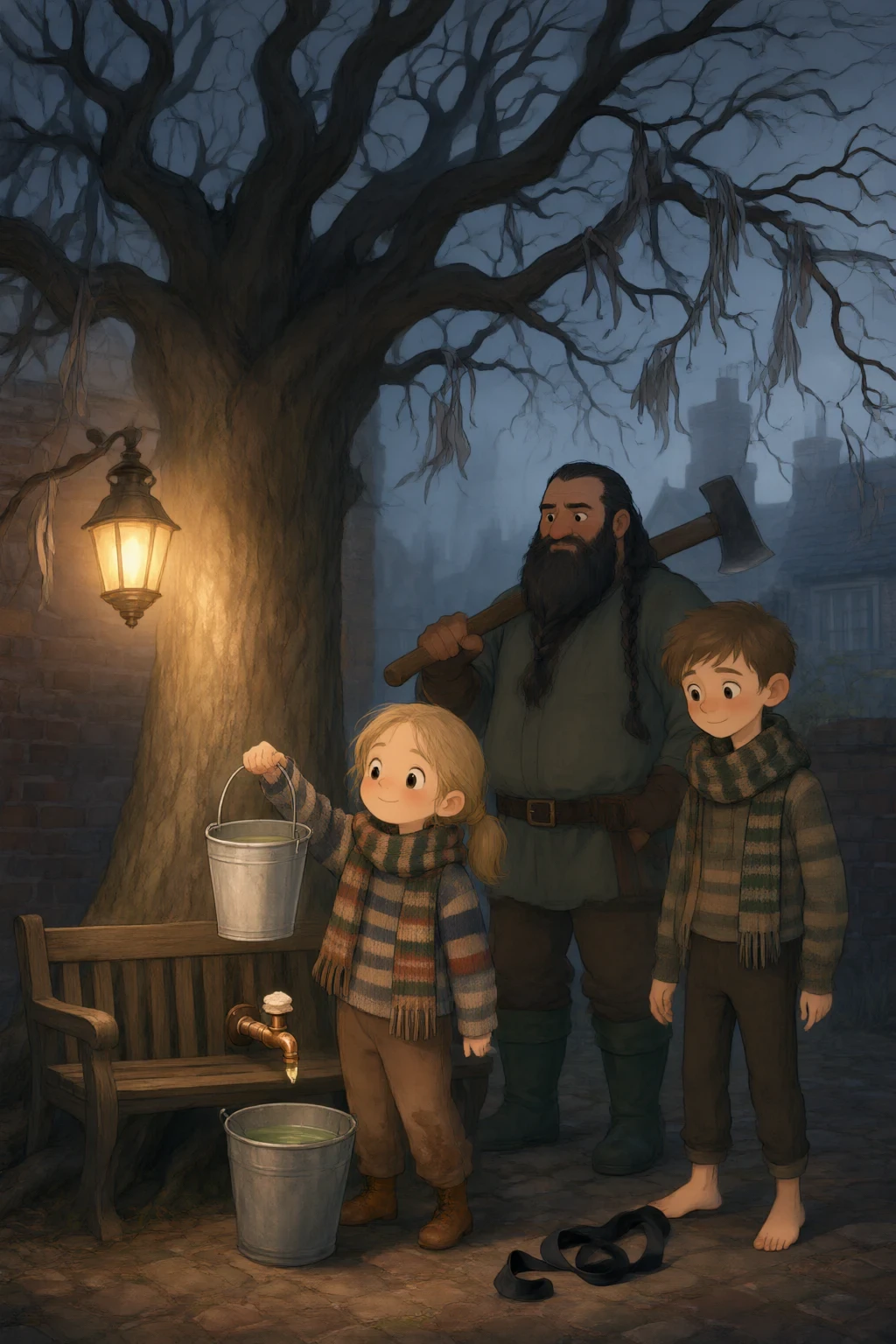
Pell Quist watered the linden. Every morning since she was six, before she had bread, Pell carried the courtyard bucket out to the tree and poured it over the roots, and every morning the linden took it without a sound. It had never had a leaf. Not one, not in a hundred and ten years.
It stood in the middle of the courtyard with its bare black limbs spread like the fingers of a hand held up against the sky, with ribbons on the lower branches where people tied them for luck, and a bench set all the way round the foot of it so you could sit and look up, and an old woman called Brannet who said it had been here when her mother was small. The courtyard was bricks, a well, a washing line, and the tree. Then the levy came.
The boy with the slate said it out loud, because boys with slates say things out loud. The Concord’s sap levy had gone up. Every sap tree inside the walls was on the list. The linden in Marrow Lane was first on the list, and it would be cut on Thursday at first light by a man from Row Eleven. Pell asked him what sap was for. “It’s for the moths,” the boy said. “That’s all it’s for.” He said it the way people say a thing they have said a great many times.
She found Teasel Sillet at the Lamp Service table, winding black silk onto a reel for his hand-lamp. He was twelve, in a striped wool scarf he had never once taken off, one of his feet bare even in autumn, and he counted under his breath, whispering the numbers to the leg of the table so they would be somewhere. “Teasel,” she said. “What is sap for?”
“It’s the thread,” he said. “Every moth flies with a bobbin of black silk on its back. Where does the silk come from? Ash. Ash and sap. The ash is the moths we burned in the Kilnfield, and the sap is bled off living trees, and the two of them together are the only thing in this city that matters.” “How much sap does one tree give?” Teasel stopped. “How much?” “How much sap does one tree give?”
Nobody had ever asked him that. He counted things. That was the whole of his trade. Nobody had ever stood in a courtyard and asked him what one of the things he counted was worth. “I don’t know,” he said. “There isn’t anywhere I can get at that says.” “Then how do they know what to take?” “They don’t,” said Teasel. “They just take it.”
The cutter came on the Wednesday to look at it, the way a butcher looks at a pig. He was a big man of forty-four with a black beard re-braided neat down his back, stiff green boots, and cuffs gone dark and shiny with sap. He stood in the courtyard a long while and said nothing at all. Then he went up to the tree and laid his hand flat on the bark. “I’m sorry,” he said, out loud, to the tree. “I have to do this. I don’t want to. I’m sorry.”
Pell said, “You said you didn’t want to.” “I did say so.” “Then why?” He took his hand off the bark and looked at the palm, which was stained green. “Because I am the man who does it,” said Fennim Sallowe. “There are forty of us in this city and I am one, and if I say no on Thursday there will be a boy on the stairs of that loft in my place. I have done this four hundred times. You get good at it, and then it is only trees.”
Then Fennim crouched and put his ear against the trunk a foot above the ground, and knocked twice with his knuckle, and waited. He stood up with a different face.
“A linden is not a grove tree,” he said. “A grove tree bleeds for you. It does not know you are there. A linden is slow and thin and you have to ask it. But you can take sap off a linden and leave it standing. A tap. A small cup, a small hole, and you fill a bucket a day. A bucket is a quart. Then you seal it and go home, and come back the next day and the next, for as long as you can stand there.” “You could tap it?” Pell said. “I could tap it,” said Fennim. “That is not what I was sent for.”
The Concord sent two people on the Wednesday, and the first of them did not look at the tree at all. He was a clerk in a grey coat with a slate. He read a number off it: the linden was worth four hundred marks, the cutting would be done on Thursday at first light, and the lane could have the timber for a year’s fire if it liked. The second was Halvard Tace, in black kid gloves, the right one cut from a different and browner leather. “Who paid for that?” he said, to nobody in particular.
“I did,” said the grey clerk. “The list.” “Is it on the list. Good.” He looked around the courtyard, at the well, the washing line, the ribbons, and the old woman on the bench. “Thursday, then. First light.” And the third person to come was Orla Vessey, late, with a lamp in her hand, and her spectacles had the right lens ground from oiled horn so that the flame in it did not double. “Two hundred and six,” she said. The grey clerk said, “I beg your pardon.”
“The linden in Marrow Lane is worth two hundred and six marks.” She held out her slate. “Four hundred is a grove tree of fourteen years standing. This is a hundred and ten, and thin, and on its last slow bit. It has been measured. There is a bench all the way round the foot of it and I could not get my arm behind the trunk, and arm behind the trunk is the only measuring any of us is qualified to do.” Mr Tace said, “Who paid for that?” “The city did,” said Orla Vessey. “Forty years ago, when the last levy was set. It is written down. I did not write it, but it is there.”
But the levy was a levy, whether the number was two hundred and six or four hundred, and Mr Tace wanted a sum he could put his finger on. A tapped linden does not give a sum. It gives a quart a day, and then another, and a thing that does not end is a thing you cannot write on one line of a book. That is when Pell Quist put her hand up. “A quart a day,” she said. “Every day. And the tree doesn’t die.” “That is the difficulty,” said Mr Tace. “It doesn’t end.”
“It doesn’t have to end. It doesn’t have to be a heap either.” She was nine and had planned none of this. “It can be carried.” Nobody spoke. “There’s a spinning house at the Kilnfield,” Pell said, “and the silk is spun there, and the Concord wants the linden’s sap there. Well. We’ll take it there. The whole lane will. We’ll carry it down in teapots, twice a week, and you can have every drop of it, and the tree stays.”
What followed took the rest of the afternoon and was, by the standards of the Concord, ridiculous. The children of Marrow Lane formed themselves into something they called the Linden Guild, wrote their names on the back of a levy sheet, and set out a rota on the courtyard wall in chalks. Two of the older Lamp Service runners said they would take the stair turns on the Kilnfield side, and one was Nell Ashgrove, who counted everybody on the rota twice and announced a total two over. “One hundred and eleven,” she said.
“It’s a hundred and nine,” said Teasel. “One hundred and eleven,” said Nell, and got it wrong again, and went off up the stairs to fetch a tap gauge. The gauge came down from the Assay six floors below Ledger Hall, wrapped in oiled paper in a hand so old and so straight that it had to be opened with a knife.
Ansel Reyne was fifty-eight. There was a pale crescent burn under his left jaw, and he wore his collar buttoned in midsummer to hide it, and he was the only man in Candleford who could say whether a thing was right or wrong. “Who paid for this?” said Mr Tace, when the wrapping was off. “Candleford did,” said Mr Reyne. “Eleven hundred and six is the fee.” Then he turned the gauge and set it against the light, and said the thing he said eleven thousand times a year to a tray of moths. “That is to Pattern.”
Orla Vessey stood at the edge of it with her slate for a long while. Then she said, “I cannot put this in the book.” “Of course you cannot,” said Mr Tace. “There is no column for a tree that is still standing.”
And here is the part that nobody in Marrow Lane liked. A tapped linden gives a quart a day, and a quart a day is not nothing. But it is not four hundred marks either, and a quart a day for a hundred and ten years comes to less than one grove tree gives in one morning, and the Concord does not care which door a barrel came through. The rest of it comes from Row Eleven.
Fennim Sallowe cut eleven trees that winter where he had meant to cut seven. He said it out loud, standing in the courtyard with the tap in his hand and the bucket already under it, apologising not to the linden but to the children, which Pell thought was much worse. “You have saved a tree,” he said, “and I have to cut eleven in the fen.”
She had not known there was a choice there at all. There had been a tree, and a day, and a number in the day. Now there were two numbers, and the lane had taken one and the fen had taken the other, and the fen had not been in the room. Nobody had sent anybody to Row Eleven. The sap had gone there on its own, the way it always went, because there was nowhere else for it to go. “It isn’t fair,” she said.
“No,” said Fennim. “It isn’t. I have apologised to a tree four hundred times and never once to a person, and now there is a child in my courtyard and I would rather it were the other way round. But I will tell you what is fair, since nobody else will. Eleven trees is eleven trees, and a quart a day is a quart a day, and if your linden is worth more standing than cut then it was worth it this morning too, and somebody would have had the sense to say so.”
The tap went into the linden on the Thursday at first light, instead of the axe. It is a small thing to look at: a copper spigot low on the trunk, a shaved face the size of a coin, and a tin bucket under it on a hook. The hole is sealed at night with a plug of wax and cloth so the tree does not lose what it is making for itself. In the morning there is a quart, and that is the whole of the day’s sap.
The bucket goes down to the Kilnfield on a handcart with two of the lane’s children on it, twice a week, rattling all the way over Bridge Nine. The black silk off that spool is tested and found good, and it buys two marks a pound. The linden still has no leaves. It will never have leaves. It is a hundred and ten years old and every autumn it sets seed in the black pods that nobody gathers, because that is not what a linden does here, and there is no column for that either.
But there are new ribbons on the lower branches, and the bench is still all the way round the foot of it, and the linden in Marrow Lane is the only tree inside the walls that anybody has ever gone to and asked a question of. Pell hung her scarf on a low branch that night, the way you hang a thing on a tree that is going somewhere. The linden had no leaves to catch it. It held it anyway.