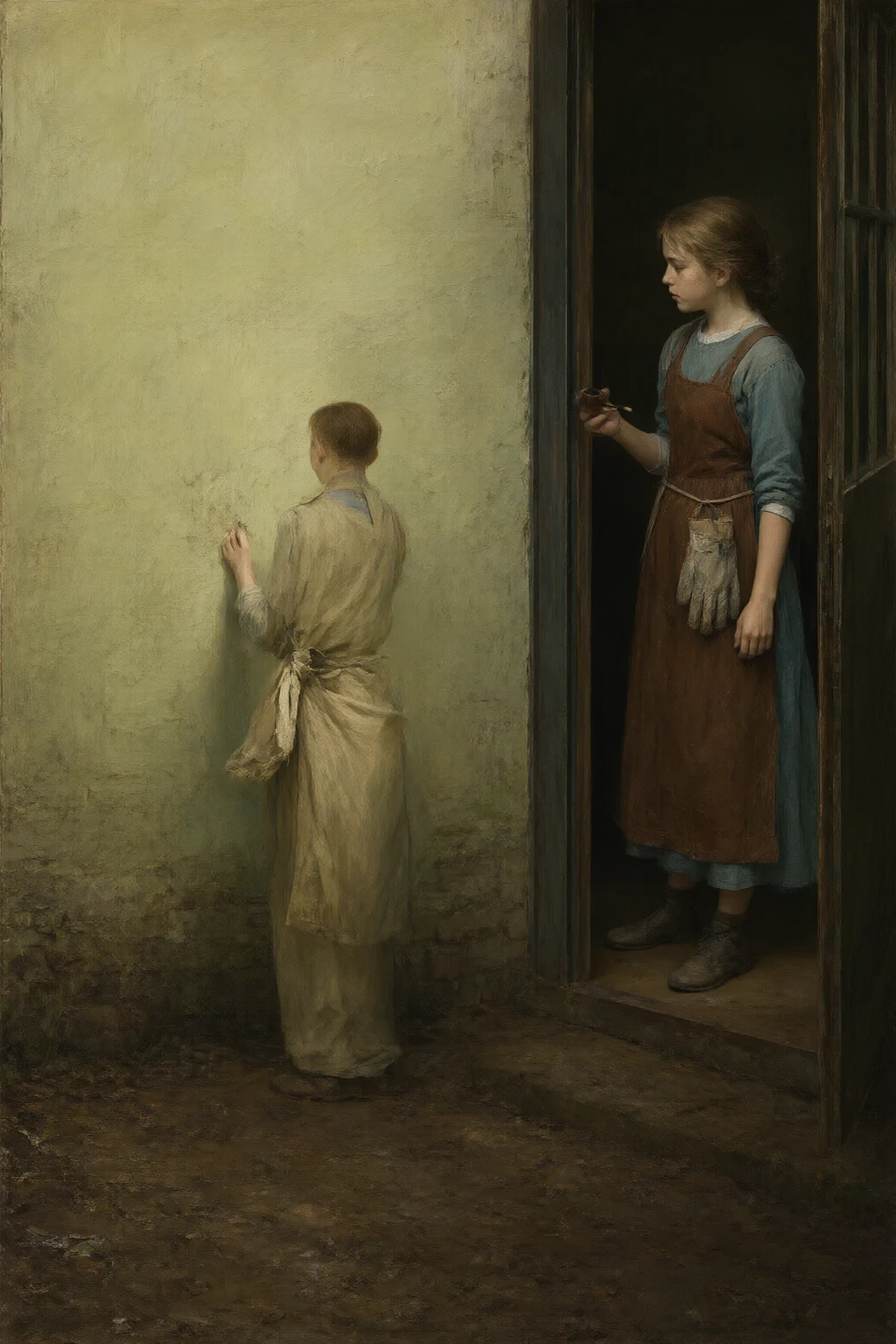
The form came back on the fourth of April in an envelope with the county office on it in a copperplate hand, and it was four hundred and eleven words long, and Wren Copse read all of it twice before she got to the ninth box, which was the only part of it she had been expecting. Box nine said, in full: state the material of the dwelling in which the applicant resides, in one of the three terms permitted by the standing list of the parish, or, if the dwelling be of a combination of materials, state the materials in the order of the majority of the cubic content. She wrote BRICK. She wrote it in the hand she uses for the wage dockets, which is her father’s hand, which is a bricklayer’s hand, and she wrote it without any doubt at all, and she was not lying, and that is the whole of the first half of this story: on the fourth of April a girl of twelve wrote down brick on a form, and every word of it was true, and there was not one thing in the world she was not entitled to write. Number eleven in the Terrace has a brick front.
It has had a brick front since 1881, when the Terrace was built nine houses long on the worst of the clay and every house in it was a party-wall house, so that there are four brick walls in the street and thirty-five half-walls and no air between any of them from the road to the backs. The front of number eleven is Marl’s best work: a rubbed Flemish bond in a hard red brick with a soldier course over the window and a blue brick plinth out of the second field, and it is what eleven means when somebody says the Terrace is brick. The form went back on the eighth. It came back again on the nineteenth, and this time it came back with a man’s card in it. ASSESSOR (COUNTY). LICENSED. NOT A WOLF. That is the whole of the card. It is a printed card the size of a playing card, it has cost the county fourpence, and it carries a brass disc on a ribbon, and the disc is the licence, and the licence is a physical object, and the man who carries it is a professional and is not permitted to want anything, which is a thing you can read on the card by the fact that it does not say it.
He came on the Thursday of the twenty-fourth of April, at ten in the morning, in a dry coat, and walked the length of the street once before he knocked, which Wren Copse watched from the front window and understood afterwards, when Tomas Peake told her what a man does when he is about to make a sound in a street: he listens to the street first. She had asked to be assessed on the straw house. The straw house is at the end of the furlong, on the worst ground in Marl, and it fell nine days after it was promised and it is a heap of reeds and a door-frame and a stove, and a girl of twelve wrote to the county office in the autumn to ask whether she might be assessed on it, and was told in writing that there is no court and no appeal, that a child may not be a creditor at all, and that an assessment requires a licence, and a queue, and a ledger, and that the ledger is on a bench at the smithy. She had wanted to be told she could not, in a way that sticks. The letter stuck. She had written the word not on it, in her father’s hand, and dated it, and sent it back, and it is the single most Marl document in the history of Marl and it has never been answered. What she got instead was box nine.
The assessor did not begin with the house. That is the procedure, and every licensed assessor in four counties works it the same way, because a house does not know what it is, and a man who has never been asked does not know what he is, and the difference between the two is the whole of the law. He asked the people. He had a book with a ruled column in it, and he stood in the front room of number eleven with his hat in his hand, and he asked Wren Copse’s father what the house was made of, and Wren Copse’s father said brick. There is no subtlety in this and there was no hesitation in it. Tam Copse was forty-one and had been in the brick trade since he was thirteen, and he had been at Upwell, at the clay pits, for four years, and he came home on a Sunday in March and on the first of April he had taken his daughter to look at the straw heap because she had asked him to, and he had not slept well since, and he said brick the way a man says the name of the town he is standing in. “State it for the book,” said the assessor. “Brick.” “Front and rear?” “Front and rear, brick.”
“Thank you.” He wrote it in the column. He wrote the word BRICK and the house number and the date and he closed the book and took a thing out of his coat, which was a short pipe with a brass mouthpiece, and which Tomas Peake had told Wren Copse was not permitted to be used except in one particular way and only by a man holding a licence. The assessor blew the note. It is a low note, on the A below the middle of the piano, and he blew it for four seconds, and the room had a hard floor of lime and brick dust and a plaster ceiling eleven feet high, and the whole of the Terrace was a hundred and forty feet of brick and timber and lime with nothing between the houses, so that a note put into any part of it does not stay in that part of it. Brick answers. Everybody in Marl knows that brick answers; it is why the material has a standing, and the sound that came back out of the north wall of number eleven was the note itself, clean, and a little brighter than the note that went in, and there was one of them.
The assessor waited. He had the pipe down at his side and he was not writing. He was doing the other half of it, which is the half that takes the time: he was listening to what came back after the note, because a wall is obliged to report on the sound, and the report is not the note. The second sound came up out of the floor. It was not a note. It was a rattle, short and dry, and it went on about a second and a half, and it came from under the boards of the back room, and Wren Copse’s father said, without being asked, “That’s the parlour. It always does that.” The third sound came from the party wall on the east side, the one between eleven and thirteen, and it was a note, and it was a note a fifth flatter than the one he had blown, and it went on twice as long, and it is a timber sound and any man who has stood in a wooden building in England has heard it and does not notice it because it does not stop. Then the wall gave back nothing at all.
The assessor wrote for a while. He wrote four lines and then he turned the book round and put it on the table with the pen laid across it, which is a thing assessors do and which is not a rule and is simply what happens when a man is being fair. “Mr Copse,” he said. “I am required to record what the wall has reported, and I have recorded it, and I will read it to you, and then I am required to ask you a second time, and I want you to understand before I ask it that the second question is the one that matters and that I have no power to make you answer it.” “Go on.” “Brick, timber, lime, and rubble,” said the assessor. “In the order of the majority of the cubic content, the wall reports brick and then timber, and the timber is the majority of the volume that is not brick, and there is lime and there is rubble.” Wren Copse’s father looked at him. “That’s the floor,” he said. “The floor’s a deal floor over brick rubble and there’s chalk under the clay, and everyone in the Terrace is on the clay, and you can put your hand on the wall of number nine and it’s the same in all of them, and every house in England has a floor.”
“Mr Copse. I have written BRICK in the column, as you stated it, and the wall has reported four materials, and I am required to put the second of those two facts in a certificate, and when I do, the certificate says the house was asked what it was made of and answered dishonestly.” The room was very cold. It had been cold since the first of April with no fire in it, because the Copse family had not lit one since the twenty-fourth of March, for reasons nobody in the house had ever said out loud and everybody in the house knew. “Then put it,” said Tam Copse.
It took the assessor eleven minutes to write the certificate and Wren Copse watched every one of them from the doorway, because the certificate is the thing that happens next, and she has understood since she was ten that in Marl the thing that happens next is always decided by a piece of paper somebody is writing at the time. He wrote it on a printed sheet with a printed number at the top. He wrote the number of the house, the name of the assessor, the date, and then the finding, and the finding was eleven words, and Wren Copse read them upside down from the doorway, which is a thing she can do. THE SAID DWELLING WAS ASKED ITS MATERIAL AND ANSWERED NOT TRUTHFULLY. “That says we’re liars,” said Tam Copse. “That says the house was asked and the answer was not true,” said the assessor. “It does not say who gave the answer. It is not permitted to say who gave the answer. That is in the form, at the top, in the small print, and I have read it out to you already and you did not hear it, because nobody hears the small print, and the small print is the only part of this that has ever protected anybody in this street.”
He put the certificate in his coat and the pen in his book and the book in his coat, and then he did the other thing, which was the thing he had come for, and which was to walk to the back of the house and put his hand on the wall of the yard. “Mrs Copse,” he said. Wren Copse’s mother had been in the doorway of the back room for the whole of the eleven minutes and had not said anything at all, and she said now, “There’s nothing back there.” “There is a promise on this wall,” said the assessor, “and I am required to read it, because a promise is a thing I am permitted to read and a material is a thing I am permitted to hear, and they are kept in different books.” He put his thumb beside the chalk, low down, on the inside face of the back wall of number eleven, at the height of a child’s shoulder, where it had been put in 1934 by a man who was making good lime and did not expect to be found out.
Tomas Peake had been standing in the yard since eleven o’clock and had not come in, because a boy of fourteen is not a party to an assessment and knows it, and he had read the wall at eight o’clock that morning from the lane with his hand flat on the brick, and he heard it from the yard. The assessor read it, and then read it again for the record. It was in a mason’s hand in chalk, and it had survived forty years on a wall that had been plastered over once and had the plaster taken off by a man in 1938 who wanted the wall for a cold shelf, and it read: BUILDEN BY T. COPSE, APRIL 1934. WILL STAND WHILST I LOOK AT IT. And under it, in the same hand, the figure. 3 2 0. And a date. And then nothing else, because the mason ran out of wall.
Nobody in Marl has ever asked what that means and everybody in Marl has heard it. It is on nine walls in the village and on two in the Terrace, and it goes back further than the ledger, and nobody living was told it by anybody living. Whilst I look at it. Tam Copse, the man who wrote it, was eleven years old in April 1934. His father was the builder. He is not a builder now, and he has a plasterer’s licence he has never used and four pounds of a debt at the weighbridge hut. He wrote the line because his father said the words and the boy took the chalk, and the boy did not know that a promise is a promise whoever holds the chalk, and the wall took it, and the wall has held it for forty years, which is the only reason the back room of number eleven is a room. He has been looking at it since the first of April. That is the whole of what is keeping the back room up. He came home on the Sunday and on the Monday he went out to the yard and stood against that wall for eleven minutes, and he has done it every day since, in the cold, in the rain, and his wife has known and has not asked him and has brought him out his coat.
The assessor wrote in his book. He wrote for a long time. Then he said the thing that turned out to be the whole of the finding, and he said it to the back wall, because that is what an assessor does when a house is in the room. “Mr Copse, I am not going to read you the second half of your own father’s promise, because I have not got it and neither has anybody. The first half is on the wall and it is the only half that was ever written. The rest of it is the man.” “I know the rest of it,” said Tam Copse. “Yes,” said the assessor. “And the man is in Upwell, and I have written to him, and I have told him in the letter that the certificate names the house and not the man, and that if he writes back with the figure it will go in the certificate, because the figure is the only part of a promise that Marl can prove anybody meant.”
The house fell on the night of the twenty-sixth of April, and nobody was in it, and nobody was hurt, and the whole of Marl knows the night it happened because the wind came round to the north-east at ten and stayed there until four. Marl’s wind is not weather. It comes off the fen and there is nothing between it and the end of the furlong, and the Terrace is a hundred and forty feet of continuous wall with nothing behind it, and a north-easter comes into the back of the houses first. It did not take the front. The front is brick, and the front of number eleven is still standing this morning with nothing behind it. It is eleven feet high and it has a window in it and a door in it and a soldier course along the top of it, and there is a gap of eleven feet between it and the party wall of number nine, and Marl walked past it on the way to the kiln road and stopped, and did not know what to do with a brick wall standing in a street with a morning sky behind it.
What went was the back. The back wall of number eleven is a timber frame, oak, four by three, mortised, with a brick nog at the bottom course where there had been money in 1934, and the timber in it is not tarred, and the thing that let the wind in was not the wall but the door-frame of the yard, which is a deal frame with a four-inch lintel, and a deal lintel on an oak frame with a north-easter behind it will go at four o’clock in the morning. The sound of a house in Marl falling is not a sound. What is heard is a long grinding, and then a sort of settling, and then the roof coming off as one piece, and then, about four seconds later, a sound that is only ever described as a sigh, and which is the plaster and the lath and about two tons of pantiles arriving on the flags of the back room at once. The Copse family slept at number five, in the front room, with the front door open, because the assessor had written to them on the Wednesday and had been instructed to write to them, and they had not understood the instruction and had done the sensible thing. Nobody was hurt. That is stated first in every account of it, and it is true, and it is also the least interesting fact available about the night of the twenty-sixth of April.
The thing that happened next was not the wind, and it was not a villain, and it was the discovery that a house in a street is one wall. The assessor had gone back down the lane to the road and was writing in his book at the roadside when the wind dropped, and he came back up the street at four o’clock to finish the certificate, and number nine came down on his way up. Not all of number nine. The party wall between nine and eleven, which is to say eleven’s own east wall and nine’s own west wall, is one wall. It is two walls, in law, in the same plaster, with the same joists in it, and it went over at ten past four, and it took nine’s back room with it, and number nine’s family were out, which is the one reaction that everybody in a street of party walls takes without ever discussing it.
By six o’clock there were four gaps in the Terrace. Number thirteen lost the front of its back room. Number fifteen lost a gable-end. Number seventeen had a wall still standing on the Sunday morning, unattached to anything at either end, and there was straw from the byres lying about the whole street in drifts, because it was April and the wind had found forty years of straw that nobody had ever looked at under a board anywhere in the Terrace. Nine households. Four of them damaged. One of them, number eleven, with nothing standing behind its front but a gate and a well and a line of frozen washing. The assessor stood in the middle of that in the last of the light with his book, and did the thing that is required of him, which is the fourth section of the form, and the section nobody in Marl has ever had to use. He had to state, for each house, whether it had ever been asked.
It took him nine days. He did it on foot, in the order of the numbers, with a schedule, because the form requires the addresses in the order of the numbers and an assessor is not permitted to go back and change one. Number five, Wren Copse’s family, the house that fell: asked, twenty-fourth of April, answered not truthfully. Number seven: asked. A man of fifty-eight who had lived there since 1931, and who said brick, and whose wall reported brick, and whose certificate says the house was asked its material and answered truthfully, and the certificate is valid for a year. He shook the assessor’s hand. It was the only handshake in the Terrace. Number nine: never asked. In the whole of the assessor’s service, which was twenty-two years, the entry for number nine had never once been made, and he made it, and the wall came back with brick and timber, and the entry went in as asked, answered not truthfully, and the man at number nine was seventy-four and had signed it without reading it, on the word of his wife, who had signed eleven forms in her life and had not read one of them. Number eleven: asked, answered not truthfully.
Number thirteen: never asked. Answered brick on the Thursday of the first of May by a boy of nineteen, in his grandmother’s house, where he had been staying, and who said brick because the assessor was in a hurry and the grandmother was upstairs and the grandmother does not come down. Number fifteen: never asked. The occupants had been there eleven years and had bought the house in a bad week, and the deed said brick, and the deed is not wrong, because a deed says what a seller says is in a house, and a seller says what he was told. Number seventeen: never asked, and the answer, when the assessor blew it in the road with four people watching, was timber. The whole of it, except lime and a little brick at the front, and the man who owned it had bought it in 1948 for nine hundred and forty pounds, and it was not a house in Marl at all, it was a shed with a pantile roof, and it had a standing because timber is a standing material, and a standing material that will do what it was asked by somebody else. Number nineteen: asked, and the occupants would not answer, and the assessor would not blow the wall, because the form does not permit an assessor to blow a house whose people are in it, and so the entry reads: not answered, and a house not answered is neither a house lied to nor a house safely answered, and the form has no column for it. Number five, again, the first of them, and where the assessor began. Of the nine: three asked, one of them truthfully, two dishonestly; five never asked in a hundred and forty years, or forty-eight, or eleven; and one house that would not answer at all and was not blown. And there is no villain in it anywhere.
This is the part that the finding consisted of, and it is a boring part, and it took the parish nine days after the wind to arrive at it, and it is the reason the whole of what happened happened. To ask a house what it is made of is to ask whether the promise has been kept. A house stands for as long as its promise is kept, and falls the moment the promise is broken. Those are the first two sentences of the law in Marl and every child over ten can repeat them, and they have never been put together with the third one, which is that the question cannot be asked lightly, because the answer, if it is not the answer the house was promised to be, is the end of that house. So a man who asks his neighbour’s house what it is made of is a man who has decided, in advance, in his own front room, that his neighbour may be living in something that is not a house. It is not an enquiry. It is an accusation with a polite word on the front of it. And in a street of party walls, where the wall you would ask about is the wall your own house is holding up, it is a man asking nine other people to stand outside their own doors while he does it.
And no rule in Marl requires it. There is no rule. Line four of the first book, which a boy of fourteen read out in a cold smithy in the winter, says that no house is entered but the builder’s own name. There is not a line anywhere in a hundred and fifty years of a hundred and fifty books that says a neighbour must ask. Marl’s whole apparatus is built to make promises and to charge for them and to say who has broken one, and it has nothing whatever to do with finding out what a thing is, and for one hundred and forty years Marl got on extremely well without ever confusing the two, and the only reason the Terrace came down is that the confusion is a wind direction.
Fennick Roke was asked, in the smithy, on the Monday, by four men at once, whether the Terrace houses were in the book, and he said they were, and they asked how many, and he said he would not know without looking, and he did not look for four days. Then he looked, and he came back, and this is what he had: nine names in the Terrace, six figures on the walls, and three houses that had never been in the book at all, one of them number seventeen, because the man who bought it in 1948 did not put it there and there is no rule that says he had to. “There ought to be a rule,” said the man from number fifteen, who had come in to hear and was a good deal more upset about it than anybody else in the room. “There ought,” said Fennick Roke. “And there has not been one since 1889, and if you want one written you can come on a Tuesday, because there is a court in this room now, more or less, and it is on the Tuesday.”
What came out of the Terrace, then, was a bill, and the bill came about because of a rule, and the rule is one sentence long and is in the book and cost nothing to write and cost everything to obey. The cost of a promise is charged to the house and not to the builder, and the house pays it whether or not anybody comes to blow. Number eleven was down. It could be rebuilt by anybody at all, which is the entire relief in this and it is not nothing, and Wren Copse had heard that sentence from the same letter that had told her she could not be a creditor at all. But to be rebuilt is not to stand. To stand it has to be a standing house, and a standing house has to be a promise somebody has made to it, and the promise has to be charged to something, and the charge has to land on a wall in a mason’s hand, and there has to be a creditor.
Tam Copse could not be the creditor. He was in Upwell and he was not a builder and he had four pounds against him at the weighbridge hut and he had said, in a letter written in a bricklayer’s hand, that he would not promise anything to a house he had not built, and that his father had promised it, and that he was not his father. Wren Copse could not be the creditor, because a child may not be a creditor at all, and because there is no place in Marl’s book for a person who cannot be a builder, and the whole of Marl’s Building Court in February had been about that, and the girl had been there for all of it. And the house itself cannot be a creditor to itself, which is the one thing that everybody in the street said to everybody else in the street for nine days. So the promise had to go somewhere else, and there are only two kinds of somewhere else in Marl, which are a bank or a neighbour, and Marl has no bank and has never had one, and the reason Marl has no bank is on line four of the first book. Nine households became creditors of number eleven. Not by a vote. By the fact that the charge has to land on a wall and there was nowhere else for it to land.
The assessor’s figure came up from the county office on the ninth of May, on a printed sheet, and Wren Copse read it, because her name is on the certificate as the person in the house when it was asked, and a certificate goes to the house. Nine thousand two hundred bricks, at seven shillings and sixpence the thousand, delivered to the door on the Terrace, which is £3 9 3 0. Lime, fourteen bushels, at two shillings, which is £1 8 0. A deal door frame and a four-inch lintel, £1 1 0. A tiler from Ely, eleven days, at four shillings, which is £2 8 8, and his cart, and the tiles themselves at eighteen shillings the hundred. Four days of a bricklayer at three-and-six, which is fourteen shillings. And a figure for the labour of the promise, which is a thing Marl has to put in because a promise is a thing a man makes and the making of it is not free. £9 14 6, and the assessor had put a line under it, and under the line he had written: THIS IS NOT THE COST OF A HOUSE. THIS IS THE COST OF A PROMISE ABOUT A HOUSE, AND THE SECOND HALF OF THE PROMISE IS NOT YET KNOWN TO ANYBODY.
That second line was the whole of the finding, and the county had put it there because county offices have a worse sense of humour than villages. Nine households. £9 14 6. Mira Sedge divided it in the smithy on the Tuesday in about four seconds and did not make a mistake, and gave a figure that proved it, which is what she does. Fifteen shillings and elevenpence. Nine times is two pounds fourteen and three. That is a fortnight’s bread and nothing else, and everybody in that room knew it was not the point within about a minute. “That is fair,” she said, “and it is fourteen shillings a year for sixty years.”
Eight of the nine paid inside a fortnight. The ninth was number nineteen, and the reason he would not answer the assessor in the road was not obstinacy. He was sixty-one and had been a moulder at the third field until the kilns went cold in 1949, and he had a daughter bedridden and no rate and no work, and a debt of eleven pounds and four shillings entered against him at the weighbridge hut in a hand nobody now recognised, and his house was asked and he would not answer it and he would not let them blow it. He was not protecting anything. He was protecting the only thing he had, which was that nobody had ever written down what his house was made of, and if they wrote it down it would be in the book with a figure against it, and he had a figure against him already. He could not pay the fifteen shillings and elevenpence. He had one pound nine. He said so, at the bench, in front of nine people, and it was the worst four minutes of the winter, and he was not a bad man, and everybody in that room believed him, and it made no difference whatever.
Mira Sedge did the thing that Marl could actually do, which was not generosity and was not a rule. She said that a creditor passed for want of the sum is not the same as a creditor who has paid, and that the two lines are the same line in every book in every county, and that a man can be passed, and that a passing is entered with a figure, and that the figure may be nothing at all if the person doing the passing writes it that way, and she looked at Fennick Roke, who had written the rule himself in February. Fennick Roke wrote it. Number nineteen, COSSER, J. — creditor, number eleven — passed — 0 0 0 — no means. And the total against the wall of number eleven came out three shillings short of £9 14 6, and it stood like that for eleven days, and then the man at number six, who was not a creditor and had not been asked for anything, came to the smithy with three shillings in his hand and put it on the bench, and Fennick Roke could not enter it, because there is no column for a gift and a gift that is entered is a charge and a charge is a promise, and the man at number six would not say why he was doing it, and went out, and the three shillings are still on the wall of number eleven, entered against a man who is not a party to the transaction and who could not be named in the entry, and to this day nobody in Marl can say who those three shillings are.
The builder’s licence was the last of it, and it was last because of the rules and not because of the schedule, and it took a form out of the machine and put it back in. A builder’s licence is made out at the weighbridge hut, in April, on a printed sheet, and it requires three things: that the applicant is of the age of twenty years, that the applicant has completed a work, and that the applicant is not the creditor of a house on which he has promised. Tomas Peake was fourteen. He had completed a work, which was a wall, and the wall was standing, and it was on the worst ground in Marl and was not licensed, and had cost the Peakes eleven pounds and four shillings of lime. He was not the creditor of it, because his mother was, and she had said no to work for twenty-one years in order to remain the woman who built a timber house in nine days and had never been paid for the nine days either. So the licence was one line. Fennick Roke said it to him on the Tuesday in May, at the bench, with the form in his hand and a man of nineteen waiting behind him, and he said it in the voice he uses for everything. “You’re not this year.” “Yes,” said Tomas Peake. “That’s all right. I’ve got six.”
The licence was for somebody else. A builder from the second field, twenty-six, with a licence and a tiler’s boy and a handcart and no money, built number eleven back, and he made the promise on the eleventh of June in a mason’s hand on the north face of the new front, where it can be read from the road, and the figure went in under it. And underneath that, because the wall of number eleven is the wall that Marl’s Building Court wrote on in February, and because a charge is a charge and the two are in the same hand and the same chalk and run into one another, there is a figure that has nothing to do with bricks. £4 6 0. Fourth of February. PASSED. That is Wren Copse. It is the first figure ever put on a wall in Marl for a person rather than a builder, it was the first passing in the history of the village, it was written in a smith’s hand and it is the only figure on that wall that anybody in the Terrace can explain. The other six, they cannot. They are all still there. They are in the mason’s chalk, under the passing, above the new promise, on a wall at number eleven in a street of nine houses, and there are four gaps in that street where four houses used to stand, and the wind has not come round to that north-easter again this year.