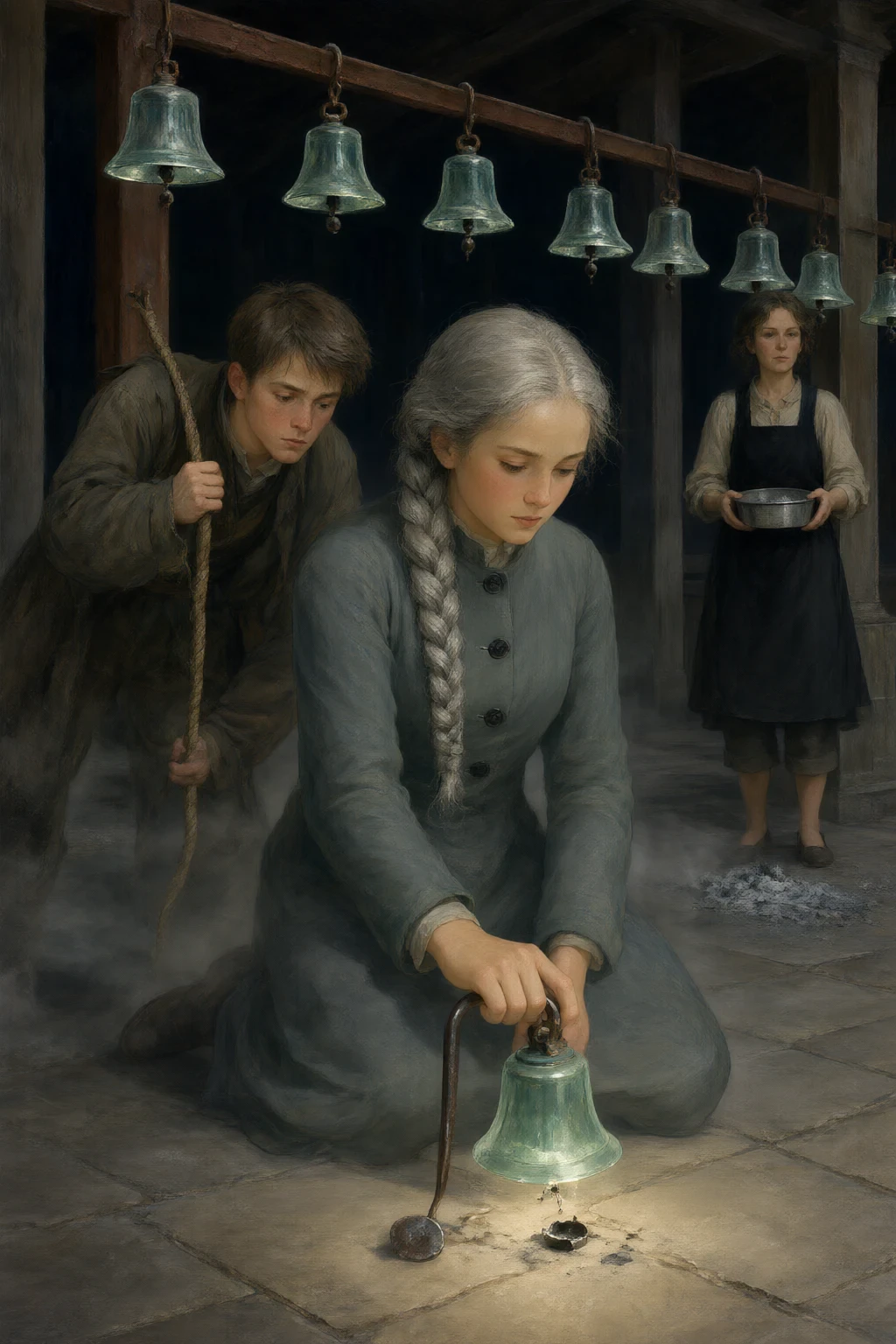
Fourth of Sleetmonth, and the chart is not finished. Ione Sarrack said it to the empty room, because the room had heard it every other day of her tenure and had never objected. She worked at the east wall with her right hand in her sleeve and her left on the chalk. The rota ran in five ruled columns: date, bay, bell, ringer, called. To the right of the last column were six inches of whitewashed wall, and had been for as long as she had been coming in, and nobody had ever put anything there. The market was on Thursday, and on Thursday the chart had to be finished, because the boy-tuner stood in the middle of the yard with a slate and read the wind out loud and nine hundred people stood and did not breathe until he was done. She was on the ringer column, bay nine, and she stopped. The name was QUILL, TAMSIN. Rota number forty-one.
She put the chalk down. The chart was recopied each year and the older years sat above the new ones in the same ruled column. Bay nine. QUILL, TAMSIN. And above that. She counted from the bottom with her finger on the rule. Eleven. She had written it herself, every year, in her own chalk, eleven times, and put a small tidy tick beside the oldest one, the way she did for entries that were certain. “Called at dusk, and yes?” Perrin Vole was in the doorway with a coil of new hemp over one shoulder, sleeves rolled four times. He was fourteen and had been a winder’s mate three years. “The ninth bay wants a new whipping on its line,” she said. “Fetch the winder.” “She’s up there. She has been since noon.” “She says she is not to be fetched down for anything short of a death.” “Bring her down. And Perrin. And when she gets here, do not tell her what the chart says.”
The girl came in because she had been told there was a death. She came in the way people come from a bright place into a cold room, eyes shut, chin down. Grey shawl over a green dress. Hair cut at the jaw and cut badly, by herself. Her right hand and forearm wrapped in a broad strip of cloth re-wrapped so often the edges had gone furry. A shallow crescent of an old scar at the edge of her left eyebrow. Ione read the name off the wall, because there was no other way to begin. “Quill, Tamsin.” The girl opened her eyes. It came back half a beat late, the way things came back to her. “Yes.” Ione waited. Nothing else came. The girl did not ask to be told twice, which meant she had heard it many times, and there was nothing in her face, which Ione had spent forty years learning to read and could not read now. “You are the winder of bay nine.” “Yes.”
“For how long.” “Eleven years. Since I was five.” “At dusk you haul the line and set the mouth.” “The ninth line from the mouth.” “Which bay is the ninth line from the mouth.” She did not answer at once. “Bay five,” she said. “How long have you known that.” “Since the first week.” “You have hauled the ninth line for eleven years on a chart that pays you for the ninth bay.” “Yes.” “Why did you not say.” “Because it was a line,” she said. “And the bell sounded. And I was paid. And I did not want to be a girl who had the bay wrong.” “Write it where it stands,” said Ione, to Perrin, who took the slate. She put the date at the head of the line and beneath it, smaller, that the ringer of bay nine for eleven years past was posted to the ninth line from the mouth, which stands in bay five. She left the tidy tick where it was.
“The Chart House posts a winder to every line in the colonnade, and takes the winder from the household that owns the bell, because a bell knows its own and the valley does not. Where the household supplies nobody, the Chart House supplies the name from the crown.” “From the crown,” said the girl. “From the lead seal. One name and one rota number, and the name is the only one we can be certain of.” Ione turned round. “Your mother could not tell us you were alive. Your mother was told you were not.” The girl stood a moment, and unwrapped two fingers of the cloth on her right hand to work the stiffness out of them. “I asked once. I was eleven. I asked the man who had the wall then, and he said the wall did not take requests.” “That is a fair account of the wall,” said Ione Sarrack.
The Ash Yard was the warmest place in Coldrow and had been all February. Under the corrugated lid the bank of grey ash out of every bell the valley had ever blown stood heaped like frozen surf, and the graduated brass sieves stood in a row on the bench, every rim dark with a hundred years of sifting. Marget Oskell was sixty-three. Her apron was black and had gone white at the knee. Her spectacles hung on a knotted grey cord. Her fingertips were the colour of strong tea. She carried a shallow tin of dry ash everywhere and tapped it with her thumbnail while she thought, and it made a small dry sound, like a beetle. “Fourth of Sleetmonth,” said Ione, before she had the door shut. “Fourth,” agreed Marget. “I want the tin. The seals. All of them.” “You know what that is.”
“I know it is sixty-one discs of wax impressed in 1952 for the four hundredth year, and that we have never once laid them out in one row.” “Have you seen it twice?” “Once. This morning. On the wall.” Marget went to the shelf and brought down an oiled ashwood box, and inside it, packed in wool, were sixty-one wax discs, each with a name and a rota number in the same hand, because in 1952 one man had sat at a bench for nine days and impressed every crown in the colonnade in wax, and then he died, and the box went back on the shelf. “Hands,” said Marget. “And no names out loud.” They laid them along the long table in the Chart House in bay order. Ione read from the yard ledger. Marget set the discs down on two fingers. Perrin wrote both lists on the slate. At forty-nine Marget said stop, and put her thumb on a disc, and read the number twice. “Marget.” “Number forty-one. Quill, Tamsin.” “The yard has no line for forty-one.” “No.” “The yard has a line for bay seven that week, and a name on it, and the name is not Quill, Tamsin.” “No. It is Sike, Wren.” “Sit down,” Ione said. “Tell it the way it happened, and do not improve it.”
The Sike cottage had flooded, eleven winters back. Wren Sike was five. The mother could not get down the valley, the passes were shut, the child was worse. The Quills, two hundred yards below, had dry cellars and a spare room, and Wren had slept four nights there on a pallet by the fire. On the Friday she was ill. A carter’s boy went down for the doctor and came back up in the dark, carrying a slip of paper. It was a clothing note, written four days earlier by the Quill mother for the carter who would come back for the child’s clothes, and at the bottom of it, because the Sikes had no paper and the Quills had paper, it said whose the clothes were. The mother had written the child’s name on it without asking, because everybody in Coldrow knew the Sike child would go home on the Sunday wearing what she was wearing.
The boy was twelve. He could not read the whole of it. He could read the bottom of it, because it was the last thing on the page. Going into the yard, he read it out to Marget Oskell with the frost coming down. “Quill, Tamsin.” Marget wrote it on the linen strip and tied it to the bundle. Then she did what the law says is done, and what she has never once not done in forty years. She read it aloud, and had it read back. “Quill, Tamsin,” said the man behind her, her partner, a tuner of eleven years who died the following spring. “Quill, Tamsin,” said the boy, who agreed with it.
That is the whole of the law. The name is read and read back. It is not read off the child. Marget looked at the child once, in the first minute, and then had two names to see twice, and saw them twice, and the second time agreed with the first, and signed the line. “Have you seen it twice?” she said. “I have.” “You have seen the name twice.” “That is the whole of what the yard can do.” “Yes,” said Ione. “And it has been the whole of what the yard can do since 1620, and that is why the yard is the only room in this valley that has never been asked what it meant.” “Six years,” she said. “Back through the ledgers, one page at a time, in the order I can bear. And I have been saving that one.” “Marget.” “I saved it because I knew what it would be. Not because I did not know.”
What the Chart House could do was put in writing, because everything the Chart House did was in writing, and the writing was the only thing in the valley that could not be argued with. The law allows a name on a crown to be destroyed once, and only in one way. A bell may be re-pitched: the crown is opened and the lip is ground. A re-pitched bell keeps its tone and loses the last sentence for ever. But it does not touch the seal, and the seal is a lead disc, and it goes on saying Quill, Tamsin to anyone who climbs a ladder.
So there were three courses, and Ione wrote them out and made Perrin read them twice. The first was to write the finding in the margin and leave the crown, and go on holding the last sentence of a girl called Quill, Tamsin, who is alive, at the table. The second was to re-pitch the bell, which would cost the last sentence and leave the false name exactly where it was. The third was the only one that took the name off the crown. A bell that is cracked, dropped, or struck on the lip rings one unbroken loud note, heard by everybody in the valley at once. The sound of the person who breaks it is taken the same hour. It stays hanging, empty, silent, listed.
“It is the bay seven bell,” said Ione. “It hangs lowest in that bay, the little one, and its line has been hauling for eleven years with a girl on the other end who thought she was winding bay nine. That is the bell Wren Sike is in, and there is no other argument about it.” “Then somebody loses a sound,” said Marget. “Somebody loses a sound,” said Ione Sarrack, “or the record is wrong for ever, and I have not got four years to make it wrong in a way I can live inside.”
The Pillar Walk at the last hour before midnight on the sixth day: a kilometre of flagged stone behind the colonnade, a low wall on the valley side, a rail of black iron on the other, and nobody’s window opening onto it anywhere along its length. Perrin carried a lantern, which was not much use, because the frost had raised a mist off the flags and the mist was brighter than the flame. Ilsa Sike came too, and walked the whole kilometre without saying one word. The bell in bay seven was smaller than the others, and that is the first thing a person notices about it, and it is why a person can stand under it for eleven years and never ask why it is the small one. Perrin made the line fast to the shoulder of the bell, drew it down, and lowered it through the iron. It came to rest on the flags with a sound like a bowl being set down carefully.
“Marget. You are the ash reader. Say what you are certifying.” “I am certifying that the crown of this bell carries the name Quill, Tamsin, rota forty-one, and that the name is not the name of the person in the glass; and that the person in the glass is Sike, Wren; and that the Chart House has been wrong since that day.” Marget’s voice did not go up or down anywhere. “And I certify it because I saw it twice, and one of the times was in a different place.” Ione wrote it on the slate as Marget said it, and read it back, and read it back again, because the law is that a thing is read and read back, and the whole of the trouble in this valley is that the same reading can be wrong twice. “Ansel Roke cannot witness,” she said. “A witness must say what was in the room without the book, and that man is the book. Perrin Vole and Ilsa Sike.”
Two witnesses, and the law satisfied, and the minute as exact as a piece of paper can be, and not one column in it for the fact that the woman breaking the bell did not want to. Ione took the shepherd’s hook off the rail. It was the right size. She got it under the lip where the lip comes the last inch into the body, which is the thin place, and which is where glass breaks. She said the date first, because she said the date first, and it came out perfectly. “Fourth of Sleetmonth,” she said. “And no, I will not read it twice.” She struck it.
What went out of that bell was not a note. It was one unbroken sound, and it was the loudest thing that had happened in the valley in the memory of anyone standing on the walk. It went down the walk and off the far end and into the houses with the windward shutters closed, and it came into the Chart House, where the plain little hand-bell stood on the long table making no sound at all, and Perrin dropped the slate. The whole valley heard it once. And the sound of the woman who broke it was taken the same hour, without announcement, in the manner of a thing that is fair and silent and never mentioned. Ilsa Sike, four feet away, saw her do it: saw Ione Sarrack open her mouth to say something to the man with the lantern, and produce a sound with no shape in it at all, and put her hand flat against her own mouth as though holding a door shut.
Nobody said anything about that. The minute was being written, and the minute had no place for what had happened to a person, and it was the correct minute, and it is on the wall. They left the broken bell hanging. That is the rule and there is no other arrangement: it stays on the yoke, empty, silent, listed, with the lead disc gone off the crown.
Market day was the Thursday and the yard was full and the boy-tuner read a north-west wind that had already been and gone, and the crowd stood still the way it always stands, and there was nothing in the wind left for the row of bells to say. Ione Sarrack read the finding, because a finding must be read in the yard, and standing, and not from a window. She got as far as the first line. “Fourth of Sleetmonth,” she tried. Nothing came. It was not that her voice failed. There was a voice and it made the shape of the first word, and then there was no sound behind it. She tried again. The same. She had said a date before anything else since 1952, and it had been taken out of her at ten past twelve on a flagged walk, which is fair, and silent, and never announced. Marget Oskell came up the two steps and took the slate off her without asking, and said it.
“Fourth of Sleetmonth,” said Marget Oskell, to nine hundred people, in a yard where not one of them was listening for a bell, because there was nothing to hear. “The Crown Kiln is a good furnace and the Chart House is a good wall, and I am sixty-three years old, and I have had a name wrong, and I have found it.” And then she read the finding out, word for word, exactly as written, including the part that said what it had cost, because a record that hides the price is not a record.
At the front of the yard a woman of sixty-five in a good black coat with a madder-red lining stood with her hood down in the cold and made no sound, and did not need to, because everybody in Coldrow knew Ilsa Sike, who swept the Chart House on Thursdays, and who had walked a kilometre of flagged walk every dusk for eleven years after that to stand under the little bell in bay seven and hear the only sound in the world that her daughter had ever made after she was born. Afterwards, in the Chart House, Ansel Roke wrote two lines into the Register of the Living in his own ink, and they were the first two lines he had entered in nineteen years that were not copied off the seal ledger. Quill, Tamsin. Living. Entered on the fourth of Sleetmonth, eleven years and sixty-one days after she was struck out. Sike, Wren. Struck out, on the fourth of Sleetmonth, on the certificate of Marget Oskell, ash reader.
He looked at the two lines a while, then said, to nobody, in the voice of a man reading out of a book he has read too many times: “It stands in the record as follows — Quill, Tamsin, living. Which is not the same as true.” “It is what we have,” said Ione Sarrack. “It is the better of the two, and it is the only one of the two that is written down.” The light went off the north window and the wind came up the valley and crossed the roofs and went into the ninth bay and into the seventh, where there was nothing on the yoke to answer it, and went on.
Ione Sarrack stood at the east wall with the chalk and put the date on the top line, because the top line of a chart that is going to be recopied is the only place a date goes that will be read by somebody after her. She could not say it. She had said it first every day for thirty years. So she wrote it, and the chalk went on white, and it did not wash off her fingers for weeks. She wrote: Fifth of Sleetmonth.