The two pounds was not for a knife and it was not for a blanket, though there was a knife and there was a blanket, and both of them had been got on credit in October from two different people in the tow shed, which is a thing you can do in a shed and nowhere else in the valley, because the shed is where the conversation is not an account and the women in it have been lending to each other for two generations out of a ledger of their own that the mill has never asked to see.
It was for a cart. The cart was to go up the combe on the Thursday and fetch a woman named Prue who had been living in her sister’s house since Michaelmas and was to be brought down before the frost if there was going to be any room for her in the mill. Two pounds four, which is a great deal, and the four shillings had been a present from an aunt and the two pounds had not. Jory Vasc was fifteen and an apprentice and had sixpence. He had the two pounds by the twelfth of November and the four shillings by the thirteenth, and the reason he had them was that on the twelfth he had asked four people in the yard, and three of them had said no in the ordinary way, and the fourth had said no in the way that people say no when they are afraid of what they are part of.
What you cannot do in Nether Combe, with sixpence and a cart hired and a fortnight’s notice given, is owe money. A debt in this valley is carried on a name. There is no other collateral in three counties: not land, not a horse, not a wage, not a promise. A man who owes can be a man who is owed, and a man who is owed is a name in somebody’s book, and the book is the only security there is. That is why the town is frightened of accounts and not of money. Money can be put down. An account cannot.
Aldis Prowse was nineteen and had a burn on the right thumb and could read the roll. She had been going up the stair for four years. She had an appointment every time, which is to say she knocked, and the appointment was a knock, and the whole valley treats the fact that she goes as evidence of something about her, and she has never been able to make the whole valley see that a person who can read a thing and is allowed to read it is not a person who is doing anything. Page four hundred and six is the fourteenth of November, 1971. The term is three nights. The shape of the call is the four words, and the name in the third column is a name she has read four hundred and six times and has never once said out loud, in her own kitchen, to her mother, or to anybody, and the fifth column, the outcome column, has one diagonal stroke through it, drawn from the top left to the bottom right, which is the stroke a clerk draws through an entry he is not willing to strike out.
She began going up for that page. She has read it more times than she will admit. She read it again on the twelfth of November, at about four in the afternoon, in order, all five columns, out loud, and she could not stop in the middle, and when she came to the page she did the thing she always does, which is to read the fourth column, because the fourth column is the only one she will read. And then she went down the stair and stood on the fourth step from the top, which is colder than the others, and she thought, in her own words, which she did not say to anybody for another two days: I have not done one.
Because there is a difference between a small lending and a real one, and she knows exactly where the line is, and it is not a matter of size. In the last six months she has done the small ones. She did a place in the queue at the binder’s for a woman with a bad thumb, and took nothing, and did not think about it after. She did an afternoon of carrying a sack up the mill stair for a man whose name she was not certain she owned, and he was not her father’s name, and he was a name she had picked up in the parish talk, and she carried it and it did not matter, because it was a sack and not an account.
Rule nine is the one everybody in the valley half knows, and the half that knows it knows it as a nursery thing, the way children know about a man under the floor. A name may be lent for a lesser purpose by somebody who is not its owner. It will hold for a lesser time, as agreed. The agreement is what limits it. And if it is lent beyond the agreement it does not hold at all, and the lender is left with nothing. What nobody in Nether Combe has ever been in a position to notice is that nobody has ever been able to find out what the agreement was. Jory Vasc asked her on the Tuesday, in the tow shed doorway, with his hand on the back of his neck, and he asked it as a second question, at length, and he was delighted when it worked. “If I lend my name to the mill for two pounds, what stops you calling it?” “The agreement stops you.”
“Yes, but you haven’t got one written anywhere.” “No,” Aldis Prowse said. “I haven’t.” “Then what is it?” “It is the afternoon,” she said, “and if it is not the afternoon then nothing is, and you will not get the two pounds, because without the name the mill cannot strike a debt off against you, and the mill cannot pay a man who is not on the board, and you are not on the board, and the board is what the float pays out of.” The deal was made on the fourteenth between two o’clock and six, in the counting house, with the pay board down off the wall and laid on the desk and the lamp on at two in the afternoon, and it took eleven minutes, and it was made in the ordinary way, and the ordinary way is to say things. His name, for the lesser purpose of securing two pounds four at the Combe, for the term of the afternoon, from the board at two o’clock to the board at six. The shape of the call, the four words, because that is the shape of a call and a lesser lending has a shape of a call like anything else. And the debt struck off the pay, the same as any debt, at the next pay, which was the first of December, because the pay is the first of the month and has been the first of the month since the mill was framed.
And Aldis Prowse took a pencil out of the counting house drawer, and there is a burn on the right thumb, and she put her thumb on the edge of the board, and the burn is on the board, and the burn is exactly the shape of the burn, and it made a mark, and Corve Merrick looked at it. “Write it in the mill’s book,” he said. “If I write it in the mill’s book it is the mill’s name that is lent and not yours,” Aldis said, “and then it is the mill that has my afternoon, and the mill will call it when the mill’s good time comes and not mine, and your want was mine and not the mill’s.” “Then I am not writing it anywhere,” Corve Merrick said, and touched the iron tally, and stated the week before the answer, which was the week before Michaelmas, and the answer was that he was not going to have a conversation with an eighteen-year-old girl about a bound ledger at two o’clock on a Thursday. The two pounds four was counted out of the float at twenty past three and put into Jory Vasc’s hand in the counting house, and the boy wrote it in the notebook he keeps on his left hand, in columns, and he wrote the figure twice, and he said thank you, and then he said thank you again to Aldis, separately, in a lower voice, on the stair.
The trouble began at six o’clock, in the sense that it had begun at half past three and nobody noticed until the Monday. A debt against a name is not struck off when the money is counted out. It is struck off when the pay comes, because the debt comes off the pay board, and the pay board is read on the first, and the first of December was seventeen days away, and the whole of the arrangement was therefore sitting on the board with its money already gone, waiting for a date, like a cart at a kerb. The agreement said an afternoon. The thing the agreement was attached to was measured in months. Nobody in the counting house on the fourteenth of November at two o’clock said which clock they meant, and the not-saying was in the conversation, and the conversation was not written down, and the only written thing in the entire transaction was a pencil mark on the edge of a pay board made by a thumb that had been burnt by a ledger iron in a girl’s first week.
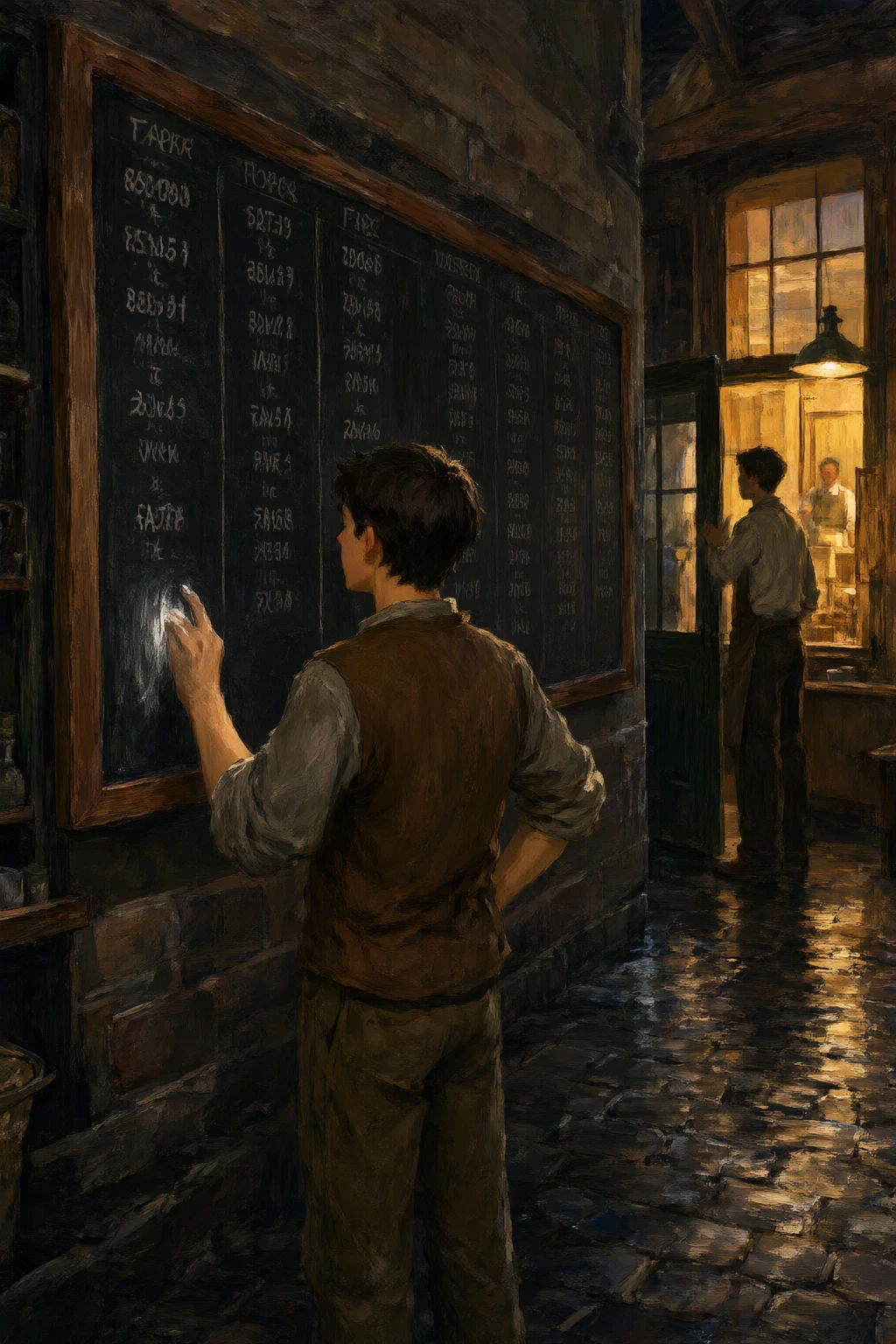
On the Monday the name went up in chalk, in the men’s column, between a man of forty and a man of sixty, in the master’s hand, and it went up the way a name goes up on a pay board, which is to say that nobody looked at it for a second time. The mill’s man sent him downriver on the Tuesday with a tally and a sheet. The sheet is the bindery’s sheet: it is the mill’s own day-sheet, headed with the name of the man whose goods these are, so that the bindery can know whose linen it is handling and can book it against him and can charge the day to him. The binder took it at the press, and could not read the name, and said so, and asked for it again, and Jory Vasc said it again, and the binder wrote it on the sheet and on the day-book and put the sheet in a rack.
The bindery’s day-book is kept for thirty years. That is the one retention in the valley with a number attached to it. The binder has had his hands on every name on the roll in one form or another for thirty years and cannot read half of them, and this is a matter of hand rather than of eye, and it is the only mercy in the whole of this story, and nobody arranged it. The shed changed in the third week. Nobody could say exactly what had changed and everybody could give an example. A woman who had asked for a quarter’s credit at the mill’s shop in October got a different answer in November, and the different answer was shorter. The grower at the top of the combe sent word down that the mill was welcome to send its own man up the lane at any hour of any day and would find the account ready. A carter would not take the mill’s paper for the horse. Not one of those people had been told anything. All of them had read the pay board, from the other side of the yard, through the window of the counting house, with the man in the green baize sleeve-half standing at it, and had seen a new name in the men’s column, and had done the sum.
On the Thursday Jory Vasc asked for it to stop. He did it well. He came to the top of the mill stair with the notebook out of his coat, and he asked the second question first, which is the correct form, and which is the one thing he has that his mother does not. “How long does an afternoon last in this town?” “It lasts as long as the agreement says.” “The agreement says the board at two o’clock to the board at six.” “Yes.” “It is a quarter past six now.” “Yes,” Aldis Prowse said. “And the pay is on the first, and the debt comes off the pay, and the debt is not off until the pay, and I cannot bring the pay forward, and neither can the master, and there is nothing in any of this you can do, and I am not going to pretend to you that there is.” “So stop it. You lent it. Stop the loan.”
“I cannot stop a loan. If I could stop a loan there would be no loans. I can only stop lending, and I have stopped, and you are what I stopped with.” He looked at the notebook for a while. “Then what happens if it goes on past the agreement?” “It does not hold,” she said. “That is rule nine and it is the only one of the ten that people in this valley have never once had cause to use. Past the agreement it does not hold at all, and the lender is left with nothing.” “So there will be nothing holding it.” “There will be nothing holding it.” “So I can do anything.” “No,” Aldis Prowse said. “You have just told me —”
“I have told you what the rule is and not what the rule is for,” she said, “and you may put that down in your book, and it will be the only sentence in it that is any use to anybody, and I am going to ask you now, for the sake of the two pounds four, not to come back to this stair and ask me it again, because I have given you an answer that is true and I have not got another one, and you are fifteen, and you will keep coming up this stair, and I cannot do the other thing, and you will work out within a year what the other thing is.” She was in the present. She has not checked the join in a conversation in her life.
The first of December was a Saturday, and the mill paid on Saturdays. The float was counted on the Friday and the pay board came down off the wall and went up again with the new quarter’s figures in chalk, and two hundred and six people were paid, and the binder’s man was in the yard for the linen and the carter was not, because the carter would not take the mill’s paper, and the shed was full. At four minutes past eleven the clerk read out JORY VASC in the men’s column, and a boy of fifteen came forward and took two pounds four, and the debt was struck off, and the entry in the pay book was made in the master’s hand with the date, and that is the whole of what the mill did. Payment releases the name at the moment of payment. The lender must hand it back in a sealed envelope within the hour. There was no envelope.
There was no envelope in the counting house drawer, or in the mill office, or in the tin on the counting house sill, or anywhere in the building, and there never had been, and the reason there never had been was that the Combe Mill has never in its history been a lender, because the mill borrows, and borrowing is what the mill is for, and the mill’s entire acquaintance with this business is on the other side of a stair it is not permitted to go up, and the mill could not produce a sealed envelope if the Queen of England came and asked for one in her own hand.
So the mill paid in full and kept a name for an hour and had nothing in its hands and could not produce what it was required to produce, and if the name had held, the mill was a thief at four minutes past twelve, and a thief is proved on the roll, and it is the only kind of proof this town has ever accepted. The name had not held. It had not held since six o’clock on the fourteenth of November, and that was not a matter of opinion or of anybody’s good intentions, it was the ninth rule, and the ninth rule says that a name lent beyond the agreement does not hold at all and the lender is left with nothing, and the agreement said the board at two o’clock to the board at six, and the board at six o’clock went past in front of a window facing the yard.
So there was no name. There was nothing to release, and nothing to hand back, and nobody was a thief, and Aldis Prowse stood in the counting house at a quarter past eleven that Saturday morning and understood, with the whole of the day’s arithmetic in front of her, that the two pounds four had been paid out of the float at twenty past three on the fourteenth of November and had not been a debt against anything since that moment, and that it had been four pounds in the world that the mill had given a boy and never got back, and that there was no book in England in which that could be entered. The mill stopped in the last week of April and the pay board came off the wall and was stood on end against the back of the counting house with a sack in front of it, and it was not wiped, because wiping a board is a job and the job is done in the morning and the morning is a Monday and the Monday is in June. In the shed, in June, Innett Sly said the thing that the rest of the valley had been saying for seven months without getting to the bottom of it.
“There were eleven days,” she said. “I have been counting. The fourteenth to the first is seventeen days, of which the days you were on the board were eleven, and the days after the first were none, and I can give you the eleven exactly, because I was on the second row and the second row sees the board over the door of the counting house, and I read it every morning for eleven mornings while the flax was coming in.” “And?” “And on the sixth of them a woman asked me whether the mill had paid you yet. And I said I did not know, because I did not know. And she said, then he is not a man yet. And she meant it kindly, and I want that written down, and I have been saying it in this shed for seven months and about two hundred people have agreed with it and not one of them has said out loud what the two hundred people are agreeing about.”
“What are they agreeing about?” “They are agreeing that the mill had put a name on its own board and paid it and could not account for it,” Innett Sly said, “and every one of them has been waiting since for the mill to account for it, and the mill cannot, and that is the whole of what has happened in this valley this year, and you may have it in a quantity, because I have one: eleven days, and no account, and a great many people in a shed.” Jory Vasc asked Nanny Rowe one question in the third week of July, and he had been carrying it since the Saturday in December, and it was not the question he had expected to be carrying, and it was the only one he had. He asked it in her kitchen with the lamp already down as far as it goes, which she does, and which is not a thing about light. “Is it a thing that has happened?” “No, I should say not,” said Nanny Rowe. “Then what is it?”
“It is a thing two people said out loud in a room, and one of them wrote down a shape of a call, and the other one was fifteen, and they went away, and that is the end of the daylight of it. And I am telling you now, as though it were this afternoon, that in ninety-four we had a night in this house where a great deal happened, and I was the only one in the house, and I have gone over it eleven times since, and I have got a different answer every one of the eleven, and it was the other people that were the same every one of the eleven. And the part I go over is not the night. It is the next morning, when everybody came down and wanted to know whether it had happened.” “Did it happen?”
“In this house there is a lamp,” Nanny Rowe said, “on the dresser, and it is a good lamp, and it was my aunt’s and it was sold to a man in the second row of the shed for eleven shillings, and it is in that man’s house now and it is his daughter’s, and it is still a good lamp. And I used to think about that lamp. I used to think about that lamp the way you would think about a person. I thought that lamp is in his house and it is mine, or it is mine and it is his, and whichever it is, it is the same lamp and it is in one place and the other place is where it is not.” “That is a lamp.”
“That is a lamp and it is a name and it is the whole of your year,” Nanny Rowe said, “and I have had fifty-five years to say it to somebody and I have said it to a boy of fifteen in my kitchen, and I would take it as a kindness if you did not look at the lamp, because I know what it is like to be looked at when you are saying a thing you have said to yourself for a very long time. The lamp is in her house. The lamp was always in her house. That is the whole of what I have to tell you and it has not once been any use to anybody, and I have asked for nothing in my life except to be asked, and you have asked me, and I have answered, and you may go out and shut the door because the draught in this house is the river and the river has been brown since March.”
The mill’s book is the weekly pay. It is ruled in nine columns and it is copied up at the end of every quarter and the copy is what goes to Bristol. There is a gap in it. There is no column and no line for what happened between the fourteenth of November and the first of December, and a pay book does not have a way of carrying a day it cannot account for, so the eleven days are simply not there, and they are not there with a stroke through them, they are not there. Corve Merrick looked at it for a fortnight. He did the quarter’s copy twice and the quarter’s copy is the thing that goes to Bristol in a leather case with a string round it, and the Bristol clerk reads every page of it, because that is what a clerk is, and a gap in a pay book is a hole in a pay book, and it is the only kind of hole in this business that nobody in Bristol has ever been able to explain away.
He could have filled it. Filling it would have meant entering a debt discharged on the fourteenth of November, and an advance on the first, and a name in the men’s column for eleven days, and the name is the part he could not put on a page in a book that goes to Bristol, and so he left the gap, and he left it on purpose, and he has not told anybody that he left it on purpose, and the leaving of it is the only thing he has done this year that was not arithmetic. She went up in the last week of August with the pencil and the tin lid and read the precedents, in order, out loud, and could not stop in the middle. There is a lending of a year. There is a lending of an afternoon, from 1834, and the fifth column says: HELD TO THE END OF THE AFTERNOON, NOT CALLED, DISCHARGED ON THE DAY. There is a lending of a lifetime, in 1861, and the fifth column says: HELD TO THE END OF THE YEAR, NOT CALLED, RETURNED AT THE YEAR’S END. And there is no entry for a lending that ran past its agreement.
Not one, in five hundred and sixty pages and a hundred and forty years, and there are certainly some in there — there must be dozens, and there are certainly men in this valley who have done a thing like that in the last year — and the reason there is not one is that when a lending runs past its agreement it does not hold, and if it does not hold then there is no name on the roll to write an outcome for, and so there is nothing to write, and the page stays as it is, and the roll is silent. The roll’s silence is not a record. That is the thing the roll is for, and it is the thing the roll cannot do, and it is why a book that has been the most valuable object in the valley for two hundred years is also, on the evidence of 1971, not complete.
Aldis Prowse put the pencil on the tin lid and then took it off it and then put it down again. She wrote the entry. The first column is the date. The second is the term. The fourth is the shape of the call. The fifth is the outcome. The third column is the name, and she left it empty, and she left it empty on purpose, and it is the only deliberate act of her life, and she can justify it in one sentence, which is that a name in the third column is the only part of a page anybody can be harmed by, and that the rule about not reading the third column aloud is not a courtesy between neighbours. It is the wall the whole building is standing on.
The first of October was a Tuesday and the mill opened for the winter and the board came down off the sack and was turned and hung, and the chalk from the November was still on it, because the mill washes the board in the yard at Michaelmas with a bucket and a cloth, and the wash takes the big figures off and does not take the small ones, and the men stood in front of it and read their own names in the places where they would be next week, and one man of about fifty put his thumb across his own name the way he has done every year for eleven years and left a clean streak in it. Jory Vasc was sixteen since the August. He is in the men’s column now, in the master’s hand, with a date beside it, entered in the ordinary way in the ordinary course of an ordinary week, and there is no instrument of any kind behind it.
He came in at a quarter past six on the Tuesday, after the others had gone, and stood in front of the board for a while with his hands behind his back, and the lamp behind him. Four inches below his own name, in the men’s column, in the chalk of Corve Merrick’s hand, thinner now and half gone under the writing of the new week, there was JORY VASC, and it had been on that board since the fourteenth of November, and the wash in the yard in the September had gone over it twice and had not taken it, and it did not come off with his thumb either, and he stood there and pushed at it for a while, and then he went home.