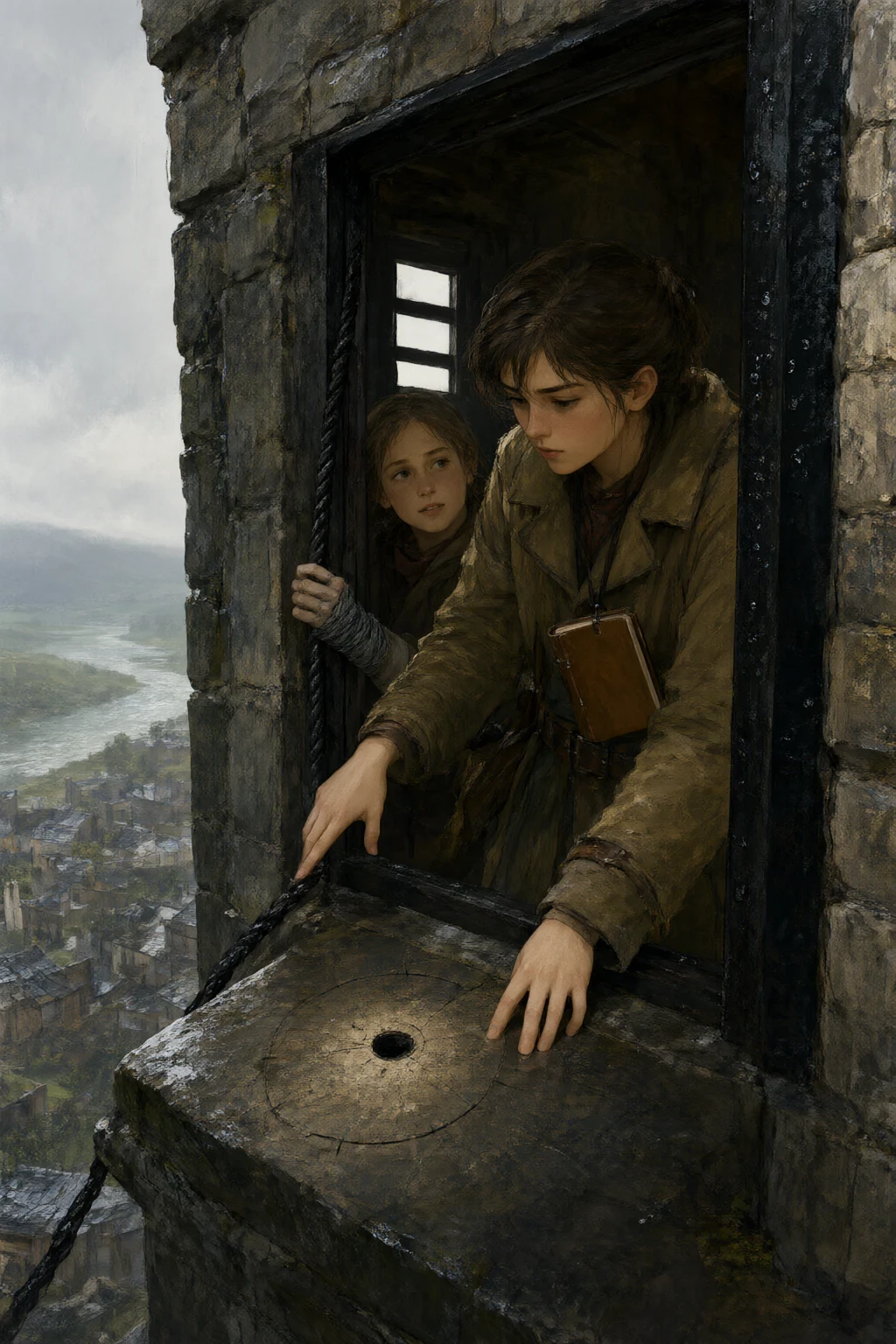
Verity Ash set the sheet on the sill and laid two fingers flat on the frame. “Two hundred and forty, give or take the wind,” she said. “Below that the tower takes it and you are measuring the tower instead of the bell.” The wind came across the moor from the north-west with rain in it, sideways, the way it comes at Sikehead, where there is nothing between the weather and you but a limestone hedge and nine courses of stacked quarry stone. Ebba Roke held the far end of the tape against the wall of the quarry office and watched the water run along it in little jerks. “Give or take the wind,” Ebba repeated. “Is that a figure or a feeling?”
“It is a figure,” Verity said. “It is the difference between what the wind is doing to the sound and what the distance is doing to it. Four, six, sometimes nine. If somebody asks you how far, you say two hundred and forty and then you say the weather, because that is the truth and the truth has two halves.” She wrote it in the waxed notebook on the lanyard, small, neat, in a hand that did not hurry. She had been asked, in the spring, to produce a document. The parish wanted a statement of the reach of the fire bell, for the renewal of the fire policy, and the parish had looked round the room and found one person who measured things for a living, and had not thought to consider whether she was the right one. Below them the Corrach ran green and fast in its gorge, two hundred and forty feet down and half a mile out, and the pasture on the valley floor was silver with standing water.
The bell went at twenty past ten, which was not the hour. That was the thing about the fire bell: its seam in the shoulder was three inches long and it came out an hour before you asked it to, so that if you were in a burning terrace at half past three in the afternoon you had the whole of three o'clock to get out. Verity had the watch out before the first stroke landed. “Ah,” said Ebba. “You will say the number.” “That is the first of the three they rang for the church. That is going to be the second of the eight, because they ring the tenor after, and then the third of the eleven, which is the big one.” She was already counting, her lips moving. “There is no holding stroke in the second. They never put a holding stroke in the second.”
“Good. The seam takes the second flat. The seam is why the bell comes early, and the seam is also why the second has no bottom to it. Write that down, because no one will believe it later and I will not be asked twice.” Ebba had the grey wool wound round her right palm, damp as ever, and she held her hand out of the wind the whole time she was counting. She was fifteen and she was the youngest hand on the ropes in the Cloth Hall tower and she was not permitted the fire bell, and everybody in Gethin Bell had been extremely careful for three years not to say why.
They went down to Bream Gill in the afternoon, which is nine houses and a smithy and a mill leat, one mile below the town on the river road, where the ground stops pretending to be dry. Rhoda Wadry was eighty-one and had been thirteen when the terrace behind the smithy caught in the summer of 1944, and she had a way of standing that put her back to a wall and her eyes on the road. Verity explained the survey and Rhoda listened to all of it, which she had not expected. “Six households heard the bell from my hearth this month,” Rhoda said. “I count them. I have counted them since I was thirteen.” “Who are they?” “The Tews, the two Odds, the Sennick girls, Nella’s house, the Cotter boy’s people, and the one up the leat path that has never once answered me about anything.” She recited it the way you recite a rosary. “Your book has never heard of any of us.” “No,” Verity said. “The book records bells.” “That is what I mean,” said Rhoda.
Nella Wadry was thirty-four and she lived in the lowest house in Bream Gill, which was also the wettest, and she had a way of putting her back to the door that was not unlike her aunt's. She did not want the survey. She said so before she was asked. “I want the bell,” she said. “I do not want your list.” “Those are separable.”
“They are not, and you know they are not, and you are the first person from this town who has written anything down in my life.” Nella's hands were red to the second knuckle. “When the assessor comes, he wants names. Names are what a man writes in a column when he is asking who has something worth burning. My husband is not mine to name. I have a debt on the wharf that is not mine to explain. You write my name and I am a line in a book, and the book is in a room with one window and a man who has been there forty-one years.” Verity had the notebook out. She put it away again. “Then what do you want written?” “That I am here. That somebody official has been in this house and put two fingers on my window frame.” Nella almost smiled. “My gran says the frame went soft. If somebody felt it, then somebody was here.”
Dykefoot was eighteen houses and a flax mill at the tram wharf, and the mill had the contract to be quiet between noon and four, which it kept by an arrangement nobody had ever written down: the girls did not run the cards while the pit was lit. Verity had expected to be told that the bell was a nuisance out there. Instead the carding mistress showed her a chalk mark on the doorpost, the height of a finger, with the hour beside it, and explained that the washing went on the line at the school bell and came off at the hour bell, and that a wet shift that hung for an hour past its hour was a shift that had to be re-scrubbed, and that there had been no re-scrubbing at Dykefoot since before the girls could remember.
“The mill would pay for a bell of its own,” the mistress said. “I have asked twice, in writing, in nineteen ninety-six and again this spring. I am told the answer is that we are not a parish.” Verity wrote that down in the second column, with the dates, because it was the third time in a month that somebody had asked her for a bell and had been told the same thing by a town that owned four of them.
Nan Ilva came down the stair from the pit in the middle of the afternoon with her sleeves pushed down over her wrists, which she did before she answered a question, and stood at the top of the shed looking at the row of moulds half-buried in the sand under the wired glass that had gone the colour of tea. “Eleven hundred and forty, and the pit is banked,” she said, before anything else, in the way she had said a temperature to the room every day for nineteen years. “You are asking me whether I have a bell that can be heard at Bream Gill.” “I am asking you whether you think there should be one.”
“The fire bell is heard at Bream Gill,” Nan said. “It was cast in 1861 with a seam in the shoulder three inches long and it comes out an hour early, and there is a line in the book in the hand of a man named Sowerby that says exactly what it is for, and it is for the fire. So the answer to your question is that the town has said the thing to Bream Gill sixty times a year for fifty-one years without once walking down there to be asked.” She put her hand flat on the nearest mould, the way a person does to a horse. “That is not your survey’s business,” she said, “and I say that as a heat problem and not as a grievance. A bell is not a road. You do not widen it because somebody at the bottom has built a house on the line of it.”
The rota was in a cupboard in the Cloth Hall, on a board, in chalk, and it was the one document in Gethin Bell that nobody pretended was old. The fire bell could not be rung in the night. That was the limit of the hour: no bell sounds after dark without a named human hand on the rope, awake, and intending the sound. Which meant the whole valley's fire warning, at night, in the winter, rested on a chalk board and whoever was on it. Verity had assumed the board was full. It was not. She stood in front of it for a while with her hands behind her back and did not write anything, which for her was a kind of shouting. “Eleven weeks,” Ebba said. “That is the last name. D. Roke, and it is scratched out, and above it F. Merrow, and above that—”
“Eleven weeks in the middle of the wet season, on a board that is chalk,” Verity said. “Which means nobody has appointed anybody, and nobody has told them, and all three of those are the same mistake in three different clothes.” “Does the bell not care?” “The bell has never cared. That is the arrangement.”
The parish met on the Monday in the counting house, which is two rooms over the foundry office with the leather book on a lectern at the north window because it is too old to be carried by one person. The wet came off their coats and stood on the floorboards in a ring. Aldous Crenn was sixty-one years in the parish by the spring, of which forty-one were in that room, and he had a green brass reading arm bolted to the desk at eye height and a cataract-yellow left eye that he read around rather than with. He put the waxed notebook down where Verity could see it, which took some doing. "Sixty-two households," he said. "In three settlements the book has never heard of."
“The book has never had any reason to hear of them.” Verity set out the sheet. Sikehead: eleven households, timing the middle shift by the hour bell since the quarry whistle was lost in the flood of ’ninety-one and nobody replaced it, because the bell was there and the bell was better. Bream Gill: nine, four of them counting the fire bell’s early stroke as a fire warning, as it has been designed to do since 1861. Dykefoot: forty-two households, of which a good half the women had the washing on the line timed to the school bell and the tram crews timed to the same, which is a thing nobody had decided and everybody had agreed on. “Fifty-nine,” Verity said. “I have said sixty-two twice and I want it in the record that it is fifty-nine, because three of the households at Bream Gill have asked me not to have their names written.”
Aldous looked up. The good eye did most of the work and the yellow one contributed a soft glare from the other side of the desk, like a lamp left on. “Then the document is wrong,” he said. “A figure is a figure. If you leave three out, the number is not a number, it is a number with something hidden in it, and in eleven years somebody will use the three to say we hid them.” “That is what I want in the record,” Verity said. “I want the three marked as withdrawn, by their own hand, in my hand, with the date. I want the document to say the bell reaches them whether we write them down or not, and that they were asked.”
They argued about the policy for an hour and forty minutes, and the argument was not about bells. The old policy covered the parish and the parish. The assessor of the county assurance wanted a certified reach, because a bell that can be heard in a house is a bell that warns a house, and a house that is warned and uninsured is a house that will send its letter to somebody. So the document went in, or the policy lapsed, and eleven hundred people had no fire assurance in a valley full of wet slate and old timber. “If we write it, we own sixty-two houses we have never looked at,” said the churchwarden. “If we do not write it, nobody owns anything, because nobody will sell to us,” said the lime yard man, who had done the arithmetic twice and did not want to do it a third time. Verity listened to both and gave them a distance.
“Two hundred and forty feet from the sill of the counting house window, give or take the wind,” she said, “and the reach of the fire bell is a property of the air and not of the parish boundary. I cannot certify a boundary. I can certify a reach. You will have to decide what a reach obliges you to.”
It was Verity who said the thing that made the room go quiet, and she said it badly, the way she said everything, with a figure stuck in the middle of it like a stone in a loaf. “The board is short a hand,” she said. “Eleven weeks. And I want it entered that the three settlements have been counting a promise that has not been kept since the middle of August, and that no one in this room told them, and that not one of them stopped counting.” Nobody spoke. “They have not stopped,” Verity said. “That is the part I cannot get past. Nineteen households came to the doors this month and asked me, unprompted, when the night hand is. Not one of them has stopped timing their work to a bell that has not been rung at night since the twenty-eighth of August.”
The rota was made up on the back of the notice-slate, because the board wanted chalk and this wanted ink. Two names went in. The first was Perrin Wadry, twenty-nine, smith at Bream Gill, who came up the hill in the rain on the Tuesday with his hands in his sleeves and said that he had been awake most nights since the survey anyway, out of his own account, and that a man who cannot sleep might as well be useful, and that he was not afraid of the ladder, having been on it for a chimney once. The second name was Verity Ash, and she put it down herself, and it was the only figure she ever entered in that room that was not a measurement. “It is Thursday nights,” she said. “Every Thursday. And I will want somebody to sit in the counting house and be bored on my behalf.” “You will be doing two jobs,” said Aldous. “Yes,” said Verity. “I have been doing two jobs since March. You will find I am quite good at it, and that is not a compliment, it is a figure.”
On the Friday they rang the fire bell in daylight, for practice, which is not a thing the book has a word for and which the whole town came out to hear anyway. They rang it properly. Perrin Wadry on the rope, Verity at his shoulder with the notebook, Ebba on the stair counting because she could not be stopped, and Aldous standing in the belfry doorway with his hands behind him like a man at a funeral he was not sure of. The seam came out early, as it does. “There,” said Ebba. “That is the first of three. That is the second of three, and there is no bottom on it, that is the seam, and that is the third of three, and that was an hour early, and it was the hour of the fire, not the hour of the bell.”
Fifty-nine households and three withdrawn. Six miles of valley. One wet October evening with a smell of hot iron coming off the town and getting into everybody’s wool for a season. Rhoda Wadry stood on the far side of the yard with her back to a wall and her eyes on the tower, and when Verity came down the hill to her she said the thing she had asked for and had not got. “Say now,” she said. “Is it rung at night?” Verity had the notebook in her hand. She could have given a figure. She had the number of weeks in her mouth and the tolerance in her mouth and the whole shape of an answer that would have been correct and would have been nothing at all.
“It is,” she said. “It is rung on Thursdays by Perrin Wadry of Bream Gill, and the other nights by me, and my name is in the rota in ink in the counting house where anybody can read it, and I have a household at the top of the street who will tell you the name of the person on the rope on any night of this winter if you knock.” Rhoda Wadry looked at her for a while. “That,” she said, “is not a figure.” “No,” said Verity. “It is a name. They are not the same thing, and I have wasted a good deal of this year finding out which of us was talking to the wrong one.”