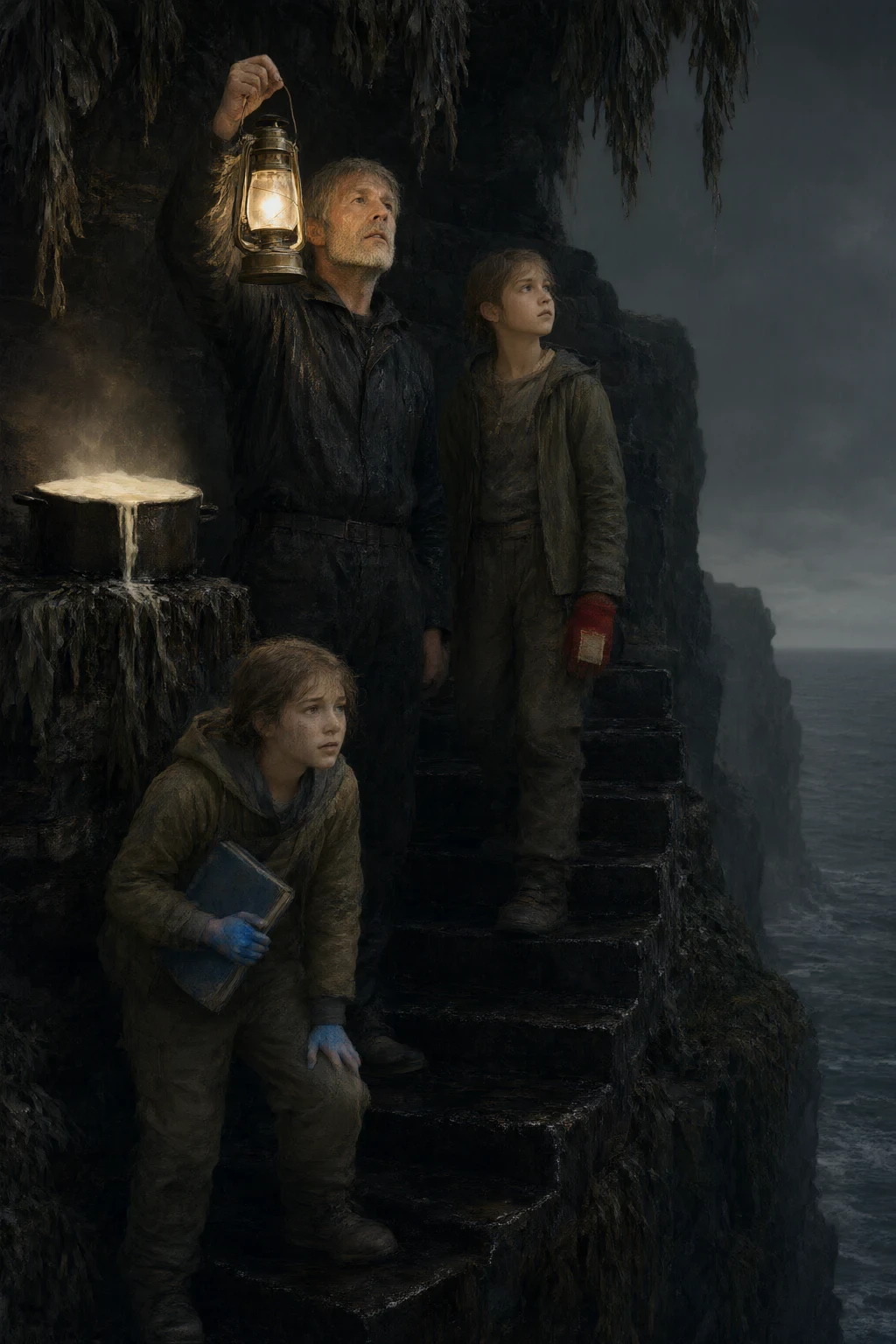
The Lamp House kept a hundred and one lanterns on cedar pegs, sorted by name, and it smelled of hot brass, kerosene, and the small grey curls of wick that came off the trimmer’s board. Wren Adry had been standing in that smell for twenty minutes with her ledger under one arm and a question she had not got round to putting, because every time she brought the question up to the front of her teeth, Hadren Vole turned a lantern about on its peg and showed her the back of the plaque, as though the answer might be on the brass somewhere the polish had not reached. He was sixty-one and looked it in a way that had nothing to do with his age. The white stubble on his jaw had gone the pale green of sea foam. There was a thumbprint of lamp-black in the crease of his right thumb that had been there so long it had become a feature, and when he worked the thumb, the crease stayed black, which Wren’s grandmother had told her was how you told a true lamplighter from a hired hand.
The room was warm. Ansel Quance sat on a stool by the stove with a board across his knees and a scraper, counting out loud as he went, because he said everything out loud, and in a warm room the numbers were the only thing moving. “Nine, ten, eleven, and — hold on. Eleven and a half. A half wick is a bad wick.” “You trim it anyway.” “I trim it into the bin. That is not the same as wasting it. One, two, three, and bin.” Neel Ferrin was carrying four lanterns from the board to the door on a padded tray, in a bright yellow slicker with the hood up, indoors, in a room with a stove in it, in October. She was eleven, and the fastest thing on Brinehold Row, and nobody had asked her to take the hood down in a year. Pim Sabiston, who was eight, sat by the key board with the brass lantern-shaped key on its cord round her neck, explaining to nobody in particular that the door was the best of all the doors, which made it a keeper, which made it a bird.
Wren had come down from the Harbour Council house with a leaf of the Great Oweing Book copied onto a sheet in her own hand, because she did not trust her own copying, and had brought the original in a satchel. It was the month of November, eighteen seventy-one. In every other month of that year the column headed HOURS GIVEN ran across the page in a firm upright hand, and under it were nine figures a night, night after night, for thirty days. In November there were no figures at all. Across the empty column someone had ruled nine pale strokes in a lighter ink, and under the heading a small bracket and three letters, and the letters were Q. T. “That is all I am asking,” Wren said. “Nine strokes, three letters, and an empty column. It is not a question about anybody’s honesty. It is a question about the column.” “There is a minute.” He took a folded paper off the bench without opening it. “Ninth of December, eighteen seventy-one, minute four, and the word is in it twice, and it is not my word, it is the Council’s. I have watched it stop meaning anything in about eleven years, which is the fastest a word has ever died in this town.” “That is not an answer about a column.”
“It is the only answer there is. It is cheaper to fill a column than to fill it with a thing that cannot be filled with.” He set the paper down on top of the lantern. “Sit down, or stand, whichever you like. The page is in here.” “The page is a document, not a lamp.” “No,” he said. “It is a witness.” He went to the far wall, where the old working stock hung, ninety brass bodies gone green at the seams. Among them, on a peg with a waxed card tied to the ring by its handle, stood one that had not been properly lit since a year Wren had been told not to ask about. Its chimney was a dull opal, clouded from the inside with a fine grey bloom like frost on a window, the sort of clouding you get in a chimney that has been filled with a fat that was never quite clean. He took it down and put it in a sack. He also took a stoppered jar from a shelf, half full of something pale that smelled faintly of vanilla and, underneath the vanilla, of something else, and put that in the sack as well. “Where are we going?” “Down to the pot.” “Chief — ” “Put your ledger in the satchel and leave the ledger in the satchel,” Hadren Vole said. “You are going to want both hands.”
The Tar Kiln Steps went down from the Lamp House in a zigzag of two hundred and fourteen steps, and the whole of them were one flat black shine, because the pitch that had dripped off the pot for a hundred years had run into the stone and made it glossy, and slightly soft, so that a boot with nails in it went in about a millimetre and came out with a black print that stayed wet an hour. Kelp and rag hung on lines overhead to catch the drip, grey-green and heavy, and dripping now, though nothing was boiling above them. It felt like walking down a wet roof. The rain came in sideways off the water, fine and cold and not quite rain. “Listen — ” Neel Ferrin said, and then changed it. “It’s nice weather for it.” “It’s filthy weather for it,” said Hadren Vole. “I was going to say the stair is nice in this weather. It saves a lamp.” She had followed them down, and Hadren Vole had not told her to, and he did not usually fail to notice a person following him. Neel went first. At the half landing there was the pot. It was an open iron pot four feet across, set in a brick hearth rebuilt so many times it had become a small hill, and beneath it a firebox that took three hours to draw and then held all night.
Hadren Vole put the sack down and took out the jar and the clouded lantern and set the lantern on the half landing, upright, where the drip from the kelp lines fell in a ring around it and not on it. Then he built the fire, small stuff and then large, speaking to it the whole time in the low flat voice of a man doing a job he had done a thousand times. It took eleven minutes. When it took, the flame came up out of the pot and stood there, orange and steady, and the air under the cliff filled with a sweet heavy vanilla warmth so thick that Wren felt it on the back of her hand. “There she is,” said Neel Ferrin.
“Thirty-one boats went out of this bay in the Winter of Lost Boats, eighteen thirty-nine,” Hadren Vole said, “and there was nobody left to row this town’s boats after, and nobody to bury, and no bottom to them that a lead would find. And the sea came up the Row at night and the doors of eleven houses stood open, and every house on the Row had an open door, and nothing had gone in or out. So the town sat down in a cold church and the sea made an offer, and the offer was this: every dusk of the season, the coast gives light. In exchange they sleep warm. The line was not raised that winter. It was raised in eighteen forty-six, seven years later, by men who were giving up, and the walking song still counts the same nine.” “They,” Wren said. “The thirty-one.”
“The thirty-one. Warm. Not rising. Not coming ashore, not standing in anybody’s kitchen, not calling down the Row for bread. Warm, and unaware of it, and never knowing they are down there. Nine lamps, nine names, one name to a lamp, because nine is the shape this coast will hold and would sooner break than be ten. And twenty-two of the thirty-one never had a post at all, and there is no tenth lamp and never will be, and that is the part of it the town has never once said out loud. The cold is what the town would wake up to.” “And the payment.” “An hour a lamp, a dusk. Out of the bearer’s own light, taken from the hours he will not live, given with a named intention, because that is the only signature the water will take. Nine lamps is nine hours a night, every night, and there is no date on the far end of it.” He set the jar on the stone and did not open it. “Do that sum aloud, girl.” She had it before he had got to the end of the sentence, because she had the ledger against her ribs and she had done the sum eleven times since the carriage.
“A hundred and fifty dusks a season,” she said. “The line is lit from Michaelmas to Candlemas and dark the rest of the year, and nine lamps a dusk, so a season is thirteen hundred and fifty lamplights. Fifty-five seasons since the line went up in eighteen forty-six is seventy-four thousand two hundred and fifty entered. I have never seen the delivered column for a season. It is not in the book at all. In fifty-five years, nobody has written down what we actually gave.” “No,” said Hadren Vole. “Nobody was short of anything. That is what got us through the first years. Nobody starved. Nobody went without. I can stand on this stair at sixty-one and tell you the truth, which is that after the Winter I was a young man with more nights in me than I could see the end of, and I gave one away, and my mother slept warm, and I walked home up the Row in the dark with the shadows of the nets on the wall like handwriting, and I was happy. I have not been happier since, and I paid for it out of the only account I have.” He looked down at the lantern on the half landing. “You have not asked your question.” “You filled in the column yourself.” “Not yet. I filled in the year. The column is the other thing.”
“In the sixties the hours ran out.” He said it the way a man says he has a stone in his boot. “It does not run out,” Wren said. “It is not a stock of anything. It is the remainder of a life. Nobody has an account.” “Lighters do.” He held up his right hand, flat, and turned it so she could see the crease. “Watch. It is cheaper.” The joke went past her, and she gave him the look he had earned, which was the look her grandmother gave, and he took it.
“By eighteen seventy the Ridge Line had five working lighters and the town had twenty-four years of this behind it. A lamplighter who has spent heavily ages fast. You have all been told it and you have all decided not to picture it, because it is easier to think of a lamplighter as a man with a pole. Osme Ludd was thirty-four in eighteen seventy and looked eighty, and everybody said that was the sea, and everybody said it kindly, because there was nothing else to say. She had lit the fourth and fifth posts and the harbour end every season since the line went up. She died on the ninth of March, eighteen seventy, at thirty-five, of a chest. A chest. Wren. Of a chest. The doctor said it was the cold coming off the water, and he was not a liar; he had a colder explanation than the true one.” He picked up the jar and turned it so the pale stuff showed. “And they sent me up to the council in the spring and asked me for an answer that did not make anybody’s face go like that.” Neel Ferrin, on the step below, said, “They made the tallow,” in a voice with no opinion in it at all. “They made the tallow.”
“Right,” said Neel, and went to sit on the lowest step with her back to the fire, which for Neel Ferrin was the whole of what she had ever been able to say about a room. “The rendering is not new. Men have boiled whale, and herring, and pitch on this step since before my grandmother. What is new is what goes in the pot. It comes from the Outer Stacks by boat, and the council calls it rendering, and the town calls it rendering, and I am going to tell you what it is so that you can stop calling it that. He set the jar down. “It is the fat of the sleepers, and the scrapings, taken off them where they lie, rendered sweet so that it will burn. It burns beautifully, and it smells sweet, and it costs nobody an hour. Not one hour. Not one minute of one person’s life. A night of it is the labour of one man with a skimmer and it takes nothing at all out of anybody, and in eight months the coast stopped being tired, and I mean that in the exact sense. The lamps stopped eating our afternoons. The lighters stopped looking like Osme Ludd. The walking song came out nicer, and I have never been able to decide whether that was a comfort or an omen.”
“The sea accepted it.” Wren had her pencil out without noticing that she had taken it out. “The sea takes a name as a signature, and a named intention, and a piece of the bearer’s own light. If the fuel is tallow, the bearer still gives the named intention — ” “The bearer still stands there and says the name aloud and means it,” said Hadren Vole, “and the water takes the signature, and the water takes the intention, and the water takes nothing else, because there is nothing else in the pot. There is no hour in it. There is no light in it. It is fat, boiled, with a scent put in so that a lamp full of it will smell like a person giving something.” He put his thumb out and touched the top of the lantern, where the clouding was thickest.
“A lamp fed that is not lit. It is warm. I have known that for thirty years, and I have walked four miles a dusk saying a name over nine lamps that were only warm, and the bay has been getting colder the whole time, and the cold has not gone anywhere. It has gone into them. Each payment buys less, so each dusk we pay more, so the sleepers rest shorter, so the next one comes due sooner and larger, and every year the pot must render a little more, and the reason it must is that the sleepers have had a little less.” He straightened. “That is the trade. It is not that the sea is owed something and is being short-changed in a small way. It is that the fuel is made out of the people it is supposed to be paying for, and it makes them quieter, and the quiet is the taking. We rendered them quiet. That is the compact. On the fourteenth of November, eighteen seventy-one, in the Council house, I took four words out of the recitation, until the owing is paid, and the tallow went into the pot the same afternoon. One decision. Mine. Nobody else in the room, and I was thirty-one, and Osme Ludd had died of a chest in the March before, and I could do the sum.” “You could do the sum,” Wren said.
“I could do the sum. A season is a hundred and fifty dusks and a dusk is nine lamplights, so a season is thirteen hundred and fifty, and I have lit thirty seasons, and that is forty thousand five hundred entered in my hand, and I could not tell you, this night, which of them the water took. I am sixty-one and I look as I do. There are a great many people on this coast who have looked at the water since eighteen thirty-nine and decided that a warm bay is worth a certain amount of living.” He said it evenly. “I signed because it was the smaller number. I want that written down in whatever it is you are going to write on. We did not do it because we were wicked. We did it because we were tired, and we could do the sum, and the sum came out in our favour, and that is worse, and you will not find a better word for it than cheaper.”
“Why the steps?” Wren asked. “You could have said it upstairs.” “Because a thing like that cannot be said in a warm room by comfortable people with the stove going. It has to be said somewhere it costs somebody something to stand there. That is the whole of the etiquette of it, and there is no etiquette in the rules, and the rules do not require it, which is exactly why it exists.” He turned to the pot. “The satchel. Paper. I will say it and you will write, and it will take a while, and this fire is not going to last an hour and I am not going to feed it again, so.” “Chief Lamplighter — ” “Write it as I say it,” said Hadren Vole. “Do not tidy it. You will want to tidy it. Tidy it and it will be a document about a problem. Write it the way it was said and it will be a document about a man in a room. And put the figures in exactly as I give them to you, because figures are the only part of this that anybody can check, and the day somebody comes up here with a better figure than mine, I should like it to be a figure and not a feeling.”
So she wrote. It took a long time, and she had to stop being a ledger-keeper and be a person with a pencil on council foolscap in the rain on a landing. The fire sank. The kelp and rag dripped into it and made a sound like something small and patient eating. The tide began to move under the foot of the stair, and the water a hundred feet down went from black to a colour that had no business being pretty. When the figures were done, Hadren Vole held the sheet at arm’s length in the firelight, and his lips moved on the numbers, and he gave it back. “There is one thing I have not said, and I am going to say it now, and then I am going to put the fire out, and then you are going to help me up two hundred and fourteen steps, and neither of us is going to manage it alone, which is the last true thing either of us will hear tonight.” He laid his hand flat on the clouded chimney.
“Sixth post is Hannah Sowerby. Of Tidetown Landing. The Sowerbys have been on the Row four generations, and there is a Sowerby still keeping a bait cellar under the weigh shed, and he does not know. Her boy was one year old in eighteen thirty-nine. She got him to bed, and then went out into the January gale with the other women of the Row, because that is what the women of this Row did in those days; they went out to hold the mooring lines. And the sea took the whole fleet off the Row in one night, because the women were on the boats holding them together. I was raised on her mother’s milk, and I was the only one of that house who did not lose her in the Winter. The council put her name on a lamp in eighteen forty-six because she was the one they were most frightened of losing, which is not the same as the one they loved most. It is the reason there is a sixth post.” Wren had stopped writing. “Your mother.” “Her name is on the sixth post, and it has been there for fifty-five years, and I have carried the pole past it on every dusk of every season since I was twenty-one.”
“The tallow,” Wren said slowly, and he watched her get there. “The stock is rendered out of them. Your mother’s. Every night that lamp is fed out of her, and the feed makes her rest shorter, and the chain fails from the inside first, and it has been failing from the inside first for thirty years, and it is the sixth post, and you have known which post it was for the whole of your time in the job.” “Yes,” said Hadren Vole. “You lit the sixth lamp on the fourteenth of November, eighteen seventy-one.”
“I lit the sixth lamp on the fourteenth of November, eighteen seventy-one, an hour after I had cut four words out of the recitation, and I did not know whose name was on it, and I have known since I was thirty-one, and I never took the plaque down. The plaque names the sleeper and not the family. Changing it would be a kindness to me and a lie to the water. I go past it and I say her name and I feed her something made out of her, and I have done that on every dusk of every season since I was twenty-one, and the arithmetic of it, girl — ” He stopped, and did it aloud, because she had taught him that much, and because it was the only answer he had. “Take them off what is left. There is a remainder in me and I know roughly what it is, and I am not going to spend one of them on a wet step in October to make myself feel better. That would be the tallow again with a nicer smell.” He bent and opened the firebox, and the light went out of the pot, and the vanilla went out of the air all at once, so completely that Neel Ferrin, on the lowest step, drew a breath like a person coming up. “Sunday,” said Hadren Vole. “At low water. The last of the stock goes off Black Spit into the sea, and it is in the page, and you will stand on the spit and watch it go, and there is nothing you can do to stop me and nothing anybody can do to help me, and that is the correct amount of ceremony for a pot of fat.”
The climb took an hour and ten minutes, and it was not a climb; it was a negotiation with a wet roof, in the dark, in the fine rain, with a rail rope down the centre of the zigzag for the men who hauled pitch and the lamplighters after them. Wren went first, on the strength of being the fittest, got nine steps up before her boots found the wet, and went down on her back in the black shine with the satchel under her. Hadren Vole reached down with the lantern in one hand and the black-thumbed hand in the other, and she took the black-thumbed one, and he said, “Right,” the way a man says it when he is lifting a weight he has lifted before. They used the red mitten. It was Ansel’s, on the rail because he had lent it to Neel at the top without a word, and there is nothing a climb like that wants more than a rag of wool to get a fist around. Wren took it in her teeth, gripped the rope, and got the first thirty steps up on it, and then she had to hand it on, because there is no way to hand anything up a zigzag except by putting it over your shoulder and letting the next one take it out of your collar.
“Pass it up,” said Hadren Vole, from below, in the dark, with a lantern in his hand. “It is behind me. I cannot — ” “Then take it off your shoulder, missus, hold it over your head, and I will catch it. I have caught a hundred and one lanterns in this town and never dropped one.” The kelp and rag dripped. The water went to work under the foot of the stair. Out on the point the Crown light stood dark, as it had stood for eleven years, because nobody had kept it and the harbourmaster had said the sea could see well enough on its own. Neel Ferrin carried the lantern in both hands above her head for the last fifty steps, hood up, and said once, halfway up, to nobody, “Listen — I have never seen the bay from up here before. It is the same water.” And then she did not finish it, because there was no way to finish that sentence that was not going to be about the thirty-one, and she went on up the steps holding the light.
At the top there were nine strokes on the tide board nailed to the Lamp House door, chalked white on black slate, and under them a line in the Chief Lamplighter’s own hand giving the order the lights go out in: inside to out, always; which had been put there after the town learned it the hard way, twice. Wren Adry put her sheet under her arm where she carried the ledger, and her blue fingertips were grey with tar and cold. “Chief Lamplighter. If the compact is the compact, and tallow is not a payment, then the debt has been running thirty years with nothing against it.” “Yes,” said Hadren Vole. “How large is it?”
“I do not know. That is the first figure I have not got, and the only one that matters, and you are the only person on this coast who might get it out of a book.” He set the lantern on the ledge beside the door and put the clouded glass to the flame and looked at the grey bloom on the inside of it, which was the inside of his own doing and had been for thirty years. “The next page is yours. Take the tin of chalk off the board and put the number up where everybody sees it, and do not put up a round one. Put up a stupid one with four figures on it. If it is enormous, then the pot is not a pot; it is a policy. And the word for a policy is a decision. And the date on the decision is the fourteenth of November, eighteen seventy-one, in the hand of a man who is standing in front of you.” “Listen — ” said Neel Ferrin. She stopped. Nobody helped her and nobody looked at her, and after a while she came out of the hood about two inches, which was the whole of what she was ever going to do tonight.
“Listen — we should have asked what the tallow was made of before we used it,” she said. “And I think I am the only one who thinks that, and I am not going to say it to anybody tomorrow either, and I said it anyway, so.” And she pulled the hood back up and went down the steps toward the landing, and her slicker went yellow, and then orange, and then was under the eaves. Hadren Vole picked up the lantern. He was going to carry it back down to the sixth post and put it on its hook and say the name, because that was the job, and the job was still the job, and because somebody had to say her name tonight, and it had better not be the girl of eleven. “Two hundred and fourteen,” he said, to nobody. “There is a number for that as well.”