The proposal came in on a sheet of grey board with a hinge on it, so that it could be closed, which nobody in the caldera had thought necessary in two hundred years, and it had been made by people who had never made anything out of paper in their lives. It ran to nine pages. Eight of them were arithmetic. The ninth was a single sentence, and the sentence was: the Seven Chains recognise the coal of Coldseam as fuel, in the whole or in part, and the Emberwastes are admitted as a party to the covenant upon equal terms.
The Emberwastes are three days walk from any gate, on ground where the covenant has no standing and does not pretend to, and where the villages have never sworn, because cairns cannot be sworn, and because sworn stone must not be set where no one is holding it. Their ground is unburned pumice. Nothing grows above knee height. For six hundred years they have cooked on sheep dung and on the hot stones of their own ground, and burned the dung that would have gone on the fields, and buried their dead under a cairn that means nothing to anybody including them. The chain appointed two assessors, which is a thing the chain has done eleven times in six hundred years, and the eleventh of them had put Ordwin Sparre and Sister-Iven Carshal in the same room, which is a thing the chain had never done and did not do again.
They were enemies. That was the whole of the qualification, and it was written into the commission as though it were a skill. Sister-Iven Carshal was sixty-eight and had grey eyes Before the door was shut Ordwin Sparre took off his collar, which he had not been asked to do, and showed them the brand, because he had learned in ten years of standing in front of people that being looked at is the only argument that ever works and a collar is the end of it. A hooked stroke from jaw to collarbone, gone the black of a bruise gone cold, and across the middle of it four long silver scars where a surgeon had opened it twice and it had closed again wrong both times.
“A black mark is not a binding,” he said. “It is a record. That is all it is. It is the only thing the covenant has ever made that means the opposite of a promise, and I have worn it for eleven years, and I want the two assessors to understand that I am in this room as a man with no stake, and that you should both decide now what you think about that, because in nine days I am going to be talking to you very hard and I would like it settled at the start whether I am arguing or buying.” gone hazy at the edges and kept a slate stylus up her left sleeve and brought it out at the exact moment a thought arrived at her, and she had, in the ordinary way of her job, told the wastes’ last three delegations that there was no record of them and no prospect of one.
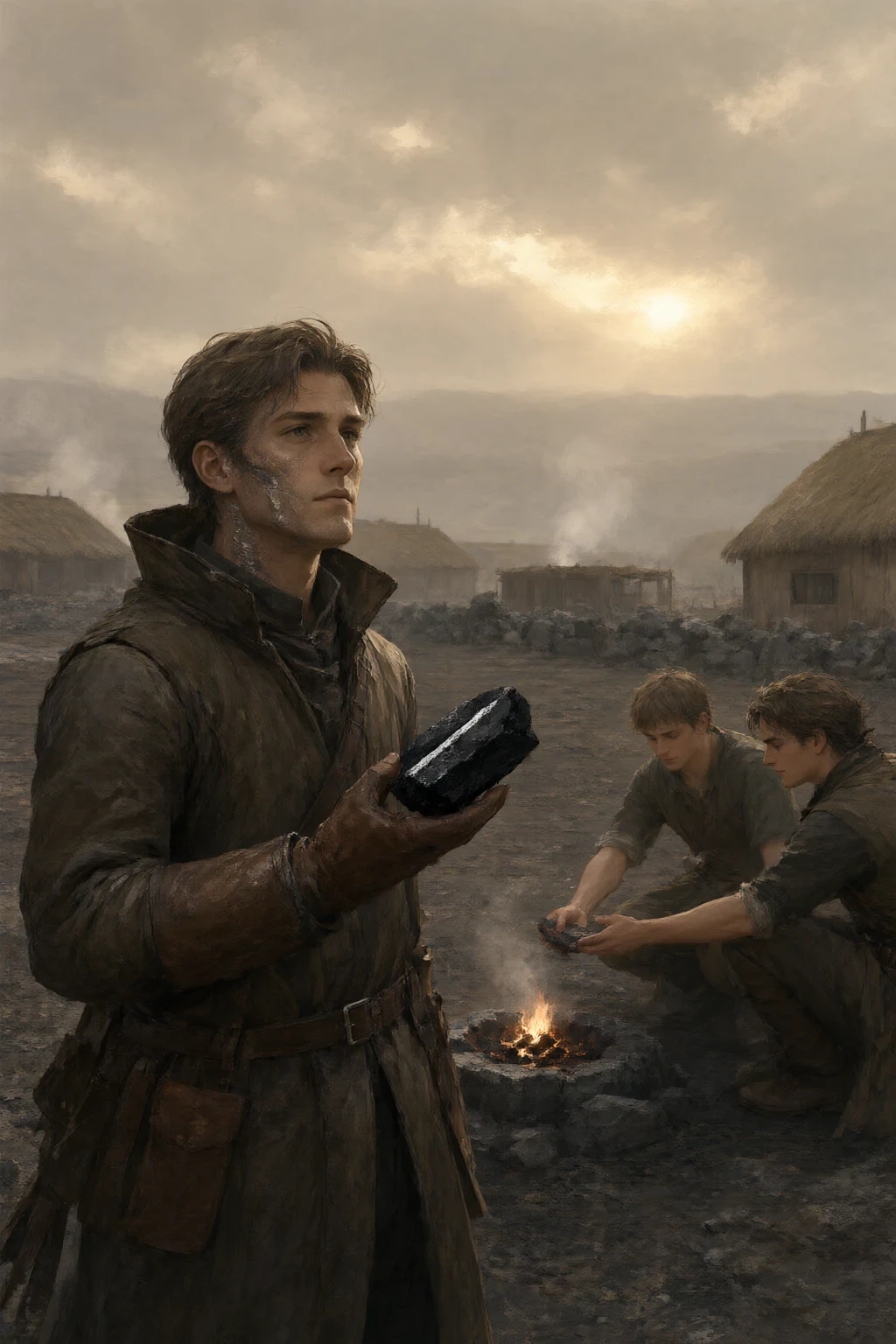
Ordwin Sparre was thirty-four and had been to the Third Terrace twice in his life and had been thrown out of the reading room both times by a man who did not raise his voice. He spoke in the plural about everything, including his own childhood. Down the left side of his jaw to his collarbone ran a broken-oath brand: a hooked stroke gone black, silver-scarred where he had had it treated and re-treated, which is what a man does to a thing when he cannot make it stop meaning what it means. They were given the evidence together and eleven days. He brought a slab of Coldseam coal in a leather sleeve, a foot long, and put it on the table, and turned it so the raking light came across it. It was not black. The wastes had only pumice and dung and shale, and so nobody had ever seen anything else, and a slab of coal with a band of bright hard seam running through the middle of it, from one end to the other, is a thing that stops a conversation.
“That is the loom,” he said. “Not a metaphor. Look at the band. We says the seam runs in lines under the ground for nine miles, and a man can walk it. Two men cannot. In the bad years we digs it out by torchlight in winter because that is when the family can spare the light. We has burned it for six hundred years in a pot and in a hole, and we have never once been allowed to bring it in the gate, and I am not asking you for a road. I am asking you for the name of the thing we are standing on.” “Coal is not first-fire glass,” said Sister-Iven Carshal.
“Coal is not,” he agreed. “That is the entire proposal. We does not come to you and say we are the same as the vent. We says: there is a second thing in this mountain, and the covenant has spent six hundred years saying there is only one, and the reason it says so is not that the second thing does not exist. It is that a cup only has one scale on it.” “And the arithmetic, Sister.” “Two hundred and forty measures a season at the worked face,” he said, “and I have costed the transport honestly, and the transport is the number that ruins me, and I have been not mentioning it for four days, so mention it now, and do not stop me for mentioning it.”
Eleven days in, they went to Harrowfoot, which is the one market town in the caldera that refuses to swear, and which has been getting rich for two hundred years off covenant-built roads and covenant-enforced contracts while paying none of the cost, and which everybody has known about for two hundred years and nobody has had the standing to say. Odo Harrow was forty-one and sole magistrate of Harrowfoot and he chewed a burnt-cork stopper when he was thinking, and he had a little book of debts in his coat that he had never once collected from, and he apologised before every demand, so that agreeing felt like being kind. He apologised before he offered them tea. “I am afraid,” he said, “that you have come four days for a thing that takes four minutes, and that the four minutes is not going to be as good as you were led, and I will not blame whoever led you because I have been sending them my own copy for eleven months, and I should have sent you the original.” He had sent them the original.
Harrowfoot’s business was paper, and that was the whole of its business. An oath sworn in a flame can only be enforced by a sworn court, and a sworn court is nine days off across a causeway, and a man who cannot leave his fields for nine days cannot have his debts collected. So Harrowfoot collected them, and Harrowfoot wrote its own deeds, and its deeds were not sworn and could not be appealed to the chain, and Odo Harrow had made himself the only man in the caldera who could make a promise stick without paying for the flame. There was not one sworn thing in the town, and there was not one contract in it that did not hold. He took them down to the market floor, where a coal fire stood in a cut basalt hearth under a hood, burning clean and bright and cheap, and it had been burning eleven days, and it cost a fraction of what a witness-flame cost, and it did not flicker.
“It is coal,” said Odo Harrow. “It is from Coldseam, by way of a factor at the Sixth who is not a sworn man and is therefore a very good factor, because a sworn man would have had to say where it came from. It burns all day. It has burned all day for eleven days and I have not had a lamp out.” Sister-Iven Carshal stood in front of it for some time. “This is a very good fire,” she said. “It is.” “I would like to say that it is a very good fire and stop there, and I am not going to, because I have read the evidence of a good fire before and the good fire is always the easy part.”
What they had in the room was a test, and Ordwin Sparre had asked for one, and the chain had paid for it, and it was the first honest thing anybody in the chain had done about the wastes in six hundred years. A man called Bel Ammun was fifty-eight and a road-mason of the Fourth, and forty years ago he had sworn a hooked stroke on his left forearm for a promise to protect, and the promise had held, and he had spent the forty years being one of the men in the caldera that other people’s marks were measured against. He did it standing up, with his sleeve pushed back, and he asked for the terms first, and Ordwin read them out: four seconds, at arm’s length, with the hand in the flame, and any man in the room may call it off, and no part of the flame touches the skin.
“Nobody is to call it off but me,” said Bel Ammun, “and I will not, and I want that written down so that nobody after today can say I was talked out of it.” “It is written down,” said Sister-Iven Carshal. He put his hand in. The fire did not do anything that a fire does. That is the thing people find hardest to describe afterwards. It did not roar and it did not flare and it did not rise up the forearm; it simply went on being a fire, and the hand stayed in it, and at four seconds he took it out and stood there in front of a market full of people who had all gone very quiet. The hooked stroke came out of him an arm’s length shorter than it went in, and paler, with the ember core gone from orange to the colour of weak tea.
“Well,” said Bel Ammun. He looked at it for a while, and then he laughed, because he was a mason and masons are not sentimental about a thing that can be described in spans. “Forty years,” he said. “I’ve carried that forty years and I have never once been asked to prove it, and I have watched three men go to their graves owing me things, and one of them didn’t, because I’d forgiven him, and I remember doing that. Well. That’s a repair I’ve not seen before.” He put his sleeve down and started pushing people out of the way with his shoulder, not roughly, but the way a man does when he has work, and a boy of about sixteen got hold of his sleeve and would not let go and kept saying, “Mine’s a comma, mine’s a comma, is mine all right?” “Show me.”
The boy showed him. Bel Ammun read it the way everybody in the caldera reads anything, without thinking about it, the way a man reads a face. “All right,” he said. “That’s a good one. That’s better than the one I’ve got and I’m not sorry about it.” Then he stopped, in front of four hundred people, with his own arm bare, and worked out what he had just said, and did not unsay it. “Go on home. Don’t run.” “Bel Ammun,” said Ordwin Sparre. “Let him say it,” said Kel Rusk, from the back. Kel Rusk was fifty-two and an ash-mason of the Ninth He had already been round the hearth twice with his thumb and a piece of string before anybody thought to ask him what he was doing, and what he was doing was cutting a length of string to the width of the firebox, which is a thing masons do, and which is a thing that has been the beginning and the end of every honest argument about fire since the first city was laid.
“Twenty-six hands by nineteen,” he said. “Cut the bed eleven inches down and the throat’s out. You’ve built this for a hood, and a hood is right, and a hood over a bed of glass is a thing a man could sell you as a fire and I would not be able to prove anything, and I have watched people be sold exactly that in my own trade and I am telling you before I have any opinion on it at all.” , tenth generation of a family of sworn builders, and he had come down four days with the assessors because a sworn man standing in a flame is a masonry question as much as it is a covenant question, and he was in the room with his beard burnt short on the left side and the bronze ring he carried on a leather cord in his pocket conspicuously not on his hand.
“A stroke that’s been fed is a stroke that’s been fed,” he said. “You can patch a joint. You cannot put a hand back. I’ll swear the repair. Give me the number.” “Master Rusk, no,” said Ordwin Sparre. The room turned around. “We says you are not the man to pay for our coal,” said Ordwin Sparre, and the whole room heard what he had just done, because there was not a person in Harrowfoot who did not know whose coal was in that hearth, and the man who had just refused it had the black brand that said he had broken a promise once and been recorded in public forever for it. Kel Rusk looked at him for a moment. “Then what do you propose.” “Nothing. I propose nothing, and that is the first honest sentence I have said in eleven days, and it is yours, and it is mine, and it is the only thing in this building I am proud of.” He turned round to the fire. “A man of the chain cannot pay for our coal, because the coal is ours and the question is not a question of a mason and the answer to a fair question is not a smaller one.”
Both of them noticed the same thing that afternoon, from opposite ends of the market, and neither of them said so out loud for another two days, and by then they had a different reason for it. Sister-Iven Carshal noticed it because she was looking at the shape of the evidence, and the shape of the evidence was the thing she had spent her life learning to read. “Eleven days,” she said, to Ashara Venn, who had been sent along to take minutes and who had been taking them for eleven days in a hand that was getting worse. “What is the shape of it.” “Eleven days of clean fire in a town that does not swear.” “Yes. Now say the other half.” “There are no brands in Harrowfoot.”
“There are no brands in Harrowfoot,” said Sister-Iven Carshal. “Not because they are careful. Because Harrowfoot has not sworn since the founding, and pays none of the cost of the roads it uses, and has got very rich, and I have known all of that for thirty years and never once put the two facts next to each other. A test cannot be negative. A test is only negative where there was something that could have gone positive. Harrowfoot is not a place where the coal was proved harmless. Harrowfoot is a place where there was nothing to hurt.” She put her stylus away without using it. “And a record that cannot detect a thing is a record that will authorise anything, and I know what that sentence means because I have spent thirty-one years being the person who decides what the record can detect.”
Ordwin Sparre noticed it because he had a mark that cannot be enforced, and therefore nothing to lose, and he had therefore been the only man in the room that the fire could not possibly touch. He had put his own face over the hearth for a count of four, on the second day, as a joke that nobody enjoyed, and his black brand had not blurred. It could not blur. It was already black, already a record of a broken promise, already outside the covenant’s reach in the one direction the covenant cares about. And it had not gone cold, either, which was the thing that bothered him, because a fed flame blurs whatever is nearest and the nearest thing to his face in that market was his own jaw, and his jaw had not gone cold, and a black mark is not the same as a mark that cannot be read, and a fool would have told you they were the same.
So he went and found the night-man. His name was Garvin Loe and he had a ledger, because Harrowfoot had a magistrate and a magistrate has a house and a house has a keeper and a keeper keeps a book, and the book said that at the second bell every night for eleven nights a tray had gone down from the market floor to the cellar and had come up again, and the second bell was the hour the fire was banked. “Eleven nights,” Ordwin said. “And the tray?” “Glass,” said Garvin Loe. “Lozenges. First-fire, from the vent, in a case with a lock on it, brought in by a man who signs for it. I bring it up. I put it under the bed of coals. It goes to ash by morning. I have never asked what for and I have never been asked.”
They put it in front of the two assessors in the same hour, and the eight pages of arithmetic went into a different order very quickly, and the ninth page of the proposal came off the table without anybody touching it. “Eleven days of a coal fire that was never the coal’s fire,” said Sister-Iven Carshal. “I want to be exact, because I have watched people not be exact about this for thirty-one years and it is how a record dies. Coal does not burn under first-fire glass. It is not a fuel and it is not a substitute. The coal is sitting on top of a bed of the one substance in this mountain that a covenant flame will accept, and the fire everybody saw in that market was the covenant’s fire, and the coal was a lid on top of it, and a lid is a very good way of making a thing look cheap.”
“And if the lid comes off,” said Ordwin Sparre, “then we are back to six hundred years and a pot, and we are back to burning the dung that goes on the fields.” “Yes.” “Then the arithmetic has not failed. It has been answered by somebody with more money than we has.” He said it without heat, and then he said the other thing, which he had clearly been carrying up and down the room all afternoon and had not wanted to say in front of the magistrate. “Sister. Before we go on. I want to say the ugly part and I want to say it here, where it costs me.”
“The submission the wastes put in at the turn of the season,” said Ordwin Sparre, “was drafted for us. In a hand that is not any of our hands. Eleven pages, and the ninth page is the sentence you have just read, and I have read that sentence four hundred times and I liked it, and it is Odo Harrow’s sentence, and the arithmetic on the eight pages is his arithmetic with our nouns put in.” The room did not move. Harrowfoot’s market went on being a market. “You will understand that I have known this since the second day,” said Ordwin. “I knew it before I came into the building. We are a delegation of thirty-one people and we have never had a clerk between us in our lives, and every one of us can read, and not one of us can write a straight sentence in a hand, and this document is beautiful. It is the most beautiful piece of paper any of us has ever put a hand on.” He put both hands flat on the table, and the black brand on his jaw went into the shadow.
“So I have been sitting in this room for eleven days letting a man in Harrowfoot believe he had taught us to want what he wanted, and that is not a thing I am going to be forgiven for by being the one who says it, so I would like it minuted in the hand of the apprentice, and I would like it minuted in the first person.” “It is minuted,” said Ashara Venn, “in the first person.” Odo Harrow chewed his cork for a while, and then he apologised, and the apology was the demand. “I am afraid,” he said, “that everything I have told you is true, and that I told it to you knowing you would find the tray, and I want to be allowed to say that I did that on purpose and for the reason people do things like that and not for a better one.” Nobody said anything.
“Four hundred years ago your chain was asked to consider a fuel and the answer was no, and the reason the page is empty is that somebody tore the names out of it before the burning got to them. I have read that page. I have read it eleven times while I was waiting for you. Somebody in your House of the Quiet Ledger has been protecting somebody for four hundred years, and they never asked to be thanked and they were not thanked, because a thing like that does not get thanked, it gets a room and a stylus and a very long memory.” He put the little book of debts on the table, which nobody had asked for. “I am a magistrate who has never once collected a debt. I got rich on your contracts. I have a town that does not swear and a fire that burns for nothing and a factor at the Sixth who is not a sworn man.
I have been selling you a lid and I have been selling it to you for years, and I would like, if the chain permits, to be the first man in Harrowfoot to be entered in a book as owing something.” “It permits,” said Sister-Iven Carshal. “It permits because the rule exists, and the rule is that a chain which will not write down what it owes is a chain that has decided it is owed. It was written in the founding year, on the same leaf as the debt of Winterlow, and if you have never seen it I will lend you the page, and you should read it, because it is the only reason this town is not in the history of the caldera as something shameful.”
The chain refused the coal in nine days, by four votes to three, on the ground that it could not be shown to be a fuel, which was true, and that the man who had offered it had built the demonstration himself, which was also true, and that the delegation from the wastes had put a paper into the record which they had not written, which was the ground nobody expected and which turned out to be the only one that could not be argued with. It also ordered a trial. That was Ashara Venn’s doing, and she did it in the grammar, and the wince went round the room before there was anybody in the room to wince. “Ashara proposes that the chain pay for a survey of Coldseam, at the wastes’ own choosing of ground, in the wastes’ own season, with sworn men present whose marks are read before and after and whose reading is published whole.”
Four votes to three again, and the three were the wastes, and one of those three was a man called Sennet Rho who dug at Coldseam and had a family and had never once in his life been asked what he thought about the arithmetic. “Not because it is not true,” Rho said afterwards, to nobody. “Because it is true and it is going to take eleven years, and I am fifty-four, and I would like my grandchildren to be able to burn something.” What Ashara proposed was, in the end, the first sworn act in the Emberwastes in six hundred years, and it cost the chain eleven hundred measures, and the sworn men who went out to read their own marks before and after a coal seam on ground where sworn stone cannot be set are recorded in the Quiet Ledger by name, in the square hand, in the alphabetical order of oath, and the entry is four lines long and is the only thing in the entire record that the Emberwastes have ever contributed to. Sister-Iven Carshal wrote it herself, and then sat looking at it for some time, and then said, not to anybody: “Noted.” And then, four lines later, in exactly the way she does:
“Noted. And the entry is wrong. It says four sworn men. There were five. I have written four because the fifth is a man of the wastes and I have not yet learned what to do with that, and I have been the Keeper of the Quiet Ledger for thirty-one years and I did not have to learn it today, and I did it anyway, and I would like the fifth name entered before the end of the week.” At the end there was one hour in which the two assessors were in the same room without a witness, because witnesses are expensive and because the room was the room. Sister-Iven Carshal had a slab of Coldseam coal on the table in front of her, a foot long, with its band of bright hard seam running through the middle of it, and she turned it over twice and set it down squared to the edge of the board, which is what you do. “When you put your face over it,” she said. “On the second day. Why.” “Because I have nothing that can be enforced,” said Ordwin Sparre, “and for nine days that was the most useful thing about me.”
“Yes.” She did not look up. “I have a mark that cannot be read, from a leaf that was cut twice by my own hand. And you have a mark that cannot be enforced, from a promise you broke and could not put back. And we have spent eleven days discovering that the difference between the two of us is which form the record takes when it finishes with you.” She pushed the coal an inch towards him across the table. “Keep the slab. It is not evidence. It is the reason the evidence was possible.” “We says it is a loom,” said Ordwin Sparre, and picked it up, and did not go on, and neither did she, and the seam went from his hand to hers across a table with nothing in the middle of it.