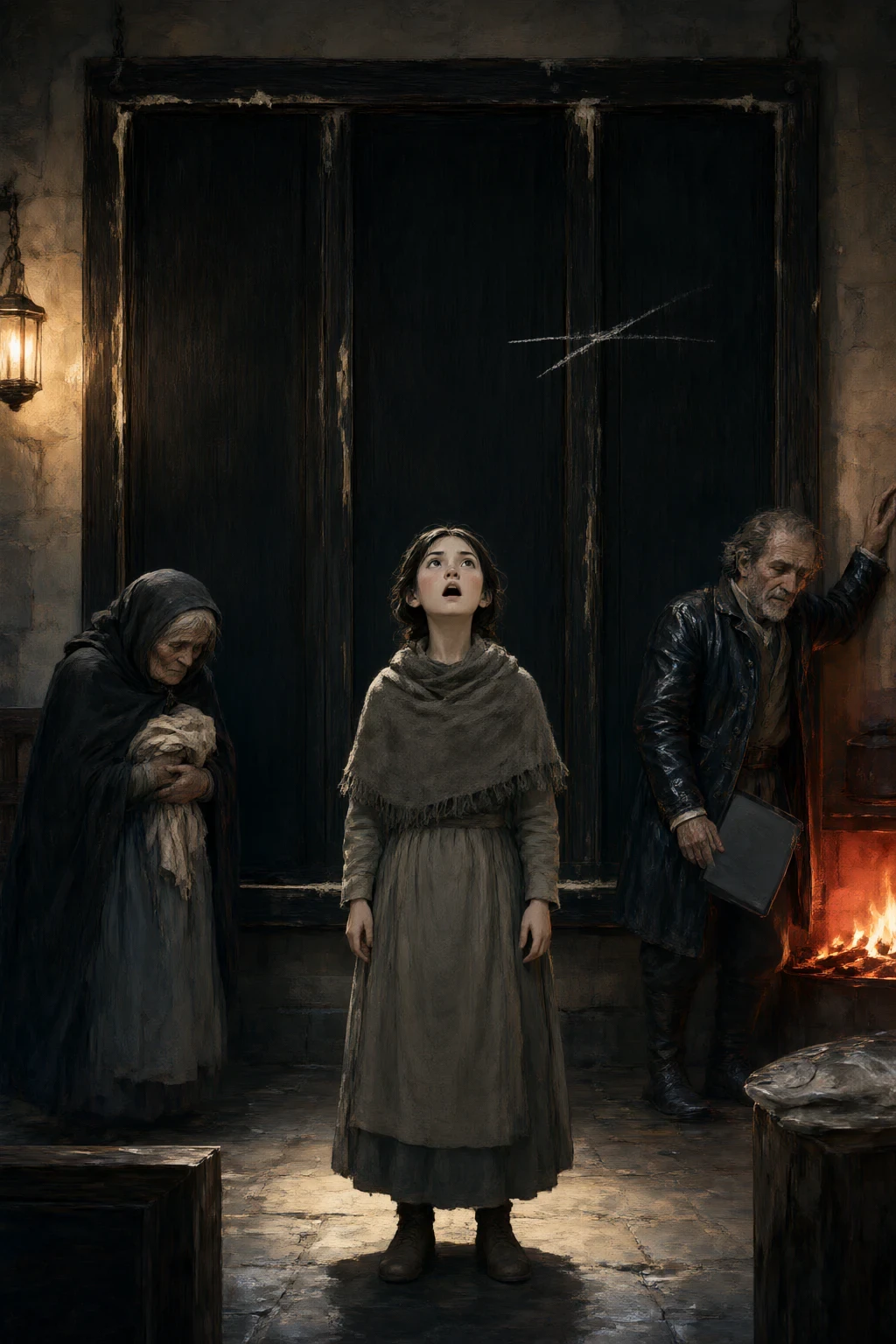
The Regalia of Bramwich is a market of three days, and it is held in the ninth, tenth, and eleventh of Sleet, under the Fish Hall, and it is the only market in the world where a name may be bought, sold, and borrowed. It has been that way since the year of the fire, when the ward found itself administering four hundred children whose guardians had all gone into the river, and needed to know who they were, and wrote the rules out plainly in a book that is still called the Assay.
The rules say: a name is a holding. It may be given, lent, and pledged, and it is property, and the person it belongs to is the only person who may withdraw it. A name cannot be taken by force. A name cannot be inherited unless it is named in a will. A name unclaimed after seven years is entered on the board and may be claimed by anyone who can say it three times in the market without being asked to stop.
Marguerite Ollins was fourteen, and everybody in Bramwich called her Mag, and she had let them, because six years ago her mother had held her hand on a bed and given her the long name and Marguerite had been too large to carry out of a room where her mother was in it. So she was Mag. She sold cloth at her grandmother's stall in the Frying Pan, three days a year, at the Regalia, and the rest of the year she was her grandmother's hands, because her grandmother was seventy-four and the stall was hers. The stall had been Bettany Ollins's for sixty-one years. The licence was up at Sleet. The fee was eleven marks, and the grandmother had eight, in a box under the counter, in coin and in a small silver button she would not sell.
"A name will do it," her grandmother said, on the eighth, in the back room, sorting the good cloth out of the bad. "They'll take a name off me. You were going to say no. Don't, it isn't worth a mark to me and it's worth a great deal to you." "They're not taking your name. They're taking a surety. One name, for one year, standing behind the licence."
"That is your name," said her grandmother, "and you are fourteen, and they will not take a minor's, and I have been to the board twice today to be told so by a man who has not had a cold since midsummer." She folded a length of grey. "So it is not yours and not mine, and we are two people with eight marks and a button. I have been in this stall sixty-one years and I am not going to be told by a board that I am finished, over eleven marks."
The man the board told was a factor of the Assay, and he was seated at the bottom of the board in a chair he was entitled to, and he had a fire at his feet that was not his, and a slate on his knee, and a name cut into the top of the board's frame, filled with wax, and the name was RUM. "Eleven marks," he said, "or a surety." "Mag, take it," said her grandmother. "I can't. They said—" "I have been to the board twice. I heard you. I am telling you to do it anyway, which is what grandmothers are for, and then we shall see what a board does with a girl who offers."
Marguerite Ollins stepped up to the front of the board. The board was a slab of black oak, four paces wide, and its columns were cut in and waxed, and the left-hand column held the names of factors, and the middle column held the names of things offered, and the right-hand column held the names of people who had offered them. "Seven hundred and eleven," said the factor, without looking up. "A name. Your own, or a name you can answer for." "My own." "Your own is not in the register. You must name it." The market was still going about them. Sixty years of this market were walking past, and the fishmongers were shouting, and a woman was buying a winter coat with money she did not have until autumn. "My name is Marguerite Ollins."
She said it in a market to about four hundred people, which she had not expected, and heard it go out over the noise and come back off the stone, and the factor wrote it in the third column, and cut the notch beside it, and did not look up, and said: "Then you are the surety for Bettany Ollins's licence for one year, and your name is entered, and the fee is discharged, and you will say so three times, and then the clerk will strike it, and it will be gone."
She went home along the Fish Hall at closing and stopped at the corner where the board's lamp is, because that is where the light is, and stood there a while. A name entered in the third column is not a name destroyed. It is a name held. It is held for a year, for the term, and the term is a year, and at the end of the term the name is struck and returned, and in the meanwhile it is the board's, and the board lends it, and the board may call it. She had known that. She had known it in the way you know things you have not yet needed. In nine months her name would be lent to somebody who could not pay their own. "Young woman."
He was sixty-eight or thereabouts, in a good coat gone shiny at the elbows, with a wrapped throat and a slate under his arm, and he was standing on the other side of the board with his hand on the frame, over the waxed letters RUM. "I am Rumpelstiltskin," he said. "It is on the board. I did not choose it, and I am not a fairy, and I should like that said first, because you have the look of somebody who has been warned about me by an aunt." "Why is your name cut into the frame?"
"Because the frame is the roll," he said. "A factor's name is on the roll and on the board, and the roll is registered, and a registered factor cannot be attached, because his name is already pledged, and you cannot pledge a thing twice. It is not magic. It is a filing system. I am seventy-one, I have been in this trade sixty-one years, and there is a fire at the bottom of that frame that has not been lit since Midsummer, and I would like to go home."
The audit of the Assay is held in a warehouse off Cooper Stair, and any person may demand it, once a term, on a market day, at the factor's own cost, and no person has demanded it in Bramwich for thirty-one years, which is why the Assay is where it is. Marguerite demanded it at the seventh bell on the tenth of Sleet, and the factor of the Assay allowed it, because it is in the rules, and because a man who refuses an audit has to explain himself to the ward, and it was raining. The Assay is forty books. She had until the third bell.
She had had a mother who could read a bolt of cloth by the twist of it, and a grandmother who could tell you the day a thing was woven by looking at it, and neither of them had taught her to read forty books in eight hours, and so she did the only thing there is to do, which is to look for the one page she cared about and work outwards from it.
Entry 4,411. Twenty-second of Sleet, thirty-one years ago. A surety name, given by a minor of fourteen, admitted on the word of an old woman, and taken in payment of a fee of eleven marks against a stall in the Frying Pan. Surety: Ollins, Abel. Surety of: Ollins, Bettany, cloth, licence 61. Struck on the same day. Returned to the register, unclaimed. Entered on the board, seventh column: held in arrears, unsold, awaiting claim. She read it four times, because it was not a page of small print. It was set out as cleanly as anything the Assay had ever contained. Abel Ollins was her father. He had been fourteen. He had stood at the front of that board sixty years ago, in the ninth of Sleet, and had said his own name to a factor to get his grandmother a licence for a year. And it had been struck, and returned, and put on the board in arrears, and it had been sitting on the board ever since, in the seventh column, in the dark, for thirty-one years.
"You took my father's name in a market when he was fourteen and then you put it on a shelf." "He offered it." "He was fourteen." "So were you," said Rumpelstiltskin, "yesterday, and you offered yours, and the clerk is a great deal more careful now, and it went through the same as his, and I have no defence and I have not come here to make one." He set the fire-screen aside. "What do you want?" "I want the entry read in the market, so that my name comes out of the third column, and my father's out of the seventh." "That can be done."
"And it can't be done by me," she said, "because the Assay only permits withdrawal by a person at whose standing the name is entered, and I have no standing, and a factor may be cited for non-payment of interest, and the Assay does not say when interest is paid." Rumpelstiltskin looked at her for a moment with the expression of a man who has been in a trade for sixty-one years and has just been shown a door he did not know was in his own house.
"A name accrues," he said. "That is the whole of it. A name is not a static thing. It is lent out, it is spoken, it is written, it is carried, and while it is in use it draws. In the Assay, a drawn name draws at the rate of the market, and the market is the tenth. Your father put his name in on the twenty-second of Sleet, thirty-one years ago. It has been on the board since the twenty-second, and it has drawn all thirty-one years, and the Assay has never been balanced, because nobody came with a claim, and the interest is due in sound." "In sound."
"A name is a sound before it is a word. Every time it is said it draws. That is the oldest line in the Assay and it is the one nobody argues with, because it goes back before there was any arguing." He took the slate out from under his arm and looked at it, and set it face down. "Thirty-one years of a boy of fourteen, at the tenth, and every day of it has to be made up in market, out loud, where it can be heard, or the Assay will not strike a line." "Then make it up."
"I cannot make up another person's name. I have been saying that to factors for sixty-one years and it is why nobody has ever cited me." He said it without heat. "It has to be said by the person it is owed to, in a market, to a clerk, and the clerk has to hear it, and that is the whole of the payment and the whole of the cost, and you have one day to do it in."
Mag had one day, and on the last day of the Regalia, at the fourth bell, in front of the market, she stood in front of the board with a clerk and a slate and four hundred people who had been coming for sixty years to buy things they could not afford, and she said her own name. "Mag," she said. "The Assay calls me Mag and I have let it, and it is not the name I gave, and I am not answering to it in front of a board." "Mag," said the clerk. "Mag," she said, again, and it went out into the Fish Hall and off the stone, and somebody in the crowd laughed, because it is a small name and she was being earnest about it.
Then she said: "Marguerite Ollins. That is the name on my mother's bed. My father pledged it in this market thirty-one years ago and was entered on the seventh column and never claimed, and the interest is thirty-one years, and I am the only person it is owed to, and I am saying it here so that the Assay can hear it, and I would like it struck." The clerk wrote. The clerk read the entry back. The clerk asked her whether she claimed the name of Ollins, Abel, in the seventh column, under the arrears, and she said that she did, and her grandmother said it too, from the fourth row, in a voice like a dropped tray, and there was no other claimant, and there had never been one, because he had had no one but them.
The clerk read the entry for Abel Ollins aloud in the market, with the arrears, and struck the arrears against the interest. And then the clerk read the entry in the third column, dated yesterday, for Marguerite Ollins, held for the term, and asked her whether she claimed it. "I am standing here claiming it," she said, "under my own name, and I will not be called Mag in this market again." The clerk struck it, and read it back, and put the chalk on the ledge, and Mag Ollins stood in the middle of the Fish Hall market with her own name in the air and four hundred people holding it, which is the price, and which she had set herself.
The grandmother took the stall. She had it in the Assay hand and the licence hand, and the fee was discharged, and the register was clear, and she was seventy-four and she had been doing that stall for sixty-one years and nobody had told her that the name of her own husband had been sitting in the dark under the board for thirty-one years. "That is a thing I would have liked to have known," she said, and then thought about it, and then said, "No, it is a thing I am glad I did not know at fourteen."
Rumpelstiltskin was struck off the roll at the closing of the third day. Not for any fault. Because a factor whose own registered name is struck for arrears may not continue, and the arrears of Ollins, Abel, were the last on the board that he had entered in sixty-one years of entering them, and they were on him, and he was seventy-one. He took his chair, and his fire-screen, and his slate, and put the slate in his satchel, and the last entry on it was the one he had written in a cold room off Cooper Stair the night before, and it was struck through in chalk from end to end. He said that in sixty-one years the bottom of that board had never been empty, and now it was.
Marguerite Ollins took her grandmother's arm on the way out through the Fish Hall, and the lamp was still burning over the black oak, and a woman buying a winter coat she could not afford until autumn turned round and said, "Thank you, Marguerite." "Pet," said Marguerite.
The Assay is still in the warehouse off Cooper Stair, and the fortieth book has a page at the back with a line ruled across it, and the rule was made by the clerk who struck her name, who wrote under it, as clerks do, the date and the term and the fact of it: claimed in full, third day of Sleet, in market, by the person at whose standing it was entered.
There is no note about the thirty-one years. Nobody asked for one. But the clerk, being a clerk, and having thirty-one years of it in front of him, drew the line a long way across the page, from margin to margin, and a woman who came in to copy the page eleven years later said that it was the only full-width rule she had ever seen in her life, and that whoever had drawn it had not been in a hurry, and had not been able to fit a name in the space, and had not wanted to.