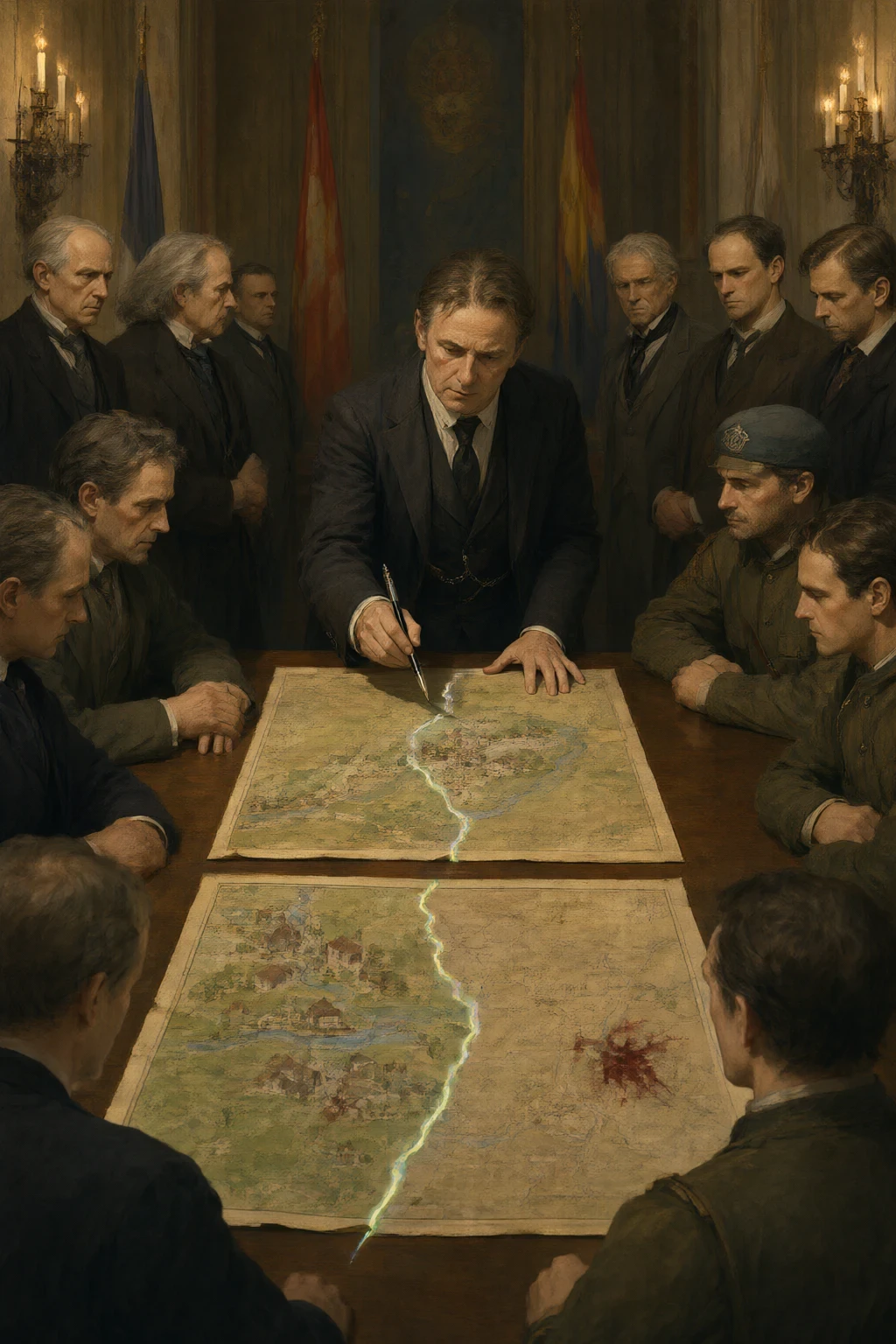
The oldest map in the North Archive was painted on calfskin so thin that trees grew through it when light passed from behind. Nera had learned the border by heart: a blue river, a red ridge, and between them the green wedge called Mallow Vale. Every child learned the line. Nera was seventeen when the Delegation returned from Bellweather and asked her to sign their report.
She stared at the name they had written for her. Nera Venn, sole surviving witness to the Border Concord. She had been twelve at the signing, a junior clerk assigned to copy weather records because her mother worked in the archive. Twelve-year-olds were not supposed to remember treaties. They were supposed to pass the ink pots and sharpen quills.
Now two armies waited along a border that no longer matched any map. The river had moved twelve miles east after the Sundering Floods, opening streets, orchards, and graveyards to the west. Bellweather claimed the river had always moved and the treaty was void. Mallow claimed the river had been stolen and settlements beyond the bank belonged to it. Each side brought evidence: survey stones, family trees, and a bell with the mark.
The Delegation’s minister, Lord Oren, placed a silver witness seal on the table. “Your signature will settle the matter.” “By saying which history?” “By saying what you saw.” Nera looked at the seal. It was the same shape as the one she had watched press into red wax five years ago. That memory had been sealed in amber by the Concord so no child could be influenced before adulthood. For five years she had carried a small ache behind her left eye whenever she tried to remember the signing. On her eighteenth birthday, the seal was meant to open.
It had opened three weeks early because the Delegation needed her. “Where are the other witnesses?” she asked. “Dead, lost, or beyond recall.” “My mother was in the room.” “Your mother was a copyist, not a witness.” “She held my ink cup. I saw her face.” Lord Oren’s expression hardened. “The Concord recognizes authorized witnesses.” “Who decided that?” “The crowns did.” Nera left the seal on the table.
The Delegation had given her three rooms in a rented house near the river. In the kitchen, a Bellweather envoy named Serafin made tea and explained that two villages had been buried beneath the new riverbank. They had evacuated, but their markets, homes, and cemetery were under water. In the parlour, Mallow’s commander brought maps showing farms that had lost a generation of labor. He did not call the flooding a crime. He said the river had been taken.
Both stories were dangerous. The river had moved. The flood had drowned buildings. People had rebuilt in places the treaty had assigned to the other kingdom. The line mattered less than who could live. She asked the Mallow commander why the treaty needed her memory. “Because the Concord says the original boundary was valid at signing,” he said. “You saw it. If Bellweather says the river was always east, they make the treaty meaningless.”
She asked Serafin why Bellweather wanted the same memory. “Because the Concord says the boundary was valid at signing,” he replied. “If Mallow says the river was always west, they make the treaty meaningless.” “That sounds the same with different clothes.” “It is not the same. One side wants to restore a stolen line. The other wants to erase a legal one.”
Nera looked at the line on his map. The line was clean, red, and not where his soldiers were standing. Lord Oren found her that evening beneath the river wall, where floodwater struck the stones in cold, regular blows. “You have not signed.” “No.” “Your refusal will be recorded as an act against the peace.” “Then record the question I was asked to answer.” He said that the question was simple. “Did you see the river at the time of the treaty?”
Nera closed her eyes. The amber seal had released the memory in fragments: flags on the bank, ink drying too quickly, her mother’s hand over her eyes when the arguments began. She had seen the river, but she had been facing west, where the water shone. She remembered thinking it looked narrower than the painted map. The Delegation had drawn the boundary at a bend called Stoneknee. In the memory, the bend was there.
Beyond it, the river vanished behind willows. “I saw a river,” she said. “I did not see a boundary.” Lord Oren said, “A child cannot distinguish a memory from a map.” “No,” she said. “So you should not ask a child to make the distinction for you.” He leaned closer. “The crowns have already decided to use your memory. If you delay, they will call a council. The council will take a vote. The vote will be uglier than a signature.”
The next morning, a message came from the copy house where the Concord records were stored. A junior archivist had found a sealed page behind the treaty, numbered out of order. The page contained no official clause. It was a measurement sheet from the surveyors who prepared the border. Nera read the figures aloud to the assembled envoys.
The river at Stoneknee had been flowing fast enough to cut a channel. The surveyors recommended placing the boundary marker on the high ridge, not the riverbank. The recommendation had been initialed by a Mallow magistrate and a Bellweather cartographer. The page was then missing from the final bundle. Silence moved through the room. “Who omitted it?” Lord Oren asked. “The number is in the margin,” Nera said. “It belongs to Clerk Iven Sarr.”
Sarr was dead, or the Delegation said he was dead. His name appeared on the treaty as the chief copyist, but not as a witness. Nera remembered him now: a narrow man with ink under his fingernails, counting pages in a voice too soft for the room. He had signed her copy of the report after the ceremony. She had never seen him sign the treaty itself.
The Delegation searched the archive’s sealed waste chest and found fragments of the page. A river gauge reading matched the figures. A second fragment contained Sarr’s instruction to remove the page “until the flood season.” Lord Oren went pale. “Sarr was Bellweather’s man.” “So were half the mapmakers,” said Serafin. “And the magistrate was Mallow’s,” said the commander.
Nera felt the argument widen beneath her feet. A missing page did not make a treaty false. It made the treaty fragile in a specific place. The river had crossed the old boundary because the survey had warned it might. Someone had removed the warning. If they restored the page, the legal line could still stand, but its meaning would change. It would be a line chosen despite danger, not a line nature had already drawn.
“Can you remember more?” Lord Oren asked. “Yes.” “Then tell us what Sarr did.” “No. I remember what I saw. You can compare it with the records.” The Delegation asked her to sign a statement about the memory alone. She agreed, but added a second statement about the missing page and the uncertainty of the boundary. They refused to call both documents a single account. They said two statements would be treated as a contradiction.
The war did not pause because she had found the truth. That night, a group of Bellweather soldiers crossed the old river line and seized a Mallow grain warehouse. Mallow archers answered from the ridge. The commander told the Delegation that the theft was an answer to the stolen river. Serafin said the warehouse had held grain donated to flooded families. By dawn, the flour sacks were burning and three people were injured.
Nera went to the river with a white cloth tied to her sleeve, an old treaty sign. It was foolish, but people on both banks knew the signal. The shooting stopped while she crossed the footbridge. A Bellweather captain shouted that the sign had no force. A Mallow farmer threw a stone into the water and said, “It has force when we decide it has.”
In the warehouse district, she found the people who had cooked nothing and the people who had lost fields. A child held a charred grain measure. A woman carried a ledger of names from the cemetery under the new water. They did not ask Nera to solve the dispute. They asked whether the missing page was real. “It is real,” she said. “It warns that the old line was dangerous. It does not tell us which line is just.”
“Then who decides?” asked the farmer. For a moment, Nera wanted to answer: not me. She was seventeen, the only witness, and already tired of adults treating her memory as a weapon. But the child with the measure was looking at her as if she might be someone who could stand between the river and the fire.
“Everyone affected can say what they need,” she told them. “The rulers can bargain. The record can hold the disagreement. No one can make a page say something it does not.” The Delegation rejected that answer. The crowns needed a border. A disputed line, they said, would invite war. Nera understood: armies were easier to command than two hundred thousand people who had not been promised a single clean choice. She asked for one day before signing. The request seemed useless until the Delegation discovered that the west bank was flooding. The old river had widened again. By the next afternoon, three more streets were under water.
Nera went before both councils. She described the room, the flags, the narrowed river, and the page. She explained that she had been a child, that the treaty had declared her a witness, and that the authority had been given to her by people who benefited from the declaration. “I will not sign a statement that ends the war by pretending there was only one thing I saw,” she said. Lord Oren asked, “What will you sign?” “The record I can stand behind.”
The statement was four pages long. It described the memory and the page, the lack of a visible boundary, and the fact that the river at Stoneknee had been dangerous. It said the treaty might still be valid, but that its final form had removed evidence. It did not say which kingdom had lied. It did not say which kingdom had been wronged. It gave the date, the names, the readings, and the exact things she could not remember.
Both delegations rejected the statement at first. Then the Mallow magistrate’s granddaughter, who had found the fragment, brought forward a record of flood repairs. Bellweather’s cartographer’s son produced a sketch of the missing page. The people who had lived along the bank sent letters about the old boundary crossing ceremonies. The evidence did not settle the dispute. It made every possible settlement narrower and more honest.
The border council used the statement as evidence, not conclusion. They set a new boundary along the ridge, where the surveyors had first recommended. They opened the old riverbed as a shared repair zone, with both councils paying for the dredging and neither side claiming the drowned landmarks. Families could keep the homes they had rebuilt for three years while a joint commission decided which valley would be made safe. Bellweather received access to its flooded cemetery.
Mallow received compensation for the seized grain and the damaged orchards. The agreement named both wrongs. It did not call one side innocent. The war stopped, though soldiers stayed in the fields for months. The first new boundary stone was a plain block of blue stone. On one side, someone carved Mallow. On the other, Bellweather. The river ran below it, brown and fast, carrying branches toward the sea.
Nera signed the statement last. Her name went under the memory, the missing page, and the line that said she could not remember more. The silver witness seal came down on the paper with a dull click. Lord Oren watched her. “That is not the ending the Delegation expected.” “It is the one I can defend.” He might have argued. Instead he asked what she would do when the old histories called her a traitor.
Nera looked at the river, the drowned streets, and the people carrying blankets across the ridge. “I will show them the page,” she said. “They can decide how much of the story I left out.” The Delegation returned north without a final verdict on the treaty. In the years that followed, histories of the Concord still disagreed about the river. Some named Nera as the child who ended the war. Some called her the witness who refused a clean answer. She disliked both descriptions.
Her mother kept the old weather book on a shelf beside the window. On the day the river finally settled into its new bed, Nera found a note tucked between its pages: Sarr asked me to hide the survey. I copied it because I was afraid of the men who sent him. I did not know he was protecting the truth. She read it twice, then placed it in the archive. The note did not absolve her mother. It did not condemn her. It was a small piece of responsibility, placed where another person could find it. Nera closed the book. The bell over the river rang once, then again. No one agreed on what it meant, so no one turned away.