The winter of the second frost was forecast in September, in the almanac, and the almanac was printed in the parish magazine, and Mrs Toft had it in her hand at the meeting in October with a finger on the page, because Mrs Toft was the secretary of the Braymoor Relief Fund and had been for nineteen years and had never in nineteen years opened a meeting without being able to produce a document. "Right," she said. "The almanac says a hard winter. It says it in the almanac, which means it says it in print, which means I can hand it to anybody who stands up in this room and tells me they didn't know." She looked up. "So we will not be having the conversation about not knowing."
The Relief Fund was one hundred and twelve pounds. It had been four hundred and six in October. It was administered by four people: Councillor Pryse, who chaired it and did not want the chair; Mr Loach, who farmed at the top of the valley and had opinions about hay; Miss Ada Venner, who had taught the parish school for thirty-one years and was now the only person alive who could say aloud that she had once known a family who ate nothing but bread for a fortnight and did not consider it remarkable. And Mrs Toft, who kept the book.
The test was not poverty. Nobody in the Temperance Hall needed a committee to establish poverty, least of all in a parish where the mill had shut, the chapel had shut, and the school had shut in all but name. The test was simpler and much worse, and it was the test that had been in the rules since 1887, and the rule read, in the book, in Miss Venner's careful copperplate: Relief administered to those who, by prudence in the preceding summer, are found to be without means. Prudence in the preceding summer. Which meant that a man could arrive at the meeting on the eleventh of February with nothing, having spent September, October and November doing everything right, and be refused, and be right to be refused, and go home. The book was kept in a double column. In the left column: name, address, date. In the right: Particulars of the case. In the margin, in pencil, when there was room: nothing. Mrs Toft had decided in her fourth year that there was never room.
The first application was from Hollis Grange, of 2 Weir Lane, cobbler, aged sixty-one, and he wrote his letter on the fourteenth of January in a shopman's hand that had been taught to him by a man who had taught it to him. He set it on the table and read it out, because he had decided in advance that reading it out was the honest way, and because he was not a man who could lie in writing.
"My name is Hollis Grange and I keep a shop at 2 Weir Lane, and I have kept it nineteen years, and I have not had a day of work I did not ask for. I am sixty-one. I am not infirm. I have come because I have got four weeks and I have told the council and the council have told me the parish fund, and I will say to the committee that I have not had to ask anyone for anything this year, and that nobody has had to give me anything, and that I do not want anybody's bread, and I am here for coal." He looked up. Mr Loach nodded slowly. Miss Venner wrote.
"In the summer," said Hollis Grange, "I laid in what a man lays in. I have a cellar. I have had a cellar since the mill, and it is dry as a church and it takes a cartload of anything you care to name. Potatoes. Onions. A hundredweight of the flour I use for the paste, and I have made my own paste since 1981 and I have never bought it. Salt beef. I have a pig, and the pig is a good pig, and I do not lend the pig. Onions, two sacks. And I made eleven pounds of jam in June and eleven pounds of jam is not nothing, Miss Venner, and I have given away four pounds of it."
The second application was from Nell Farrow, of 9 Mill Steps, aged nineteen, and she did not write it, because she could not write it, and the Relief Fund did not pay for clerks, and so it was taken down by Mrs Toft in the right column while Nell Farrow stood in front of the panel and spoke, and Nell Farrow had a way of speaking that made people lean, that quick bright thing, and she had used it since she was fourteen on the Harvest Supper stage, and it was not a lie, that was the trouble with it; it was simply a light. "I'm not here for the fund exactly," she said. "I know how it sounds. I want to say what my summer was first, because you can't have me without it." "Miss Farrow," said Councillor Pryse, "you may present the particulars of the—" "I'll be quick."
And this is what Nell Farrow said to the Braymoor Relief Committee on the twenty-eighth of January, and it is set down here exactly as she said it because Mrs Toft wrote down exactly what she said, and Mrs Toft wrote down everything. "My summer was the best summer of my life. I don't say that the way people say it to be liked. I sang thirty-one times. Thirty-one. I know because I kept the sheet. I sang at the Fox and Hounds twice a week, and at the harvest, and at three weddings, and one of them was a Wednesday, and there was a man who put a five-pound note in my hand and I said I couldn't take it and I took it, because you have to eat, and I'd rather be honest about that than proud about it, which is more than most of you can say." Nobody laughed. It is important to record that nobody laughed.
"And I was fed," she said. "I want that said first, because it's the thing people get wrong about people like me. I was fed all summer. Mrs Quinton kept the room over the fish shop and it was two pounds a week and I did her washing for the fish. And the harvest money came down a bit, and I know it did, but it came down for everybody, and the men in the field were saying worse things about the men in the field, and I was not to blame for the price of wheat, and I would like it noted that I have never once blamed anybody for anything, because it isn't in me, and because there's no point." She stopped. She had not expected to stop.
"I have not wanted for anything this year," she said, "and I am not here because I was idle, and I am not here because I sang. I am here because my mother died in the September and there were three of us and the cottage is a different thing now, and I have got nobody under this roof, and I don't want to be fed, and I want to be warm, and I'll do anything."
Both applications were refused, and the reasons were as follows, and the reasons were the fault of nobody at all, which is the only comfort in the entire business of being poor in a hard winter in a place where a rule has been written down. Hollis Grange was refused on the grounds that his account of the preceding summer was not credible in the matter of the cellar, the pig, and the jam, the committee being of the opinion that a man who laid in as he described would not be before them. Nell Farrow was refused on the grounds that no evidence of means had been adduced, she having stated herself to have been abundantly employed and adequately fed throughout the summer months, and having declined to name any person who had provided her with either, it being the practice of the committee to act upon statements.
There is a detail in this that took Mrs Toft eleven years to understand, and she understood it at the end of a meeting in the second week of February, alone, after the other three had gone, with the book open in front of her and the pen in her hand. Hollis Grange's lie was four words long, and it was not in his own account. It was in the answer to a question Councillor Pryse had put at the end, kindly, to help him, and which Hollis Grange had answered without pausing because he did not know it was loaded. "Is there anyone in this parish you have had to call on, Mr Grange? Family, neighbours?" "No," said Hollis Grange. "Nobody."
There had been his sister's two girls at Brackle Bottom, and they had eaten at his table on eleven days between the fifteenth of August and the end of September, and their mother had not known, and he had told nobody, and it was not that he had refused them. It was that he had not been able to say the words I am the man people come to. And Nell Farrow's lie was in the same room, on the same afternoon, and it was this: she said that nobody had given her anything, and she said it twice, and the second time she said it she was looking at Councillor Pryse's inkwell.
She had a coat. A good coat, a man's overcoat, blue-grey, and she had had it since the November before, and she had worn it every night of the winter, and it had come to her at a door on the ninth of November from a man who was not Hollis Grange but had walked from Brackle Bottom and had his coat off and his hands going, and he had not given his name, and she had not asked, and she had told nobody about it, ever, because to say a man gave me a coat in November in a parish where a woman is a woman is to open a door you cannot shut. So they were both lying, and they were both lying about the same person, in the same room, on the same afternoon, and each of them was believed, and the belief was fatal, and neither of them ever said the word the when they spoke of the other in that room, and it was months before either of them understood what had happened to them.
From the book of the Braymoor Relief Fund, the twelfth of February, opposite page forty-one. The ruling is the original. The right-hand column is in Mrs Toft's small round hand except where noted. `GRANGE, Hollis — 2 Weir Lane, cobbler — 11 Feb — Particulars: cellars said to be well stocked; same disbelieved. Rule 4, prudence in summer. Declined. No need.` `FARROW, Nell — 9 Mill Steps — 28 Jan — Particulars: stated herself abundantly employed & adequately fed the summer. No evidence of want. Rule 4. Declined. No need.`
Both entries are in my own hand and both are honest copies of what was said. I have read them again tonight and I want it entered in the margin, because the rule says relief is for those who were not prudent, and I have had two applications this year from two people who were prudent, and one of them is the man who is going to the coal office on Monday with his own money because the coal office does not ask questions, and I could not find it in the rules to refuse a man who has not asked. I do not know what the rule is for. I have kept this book nineteen years. — E.T.
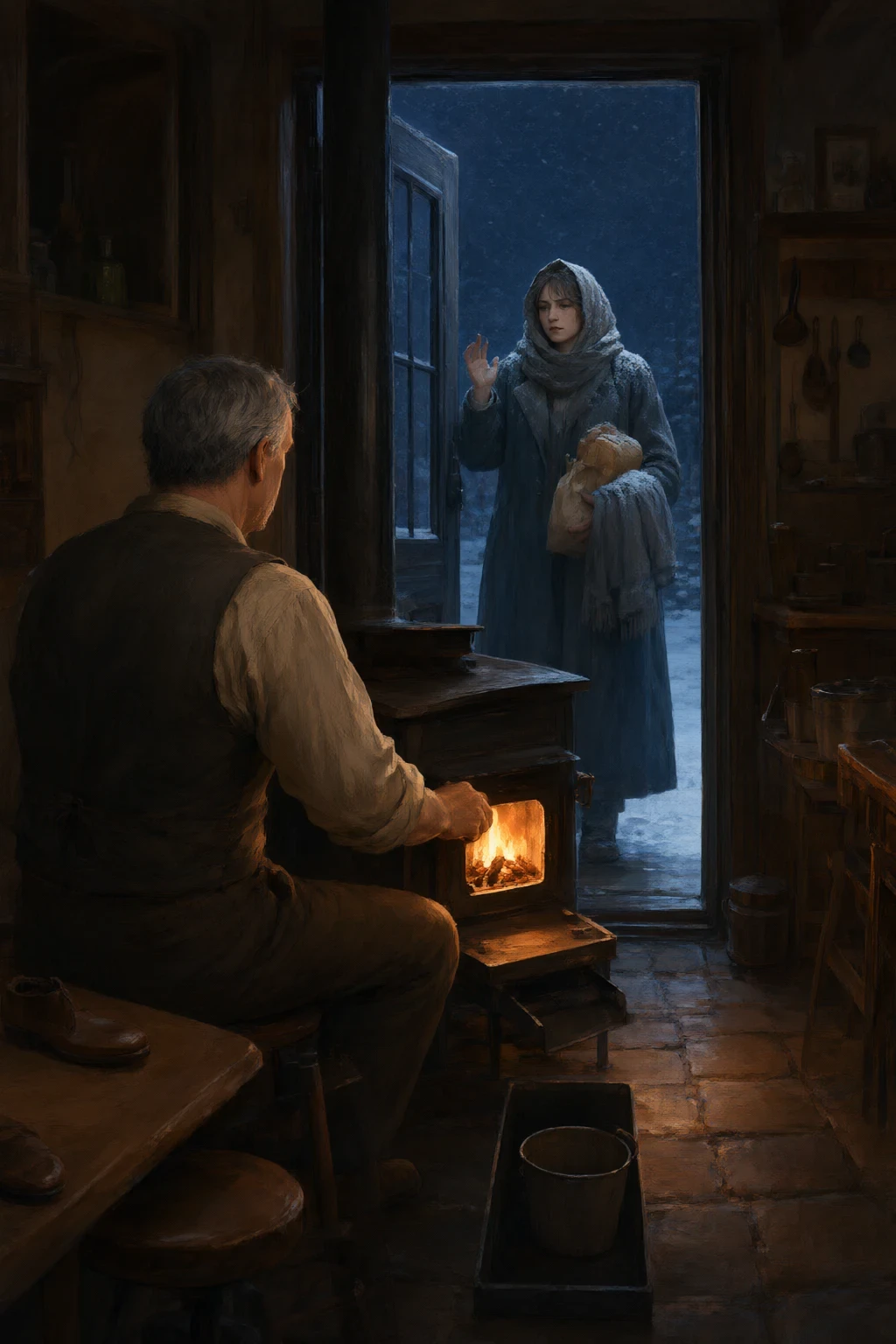
The stove in the back room of 2 Weir Lane had gone out on the seventh of February, a Saturday, and had stayed out through the Monday, and on the Tuesday Hollis Grange came in from the yard at four in the afternoon with his hands black to the wrist and a piece of board to sit him down in front of it, and there was no coal in the cellar. There had been coal in the cellar in November. Coal does not lie about November. Coal, and potatoes, and salt beef, and eleven pounds of jam of which four pounds had gone to Brackle Bottom in jars with his sister's name on them, because his sister had a way of getting nothing from a shop and a bad way of getting something from a man.
He sat on the board. He put the board against the wall. He was not a man who looked at his own life and thought it was a life that had been done to him; he was a man who had looked at his own life for sixty-one years and thought it was one he had managed, and there is a particular kind of cold that belongs entirely to a person and cannot be fixed by anybody, and it is not the cold in the room. The room behind the shop had a coal chute that had not worked since 1994 and a door that did not shut, because the door had a warp and a swollen frame and had been on the list at the Joiners' in 2011. He had oilcloth on a wire across the gap, which he tied back each morning, and untied each night, and which he had bought in 1996 from a man who sold oilcloth.
At half past five on the fourteenth of February, Miss Venner would later say, somebody was standing at the front of the shop for a while before she came round the side, and it was the tread of somebody who did not want to be heard. She had a blanket over her arm, and under it, in her other arm, a loaf and a piece of cheese in a paper bag, and she had walked from Mill Steps in the dark, four miles, in the cold, in a blue-grey coat that was not hers and would never again be mentioned by either of them. She did not ask. That is the part that must be understood. She did not knock on the front of the shop to ask a man of sixty-one for coal. She went round the side, because the coal chute faced the yard, and she stood in the yard in the dark and she sang.
It is difficult to write this part and it should be written anyway. She sang the way she sang, which is to say she stood in the snow in a yard in a blue-grey man's coat and sang, in a voice that carried about ninety feet in still air, which was enough. She sang the Molly Malone and she sang Brighton Camp and she sang the one about the miner going down, and it took her forty minutes, and she did it for nobody, in an empty yard, to a shut shop, on a Thursday evening in February, because the yard was the only place a voice like that could be used without a licence, and because she had worked out, with the terrible arithmetic of a nineteen-year-old who is clever, that the coal chute was the only way to get coal into a house without knocking on a door.
Hollis Grange was in the front shop. The front shop was shut and dark and the stair was behind the counter and it went up in one straight flight, and from the fourth step you could see, through the doorway at the bottom, the yard. He came down. He did not go into the yard. He went to the coal chute and took down a bucket he had emptied on the Wednesday, and he filled it from the sack in the yard, and he pushed it up the chute with a stick, and the bucket went up with a noise like somebody clearing their throat, and it stopped halfway because the chute had a kink in it that everyone in the parish knew about. The singing stopped. He waited. She did not come and knock on the front, because she could not, because that would be the end of it, because she had planned for the possibility of silence and had planned well.
The singing started again. The Molly Malone again, from the top, which showed that she had gone back to the beginning, which is what a person does who is not singing for an audience. He put his hand on the bucket and pushed it up the chute with the stick, and it went up the whole two feet of the kink and went into the coal bin on the other side, and it made a noise, and the singing stopped, and there was a silence of perhaps two seconds, and then she began the second verse, because she had decided that the noise was a house, and not a person, and she was not going to stop singing in front of a house. He stood in the chute with his hand on the stick for the whole of the second verse and the third.
She sang for forty minutes in the yard of 2 Weir Lane. In the end she put the blanket and the loaf and the cheese on the flagstones under the chute, because the chute was too high to hand anything through, and knocked twice on the side of the building with her knuckle, twice, and went away. He did not go out to the gate for nineteen minutes. When he did, the flagstones had snow on them and two sets of prints going away, and the cheese was gone and the blanket was gone and the loaf was gone. The coals from the fourteenth of February lasted until the eleventh of March. He bought more on the eighth of March with his own money, in daylight, from a yard in Brackle Bottom, and carried it home in a sack on his shoulder, four miles, because he would not have a man in a cart know where he had been.
Neither of them ever mentioned it. Not to the committee, not in the spring when the parish magazine did its piece on the winter and asked the question who in Braymoor remembers a neighbour in March, not on the day Miss Venner died, not in any year in which either of them had cause to be in the other's doorway, and not when the Farrows moved away in the dry summer, when Nell Farrow, by then a woman with a car and a house of her own out past the reservoir, drove forty miles and parked outside the house at 2 Weir Lane, then a shop that sold cards, and put her hand flat on the front of it for a moment and drove off without getting out.
On the nineteenth of April the ash came out early, and the frost went out of the ground in three days, and it was, as the almanac had said, a hard winter, and then it stopped. Hollis Grange was in the back room at eleven in the morning. He was doing what he had done every day since the fourteenth of February: opening the door of the shop and letting the two rooms be one room, tying the oilcloth back on its wire, and standing in the draught, and waiting for the fire to go out, which it did at about two o'clock, and which he had stopped minding at some point in the second week of March, because a shop that is cold all day is a shop that is cold all day, and there was no version of the fourth of March on which he had heat.
He had coal. That was the new fact. He had eleven days' worth, in the bin, from the yard in Brackle Bottom, and on the nineteenth of April he carried a scuttle from the front shop into the back room and set it down beside the stove and opened the door of the stove and put a shovelful in and shut the door of the stove. Then he stood in the doorway of the back room, in the draught from the open shop door, a man who had kept a room warm for nine weeks for nobody, listening to the fire take. He did not go into the front shop and close the door and do his work behind the curtain of oilcloth. He stood where he was with his hand on the frame, and he left it open, and outside in the yard there was nothing at all, and the almanac had been right about the winter and had said nothing whatever about the spring.