Trude's household had a hayloft, a churn, an ash-pit under a lean-to, a goat, a bread oven, a roof with a bad side, and a well at the top of the field where the washing was done on Mondays. Her father did the outside work. Trude did the inside work, and there was more of it than there looked. She was seventeen, and the village had already decided that Trude's worth could be put in a list, and the list was done twice a day: the bread, the butter, the water, the milk, the ashes, the spinning, the mending, the goat, the oven, the floor. Nobody asked her to read anything. Everybody asked her what was ready.
The well was where the words were. Not the words of the world, which is a different thing altogether, but the words about the house. Whatever was said there, about a household and its work, came true, and everybody knew it, and everybody said it without being asked to, because a well on a hill is not a well that you lean over and say nothing to. So when Oswin the cartwright's son wanted to stand in front of the household with a gift, and Trude wanted him to go away, she said what the household would say about herself.
"You may have me," she said, "when, at the end of three days, this kitchen will be sorry." Oswin had brought a chest of tools worth nine guilders, and a new collar for the goat, and he had a plan. He had the plan for one day and a half. On the second day the tools were in his father's cart, being very politely returned. On the third day the well confirmed it. The kitchen was sorry. It had been sorry since the second day, and there is no arguing with a kitchen.
The bailiff's clerk was a different matter, because he counted. He counted on his fingers, and he was a great deal better at it than anybody gave him credit for, and on the third day he was extremely pleased with himself, and at the well he said, with his hand in a flourish, that at the end of three days this kitchen would be sorry, and it was not, and everybody knew why, and the clerk spent a fortnight going backwards through the arithmetic of his own life in front of the mill and never found the day.
The miller's son did not count anything. He hired men. That is a real answer and it works for hay, and Trude was fair enough to say so. "At the end of three days," he said, at the well, "this kitchen will be sorry." "A good answer," said Trude, "but it was not this kitchen that will be sorry. The man who was standing here. Look at the work tomorrow morning and see whose it is."
The miller's son was on the river road on the first evening, and on the second day, and on the third day a man he had hired was still there at ten at night, and the ash-pit was not swept, and the churn stood still, and the water was carried, and the household was not sorry at all, because nothing had been done and nothing had been neglected. It was a still and pleasant house in which nothing whatsoever had happened. Oswin's kitchen, after three days, had a hole in it. This one had a house that had simply forgotten to be a house.
The fourth suitor's name was Wick, and he was fourteen, and he had come to ask after a job and not to have a household at all. Trude said the words with him, because her father said she had said them three times, and that a thing said once is an accident and a thing said three times is a plan. They did not talk to him about it. That was how she found out later that he had spent three days in the hayloft.
"You cannot hide in a hayloft," she said to him, on the evening of the third day, standing in the doorway with the milking pails in her hands. "There is a cat." "There is," Wick agreed. "You have been in the hayloft for three days." "I have been thinking," said Wick. "In the hayloft." "The hayloft is where the thinking is," said the boy, with more confidence than anybody has ever had about a cat, "and if you count the hay that is half of the year in one place then the household has one good roof, and I have been working out what the fourth day is for."
On the fourth morning Trude went up to the washing well, which is the thing you do on a Monday whether or not there is a suitor in the hayloft, and she said, out loud, with a wringer in her hands and her mother six steps away, that at the end of four days this kitchen would be better than it had ever been. Because she had thought about it. Three days was a punishment and a punishment only needs a person to survive. Four days was a job, and a job has an end, and the end of a job is when it is done.
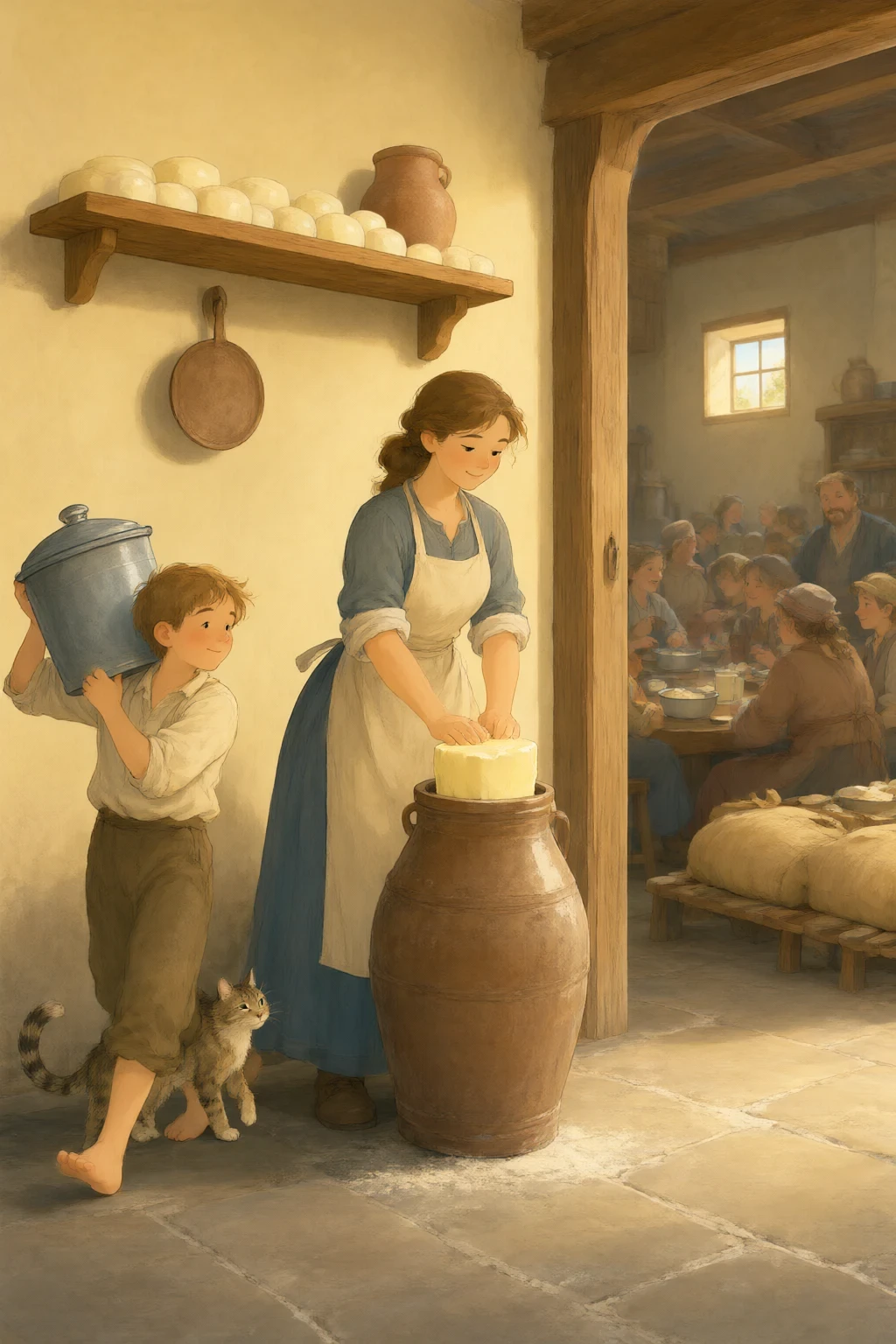
So they did it in one afternoon, in front of the village, because a household that has said a thing at a well ought to be watched doing it. Water first: four trips, and no spilling, from the well at the top of the field, and the boy who carried it was Wick, and he carried it on his shoulder with a lid on, and the third trip he learned something, and the fourth trip he was good.
Then the ash-pit: the floor of the passage swept and scraped and then swept again until the grey showed white between the stones, which takes a broom, a flat scraper, a bucket of water, and a great deal of patience, and which Oswin, who is a good man with a cart, said could not be done, and then did, badly, and then did well because the second attempt is always the one that works.
Then the wood: split and laid and lit at four, and the bread in at four, because the oven holds its heat for two hours after, and if you are clever about the hour you can have bread and hot water in the same fire without a second fire, which is a thing her mother has known for thirty years and has never once been thanked for.
And the last of the milk went through the churn in the time it takes to eat, and it came out butter, and it was not much, and Trude pressed it and said the household would be judged on a shelf and not on a lump.
It was a good afternoon. Her father built a small table where the court had gathered, out of two sacks and a hurdle, and served them, and the village ate on the dairy floor.
Wick was hired on until the spring and then hired again, because the dairy wants two people and not one, and because a boy who can be trusted in a hayloft is worth having on a farm. Oswin went home with his nine guilders and a good coat that Trude's mother mended for nothing, and said that he had learned something about tools that he had not expected to learn. The miller's son sent a hired man to say he was sorry, and Trude told her father to say it was not necessary, because it was not.
The bailiff's clerk did not come back at all, and was, people said, still counting. Her father built a shelf. That is the last part of it that matters. It went on the north wall, out of two boards and four brackets, and it is still there, and it is a good shelf, because the mason who made it was her father and he is a better man with wood than anybody suspects.
Trude had forty-one cheeses on it in the first winter, in rows, and the row nearest the window was hers and the row nearest the fire was her mother's, and the shelf filled the way a shelf does, not all at once but by the calendar, and the only way to get forty-one on it is to keep the goat, and keep the churn, and keep the well, and carry the water up from the top of the field on Mondays.
On the door frame, where the household tallied everything that had to be done and when, there are four chalk marks under the heading for the well, and the bucket stands on its rim outside with three wet stones in the bottom of it, because her father found them there on the fourth morning and would not move them, and nobody has ever thrown them out.