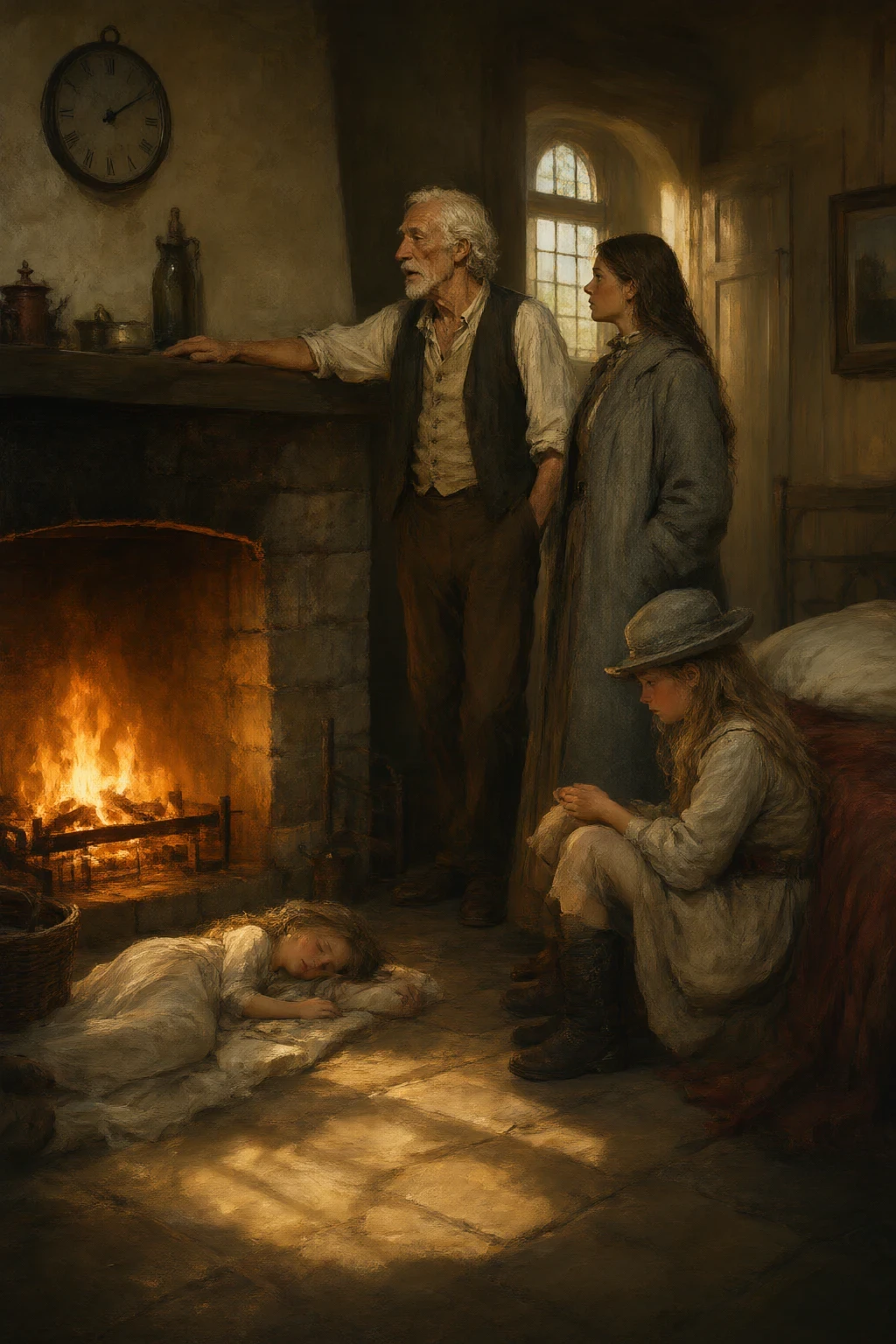
A calling of the seven was set for the Friday of the fourteenth of August, and the notice went to the tithe barn in the clerk’s hand, which was not where a notice of calling came from, because a calling is not the clerk’s document, and the warden’s office knows the difference between a document it sends and a document it keeps, and Ivo Colm had been asked to write it out, and had written it out without a comment. The notice said: The seven holders of the stands will come to the first stand on the fourteenth day of August at two of the clock, and each will answer for his own holdings, and one shall not answer for another. It said the last part on a separate line, by itself, and the separate line was the whole of the notice and everything else on it was furniture.
Nobody in Coldhay could remember the last calling. Ivo Colm, who was fifty-five and had been in the roll room thirty-one years, said in the roll room on the Monday, to the volume, that the last one was in 1841 and that the entry for it was a single line and that he had read it nine hundred times and could not remember a word of it, which he said out loud in the room and then waited, and the room did not finish it. The letter from the warden’s office had come on the same Monday. It said that Ivo Colm’s successor would be appointed in the spring of 1982 and that the present holder of the office of boundary clerk would be asked to attend the last quarter of the year in an advisory capacity, and Ivo Colm read it twice and put it in the inside pocket of his coat, where it was on the Friday.
The first stand has one room, a hearth, a door, and a yard eleven feet deep, and seven adults in it on a Friday afternoon is a room with no room in it. They came at two, and on foot, and through the nine-foot wall by the seven gates, and there is no corridor in Coldhay and there are no spare rooms, and everybody in the town has understood that for a hundred years as a fact about character. The fourth came first and the sixth came behind him and they had not spoken on the way and they did not speak in the room. The holder of the seventh was last, because the seventh is at the end of the row and the lane ends at the seventh gate. Halla Dree came at two with her coat open, having come straight from the second stand, where she had left a fire that must not be let out go out, and a scrubbing stone, and a sheet of ruled paper with two lines and a third ruled under them and nothing on the third. Tam Kelder came at two and stood by the door and counted the doorways he came through, which was one, and said so.
The fire in the first stand was lit and had been lit since ten past six in the morning and had not been out for one hour since the September of 1966. It is in every census photograph of the first stand since that year. In 1966 there is a man sitting with his hands on his knees. In 1971 there is a man standing. In 1976 there is a man and a girl of four at the end of the bed, and the girl is looking at the door and the man is not looking at anything, and the fire is the same size in all three pictures, and the census man asked nothing, and a photograph is a record that cannot be cross-examined. Old Brannic Sallow was seventy-one and had not spoken since the ninth of May, 1975.
Wren Sallow was eleven and was in the room because it was the only place in the house she could be that was not the yard, and she sat on the bed with her legs over the edge and her hat on her knee, and she did not take the hat off, and she turned it up once when the fourth and the sixth came in, and once when Ivo Colm came in with his satchel, and once when Tam Kelder moved his hands. “Who is it for?” she said, to nobody, about the calling. “It is for the year,” said Ivo Colm, who had a green reading arm at the end of the desk in the roll room and did not have one here and was holding a satchel against his chest. “Whose year?” said Wren Sallow. Nobody answered her, and she did not ask again, and the room went on, and the fire moved, because a fire moves when a door opens in a house where a fire has been burning since the morning.
The covenant was read out because it had to be, and Tam Kelder read it as it is written, word by word, and cannot be stopped without becoming unpleasant, and nobody tried, because the whole town knows what he is like. “I, Brannic Sallow, of the first stand, take of Halla Dree, of the second, four hundred pounds, and give her the north close for the term, and the term is one year from the day of asking, and at the end of the term I pay the sum with the arrears, and if I do not, the sum stands against my holding in this house, and the lender may ask me once a year, in this house, with a witness, whether the covenant is discharged, and my answer ends it or it does not.” “Ends it or it does not,” said Tam Kelder, and he put his hands down at his sides, palms out, fingers apart, in the posture that Coldhay has one word for, and the word means he is a witness to what happens next and not a person who is merely present, and he is the witness, and he has been the witness for every asking in this room for nine years, and he is forty-seven years old and he is the only one of the seven who can read.
“There have been seven askings,” said Ivo Colm. He had the year book open on his knee and was not reading it, because he knew it. “In the springs of 1973, 1974, 1975, 1976, 1977, 1979 and 1980. There should have been eight. The eighth was in 1978 and it was not made, because the chimney of this house was being rebuilt in March of that year and you cannot hear a question down a chimney, and a question that is not heard is not asked. I did not make the rule about chimneys. Aldis Roache made it in 1978 and I have never had cause to disagree with him.” Nobody in the room contradicted him. He put the year book away and took out a sheet, and it was a single column of figures in his own hand, and he had made it that morning in the roll room with a rule and a pencil and the same figures four times.
“Nine years,” he said. “From the fourteenth of April, 1972, to the fourteenth of August this year, which is nine years and four months, and the sum is four hundred pounds with arrears, and the arrears are entered against the holding in the spring of every year in which it is not paid, and the holding has been paid in nothing, so the entries are 1973, forty-one pounds, and 1974, forty-four, and 1975, forty-eight, and 1976, forty-eight, and 1977, fifty-one, and 1979, fifty-five, and 1980, fifty-nine, and 1981, fifty-nine, and the sum is eight hundred and five pounds, and the north close was forty-one acres in 1972 and was nine acres in 1975 and was given away in the summer of 1975 to a person who is sitting on that bed.” He stopped there, because it was the end of the column and the room had gone quiet in a way the room had gone quiet once before, on a Thursday in April 1975.
“And here is the failure. The roll takes the land in one year and the money in another and it has never taken both in the same year in four hundred years, and it took both here, in 1973 and 1974 and 1975, and I have had the file of those three columns on my desk since the June and I cannot lay my finger on the page where it says the ground.” What the town tells about the seven stands is a story about a mirror, an apple, and a woman who was too good to survive seven small houses. The woman is asked seven times, in the telling, and answers never, and the never is a kindness, and the kindness is held against her for a year, and at the end of the year she is a person who has been told what she is, and the seven small houses are the instrument, and the whole of Coldhay is a place where a person is taken to pieces politely.
It is a good story and it has been told since before the tithe barn had a roll room, and the clerk’s office has a copy of it in the press on the bottom shelf in a hand of 1808 that nobody has read aloud, and when Ivo Colm read the covenant of 1972 out on the Friday he read the names at the top of it, and the first name was the lender and the second name was the man of the first stand, and the man was sixty and the lender was twenty-five, and both of them were in the room, and the lender was standing with her back against her own wall, because there was nowhere else in a house with one hearth in it for a person to stand. “You are the woman in the story,” said Tam Kelder, and he said it without any weight at all, which was the only way it could be said.
“No,” said Halla Dree. “I am the one who asks. That is the whole of the difference and it is the only difference there has ever been, and the town has had it the other way round for a hundred years because the town likes a story where the person who says nothing is the person who is punished. He said nothing for nine years and the punishment was mine. That is not vanity. That is a column.” “The column is a very fair thing to say about a column,” said Tam Kelder, “and you have said it in a room where there is a girl of eleven on a bed who has said nothing but no twice.”
A house of seven holders may be called, and when it is called all seven come, and each must answer for his own holdings, and one may not answer for another, on any grounds, including love. The last clause is the reason the notice had a line to itself. The fourth answered for the fourth. He answered for a strip eleven yards wide and a wall that needed eleven pounds of lime, and his answer took a minute and a half and was the only one anybody in the room understood entirely. The sixth answered for the sixth, and his was two sentences. The seventh answered for the seventh and named the long close, and the room did not look at Tam Kelder, and Tam Kelder did not look at anybody, and the seventh’s man said that his long close was in the roll and correct and the clerk’s business, which it was, and which was true, and which had not been true in June.
The third answered for the third, in his own words, having promised himself he would not do it in the written words, and he said that the third stand held no covenant of the first stand and no term of the first stand and had never been asked for one, and that the third’s glass had held the account of the third since 1889 and the account of the third had nothing in it about the first. The second answered for the second. “I hold the covenant of the fourteenth of April, 1972, and the sum of eight hundred and five pounds, and I have asked it seven times in nine years and had nothing seven times, and I entered it in my own column in my own kitchen, and my column is on a sheet of paper and not in any roll, because the roll is the town’s and the column is mine.” She put her hand flat on the table. “And I have to tell this room that I have asked the same question in four houses in this county in this year and had four different answers, and I cannot tell you which house gave me which, and that is not a figure of speech, it is the state of my books.
And I am in a covenant of my own this year that is not the first stand’s, and I am not going to describe it here, because if I describe it in a room with a witness in it, it is a disclosure, and a disclosure in a room with a witness in it is a covenant, and I have one of those already.” “Which is the reason the second stand cannot be the house of the calling,” said Ivo Colm. “And the first stand can, and the first stand has not got a spare room, and I am not going to pretend to you that I know what Friday afternoon was going to be like in here with seven of you and a fire that is not going out. I have written the notice and I have sent it and I am the clerk of the county and I am a witness to nothing in this room except the four words, if there are four words, and there may be no four words, and I have entered nothing since the March of 1974 in which I was certain of anything.”
The fifth stand was brought in at five minutes past two, late, and the reason was the girl, and the reason for the reason was the rule, and the rule was the reason the whole town has the arrangement it has. Mira Ottery is nine. She sleeps in the fifth stand four nights a week, in a back room, on a bed with a sheepskin, and a door that does not lock, because a door that locks implies somebody might come in, and no covenant in Coldhay permits that. Nothing said to a sleeping person is a covenant. Nothing said by a sleeping person binds anybody. And nothing done in a sleeping house is heard by the house. That last one is the one a whole town of competent people forgot, and the town has not forgotten it since, because the town cannot: a house with a hearth in it that is a house, and the house is an ear, and a house that cannot hear is not a house at all, and everything said in it goes into a room and comes out of it again with nobody in it.
So the fifth stand’s holder had lived five years inside that fact, and the fifth stand’s covenant had been made in the fifth stand’s roof in the autumn of 1976 at nine o’clock at night, and it had been made while the girl was awake, and she was awake because she was in the back room with a blanket over her head and an infection in her ear and a temperature, and her mother had said out loud in that roof, with the holder of the third standing there with his hands open, I give you the term that she shall sleep here four nights a week, and the girl had said yes. And in the fifth year the girl was awake.
Nobody woke her. That was the arrangement, and the arrangement was the whole of the household’s method, and the method was this: the fifth stand does not wake Mira, and does not ask Mira, and does not put anything in Mira’s hands and ask her what she thinks of it, because if Mira wakes in a room where a thing is being said, the fifth stand is a house with a person awake in it, and the fifth stand is a house, and the thing being said has been said in a house, and there is a witness, and a word spoken under a roof with a witness binds. So the fifth stand’s daughter wakes in a house in the middle of the night, and asks questions in a very clear voice, and does not know what she is interrupting, and has been doing it for a year.
On the Thursday night before the calling she slept in the fifth stand, because it was one of the four nights, and her mother was at the first stand with the household, and the room was empty at four in the morning, and Mira Ottery came down the stairs in the dark, and stood, and said, out loud, to nobody: “I do not consent to sleeping here four nights a week. I take back my yes. I said it when I was ill and I am not ill now.” And then she went back to bed.
Nobody had asked her. That is the whole of the law about it, and it is four lines long, and everybody in Coldhay learns it at fifteen and forgets it by twenty and remembers it, if at all, only when somebody wants a thing. A consent given under a covenant is a term of that covenant. A term can be withdrawn only by the person it was given to, in the same room, alone, unprompted, and out loud. A withdrawal asked for, hinted at, or obtained in company is not a withdrawal. Nobody had asked her, hinted at it, or been in company. Her mother was four doors along the row in the first stand and asleep. And a girl of nine, alone, in the dark, at four in the morning, unprompted, out loud, in the same room in which she had said yes. “A withdrawal with no witness in it cannot be entered,” said Ivo Colm. “It cannot be entered,” said Tam Kelder.
“It is a withdrawal,” said Halla Dree. Nobody said anything else for some time. The fire moved. The girl on the bed in the first stand, who was eleven and not nine, turned her hat over on her knee. “A term withdrawn is a term gone,” said Tam Kelder, “and there is no clause anywhere in this county that says a term goes back because nobody heard it, and if there were such a clause then every person who ever lost a thing in this town would have it back whenever a clerk was not in the room, and this town would be a very different place to live in.” The seven got as far as half past three, and then the room ran out of time. That is the whole of why the calling had not finished by four o’clock, and the roll records the day and the hour and the duration of a house of seven, and Ivo Colm wrote: Called. The first stand, the fourteenth of August, two of the clock. The house did not hear from twenty past three of the afternoon until the person in it was woken. Mira Ottery had fallen asleep at twenty past three in the first stand.
She had come at noon, with a blanket round her shoulders and nothing to do there, and had eaten at the table, and had asked four questions, and the fourth was about the copies of a deed, and then the room began to fill, and a room with eleven feet of yard and one hearth is a warm room in the afternoon even in August, and a girl who sleeps on a sheepskin in a house with no corridor, who had never in her life been in a room with eleven other people in it, and who was not tired at three o’clock because it was three o’clock in the afternoon, was asleep at twenty past three on a folded blanket on the flagstones by the hearth, eleven feet from a fire that had not been out since 1966.
And the house did not hear. Nothing said in that room entered the house, and the house was the thing a covenant is made in, and the grown-ups in there could have said every word in the English language out loud for the rest of the afternoon and not one of them would have been speaking in a house at all. Tam Kelder found it. He was counting the doorways he came through, and the count had not worked out, and he stood with his hand on the jamb and looked at the fire and at the girl and at the grown-ups and did the arithmetic of his own trade out loud, once, very quietly, so that only the grown-ups heard it and not the girl: “She is asleep. Nothing said in this room is said in this house. I am a witness to a room.”
They woke her. That is the plain fact of it and nobody in Coldhay had ever done it, and it took eleven minutes, and every adult in the room wanted it not to happen and every adult in the room did it, because the alternative was that the eighth asking of a covenant nine years old could not be made at all, and the covenant would go into a tenth year, and a tenth year is not a thing the town has room for. The holder of the fifth stand was the one who knelt down. She said the name, Mira, twice, and then said the date, out loud, the way you say it to somebody who has been under something, and the girl came up out of the sleep in three stages like water coming up through a sieve, and the first thing she said was a question. “Am I in the way?” she said. “You are the house,” said her mother. Which is the truest sentence anybody in Coldhay has said about the arrangement in four hundred years, and nobody wrote it down, and two of the people present thought it was the finest thing they had ever heard, and nobody said so to anybody.
Ivo Colm ruled on the girl before anything else was said, and he ruled it aloud, in the middle of a room, with the volume not there, out of memory, which is not a thing he does. “The roll does not say at what age a person knows what is being said. I have looked for it twice this afternoon in my own head and it is not there, and there are two hundred and six entries in this volume with a person under ten in them, and I have never had to decide it, and I am not going to decide it at five past four in the afternoon in a house with a fire in it. The witness is Tam Kelder, who is forty-seven, and awake, and not a party. The girl is not the witness. The girl is present, and she is nine, and the entry will say so and say her age, and it will not say she understood it, because the roll does not know how to say that and because nobody in this room knows that except the people who are eleven and the people who are seventy.”
Halla Dree asked it in the exact words, and she had asked it in the exact words seven times in nine years, and she waits for the exact answer and has never once got one. “Is the first stand discharged.” And the room did not answer. And Halla Dree said: “That is not an answer.” And then nothing, for a long time, the length of a page of a very large book. Outside, in the eleven feet of yard, a hen got over the wall and went along it and came back, the same as it had done on the Thursday of that week in 1975, and the fire moved because the girl in the room was breathing, and nobody else in the room moved at all, and Ivo Colm held his satchel against his chest with both hands and did not look at his coat. Old Brannic Sallow looked at the girl of nine on the floor by his hearth, and then at the girl of eleven on the bed, and then at the woman against the wall, and he said four words, in a voice that had not been used in six years and that was very quiet and did not break. “There is nothing there.” And Tam Kelder, who had his hands out and who could not be stopped without becoming unpleasant, said, in order, and this is the whole of what happened:
“A word spoken under a roof, with a witness, in the first stand, on the fourteenth of August, 1981, binds the holdings of the speaker in that house for one year from the day. The holdings of the speaker in that house are a house, a hearth, a door, a yard of eleven feet, a fire, and the covenants of 1972 and 1961, which are in a box on a shelf. The lender may ask once in the year, in this house, with a witness, whether the covenant of 1972 is discharged, and may do so before this date of 1982, and not one day earlier. The covenant of 1972 is not discharged. The sum of eight hundred and five pounds stands against the house and the fire. The witness is Tam Kelder of the third stand, forty-seven years of age, awake, not a party. The girl was present and is nine years of age.”
They did not leave until the light went. The sixth went first, then the fourth, then the seventh, and the seventh stopped in the doorway and said, to Ivo Colm, that the clerk would find the paper for the long close in the June book, and Ivo Colm said that he knew where it was, and did not look up. The holder of the fifth stand took her daughter up the lane and did not run, and the girl walked, and at the fifth gate the girl turned round and shouted, across eleven feet of lane, in a very clear voice, at a shut door with a fire in it, that she was not coming on Tuesday, and shut the gate, and the sound of the gate went up the row of seven.
The girl of eleven was asleep on the bed when the room was empty, with her hat on, and she had asked twice who the words were for, and had been answered twice, and the second answer had been a man of fifty-five quoting an entry exactly, and the entry had not finished itself. Ivo Colm wrote the entry on the Friday night in the roll room, under the north window, with the reading arm pulled down to the height of the eye that worked, and he read the previous entry exactly first, and waited, and the room did not finish it, and then he wrote: Called. The seven of the stands, the first stand, the fourteenth of August 1981, two of the clock to six. The house did not hear from twenty past three of the afternoon until the person in it was woken, a person being asleep in the house, and the person was nine years of age, and the waking is entered, and the waking is not a covenant and is entered because the roll does not permit a gap.
Covenant made. Fourth words: There is nothing there. Witness T. Kelder. The holdings of the first stand bound one year from this day. The covenant of the fourteenth of April 1972 is not discharged and the sum of eight hundred and five pounds stands against the house and the fire. Note. A term of the covenant of the fifth stand, given on the ninth of October 1976 by a person of four years of age, was withdrawn by that person on the thirteenth instant at four of the clock in the morning, in the back room of that house, alone, unprompted, and out loud. There was no witness, there is no witness, and a withdrawal has none by the rule. It is entered as a note and not as a covenant. I. Colm, and beneath it his four initials and the date, and the same as every other note in the bottom drawer, of which there are a hundred and eleven.
The press was locked and the key went back on his person, and the day book was on the shelf and not in the press, and the letter from the warden’s office was in the inside pocket of his coat where it had been since the Monday, and it was still there on the Saturday, and on the Sunday, and on the Monday morning, when Ivo Colm came up the stair at eight o’clock, which he had done every working day for thirty-one years and expected to go on doing for some time. The fire in the first stand is lit at ten past six. It was still lit at four o’clock in the afternoon, and it was still lit at ten that night, and it will be lit at ten past six tomorrow, and the year it binds expires on the fourteenth of August, 1982, and after that date somebody has to go up the lane and ask him again.