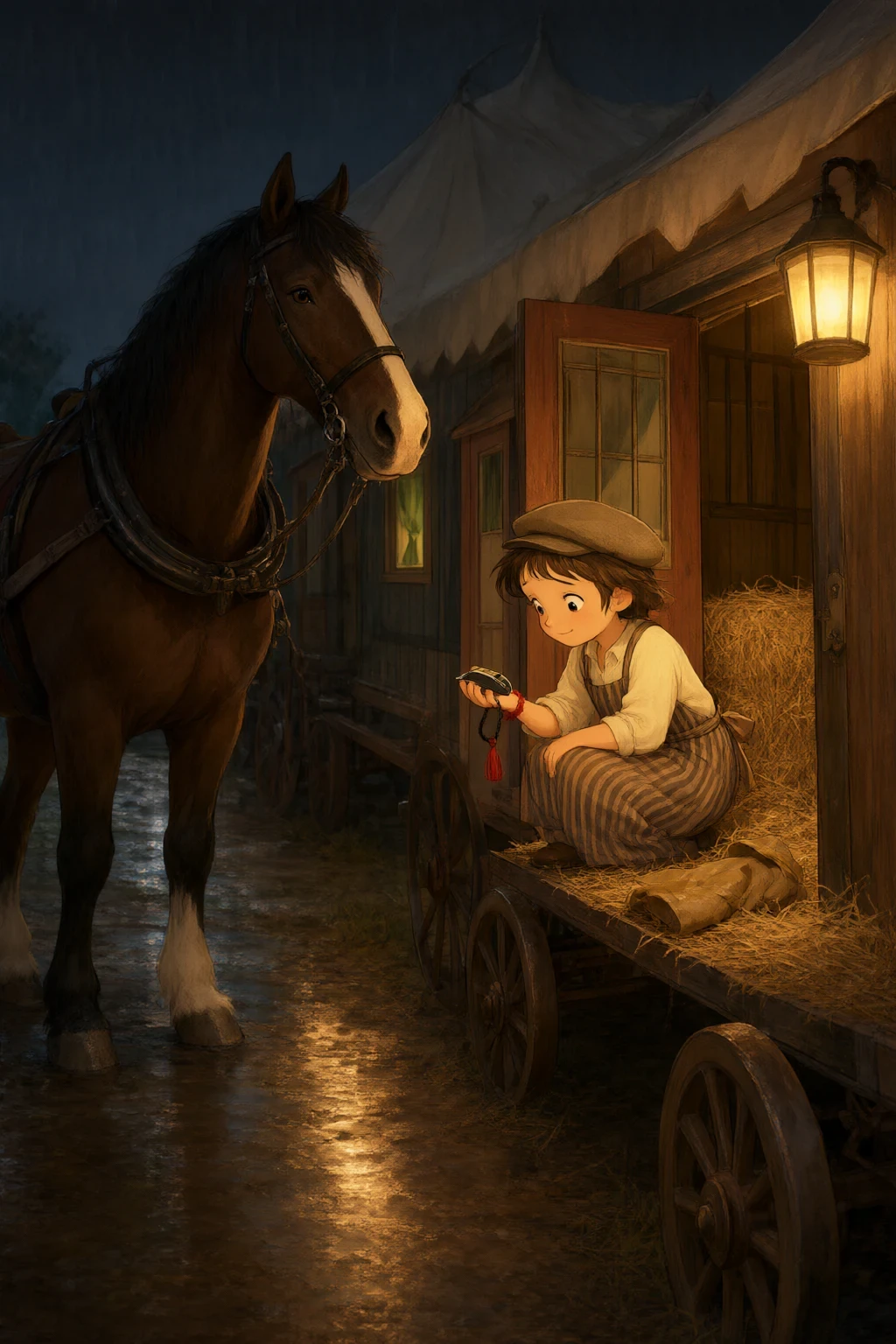
The rain came in from the west on the Sunday and did not stop until Tuesday, and that night the Gilded Menagerie stopped on the Salt Line at a siding, because the causeway had gone soft and there was nowhere to put nineteen wagons. Nell Ferrule did the last round of the hitching rails with a lantern, because it is not a night for letting animals think they are alone. Four of the draught horses were quiet. One was chewing. One had opinions about the weather.
And one stood at the far end of the line with his head down and his near forefoot lifted an inch off the ground. Not stamping. Just lifted, the way a man lifts a foot when he is waiting for somebody to say something. “That is Comfrey,” said Junie Sparrow, who had come out into the rain with a coat over her head. “He is always like that.” “He is not always like that,” said Nell.
Nobody sleeps in the Scented Row who is not signed, and Tomas has not been signed for three years, so his wagon is the one at the end of the line with the lamp out. The nameplate is still on it. You do not take a nameplate down. It says T. FERRULE in somebody’s careful capitals, and the straw is turned every morning by a man who does not know why he turns it. That night she went in for the cup, and the shutter of the small window had swung open in the wind. She had not been inside that wagon in a year.
On the straw, folded, laid down flat with the wet side up, was a child’s coat. It was an oilskin, a boy’s coat, and a small one, and Nell knew the inside of it the way you know a pocket you have had since you were six. Blue lining. A button off. Nobody put that there. Nobody folds a child’s coat on a straw bed in the dark, and if somebody had they would have done it inside out at the least.
The shelf door had flown open when the road pitched, and the slide door of that wagon has never latched, because there has been nobody in there for three years. It cannot pick anything up. It has no hands. It cannot open a pocket or say a name. It can put its nose under a folded coat and push it, and a horse in a dark wagon goes on doing a thing it has wanted to do all night. Nell put her hand flat on the wet oilskin and said, out loud, in a wagon with a nameplate on the outside of it: “I know. I know it is you.”
The pocket was on the left, and it was stiff with wet, and it took both her thumbs to open it. Out came a small tin whistle on a loop of black string, tarnished green, with a hole worn in the top of it by a tooth. Nell had not seen it since a summer with a bed and a window in it. She put it in her pocket and did not blow it.
Under the whistle, folded small and soft as cloth from being handled, was a piece of paper with a red wax seal on the fold, the size of a thumbnail. It was the paper the Bookkeeper gave every performer on the first night. The counterfoil. Your own copy. The one you keep. Nell had one in her own bag, and had carried it for three years the way you carry a spare button: because it was there, and because it was hers, and because nobody had said that it was the one paper in the circus that said what she had agreed to.
She got her lamp up off the ground and opened the counterfoil on her knee in the rain, and read her brother’s handwriting, still a boy’s handwriting with the loops done backwards. The date was the fourth of June, four years ago. The term was seven years. Under that, in his own hand, he had written the name of the object he was giving, because the form asks for it. The Box his father kept his whistle in. Wood. With a lid. And at the bottom, on the left, in the space where the witness signs, there was a second signature, small and round and very careful, in a hand Nell knew as well as her own.
She sat on the step with the rain coming sideways off the canvas and could not get her breath to go properly, so she counted. The ring-pole irons going past the lantern, forty, forty-one, and then the knots in the red thread at her wrist, which was forty-one as well, and then the shakings in the rig, which was not counting and was better. Then she got out the stub of pencil she kept in her apron, and turned the counterfoil over, and found nothing at all on the back of a counterfoil.
She wrote the six questions on the back of a handbill, in order, because there were going to be six, and a list was the only shape her head would hold. One. August Vane: what time did the road open, and who was standing where. Two. Mateo Brill: what was my brother doing when you found him. Three. Halloran Quill: did you read him the words. Four. Odette Vrain: is there anything at all you can do, and have never told me. Five. Junie Sparrow: were you there that morning. Six. Barnaby. And at the bottom, in a different pencil, because it was not a question: NELL FERRULE.
The first answer came inside the first hour, because August Vane could not sleep either and was at the front of the Ivory Tent. “Four o’clock the tents came down,” he said. “Eight o’clock the road opened. Half past eight the queue was round the obelisk. I rang the morning in at nine.” “Nell. Look at me. I did not see your brother that morning. I stood at that gate with a programme in my hand for two hours and did not see one member of my own company go past.” “Why does that matter?”
“Because that is where the words were read,” said August Vane. “Aloud, at the front of the tent. A contract does not take in this circus unless somebody paying to come in can hear it. Your brother was not taken in a room. He was taken in a queue, in the open, and I was the fool in the gate.” Mateo Brill was in the Widow’s Pew, in the dark, in the one place in this circus where nobody performs. He said Mmm, twice, before he answered, and the second Mmm went on a long time. “He was counting,” he said. “That is not a thing.”
“It is the only thing I have,” said Mateo. “I found him on the rail at a quarter to eight, and he was not crying and he was not drunk, and he was counting. He had counted the wagons and the ring-pole irons. He counted the horses in the hitching rail, all of them, including himself.” “Counting what for?” “For knowing,” said Mateo. “People count when they cannot think of anything better to be doing with themselves.” “He counted like me,” said Nell.
“He taught it to you,” said Mateo. “You did not invent it. That is what I have been trying to say for two years and you have never let me finish.” And then he said the thing she had not known to ask for. “He told me your mam had sent you for a penny,” said Mateo Brill. “He said you would be back in a minute. He was in a hurry to go first. He got in a queue by himself and a stranger read a paper to him, and by the time you came back he had already done it, so that you would see.”
Halloran Quill was awake because Halloran Quill was always awake, in the Paper Caravan, behind the one window with the green curtain drawn half, in a green eyeshade, with his cuffs inked black to the elbow. Nell had to leave her matches at the door, one at a time, into the tin by the step, which took her longer than the question would have. “No,” said Halloran Quill, when she told him it was not a question that needed ink. “It does not. Sit down. You have brought the counterfoil.”
She laid it on the long desk, and he put his hand flat on the wet paper the way you put a hand flat on a horse. “His entry is in the book,” he said. “Tomas Ferrule, fourth of June, seven years, the Box his father kept his whistle in. I entered it. In the correct column, in the correct hand, and the wax is mine.” “Did you read him the words?”
“I read him every word of it,” said Halloran Quill. “That is what I was for, and nobody has ever asked me to do it badly. I read him the term and the cost and the part about the name in the book, then asked him if he had anything to ask, and he said no, and he signed.” “Then why do you keep the green curtain drawn half?”
“Because I would like, strictly speaking, one day to be able to say I saw it coming,” said the Bookkeeper, “and I have not got the nerve to shut it, and I have never once refused a superior in thirty years. The same sentence twice.” Odette Vrain was on the leading horse of the second pair, awake, because Odette Vrain slept like a cat. She read the counterfoil by lantern light over her own saddle and told Nell to hold on to the strap.
“Now listen,” she said, quickly. “There is one performer here who signed in pencil, and it is me, and the pencil is the only door in this circus that has ever been left unlocked. A signature in pencil can be argued with. It can be lost. Yours is not in pencil, and your brother’s is not in pencil, so do not wait for him to change his mind. That is not cruelty, that is the door being nailed. Do this. Now. Again: find the paper, and do not go looking for the man.”
“Whichever one has his name on it that nobody can get at easily,” said Odette, and then said over her shoulder, in a completely different voice, small and sweet: “You are going to be all right. I am not being kind. I am saying it so that you have heard somebody say it.” Junie was the one Nell nearly did not ask, being ten, and signed two seasons, and not there four years ago. But Junie had not been in the tent. She had been in Pettifer Bridge that season, in a woman’s back kitchen, learning a change of costume in a hallway, and Pettifer Bridge was where the circus had been on the fourth of June. “Was there a girl in the tent that morning?” said Nell. “About my age. Nine or ten.”
“There was a girl at the back,” said Junie. “She was not with anybody, and she was the only one not sitting down. And a man was reading a paper out loud in the middle, and the girl was not pretending not to hear. She had her hand up, like she was going to say something, and she never did say it, and afterwards she went out to look for somebody.” Nell sat down on the wagon step with the whistle in her fist. “He was my brother,” she said. “I know,” said Junie. “I worked it out a year ago. I did not say anything because I did not know what would be kind. Is this the kind bit now? Is it fine?”
Barnaby was the sixth name on the back of the handbill, and not a person who could be asked a question, and Nell had written him anyway, because the list wanted six. Barnaby was the oldest animal in the company. He was the one with his nameplate on the manger and not in a cage, because a horse that can still be spoken to does not sleep in a cage, it sleeps at a trough. He had walked the Salt Line longer than Tomas had been alive, and he was going quietly.
The teams were made up at two, and the yard was churned to soup. Nell went along the loading rails to the far hitching rail. Barnaby was thirty yards off, on the rail, facing the way they had come. Nell put her hand on Comfrey’s neck first, because she was not going past him, and then stood under the old horse’s chin, and said the thing out loud, because she had promised herself she would do nothing on that handbill quietly.
“Seven,” she said. “Seven years. The fourth of June. Barnaby, did you see him that morning? I have to ask you something and you cannot answer, and I am asking you anyway, and I am sorry for asking.” Then the whole yard of horses and the whole lit hill of the Ivory Tent went perfectly quiet, and Barnaby turned his head and put one ear back and looked past her, up the road, the way a horse looks at something a long way off that it has not seen for a very long time. Nell turned round.
Up the Salt Line, where it came over the rise out of Pettifer Bridge, there was a whitewashed milestone with a lantern-post on it, and nothing else, and no more road behind it than there had ever been. “Thirty years,” said Mateo Brill, from somewhere behind her, quietly. “He has done that at that post for thirty years. He does not do it for anybody else, and he will not be led past it, and at two in the morning he stands and looks at it until somebody comes.”
Nell went back and got Comfrey’s ear and turned him round, and counted him down the road, one to twelve and then past twelve, and he stamped, and she counted him back up, and led him, and he came the first time, which he has not done for anybody since June.
At half past five the rain stopped, and Nell Ferrule sat on the step of T. FERRULE with a counterfoil in one hand and The Box his father kept his whistle in written on the front of it. She read the whole thing. All of it, out loud, twice, going along the line and saying it again so that she was certain of it, which is a thing she learned in a yard with a bed and a window, from a boy who could not count past forty wagons.
The term. The cost, which was the whole of it, and cost no money at all: one day of his life for every night he went on as a horse, and the day gone, and not remembered as gone. The clause that said what he would be, and the clause that said it could not be given away or lent or sold while his name stood in the book unstruck. And the line in the middle that she had never once looked at, because it did not have her name on it, and she was ten when she signed.
The Keepsake holds the human half answerable. The object named above is to be kept by the signer, and named in his own voice, and is not to be surrendered, sold, or left behind. Nell read that four times, in the wet, on a step, at half past five in the morning. Then she put the counterfoil in her apron, next to her own, which she still had not read, and which she read that same night as well. And she took out the little tin whistle and put it to her lips and blew one note.
It is not a loud note. It went about thirty feet over wet chalk, and not one thing in the Gilded Menagerie moved. But a heavy black-bay horse with a white stocking on the near hind and a split in the hoof that made his step go sideways lifted his head at the far end of the hitching rail, and looked. Nell walked the whole length of the line and put her forehead against his, and said: “One. Two. Three.” And the horse stamped.