Eleven months after the night the wind dropped, a bell in the ninth bay spoke at twenty past nine in the morning in a still, bright, hard frost, with no wind anywhere in the valley, and every person in Coldrow heard it, and there was nothing anybody could do about that except shut a door, which does not work on a note. A bell is set to the valley’s evening angle. That is the winder’s whole office, and it is done with a line of tarred hemp off a winch on the Pillar Walk, hauled to a notch, and the mouth of the bell brought round to face the quarter the wind comes from at dusk and nowhere else. A bell that is wound is a bell that has one hour in the day and one hour in the year, and the whole of Coldrow is built on that being true, and has been for four hundred years.
A bell that has never been wound is a bell that keeps the angle it was blown at. The low bell in the ninth bay had no line on its winch. It had not had one since it was hung, which the Chart House could prove, because there was an empty cell in the ringer column with no entry in it for eleven years, going back to a copying error in a hand that no longer existed. So the low bell in the ninth bay was sitting at whatever angle a blower in 19-something had left it in, and any air at all could reach it: not only the wind of the evening, but the small bright airs that come off a winter sun onto a slope, and the drain of cold air down a cold wall, and whatever a person walking up nine bays of paving pushes ahead of them. It had been saying its note for eleven years to the wind. For eleven years, it had been the one sound in Coldrow that nobody could pay for, because nobody had ever been told it was there. Then the wind dropped for nine days in a single month, and came back, and did not entirely fit the valley again, and everybody in Coldrow heard the note at nine in the morning and at four in the afternoon and at two o’clock at night, forever, without end, without a winder, without a rota, without a date.
Ione Sarrack had a piece of paper on the wall of the Chart House that had been there for eleven months and had never been recopied, because it could not be recopied, because there was no column for it. It said, in her chalk, under the ruled lines where the plaster is scuffed from the table: Ninth of the month, and the ninth. Wind: none, nine days. One note throughout, bay nine, from the floor. No column for this. Under it, in a different hand, smaller: Nobody answers first. The second line was unsigned, and it was the whole of the finding of the investigation, and it had been written by a girl of sixteen on a walk at midnight with her hand on a black iron rail, and in the eleven months since she had not once said it again, and nobody in the Chart House had ever asked her to. “What is the state of the village,” said Ione. “It is not good,” said Perrin Vole.
“That is not a state of the village, that is a mood. Give me the state.” Perrin Vole was fourteen, and three years a winder’s mate, which is a person who is paid to walk a kilometre of flagged stone in the dark and haul nine lines, and who is given a brass tally with a bay number on it and no other instruction. His coat still did not fit him. His nose was red from November to April. “Eleven households have shuttered the north side and have not opened them since the third of the month,” he said. “Two families have moved down to the lee. Old Hesk has taken a lamp out of his house at night and the Lamp Committee has written to you about it. The Ash Yard cannot keep the sieve girl because she cannot hear the ash, and the Ash Yard is the warmest place in Coldrow, and the sieve girl has gone to Wick to her aunt.” “And the hearing.”
“The hearing is worse than the hearing was.” That was the part Ione had not wanted said in a room with a north window. In the first month after the note began to come in at all hours, the valley had simply been frightened, which is an ordinary condition and passes. What had happened since was that people had started finishing it themselves. Two women had been at it in the courtyard on the Thursday before last, and it had got loud enough that the boy-tuner put down his slate. One of them said the note said a name. The other said it did not. The first said the note had said a name and she had heard it in her head, not in her ears, and that was the whole of her evidence, and it was not nothing; the second said the note was set in glass by a blower’s judgement four hundred years ago and could not say a name, and she was right, and the first woman was standing in the courtyard of the Chart House with her hand over her mouth.
A bell can only repeat, once per wind, the pitch of the sentence it holds. It cannot warn. It cannot answer a question. It cannot say a name. Anything that seems to be a message is the listener’s own ear finishing the job, and the Chart House has said so from the wall for four hundred years, and it is true, and the truth does not stop nine hundred people from arguing about what a sentence is in a yard at half past two. “It is not a message,” Ione said. “No, ma’am,” said Perrin. “Then what do I minute.” “That,” said Perrin, “is what I have been trying to tell you for a month.”
The Crown Kiln is east of the stream, a low hall of firebrick and soot, and it is the only building in Coldrow with orange in it. The floor underfoot is a black glass crust, years of it, worn into a shine. A wall of finished bells lies on racks along the north side in rows, mouth down, like animals asleep. Bela Truce was thirty-five and had a leather apron burnt shiny at the front and forearms shining with sweat and pale with fine glass dust, and one ear permanently reddened from standing beside the furnace mouth, and a long grey streak in her black hair where a gather had dripped down it eleven years ago in a way that nobody in the glasshouse would explain to a boy. She listened to the whole of it standing at the glory hole with the pipe in her hand, and then she said, “That is the low one.” “How do you know which low one.”
“That is the fourth from the mouth, the one with the split wax.” She said it without turning round. “It has had the split wax since I was a girl. It is the only one in the ninth that has never had a line marked on the rack, because I mark a rack for every bell that gets hauled, and I have never marked that one, and you know I do not read the numbers, so you have never once had to believe me about a number.” Ione Sarrack stood in the middle of a glasshouse at four hundred degrees of firelight and did not say anything for a moment. “Your marks are wax on a rack,” she said. “They are not a record. They cannot be entered. A court would not —” “A court would not,” Bela Truce agreed. “A court would say the blower’s girl says the rack is not marked. That is what a court is for.”
“Fourth of the month, and no —” Ione stopped, because she had started to say the date and could not finish it, and the girl at the glory hole waited politely for the rest of a sentence that was never coming, and then Bela Truce said, “I know,” and went back to the gather, and the pipe went on turning, and the orange light came up the wall of sleeping bells and made them all look like faces. The Ash Yard is down by the Washing Steps, and it is the warmest place in Coldrow, and in the eleventh month of the year it is warm enough to have the flue open and the sieve bench out. Marget Oskell had the yard register open on the bench under a board to keep the wind off it, and a brass sieve beside her, and the shallow tin of dry ash in her left hand, and she was tapping it with her thumbnail because the furnace at the Crown Kiln had been lit since noon and the yard could hear it, and the yard is not supposed to be able to hear anything but the stream.
The Ash Yard keeps a register. It is not a book; it is a table, ruled in five columns like the rota, on sheets of linen-backed paper because the yard is wet and paper does not last here. Column one is the date. Column two is the name. Column three is the age. Column four is the weight of the ash returned, in pounds and ounces, which is the only measurement the yard takes. Column five is the rota number, which is the number the Chart House will hang the bell under, and which is the joint between two institutions that have never in four hundred years sat in the same room. The sheet for that winter, eleven years back, is in Marget’s hands, and the left-hand edge of it is black and brown and crumbly, because the flue has run hot in a hard winter and the sheet was on the bench too long and the heat went along the top of it like a tide going along a shore. The scorch has taken the first three columns off every line of the page. Every line of the page reads like this: That is the whole of what is left of eleven dead people. Column five is untouched. The heat went along the top of the sheet and the right-hand corner and left the rota numbers standing in a clean ruled column down the side of the page. “Have you seen it twice?” said Marget. “I have seen it once,” said Ansel Roke.
He had come down with his satchel over his shoulder, the green leather gone grey at the strap, and spectacles pushed up on his head because he was thinking, and a blue ink stain along the side of his right hand from the satchel. He was looking at the page and his mouth was shut. “Then you have seen the rota numbers twice,” said Marget, “and the children once, and never both at once, and that is how the whole of this valley has been made, and I have been doing it for forty years.” “The numbers correspond to the Chart House column,” said Ansel. “Not the bay. The number. I have three that the Chart House has never been able to account for: they were blown, they were hung, and there is no crown for any of them. One of the three is the crown on the low bell in the ninth bay.” “Then the bell is settled.”
“The bell is settled. The person is not.” He put his spectacles down onto his nose and looked at the black edge of the page. “The three children on that page were born between the eleventh month and the second, eleven years back. There are four in that window in the Register of the Living and one child in the burial roll of the next valley, and the burial roll of the next valley is a family’s own book, and a family’s own book is not evidence, it is a memory with a date on it.” He took a folded paper out of the satchel and did not open it. “It stands in the record as follows,” he said. “That four children of the right age were alive in this valley in that fortnight, and that the Crown Kiln made a bell for one of them, and that I am not going to read you the four names off the page and put one of them in a minute, because the minute is a document and a document is not a place for a guess, and because if I put one in it, then in forty years somebody will come along with a seal and a date and a bit of wax and it will be a name on paper in a schoolmaster’s hand, and it will be the whole of what anybody knows.” “Ansel.”
“I know what it is to have a name on paper in my hand that I cannot account for,” said Ansel Roke, “which is not the same as true, and I have been the compiler of this list for nineteen years and the list has only ever been able to agree with me.” He put the paper back in the satchel and shut it. Marget Oskell looked at the burnt page for a while and then counted the words she was about to say on the fingers of her right hand, one, two, three, four, five, and stopped at five, which is what she did when she was frightened. “There is one more thing,” she said, “and then I will stop. To open a crown, the minute wants the name of the person in the glass. It has always wanted it. It is the first field on the sheet.” “Yes.” “It has never been blank in four hundred years.” “No,” said Ione Sarrack. “It has not.”
They took it down on the ninth of the second month, at the hour before midnight, in the dark, because the bell is the height of a person and weighs more than a man, and there is one way to move it and that is along the Pillar Walk in front of nine hundred people, and the alternative is at night and in the dark, and the Chart House chose the dark, and minuted the choice, because the Chart House minuts everything, including the things it would rather not have done. Perrin took the line off the winch and the bell came down out of the iron on its shoulder like something being set on a table carefully, and then it was on the flags, and then the three of them got a hand under it and stood it on the ash-sled, and the ash-sled went down the kilometre of flags with two men on the shafts and a boy at the back holding it straight with his shoulder.
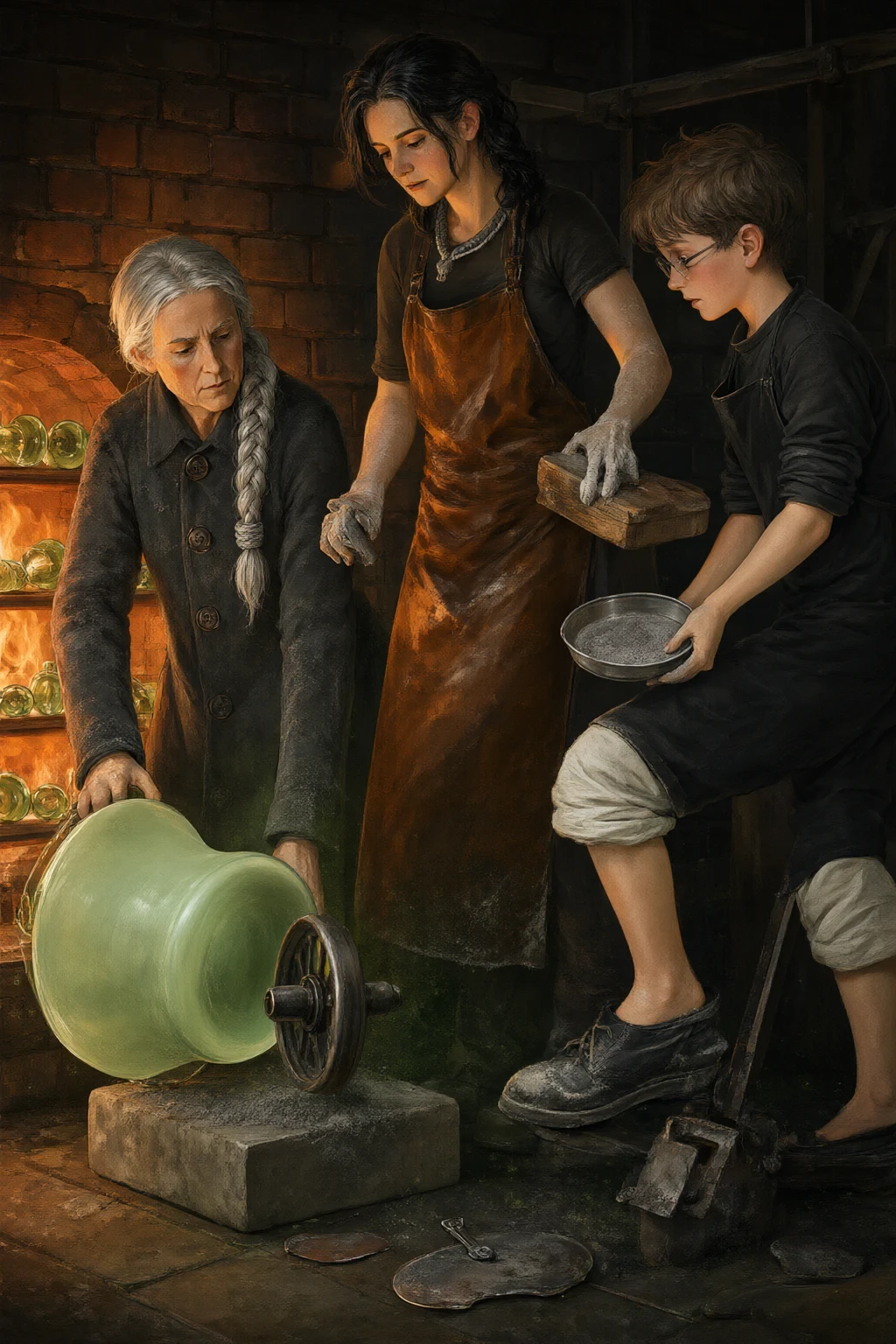
Nobody was watching. A window or two had a light in it and both went out. The Crown Kiln at midnight is a different animal from the Crown Kiln at noon. The glory hole is banked to a low red and the annealing furnace is going and the water trough is steaming and the light in there is not lamplight, it is the orange of a foundry, and everything in the hall stands out of it black: the bench, the pipe, the racks, the wall of finished bells lying mouth down in their rows like animals asleep. Bela Truce had built the annealing fire up over the afternoon and had the wheel out, a lead-capped iron wheel the size of a cartwheel on a stone block, and a trough of glass powder ground fine and sifted, and a pail of water, and she had the bench clear.
Bela was the only one in the valley who could do it and everybody knew it and the Chart House had never once fully trusted her, and there was no alternative and there was no time to argue about a blower’s marks on a rack. “Shut the door,” she said. “It is not warm in here and it will not get warmer.” Marget Oskell came forward with a canvas roll and unrolled it on the bench, and in it were her tools, and a small hammer, and a pair of lead blanks, and the shallow tin. “Have you seen it twice?” she said. “Once,” said Ione Sarrack. “Then look at it and do not stop looking.”
The crown of a bell is the cap at the top, where the clapper is hung, and on a bell of this size the cap is a separate piece, made to be lifted off, and there is one seal on it and the seal is a lead disc the size of a crown piece, punched by hand, one name and one rota number, and always slightly crooked, and the crookedness is the only decoration in the valley. Bela got the shoulder of the bell up onto the anvil block and Ione took the small hammer and knocked the crown loose, and it came off with a sound like a lid off a jar, and there was a thimbleful of grey ash in the middle of it, sitting in the hollow of the cap where it has been sitting since the glass was blown. Marget Oskell took the tin, tipped the ash into it, and set it on the scales, and the needle came to rest, and she read it.
“Four pounds two ounces,” she said. “Have you seen it twice?” “Once.” “Look at it again.” She looked at it again. “That is the ash of a child of about five,” said Marget Oskell. “Write the weight and write the age as an estimate and write that the estimate is yours,” said Ione. “And read it back.” And then she turned the cap over, and the seal was on the underside of it, which is where it is put, and there was a name and a number, and Marget had to take her spectacles off and wipe them and put them on again, and read it, and then set the cap down on the bench, and turn away from it, and then read it a second time, which is the whole of what the yard can do. “Write it,” said Ione Sarrack.
Ansel Roke had the minute on the long slate, propped on an upturned tray, and he wrote the name and the number, and read it back, twice, as he read everything. “It is a name that is on the Register of the Living,” he said. “Living, in my hand, this year, sixteen years old. And the rota number on that seal is the number of a bell in the third bay, which is hung and holds a person who was certified in 1897, and which is not this bell, and this bell’s number is not on the page in your hand, Marget, because its number is on the page that was burnt.” Nobody said anything for a moment. The annealing fire ticked. “So the paper names two people who are both demonstrably not in this bell,” said Ione. “One of them is sixteen and standing in this valley. The other has been dead since the year my father was born.”
“Then the name on the crown is a name on a piece of lead and nothing else,” said Marget, “and the child in the glass is a child whose name went off the top of a sheet of paper, and the paper is the yard’s, and the yard is mine, and I have been reading these ledgers for six years looking for a name I got wrong and I have been looking for it in the wrong place.” “Write the blank where it stands,” said Ione Sarrack. “Write what.” “The name of the person in the glass. It is a field on the form. It has never been blank. I want it blank, and I want the word blank written across it, and I want the reason written underneath, and I want the reason to be that the Chart House does not know. That is a thing a form can say. A form cannot say a name it has not got, and it must not be made to.” It was the only order in eleven years that Ione Sarrack had given that Marget Oskell did not immediately agree with, and the explaining took four sentences, and then Marget tapped the ash-tin twice against the edge of the bench, which is what she did when a thing had been got right.
The grinding of a lip is not a delicate operation. You lay the bell on its side on the stone block, you let the wheel down onto the lip, and you take a quarter of an inch off the glass where the lip comes the last half inch into the body, and you do it wet, in glass powder and water, because dry glass dust will go into a lung and stay there, and it is slow, and it is loud, and the sound of it goes out of the kiln into the east end of the village and does not stop for five hours. Bela Truce did it. Ione Sarrack held the bell on the block with a strap and a knee, and Marget Oskell worked the wet powder in with a flat piece of wood, and Perrin Vole worked the treadle.
The treadle is a lever on the floor of a furnace that blows the fire when you put your weight on it. A boy can work it for hours and it gives him a rhythm and nothing else, and after an hour his calf is going and after two hours he is thinking about his calf, and after four hours he is not thinking about anything. That night he was thinking about the note. He was not able to say afterwards how he had known to expect it. The note had been going for eleven years and he had been making it at the back of his throat since he was ten, and it had never once been in a room with other people in it, and it was.
It came up out of the floor of the ninth bay, the two hundred yards of cold and dark away, and it did not change when the wheel came down onto the lip. Bela took a quarter inch off and the note stayed. She took a third off and the note stayed. She got to half an inch and the note stayed, sitting above the grinding the way a note always sits above the wind that is making it, and the fire went on roaring and Perrin Vole went on putting his weight into the treadle and the note went on, and by two in the morning he had stopped being able to hear the fire. He told Ione at about the third hour, in the flat voice of a boy who is not making an accusation. “Ma’am. It stops when I let the treadle up.” “What stops.”
“The note. It stops every time I come off the treadle and it starts again when I go back on. Twice now. A second each time.” The hall went quiet in the way a hall does when five people stop breathing at once. The fire was still going. Nothing in the room was making a sound. Bela Truce put down the wet block and looked at the boy and then at the bell and then at the ceiling. “Shut the fire,” she said. “Bel —” “Shut the fire.” Bela Truce cannot read numbers and has never pretended otherwise, and she has been in a glasshouse since she was four, and she is the only person alive who knows what the sound of a furnace with no air in it is, and it is not silence, it is a low rush, and the low rush went on, and it was nothing to do with the note. “Fire’s down,” said Perrin. “I only came off the treadle.”
“Nothing,” said Ione Sarrack, in a voice that had gone very calm, and that was the thing Perrin remembered afterwards about that night, more than anything. “Nothing stopped. Nothing moved. You had the fire shut and the note was going. It is going now. It has been going the whole time you have been standing there.” And it was. He could hear it. The bell was on its side with half an inch of its lip ground away and the fire was dead and there were four people in a room and it was in the room, out of the floor, exactly where it had been out of the floor of the ninth bay for eleven years. “Ma’am,” he said, “it was there both times.” “I know you heard it,” said Ione Sarrack.
The wheel went back down onto the lip at ten past three in the morning and Bela Truce ground it to an interval that no wind coming down the grail in the month of the turning makes. The pitch was set by her judgement, alone, in a glasshouse, with nobody to check her, which is the most frightening thing in the world to a blower and the most reassuring thing in the world to anybody who has spent a life not trusting her. The note in the floor of the ninth bay went out at about a quarter to five, the way a lamp goes out when it has been turned down rather than blown, and it did not come back.
They rehung it before the light, and it came up out of the iron on its shoulder and it went there and stayed, and the mouth of it faced north-north-east in a hard frost at six in the morning and the first wind of the day came across the Chart House roof at half past seven and went into the ninth bay and found nothing there that it could play, and went on. Tamsin Quill was in the yard at eight with a slate under her arm, because she was in the yard every morning now, and she was not working, and nobody had found work for her either. “What is it like?” said Ione Sarrack. Tamsin thought about it, half a beat late. “It is like the room after somebody has gone out of it,” she said. “I keep turning round. I have been turning round for eleven years and I did not know that was what it was. I thought I was mad.”
“No,” said Ione Sarrack. “You are not mad. There is no column for it.” “I know there is no column for it. I have read the wall. I have read the wall since I was eleven.” Ansel Roke nailed the minute to the east wall of the Chart House under the ruled lines, where the plaster is scuffed from the table, and the Chart House nailed minutes up the way it has nailed them up for four hundred years, with three nails, in a line, and nobody has ever taken one down. It reads, in full, the whole of it, the way the Chart House writes everything: Ninth of the second month. Ninth bay, low bell, crown opened, lip ground, re-pitched once. Ash reader present: Oskell, M. Two witnesses: Truce, B. Minute taken by: Roke, A. Weight of ash returned, four pounds two ounces, estimated age of the person, five. Name on seal: [blank]. Rota number on seal: [blank]. Name of the person in the glass: BLANK, the Chart House does not know. Reason: the name column of the yard sheet for that winter is burnt; the crown bears a name and a number that are not this bell and not this person; no lawful instrument in this valley can establish the person in a bell without a person in it to be established by. Sound of the bell after re-pitching: none at any hour.
The boy worked the treadle of the annealing furnace until six that morning, and then he banked it, and then he went out into the yard and stood in the frost in his coat with his sleeves rolled four times, which he had not troubled to unroll in nine hours because nobody had told him to, and it was cold. He put his hand in his coat, where he kept it, because winders keep a tally. It is a strip of lath about the length of a forearm with a lead pencil stub on a string, and a winder marks the wind on it, because the wind is what the winder is for and if the winder does not write the wind down then nobody knows what the winder did all evening. He had made the marks by feel, in the dark, with the lath against his knee. He counted them, because it was his job to be able to count them.
There were nine hours of marks in the ordinary place, in nine neat runs, and then, in the last hour, after the fire had been shut and the wheel was off the lip and the four of them were standing about waiting for the sky, there were marks in a second place on the lath, on the back of the strip where nobody had ever put a mark in the four hundred years of the tally, and he could not account for them. He had not been making them about the wind. He did not tell anyone about them, because there was no column for it, because the winder’s tally is not the rota and is never copied to the Chart House and has never once been asked to account for itself, and because he was fourteen, and it was six in the morning, and the bell in the ninth bay was silent for the first time in its life. He put the tally back in his coat.