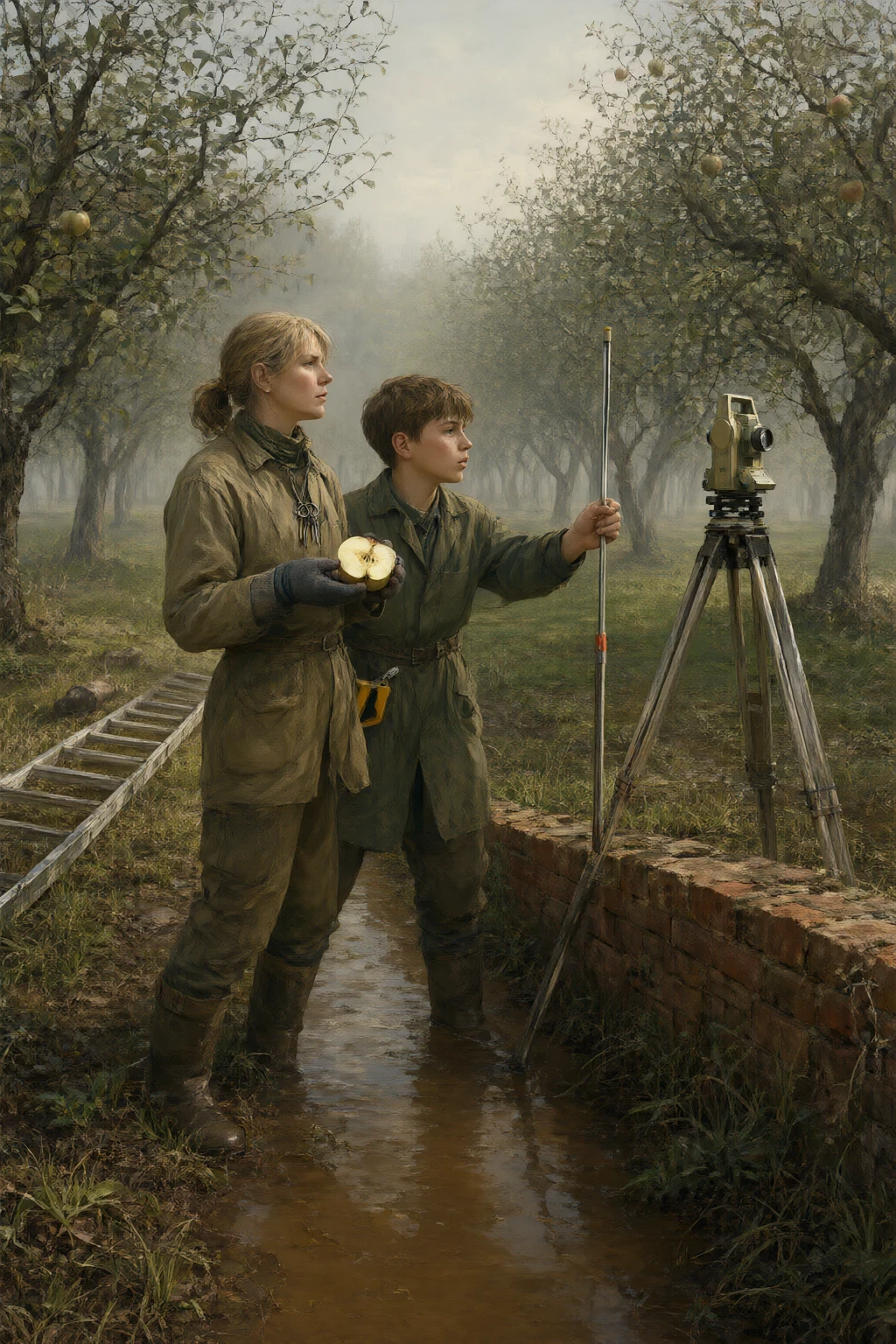
The dispute began, as most disputes on this ground do, with water and a length of string. By the third week of November the fog came up off the river at four in the afternoon and stayed until the second week of December. The pipe-gallery forty feet down sang all day like something being poured into out of sight. In the Fenrows the water stands in the wheel ruts most of the year. That November it stood in them in November. The north row of the eighth block was under six inches of brown water on the first Monday and on the last three days of the month, and in between it drained, and nobody in the district considered this remarkable.
Sennet Bray stood at the head of the ditch with a spade in her right hand and a mitten with no thumb on her left. The mitten had belonged to Millward. The spade was her own. She had decided before she got out of bed that the outfall would be re-cut this year or the east half of the orchard would go into the river. The outfall was a brick headwall set into the ditch bank, four feet by ten, laid in courses nobody alive had laid. An iron pipe came out of it eighteen inches above the mud and turned down into the dark. The last man known to have opened it had died in April, and he had reported that the pipe ran clear for nine feet and then stopped being a pipe.
Sennet wanted a new trench, thirty-eight yards, from the headwall down to the meadow boundary, deep enough to carry what was coming. Her two diggers had pegged it out at first light. Marren Ashlock had walked down to look at the pegging, and had stood in the mud a long while, and had then driven a stake of his own a yard to the left of the line, and had chalked a number on it, and had gone back up to the shed without speaking to anybody. The number on the stake was the eleventh tree of the ditch bank. The stake said, in the shorthand of the trade, that the ground her line ran through was Ward ground. That Thursday she said it out loud in the packing shed, to the register's clerk.
“A boundary,” she said. “Forty square feet of it, four by ten, a headwall and a pipe. I have measured it twice with a bootlace and a bootlace is not a crime. I want the trench and I want it this month.” “Two hundred and six,” said Ottiline Vrey, without lifting her head from the ledger. “That is the number of the entry your trench will want, if it wants one. And nobody asked you to measure it twice with anything.”
The eleven trees of the ditch bank were the only trees in the Rootwork that both families had a document about and neither family had ever cut. Hollis Bray counted them twice on the Sunday because that is what you do with eleven, and because he wanted the number to be his. He walked the bank with the saw in his belt and his boots in the mud and he said each one out loud as he came to it, one, two, three, and the number came out faster than the walking, four, five, six, seven, and the fog was up to his knees in the ditch and the water was coming into his boot tops through the seams. He found a windfall under the ninth tree, small and green and bruises already going brown at the shoulder. He cut it with his own knife, sitting on the bank with his knees up, and turned the halves in his two barked hands, and counted.
Five carpels in a hand. Five in a hand is what a Fenrow Ribston gives you and what a Ward Codlin gives you, and the ninth tree of the ditch bank gave him nine. He sat with that for a while. Then he carried the two halves up to the packing shed in his shirt and put them on the register's table, and Ottiline Vrey looked at the seed and then at him and said, “Nine. And you counted it yourself, which is worth more than me counting it, and I am going to write that you counted it.” “Does nine mean anything?” he asked. “It means that tree is not standing where it is standing,” she said. “It means it is standing on the headwall. Everything under this bank is on the headwall.”
That is the thing about this ground. Nothing grows where it is planted. A tree sends its taproot down past the soil line into whatever is under the soil line, a street or a cellar or a cistern or a flooded nave, and the fruit is the shape of that thing’s influence, and the fruit is a place you can hold. Cut a Rootwork fruit in half and you are cutting open a piece of the address. The ditch bank ran over a brick headwall, and had for a hundred and forty years, and the eleven trees had been reading it the whole time. Nine carpels. Where a Ribston on the ninth row of the Fenrows would show five, and a Codlin on the third row of the Ward would show five, the ditch bank showed nine, and had shown nine since before Sennet Bray was married.
Marren Ashlock kept the Ward Survey in a plan chest in the survey house, and the plan chest held the field books, and the field books for the ditch ran were four, going back to 1826. He laid them out on the table that Sunday night under the bulb, and he did not offer anyone a chair, and the plumb bob came out of his chest pocket and hung and swung a long time before the table was still enough to write by. The Ward Survey described this ground from the west. Its chainage began at a cut stone in the hedge at the west gate, lettered W and S and dated 1826, and it ran easterly along the high side of the drain, because the Ward hedge was set back two hundred feet from the drain when the road was moved in the middle of the century, and it counted off ditch-head at one thousand two hundred and four feet.
The hundredth year of the Ward Survey ended with the frost. That was the whole ambition of the man at the table, and he had never said it out loud to anyone but his own notebook, and the condition attached to it was that it ended complete. Complete meant every strip of the hundred and eleven acres described once, and once only, and every figure traceable to a mark still standing in the ground, and the volume closed, and the closing entry made, and the whole thing handed over finished.
It did not permit a note that might be wrong. It did not permit a note that might be right and might also be a nuisance. A hundred years of chainage ran out of that cut stone in the hedge, and Marren Ashlock was the last person alive who would ever walk the whole of this ground row by row with a tape before dark, and he was not going to close the book on a corner he had not made clean. The Fenrow Survey described the same ground from the east. Its chainage began at a brick in the east wall of the packing shed, dated 1831, and it ran westerly along the lip of the ditch itself, because the ditch was cut in 1831 along the line of an older hedge, and it counted off the same ditch-head at one thousand and four feet. One ditch-head. Two numbers. The difference was two hundred.
He checked it at ten other stations along the run, the nine other trees, the ditch at the lane, the corner of the eighth block, the place where the meadow water joins. At every one of the ten the difference was two hundred feet, to the inch, every time, like a difference in the two languages rather than in the ground. “Noted,” he said, to nobody.
Mirren Ostley came on the Sunday, which was the wrong day for her, and stood at the shed door with a canvas coat on and her left hand shut on a paper docket-book, and looked at the eleven trees of the ditch bank for a long time without coming in out of the wet. “You and me,” she said, “we both know what this tree is worth. Nine carpels. That has not been written down anywhere in the district, and there is a buyer in the county who would pay for a nine-carpeled fruit and would not ask what it grew over, because he is not a fool and he does not need to be.” Sennet Bray put down the spade and came across the yard and stood in front of her. “I know what you buy,” she said. “You buy ground that cannot be read. It is the only trade you have.”
“It is the only trade anybody in this valley has,” said Mirren Ostley, and went away up the lane, and did not open the docket-book, which is a thing she does not do in front of anybody. The theodolite came up from the town on the Tuesday in the back of a hired flatbed, and the two men who brought it did not speak to each other, and did not speak to anybody else either, and set the tripod up in the yard of the packing shed, and went and stood by the engine with their backs to the work. Marren Ashlock set the instrument on the cut stone in the hedge. Sennet Bray stood eleven feet off and watched him do it and said nothing at all, which for Sennet was a considerable expenditure. “Staff on the headwall,” he said. “Hollis, take it.”
Hollis took it. He went down the bank with the levelling staff in both hands, put the foot of it on the brick, and stood there in six inches of ditch water in a pair of boots a size too big, holding the staff dead, in fog, with a man watching him who was his mother’s opposite. “Off,” said Marren Ashlock. He read the staff. He read it twice. He read it a third time because the fog was thickening and he wanted the third one to be the same as the first two. “One thousand two hundred and four,” he said. “That is the ditch-head. Four tenths on the fog. Write it down as two-oh-four and a bit and let the bit be honest.” Then they walked the instrument, unassisted, three hundred yards, and set it on the brick in the east wall of the packing shed, and Sennet Bray read the staff this time, and her hand was steadier than his had been. “One thousand and four,” she said. “Two-oh-four and a bit. The same bit.” “Two hundred feet,” said Marren Ashlock. “Two hundred feet,” said Sennet Bray. “And both of us are right.” “I never said you were not.”
It took them until Thursday to walk the two hundred feet, which ought to have taken a quarter of an hour, because the two hundred feet is not a number, it is a strip, and a strip has to be walked to be believed.
They walked it with a tape and Hollis carried the far end and called out the figures into the fog, and the fog gave the figures back flat and wrong-sounding, and Hollis called them again louder. The strip is bounded on the high side by the Ward hedge, which is a hedge, and on the low side by the Fenrow ditch, which is a ditch, and the two have run two hundred feet apart since the road was moved, and they are both of them the true edge of something. It is good ground. It has never been bad ground. It grows the eleven trees, and the eleven trees bear the nine-carpeled fruit, and for a hundred and forty years two families have mown it, pruned it, picked it, grazed a pig under it in a bad year, and never once put a fence on it, and never once agreed whose it was.
At the place where the hedge jogs, and the ditch bends, and the strip closes to nothing, there is the headwall. Four feet by ten. Forty square feet. And the disagreement is a corner, and the corner has a brick in it, and the brick predates both surveys by an unknown amount. Dellory Fenn came out to look at it at about two o’clock, in a hat that had not been brushed, carrying his tin of drawing pins and a folding rule he never separated. “On the record?” he said.
“No,” said Ottiline Vrey, who had come down without being asked and was standing on the ditch bank with her arms folded inside her coat. “Nothing is going on the record, because there is nothing to go on it. The register says who a tree’s parents are. It does not say where a tree stands, and it has never said where a tree stands, and there is no column, and I am not ruling one out on a Thursday in November because two men brought a theodolite up in a fog.” “I have a column,” said Dellory Fenn. “On paper. At home. Ruled and headed. Forty years old. I have never had anything to put under it.” Nobody asked him what the heading said. He did not say.
They cut the trench on the Friday, in the rain, and Sennet Bray stood in it with the spade and Marren Ashlock stood on the bank with his notebook lashed to his wrist, and neither of them said anything at all for four hours except about the pipe. The instrument laid the new line. That is what the instrument is for. Set anywhere, it will lay a pipe to a brick, and the brick does not care whose survey brought you there, and the water does not care either. At ten feet from the headwall the spade went through a course of brick that was not on any plan of anything, laid flat, a landing, with a step worn smooth in the middle of it, and the whole digging stopped for a minute and a half while four people looked at a floor nobody had written down, and then Sennet said, “It is wet under the north end. It is always wet under the north end,” and they went on.
At half past three Marren Ashlock said the thing he has said six times in forty years. “Noted, corrected,” he said. “The line is yours. Cut it.” Hollis, who had been narrating the whole morning at a speed that had frightened his mother, stopped, and said, “You said noted,” and then, when nobody answered, “you said both of them.” “I said both of them,” said his mother.
They wrote it up in the spring, at the register’s table, with the doors open and the yard noise coming in, because the Register Room is the only room on this ground where people lower their voices and there was no reason for it that morning. What went in the register: the parentage of the eleven trees of the ditch bank, entered on their existing lines, eleven entries, eleven docket numbers, nothing altered. The graft history of that strip had not changed in a hundred and forty years and would not change in a spring.
What went in the Ward Survey: a note in the hundredth-year hand, in Marren Ashlock’s writing, that the ditch-head is at chainage one thousand two hundred and four from the west stone, and that the Fenrow Survey records the same headwall at one thousand and four, and that the two hundred feet between the two figures is good ground lying between the Ward hedge and the Fenrow ditch, and that it is to be described in both books for as long as the district lasts, and that neither description is to be altered to agree with the other. What went in the Fenrow Survey: the same note, in Sennet Bray’s hand, unsigned, dated, and initialled in the corner by her son because she does not sign anything and the block requires a hand. And what did not go anywhere, because there was nowhere to put it, was the fruit.
The ninth tree of the ditch bank came into leaf in April as usual and set in May as usual and was picked in the second week of October in fog, by lantern, by four people including a boy who was extremely pleased with himself. Hollis cut the first one of the pick on the bank and carried it up to the shed and opened it on the register's table under the bulb, and the halves came apart in his two barked hands with a sound like a wet paper bag, and he turned them, and he counted. Six. Not nine. Six carpels in a hand, in a strip of ground that had borne nine for a hundred and forty years, because the new trench had taken the headwall's address out from under the roots and put a fresh trench in its place, and the trees had done what trees here always do, which is to go on describing whatever is underneath them.
“A different place,” said Ottiline Vrey. She wrote nothing. There was no column for it and there was never going to be a column for it, and the two hundred feet was going to be described twice in two books for as long as the district lasted, and the sixth carpel was going to be in nobody's book at all. “Does that mean we did it wrong?” Hollis asked. “It means we fixed the drain,” said his mother. “You will find it wet under the north end. It is always wet under the north end.”