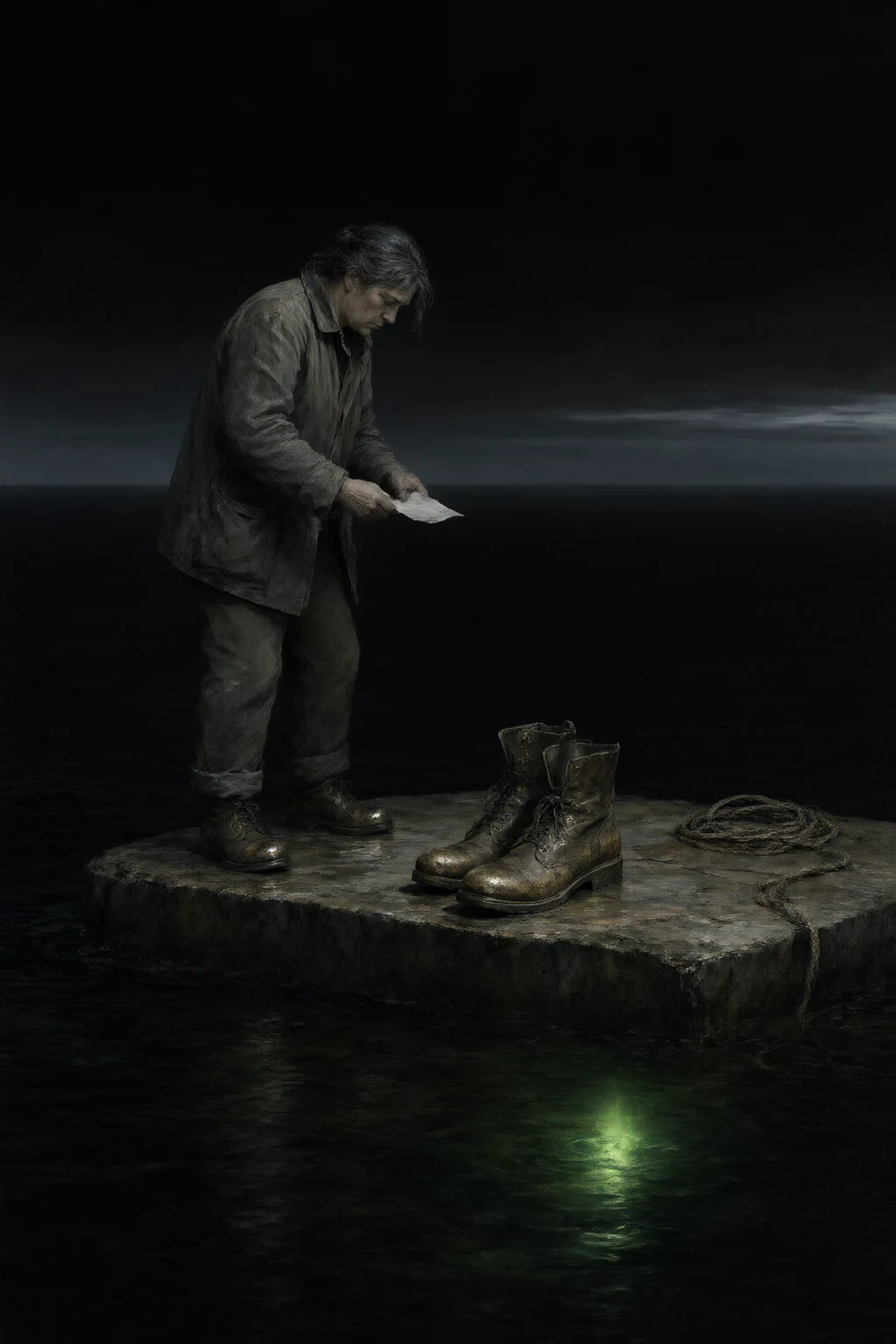
The claim was read out on a Tuesday by a young man with a cold nose, in a room with two benches and a stove, and it ran to four lines, and the fourth was the one that mattered. "In the matter of the estate of Kuzma Grigorievich, deceased, the creditor the Sea claims its principal and all arrears, and does not claim the movables, and offers in exchange the balance of the store held in trust, and asks the heir whether she will have the debt or the movables, she having no power to have both." The starosta of Ozerki looked at the woman in the second bench, and then at the paper. "You understand that. That is not my sentence. I only read what the Sea sends." She understood it. She was forty-one and had kept the salt book for fifteen years, which meant she could hear a sentence like that without moving her face, and so she was quiet for slightly too long. "I want the book."
"He said whether you will have the debt or the movables." "I heard him. I want the book." The starosta sighed, in the manner of a man who has read the same clause four hundred times, and told the clerk to fetch the sea-book, and the clerk said it was not in the room, and the starosta said that it never was.
Her name was Avdotya Kuzminova. She was the daughter of the fisherman, and the reason she could read was that the Sea had insisted on it, in the only communication it had ever sent her, in a strip of grey paper folded in four, carried by a boy who would not say who had given it to him: The estate requires an heir who can read. The estate is not patient. She had been seventeen, and could read, and had learned out of a psalter with the saints cut out by somebody's knife. Her mother had gone to the mainland in a timber cart when Avdotya was two and had not come back and had not written, and Avdotya had decided at eleven that the story the village told was the same as the silence.
Her father married Matryona when the girl was four, which was the arrangement of the household: a girl with no mother, a wife with no girl, and a man in between who was not a man of great decision. Kuzma went to sea in weather his brother would not go out in, and had never in his life asked for anything for himself. He came in from the bar one Tuesday in the autumn of his forty-first year with a fish in the net that was not a fish, and sat on the shingle in his boots and could not get up. It was the length of a forearm and it was gold, all of it, and it lay there the way a hare lies in a snare, and its eye was the eye of a fish, and it was looking at the house. Matryona came out and stood over him. "It is alive." "It is alive," Kuzma agreed. "Then take it. We have had a bad year and there is gold in that net."
He shook his head. He was not refusing. He was gathering, in the manner of a man who has run out of small decisions and must make one large one. Avdotya watched him look at the gold thing, and at the roof, and at the boats, and understood that he was calculating, and she was right. "It spoke to me," he said. "It said a thing. I am not going to tell you the thing, and I am not going to say the thing, and if I do say it, then I will be done for, and you will be a widow's bread, and the girl will be on the mainland by Tuesday." "Father." Matryona's voice was perfectly level, which is how Avdotya learned that people are about to be terrible. "Whatever it said, say it to nobody. Say it to me. Say it to the wall." He said it to the wall.
The sea at Ozerki has a shelf in it that the water goes over at a spring tide and does not go back over until the next spring, and the shelf is flat and about the size of a threshing floor, and on a still evening you can see what is on the bottom of it. "I will give you one clear answer, and I will give it once, and you will not have a second, and I will not be caught a second time. Ask." He stood in a foot of water with the net rolled on his shoulder and thought about his life, which was short and had been made of a great many small refusals, and the goldfish waited, glittering on the bottom, and did not hurry him. "Then my wife shall sit at a table and be served. Let Matryona be served at table and let her be told what she is." "Say the form."
He said the form, because a fisherman of Ozerki cannot say a thing and not say it exactly, and the sea heard it and wrote it, and the goldfish went down into the green, and the tide went out, and Kuzma walked home with an empty net and a household that had changed. What nobody in Ozerki understood for a year was that the Sea is exact in a manner that is not moral. It granted the wish. It had Matryona served at a table nightly for the rest of her life. And it charged the whole of it, in full, at four in the hundred, compounded, to the man who had asked. And it took payment in the only currency Kuzma had, which was wanting. From the night of the shelf onward he was not permitted a single thing he might otherwise have wished for.
It began so quietly that Matryona did not see it for most of a year, and by then it was the shape of the house. He ate last. He had always eaten last; now it was not modesty. He was not permitted an appetite in advance of the table, so he sat with his hands on his knees through the first half of every meal while the smell of the onions was a thing he was not allowed to want, and he was a man who had liked onions. His boots went at the heel that summer and he did not look across the road at the leather merchant's stall, which was the price of a pair that would have held a year. In the doorway one evening, with the plate in her hands, she said: "My father. You have not asked for anything. In eleven years. I have been counting." "There is a price on it." "I do not mind the price." "That is what it is like," he said, and went out. And the not being able to explain it was the clause, exactly, the way a nail is the clause in a board.
The claims came in a year at a time, and Matryona learned them the way other women learn the phases of the moon. The first was a wish, out loud, in her own voice, before a witness, with her husband standing there with the firewood in his hands to prove he had asked for nothing: that their daughter be got a good match, a decent man, not a drunk, and a dowry. It cost him. The girl was fifteen and had been, that year, the happiest person in Ozerki, because she did not know. What was taken out of him was not her. It was the whole interior of him in which he might have wished his own daughter a better thing, and Kuzma was not permitted any of it.
The second was a season later and was worse: a muzhik, a great rich muzhik. Because a nobleman is one step above us, she said, and a muzhik with forty oxen is one step below a nobleman, and one step below is nearer. The third was a boyar. The fourth was a king, and by then Kuzma was forty-five and had not had an unbidden thought since he was forty-one, and the sea granted a king, and the sea was quiet. The fifth was that she herself would be empress, and that Kuzma would be the sea's equal, and would sit in the waves, and the waves would obey him. He said the form, because he had to; and the shelf did not answer, and the water went on moving over the flat stone the way water goes on moving over a flat stone, and then the green below the shelf lit up, and the goldfish came up, and it did not come slowly. "Say the form again," it said, "and hear what a thing is."
He said it, and it said: "Every word a man says after the form is a term, and every term is set against what he has not had. Sit down there and want nothing, Kuzma, until there is nothing left in you to be taken, and then come and ask me again, and by then I will not owe you an answer." He came ashore. There is no line of that conversation in any book, because there was no answer; a refusal is a term, and terms are added.
She went down to the shelf in the morning, and every morning after that, and she said her wish, and the sea did not sell it, because the sea does not deal in what cannot be sold twice. It is not that she was refused. It is that the price of an empress was a man who could still want, and Kuzma had nothing left in him to be taken. The condition it set her was not a punishment. She had asked for one clear answer and the sea had given one, and this was the answer: sit on the shelf until you have no use for wanting. She sat on the shelf for eleven months.
They found her sitting up, which the villagers made much of afterward and Avdotya never repeated. They buried her above the tide line, because the ground there was sand and would not take a coffin. Her father dug the hole himself, badly, with a spade cracked in the shoulder of the blade, and nobody helped him, because he was not a man that people helped. When it was finished he found that he had nothing to put in it, and Matryona's people sent bread, fish, and forty kopeks, and he could not put the kopeks in the hole, so he put them in his pocket.
The statement below is transcribed from the fourth book of the Sea's account for the coast of Ozerki, and is given as it stands, without the clerk's ornament, which is a flourish and was cut from the copy. From the day of the shelf, the first year: a chair, a high back, a wage of six kopeks a month to the neighbour's daughter, and four kopeks for a cloth to the boy who carried the water. Second year, a dowry, entered at eleven oxen and a good hammer, being the price of a match, and against it the interior of a man, entered not in weight but in items, there being no other way to write it down: the wanting of a warm house in the first winter, the wanting of his daughter's health, the wanting of a full belly, the wanting of another year, the wanting of a boat with a sail.
Third year, a muzhik, entered at the value of a rich peasant, and against it the wanting of a muzhik, entered separately, and the more expensive of the two, the reason being a matter of form. Fourth year, a king. The largest single entry in the volume. Fifth year, a refusal, entered at its full value, which is the value of what was asked and not given. The column is even. No person was taken and no person paid and no sea calmed. Sixth year onward, the account stands. The creditor does not press. The creditor is the Sea, and the Sea is not pressed, because the Sea has never once wanted.
In respect of the fifth year the seaward side of the balance is level. To the landward side the creditor holds a claim in the currency of the debtor's whole unspent remainder, where the remainder is the entire life of the debtor from the day of the shelf forward. It is not discharged by death, and it does not pass to the creditor, because the Sea does not want, and what the Sea does not want the Sea holds in trust for whoever stands in the debtor's place. Against the trust there is one condition, entered by the Sea's own hand, which has never been accused of anything: the heir may not hold the store and disown the claim. He who has the store has the debt. He who disowns the debt has not the store, and the movables of the estate are then seized. Eleventh year, the debtor dies.
There is no entry of his death in this column. The Sea entered the fact of it elsewhere, in the shore book, under the low tide, in the ordinary way. The two books are not the same book, and the Sea has always refused to say which of them is the real one.
The salt book is kept at Ozerki because the district once farmed the salt pans, and it is large and dull, and it has four columns: the day, the seller, the weight in buckets, and the deficit. Avdotya had kept it fifteen years. She could tell at a glance whether a figure had been altered and put back, because altered figures always went back with a wider nib. She was in the volost court with a transcript open on the second bench, and it was not the sea-book; it was a copy made by a woman in another district at Avdotya's expense, copied without ornament. "You are not looking for an error," the young man said. He was not unkind. He was new. "I am looking for an error." "There is no error. The Sea does not make errors. That is the whole of what the Sea is."
"He makes one," Avdotya said, "and he has made it four hundred and eleven times, and he makes it in a manner that is technically correct, which is why nobody has caught him. Bring me the volume on Thursday. If the Sea is a creditor it is bound to produce, and if it is not, your four lines are a libel." The clerk looked at the starosta. The starosta looked at the stove. "Produce it," he said. On Thursday she found it on the eleventh page, in a sum carried forward for four centuries: the Sea compounds at four in the hundred, as everyone understood, but it compounds the arrears as well as the principal, and the arrears are themselves compounded, so that it charges interest upon interest upon interest, every year, for ever. That is not a rate. It is a rate a man sets in a stable when he wants a horse to run.
She did the sum on the back of a salt delivery note, and she did it twice, and both answers came out at the same figure, and the figure was small. Not nothing. Small. "You have understated your claim eleven times over. The Sea is a creditor and cannot understate, and a creditor who understates has admitted a payment, and an admitted payment stands whether anybody likes it or not. I do not want the eleven. I want it read out." They read it out. The starosta read it twice, which he had not been required to do.
The Sea was content, and that was the part nobody at Ozerki believed and everybody in that room understood. It did not contest the sum; on the fourth day it sent a strip of grey paper folded in four, carried by a different boy, who waited in the road until Avdotya came out and read it standing. The principal is adjusted. The claim is reduced to nine kopeks, which is less than the cost of the sea-book, and is discharged. Your father's net, his hut, his skiff, his boots, and the eleven kopeks, are yours. You may have them on the eleventh day. Bring nothing to the shelf. Do not come to the shelf. The store is discharged, and the store was discharged against you, and you were not obliged to receive it, and it is discharged. She stood in the road with the paper in her hand for some time.
The Sea, which cannot lie about a figure, had told the truth, and the truth was that the debt was a straw and the nine kopeks were the price of a straw, and that the Sea had discharged nine kopeks' worth of a life, because the life had not been in the account any more. It had been in the store, in trust, since the fourth year; the account was a mechanism for drawing down the interest, and when the interest was wrong the interest was small. Avdotya had found an error in a four-hundred-year-old sum and had been paid nine kopeks for the rest of her life.
She went down to the shore at night in the last week of that month, and it was the wrong thing to do, and she knew it was the wrong thing to do on the road down, in the manner of a person who knows that a door she is walking toward is going to close on her. The sea was flat. The shelf was under two feet of water and the tide was on the turn, and there was no gold anywhere in it. "You have discharged it," she said. "I do not want to dispute a discharged thing. I would like to know what a discharge is, since nobody at Ozerki will write it down for me." The water made a sound like a man clearing his throat in another room. Then it spoke, in the voice she had heard twice, from below the stone and not from anywhere near her.
"It is this. A man leaves behind him the whole of what he did not get. You cannot give it to a child; there are years in it. It can only be spent, and only by the one it was, and only on what it was made of, which is wanting, and there is not one of those in a person but what a person can do with a winter." "And if I do not spend it." "Then it stands in trust, and the Sea holds it, and the Sea does not want, and it will be there after you, and after that." "So I have to." "You have to. It is not a punishment. It is only a shape." She stood on the stone. The sea waited with the flat patience of a thing that has been owed nothing for four hundred years and is in no hurry. "Does he know," she said. "Does he know it is here." "He was told at the time. He could not want to know. That is what it cost."
Avdotya Kuzminova, forty-one years old, keeper of the salt book, took off her boots and set them on the stone, because she had watched her father do it and had never understood why, and stood in the flat water up to the knees, and made herself want, deliberately, the way a woman lays out a row of things on a table, every single thing she had wanted at eleven and put aside. The wanting of a mother who came back on the cart. The wanting of a house of her own with a door that shut. The wanting of a man who would ask her to leave the district, and be answered yes. The wanting of a second helping, of a pair of new boots, of somebody to say a thing to at the end of a long day. The wanting of a child, and of not having a child, and of a singing in the hut, and of a cat. And the sea took it, the way a clerk takes up a pen, and did it in order.
A boy who had come down to cut bait found her on the shelf at first light, with the tide going out and the water off her, sitting up with her hands open on her knees in the cold. She got herself off the stone and up the shingle on her own, and he did not offer to help. Her father's hut was still there. The net, the skiff, the eleven kopeks. The door stood open on its hinge, and on the frame there were marks, cut in a year when there had been nothing to cut with but a kitchen knife: two hundred and eleven of them, in the deep flat notch of a man counting something he had never told anybody what, cut close together from the sill to the lintel. She had known about the marks all her life. She had never counted them.
She put her hand flat on the wood at the level where a child of two would have stood, and her hand went to the same place without her telling it to, and it was no longer a hand that went to the bottom of it. Behind her the light came in along the floor, and the last of the marks was at her own height, and above it there was another, and above that another, cut by a man with a knife, in a year, with nothing to put in a hole.
On the sixth day she took the sea-book to the volost court and asked the clerk to enter the discharge, and the clerk said the form required a manner of satisfaction, and she said the wording was in years, and he said he would need it from somewhere, and she said that it was the wording, and he wrote it. It was the shortest line in the volume, and the line read: Claim of the Sea against the estate of Kuzma Grigorievich: discharged in full, of the whole of the remainder, in years, at the rate of one to the one. Witnessed: the fish. Underneath it, because the form required an accounting of what the creditor had taken, he wrote the amount, and then he stopped, and asked whether it was to be entered in the ordinary column or the other one, and she said the other one, and he put a single mark in it, and the mark was a stroke straight down, and it is the only stroke in the salt book that is not a number.