Once a year the Well Court draws at all nine collars and looks at the water, to certify that no well in the parish has gone to salt. It is the oldest routine in the book. It was entered on the first page, in the year 1841, in a hand nobody now living could be traced, and it has been carried out on the first Thursday in February every year since, and it has never once found anything. The check is done with nine glasses, one for each collar, and the nine glasses are carried in from the wells in a flat basket and set in a row down the middle of the long table in the tithe barn, and the court looks at nine glasses of water. It took four men most of a morning in February and nobody resents it, because after a morning there is a fire and a matter to argue about. What the check is looking for is a taste. A well that has gone to salt tastes of it, and it tastes of it in a glass within a minute of standing, and a man can be got to the first house on the track to taste a glass out of his own butt and will say so. The court simply looks. On the first Thursday in February of the year after the boy was named, the ninth glass had a line in it.
Not a taste. The court put the ninth glass to four men in turn and none of them found salt and one found a taint of something he could not name and would not be pressed on it, and they were about to go on to the next item when Micken Vaunt, who had been in the room for an hour without being asked to be, said: “That is not a taste.” “Micken, the court is not—” “It is not a taste,” the boy said. “It is a ring.” And he was right, and it was visible to anybody who put their thumb in it: a line round the inside of the glass about an eighth of an inch above the water, dull grey, and above the line the glass is beaded and below the line it is clear, and the water underneath the line is a degree and a half colder than the water in the eight glasses on either side of it.
The eight other glasses were sound, and the court went over them again out of order to be sure. Then Nell Drury had the ninth glass carried out to the yard and set on a flat stone in the shade and left there while she made an entry, and after twenty minutes the ring had gone, and after ten more the water stood level with a glass filled from the same well, and there was nothing on the stone at all. “Then it was the glass,” said somebody at the back. “It was not the glass,” said Micken Vaunt. “It was the water. It has just gone out of it, that is all. It does that.” “How long have you known that it does that?” “I have not known anything about it,” the boy said. “I have never been in the Sluice Well.”
Here is what the girl did, and it took her four minutes, and it is the whole reason the rest of this happened. Bess Brack was sixteen, carried four pails a day up the Fen Track, had blue at the nails permanently, and looked at a surface before she looked at a face. When she came back into the barn she did not go to the table. She went down the row of glasses and put the flat of her hand on the side of each one, the way a person feels a wall going along it in the dark. “That is strange,” she said, at the seventh. “Which one is the seventh?” “The seventh is the Sluice Well and the eighth is the Gleaners’ and the ninth is the Sluice Well again.” “It is not the Sluice Well twice,” said Nell Drury. “The basket goes out in the order of the book. Nine collars, nine glasses, and the basket comes back in the order of the book.” “Then the court has been drawing at the Sluice Well twice for a hundred and eighty-four years,” said Bess Brack, “and not once at the Blind, and nobody has ever noticed, because the Blind is the best water in the parish after the Bent and a glass of the Blind looks like any other glass.” Nobody had noticed, because the ninth glass had been the ninth glass for a hundred and eighty-four years, and it came from the Sluice Well, and the Sluice Well is a well nobody uses, and a well nobody uses is a well nobody asks a second question about.
The salt check was abandoned at twenty past eleven and the court sat with its doors shut and did the other thing, which was the thing it had to do and had been putting off since the boy said ring. The parish book has two columns for a bond. One is headed with the well. The other is headed with the holder. The second column is the oldest thing Nell Drury has. It is the column that made the book worth keeping, and the parish had never once had cause to doubt it, because the two headings are the two halves of the law: a bond is spoken at a wellhead, it binds the water of that well to the speaker, and the speaker therefore holds the well. A person opening the book reads those two headings and understands the whole country in a second. And the second column is filled in with the name of the person who spoke.
That is not an error. That is a consequence. A bond is entered when it is spoken, once, and the book has a place to enter the name of the speaker and no place at all to enter anything else, because a bond transfers only by the bonded person, freely, to somebody who touches the collar with both hands, and no third party can move it and no court can move it, and a transfer made under fear is a transfer that does not hold. A transfer in this country requires two people standing at a collar. There is no register of transfers in the parish of Coldwick because there has never been a need of one. The parish has recorded where every claim began for a hundred and eighty-four years and has not recorded where nine of them ended. “Then they are all wrong,” said Gideon Sparre. He had come up from Sallow on the Tuesday and had been in the room since eight, and he had said almost nothing, and he was a bailiff’s clerk of the sluice house and had been in the parish three months. “Not all wrong,” said Nell Drury. “Eight. At the outside, eight.” “How do you arrive at eight?”
“Because there is a second thing,” said Nell Drury, “and it is that a well cannot be forced. Every person in this parish knows a person can be got to do a thing by standing near them, and every person also knows that a thing done under that is not a thing. It is in the water. You cannot force a well. So a claim on a well is a claim that was set up by somebody who was not frightened, and the record of it is the wrong end of it.”
They did the work in the barn over two days and the fire went out twice and was relit twice and nobody noticed. The method was Micken of the Third’s method, which the court wrote down in November and put on the wall. Water drawn by the person named, at that person’s own well, in a vessel rinsed out of that well, with the person standing in it alone, the figure spoken aloud before a witness, entered as spoken. Nine wells. Nine lists. For each collar, the people bonded there. The book gave, for each collar, one name. Eight of the nine lists came back longer than the book. In six cases they were longer by one. In two cases — the Blind and the Gleaners’ — they were longer by two, and the extra names were people dead between eleven and thirty years, which is what a list of the bonded at a well looks like when a well has been drawing from the same four families since the century turned, and nobody could say which reading of those two was right. The court entered both and marked the column disputed, which is the first disputed mark in the book since 1841. But it was the third list, the one from the Sluice Well, that stopped the work for the rest of the day. The Sluice Well carries nine.
Nine names, spoken off the Sluice Well’s own water, standing in a vessel rinsed out of the Sluice Well, on the first Thursday in February, in a thatched barn, to a clerk of sixty-six who wrote them down in the order spoken and read them back. Nine names. The book records one bond at the Sluice Well, spoken in 1802, and the speaker is a man called Peter Rill, who was forty-one at the time and is dead, and the book has carried his name in the holder column for eighty-three years in a fair copperplate hand with no comment on it. “Where are the other eight from?” said Gideon Sparre. “They are from the book,” said Bess Brack. “All of them. I have checked them twice against the page and they are all on the page, and every one of them is a holder of something, and not one of them is a holder at the Sluice Well.”
The laying-out of it was done in chalk on the chalk flags of the barn floor, and it took Nell Drury, Hester Colm and the boy the whole of the second afternoon, and Gideon Sparre stood over it with his boots well clear of the chalk. Each name on the Sluice Well’s list was a person who, according to the book, held a claim on some other well in the parish. Six of the nine were themselves bonded at a well: the Blind, the Long, the School Well, the Gleaners’, the New, and the Bent. Two of the nine were bonded at two wells apiece. One of the nine had died in 1871 and was entered in the book twice, in two different years, at two different wells, and was the speaker of the oldest bond in the parish. The Bent was the one that got the room. Hester Colm, who had been in the court since nine and had not sat down since the first hour, as is her habit, said: “Not the Bent.” “The Bent is in the list, madam.”
“It is not in the list of the bonded,” said Hester Colm. “It is in the list of what a well is owed, and the two lists are not the same list, and that is the whole of what you have all been doing to each other on that floor for two days. And the name against the Bent has not moved in a hundred years, and it has been given away, and a thing that has been given away has not moved. It has been taken. That is not the same word, and this court has not got a column for the other one either.” “Then you will forgive me if I read the list again.” “Read it again,” said Hester Colm. “Blind. Long. School Well. Gleaners’. New. Bent.” “Who wrote that?” “He did,” she said, and nodded at the boy. “And he is eleven, and he has had nine of them stand one at a time in their own pails of the Bent’s water this afternoon with the court at the collar, and he is right, because he has been right about everything since November and the only thing he has ever done wrong is a duck.”
What the chalk showed, when it was finished, was this. The Sluice Well is owed to nine people. The book says the Sluice Well is owed to Peter Rill, who is dead. The water says otherwise and the water is the older authority and has never once been asked. Each of the nine is owed something further on. Six of them are themselves owing water at another well in the parish, which makes them a creditor in one place and a debtor in another, and the court had been carrying the two facts in two different columns of a book for eighty-three years without ever putting them on the same piece of floor. So the nine were followed out, and each ended at a person who owed nothing to anybody. And the nine ended at the same person. It is not a complicated thing. Nell Drury did it twice, and the second time with the book shut. Six chains of two. Two chains of three. One chain that ran Blind to Long to the Sluice Well and back to Blind, and had to be broken by hand because a chalk line cannot cross itself, and was broken. Nine wells. Nine claims. Nine chains. And at the end of every one of them, the same name, or the same absence of one. “Then it is the parish,” said somebody at the back.
“It is not the parish,” said Nell Drury. “The parish is not a person. That is the entire finding. A claim can only be held by a person. A person may bond only what they have, and the well is the judge of what they have. A person with no household and no draw and nothing to apply water to is not a person the well judges to have anything. There is nobody in Coldwick-under-Fen whom the nine chains can end at except one, and he is a piece of the parish’s water, and he has been the end of every chain in this country since before the book was started.”
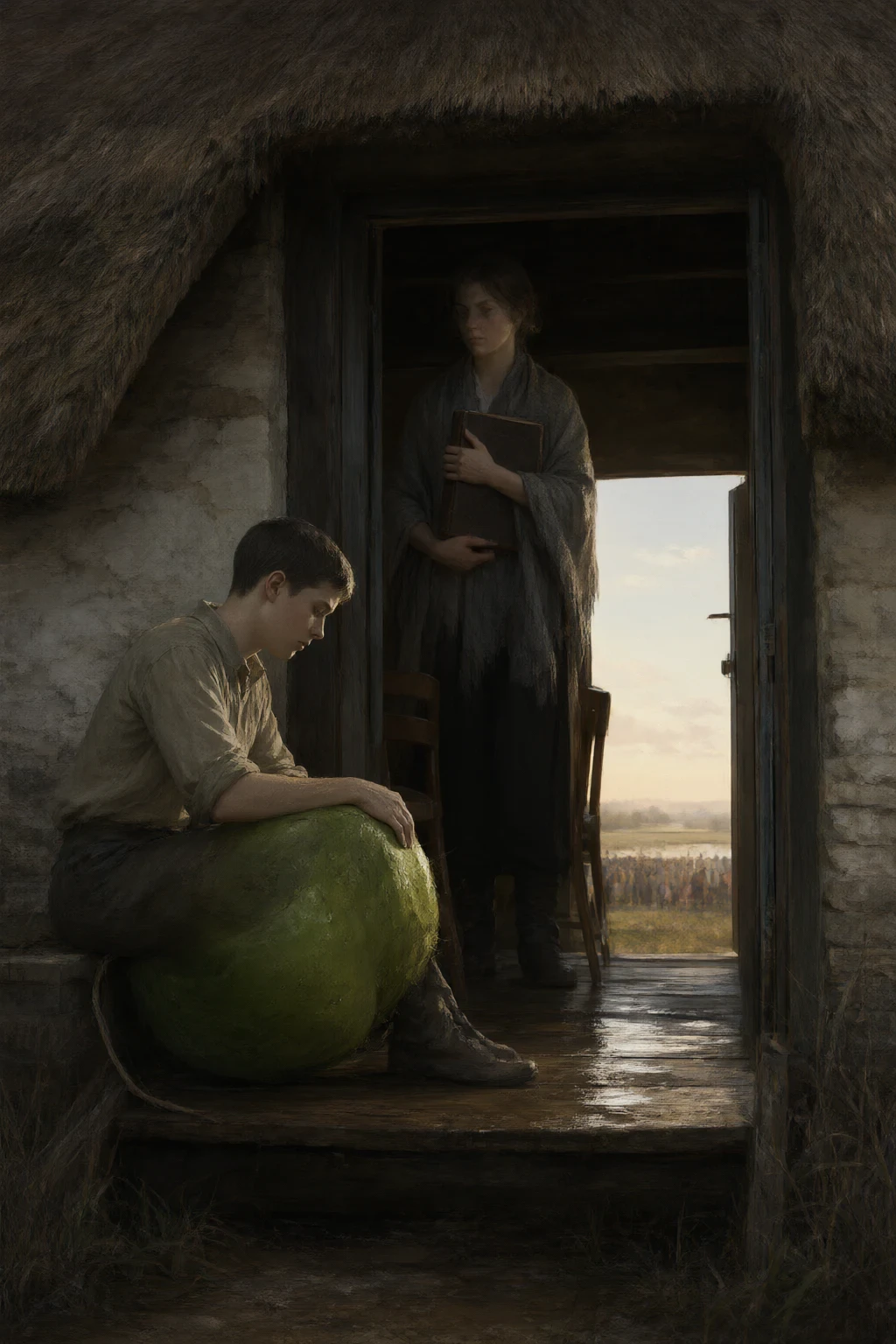
They got him up on the Thursday. That is the phrase the tithe barn minute uses and it is Nell Drury’s phrase and she has never corrected it, because he came up, and because he was brought. He came at about four in the afternoon, out of the Third, nine hundred yards from the barn, and he came along the track on his own, because nobody in Coldwick has ever been able to make a thing come from anywhere. He is green. He is the size of a large turnip and round rather than long, and he has a cough that goes on for a count of about nine and then stops, and a very good memory, and a name he has not used in front of anybody since 1871, which Nell Drury entered on the seventeenth page of the year under the heading for the holder of a bond, in his own spelling, having been given it by him without being asked, on a stone by the water-cut at half past two. He got up onto the duckboard and sat down on the step, in the light, and about ninety people looked at him, and nobody in the barn was afraid of him, and Gideon Sparre, who was the only man in the room who was, put his hand on the chair in front of him. Nobody had ever asked him anything. It took the clerk four years afterwards to write it down in the way she writes things down, which is: “No question of this kind had ever been put to him at any time in the history of the court, and the court finds that it is to its own shame.”
The court sat with him on the step and the doors open and the stove lit, and it took until dark. Gideon Sparre put the first question, because it was his question and he was entitled to it, and it was the right one. “Did you take them?” “I do not know what taking is,” said the thing. “I have a bad cough. I will not be long. Ask me the question you have.” “Then I will put it plainly. Nine claims on nine wells, held by a person with no household and no draw, and I am asking you whether you took them.” “Yes,” he said. “In nineteen years I have never heard a parish admit anything at all and I am certainly not going to be the man who objects to one. I am asking you how.” “They were given to me,” he said. “That is the only word. I did not ask for them and I have never asked for them and I cannot give them back, because a thing that is given in this country is a thing that is not given back, and that is not an opinion, it is the law, and I have read it as well as anybody because I have been in the water of the Third since the day I came out of it and I know what is said over me.” The room was very quiet, and Hester Colm said, from the back: “Then nobody can take them off you.” “No,” he said. “And I have never said no.”
That was the sentence the court spent a fortnight turning over, and it is worth setting down exactly, because the whole of what follows is in it, and because nobody in the tithe barn understood it at the time. The kiss is a transfer. It is the oldest and the quietest, and it moves a bond without a word being spoken, and it cannot be refused by a person who has not already said no out loud and in advance, which is why nobody ever thinks to. Nobody ever thinks to. That is the sentence in the rule. Not a prohibition. Not a defence. A thing that is in the world and that nobody ever brings into use, and the reason nobody brings it into use is that it is a good rule and a good rule is a rule you never have to think about. A transfer requires two hands on a collar. A kiss requires nothing. In a parish where a widow dies, or a man goes to sea, or a child is sent to a household on the other side of the track, somebody in that household will put their mouth on the person they are taking the bond from, and the bond will move, and there will be no record, because a kiss is not a document and cannot be and is not meant to be.
For a hundred and eighty-four years the parish of Coldwick-under-Fen has been transferring its bonds by mouth, in kitchens, on the day of a funeral, in the middle of the worst thing that has ever happened to anybody in the room. And the protection against it — the one protection the law has, and it is a real one, and it has worked for a century — is that the person receiving must say no, out loud, and in advance. Nobody in the parish had ever thought to make him do it. Not out of cruelty. Nobody knew it was needed. He has no household, no name in use and no part of the day; he lives in the water of the Third and has been in the water of the Sluice Well on a Tuesday for a hundred and twenty years, and a boy of eleven has known that since he was five, and has never mentioned it, because it was not his. And so: for a hundred and twenty years the parish of Coldwick had been giving its wells to the only person in it who could not refuse, and the reason it never had to be sorry about it was that it was legally incapable of being sorry about it. The law had held for a century on a person who had never been asked, and every transfer was free, and every transfer holds.
“What has to be done,” said Nell Drury, “is that you say no.” The green thing on the step of the duckboard considered this for a while, and the cough went on for a count of about nine. “No,” he said. The room did not make a sound. Hester Colm, at the back, put her hand on the side of the stove. “Will you say it again.” “No,” he said. “Out loud, and in advance, and I have said it now, and it is done, and from this minute nothing may be moved onto me by anybody at all, including me.” “That,” said Nell Drury, “is the whole of what I came out here for. Do you understand that you have just made yourself the only person in this parish who cannot be given anything, and that I have done it to you on purpose, and that I did it in a room?” “Yes,” said the thing. “You have made me safe. It is late. I will tell you what I am owed, since you have not asked and I have been waiting a hundred and twenty years to be asked.”
What he was owed was nine wells, and then he gave the account. It took from about half past four until the fire wanted doing. He gave it standing on the step, in the light, in the flat voice of a boy stating a fact about a bucket, and it was the only time in the history of the Well Court that a witness was permitted to speak for two hours without being stopped by the chair, and it was permitted because he would not stop and the clerk would not let him. It was not a memory of events. It was a figure for each of the nine, with the well, the date the bond was spoken, the person who spoke it, the person who passed it, and the kitchen. Three he could not date closer than a season. Two he gave with a name that is not in the parish book, and the clerk wrote it down and did not query it, because the clerk does not paraphrase and does not query. One — the Sluice Well — he gave as 1802, Peter Rill as the speaker, the passing done in the yard of the almshouse at Sallow on the day of a burial by a woman whose name he gave in a form the book had never seen, and Nell Drury entered it in the form he gave it.
Two of the nine he could not give a day for at all, and said so, and said that the water of those two had been in the Sluice Well since before the parish had a book and that he would not put a year to a thing he had no year for, and the court entered no year. At the end he gave the name of the man who had witnessed the bond spoken at the Third Well in the summer of 1871, which is the bond that is not in the book, because the clerk of that year could not enter a speaker who had no name to enter, and wrote instead, in a hand nobody now living could be traced: “the Thred — a bad sumer — witn. J. Vell — no name given.” “That is you,” said Nell Drury. “That is me,” said the thing. “I said it. I have never been able to say it again, because a bond is spoken once and cannot be withdrawn, and I said that one in a bad summer when I was not yet a person, and the man witnessed it because he was the only one in the water, and he wrote down that there was no name, and he was right. The book has been right about me for one hundred and twenty-four years, which nobody has ever thanked it for.”
The session was held on the first Thursday in March and it began at ten in the morning and finished at about nine at night and it is the longest single sitting the tithe barn has ever had. The court adjourned to the collars. The court rises, the men follow, the business is done standing at a collar, and the court comes back in, and nobody could give a precedent for it in four hundred years. It was done eight times. The Blind is four hundred yards off and the Gleaners’ a mile and a half, and the Sluice Well is off the track altogether and takes twenty minutes in a cart, and the court did the eight in the reverse of the order of the list. And on the chalk floor of the barn, before anybody left, nine pails came in. Nobody ordered them. They came up the track in a line, one after another, about ten minutes apart, and they were full, and each was from a different well, and they stood along the north wall under the eave where the roof does not drip, and everybody in the room understood what they were before anybody said a word, because it is the oldest thing in the parish after the stove.
Water drawn under a disputed bond appears in the pails at the Thursday. The well cannot be blamed and the defendant cannot be hidden, because the pails are the evidence and the pails come from nine villages. So the barn had nine pails of water standing along its north wall for eleven hours, and the floor is chalk flags, and chalk flags take water. By the middle of the afternoon there was about an inch of it across the middle of the floor and the feet of ninety people went in and out of it all day, and the fire had to be built up twice, and nobody opened the doors, because opening the doors is what you do when the weather is in your favour.
A release is not a discharge, and the court was at the two collars with that on the second morning, and it is worth being exact, because the whole of the day’s work turns on the difference, and the difference is a night’s work and a salt well. A discharge is done by naming the thing owed, out loud, at the wellhead, and the well hears it and the claim ends. And if you name it and are wrong about it, the well accepts the false discharge and takes the fine instead, and the fine is the whole amount twice over, in water, in one night, and there is no court in Coldwick-under-Fen that would let a person say that word. Nobody said the word. There was a rule about it and the rule held for eleven hours, and twice somebody started to and was stopped by somebody else, and one of the two times it was a woman of eighty-one from the Long, brought in a chair, who said, “I am not saying that in my house.”
A release is the other thing. A release is a holder giving up a claim. It is not a promise to owe and so it does not have to be spoken at a wellhead, because speaking at a wellhead is what makes a bond and a release is the opposite of a bond. It has to be made at a collar all the same, because a collar is the only place in Coldwick-under-Fen where two hands mean anything, and it has to be made by the holder, freely, and a thing done under fear does not hold. Eight collars, in the order of the list, which was the reverse. At each one the thing was taken to the collar in a cart and got up onto the duckboard that goes round the windlass and put both hands flat on the dressed chalk blocks, and the clerk stood behind it with the book open for the first time in her life in front of ninety people, and it named the well, and said that it gave up the claim it held on that well, and said that it gave it up freely, of its own motion, having said no first, out loud, and in advance, on the fifteenth of February, in this barn, before ninety witnesses. And the crowd did the thing that crowds do. On the fourth collar, the Gleaners’, a man at the back said, loudly, in real bitterness, that the whole business was a robbery of his grandmother, and Nell Drury did not stop him, and the man’s own wife took his arm and said, “Now leave it,” and the release held. The last of the eight was the Third.
There is no ninth collar. The Third Well’s bond is not in the book. It was spoken in 1871 by a person who was not yet a person, and a bond spoken once at a wellhead and witnessed cannot be withdrawn, so it is a bond, and it is valid, and it binds the water of the Third to a green thing with a bad cough who has sat on the lip of it since 1871. And the book has no entry for it. And the claim on the Third is held by the thing. And the thing is not holding the Third — the thing is in the Third, in the only sense the word has ever had in this parish, and a man does not give up the ground he is standing on and go somewhere else. Which is the whole of the ninth, and the court had known it by half past two on the second afternoon, and had gone on doing the eight because the eight were the eight. At four o’clock on the Thursday he asked them. Rule three: whatever lives inside a bond is a person. It will have a name, a temper, a cough, and an account. It cannot be drowned, trapped, or disposed of, and it will ask you, in the end, what you are going to do about it.
He had been given an account and a name and a table for two hours and a fortnight to say no, and what he asked was not about the Third. “What are you going to do about the wells I have just given up?” And the court did not have an answer ready, and Gideon Sparre, who was standing at the back with his hat in his hand for the first time in six weeks, said afterwards that he had never in his life been so glad to be the wrong man in a room. There were four answers on the table by dark and two of them were ruled out inside a minute. It could not be a bond. A bond binds the water of a well to the speaker until the debt is paid, and it cannot be withdrawn, and the parish had spent two days taking every promise it could out of its nine wells and had no intention of making another, least of all one it could not take back. It could not be money, for the reason it was never money: a claim is paid in use. A man who bonds a well for a crop discharges it by growing the crop. A hundred and twenty-four years of keeping an account is a use, and it is the use this parish has been getting from one person since 1871 without once naming it, and the clerk said so in about nine words and the room went quiet again. And it could not be nothing, because rule three is the oldest rule there is and there is no version of this court in which a person who has been in the water for a hundred and twenty-four years is thanked in words.
The one the court took was Nell Drury’s, and she took it standing at the table with the book shut, and said that she had been clerk forty years, that this was the largest single thing she had ever entered, and that she would enter it herself and not have anybody’s hand on it. She entered, on the seventeenth page of the year, under the heading for a bond spoken at a wellhead and witnessed: the parish of Coldwick, at the Third Well, the first Thursday in March, ninety-one persons present, that it owed to the holder of a bond on that well for a hundred and twenty-four years of an account kept in the water, and that the debt was discharged in use. And then she ruled a line, and wrote underneath it, and it is the only line in the book in a hundred and eighty-four years that is a promise: “The parish of Coldwick-under-Fen, being unable to pay in water, in use, or in coin, binds the water of the Third Well to the said holder, in his own name, until such time as the parish is discharged, which will not be.”
It holds. It cannot be withdrawn, and it cannot be discharged while the parish is a parish, and the parish is not going to stop being a parish this winter. The Bent, the Cold One, the Blind, the Long, the School Well, the Sluice Well, the Gleaners’ and the New are open and drawing. The Third is closed, in the only way a well can be closed in this country: a person is holding it, in their own name, and he is the only person in Coldwick who could be asked whether to let it go, and he said no, in advance, on the fifteenth of February, and it has never been withdrawn. Micken of the Third lives at the Third and had nowhere else to live on the seventeenth of March, and the court did not discuss it, because there was nothing to discuss, and because a house on the track can be got for nine pound a year and the parish has no nine pound, and because a boy entered in the parish book under a name of his own choosing is not a thing the parish has any standing to move.
The salt pits at the west end are four hundred yards from the Third and they are the same colour from where he now sits as they were from where he sat before, and the school fence is the same distance, and the sign is the same sign. In the barn, at about nine o’clock, Gideon Sparre put his hat on and checked the latch on the door behind him, which is what he does, and which he has done every time he has been in this room since January. He had struck out eleven hundred years of accumulation on the second day, in a hand of his own, on a return to the sluice house, and the striking-out was correct, and he was entirely within his rights, and the fen owed nothing to the sluice that anybody could name. “I will want it in writing from the court,” he said. “You have had it in writing since the second day,” said Nell Drury. “I will want it in the hand of the clerk, with the finding of the ninth, and the name of the holder, and the date.” He had his hat on. “And then I shall go home.”
“Certainly,” said Nell Drury, and did not say anything else, because there was nothing else she had been asked, and because everybody in the room including the man knew that nobody in Coldwick-under-Fen is going to tell a bailiff’s clerk from the sluice house that he may go home, and that it is not unkindness, and that it is not going to happen this side of the audit, which is in the spring. Outside, on the step, the green thing was still sitting where it had been sitting for five hours, in the flat white light, with the damp coming up out of the duckboard, and it had its account in its hands — nine columns of figures in the wet, in a hand that had been going for a hundred and twenty-four years and had never once needed correcting. Micken of the Third came out of the dark and stood over it and looked down at it without saying anything, and it did not look up, and the two of them stayed like that for a while, and then the thing coughed, and the count went to about nine.