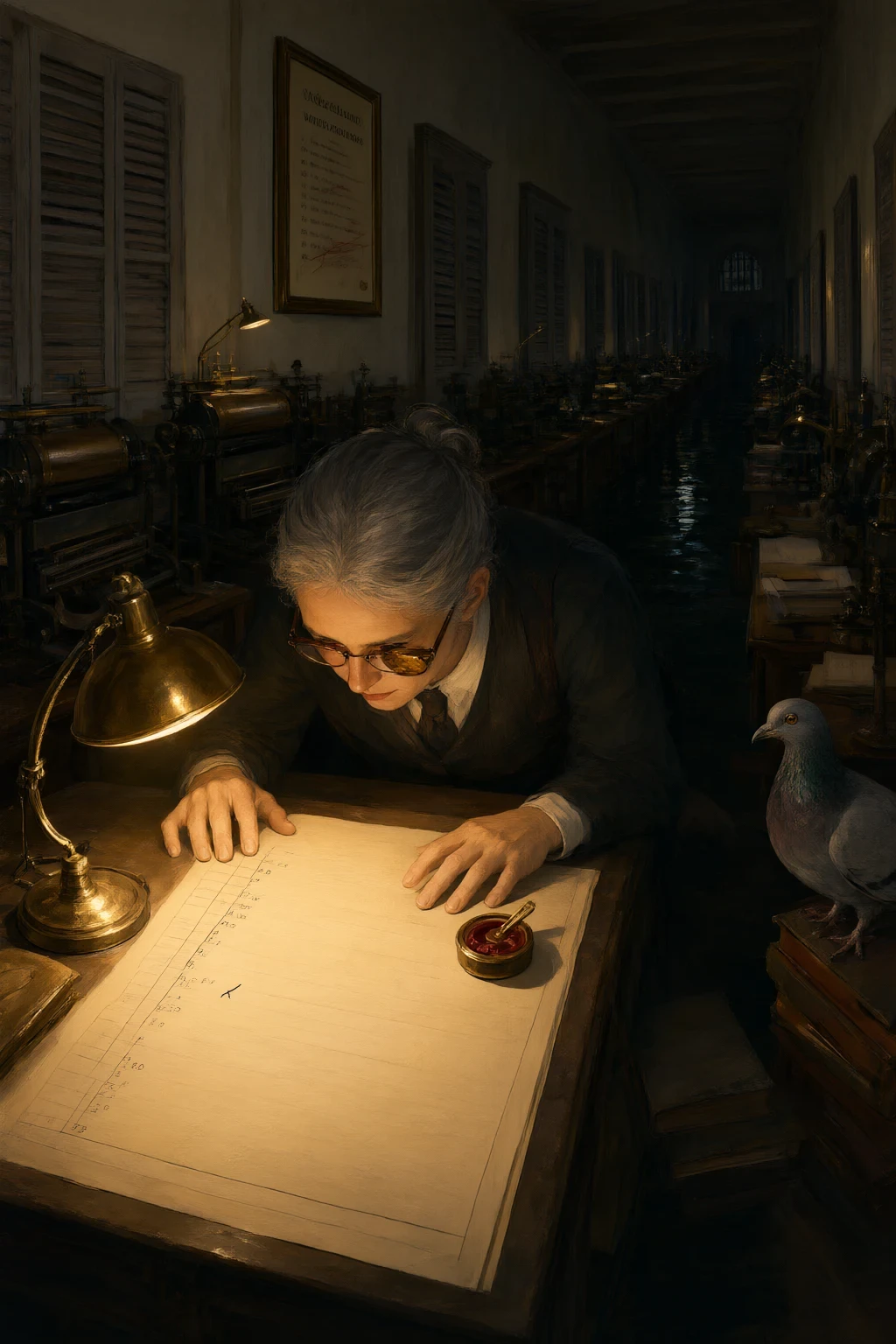
The Concord’s Returns came into Ledger Hall on the ninth of every month, in a canvas bag, and Orla Vessey had been copying them out of that bag into the fair book for seventeen years. The Returns were not a ledger. A ledger recorded what the city did; a ledger had to be exact, and could not be argued with, and had one question per line that could never be widened. A Return recorded what a plantation had produced, and it was printed, and it arrived, and it went into a book that nobody read because nobody was meant to. The release ledger was the instrument. The Returns were a report about the instrument.
The Sallow district page was three columns ruled side by side on one sheet of thin cream paper: the name of the plantation, the seed in barrels, the sap in hundredweight. The sap column was in a fainter ink, because it was a different clerk’s work in a different office and the sheet had been printed for two. Orla copied the three columns into the fair book in three ruled spaces, side by side, in the order they were printed, seventeen years without a break. On the ninth of a month in the middle of that year she came to the bottom of the page and, instead of moving on, she read across. Fourteen rows. Nine thousand, four hundred barrels of seed. A hundred and forty hundredweight of sap. She read it again. It was the same on the page. She had simply never once, in seventeen years of copying a table, looked sideways along a row instead of down a column.
Teasel Sillet came to the hall twice a week in that season, because the Lamp Service drew its reels of silk over on Bridge Nine and the boy was permitted to stand in the doorway and watch the clerk rule the day, which he held to be the most reliable numbers in the city. He came in on the ninth of the month, while the Returns bag was still open on the desk, and he was twelve and a half and had a striped wool scarf he never took off and one bare foot in the cold, and he stood at the end of the first desk and waited to be spoken to, which he had been taught. “Mrs Vessey, I counted nine thousand and four over the Sounding Bridge last night.” “Eight thousand,” said Orla Vessey, without looking up. “Eight thousand and eleven. The ninth is the Aldersday double.” “Oh.” He wrote the number on his cuff. “Then can I ask you something that is not about a number?”
“That is not a number question.” “It is a question about a number.” His voice went down. “When they go out they go out over the water and they come down in the Rows and they do not come back. The ones that come down are paperweights, and then they are firelighters, and then they are ash. So how many of the ones that went out last night went out, as against how many of the ones that went out last night are still moths.” She put the pen down. She had been ready for a number. She was not ready for that. “How many came back,” she said. Teasel nodded at the shutter, as though it had told him so. “How many came back.”
She did it at night, because it could not be done in the day. In the day the hall was full of presses and window light and forty thousand little radiators warming paper, and the fair book had to be kept, and the second desk had a pigeon on it who had been there since 1902 and who was, as far as anyone could establish, permanent. At night the hall shut down to one lamp on the first desk and the smell of hot brass and sealing wax, and the water under the floor moved, and the radiators ticked. She began the way she began everything, which was by getting the paper right.
Twenty years of Sallow Returns, one to a year, laid out in twenty rows and three columns, the seed in the middle. She ruled her own sheet — cream, because the Returns were cream; pencil, because pencil could be a first draft; and she ruled the third column in a narrower space, because the third column was going to be a ratio and ratios want less room than numbers. Then she divided. Nine thousand four hundred barrels, a hundred and forty hundredweight of sap. Sap per hundred barrels: one and a half. She went back to the first year she had. Four thousand one hundred barrels, sixty-two hundredweight. One and a half. The next: four thousand three hundred, sixty-four. One and a half. And the next, and the next, and the next, all the way down twenty years of Returns, one hundred and one lines in pencil, and the third column came out the same every single time.
That was the first thing, and she did not understand it for two days. The second thing arrived on the third night, when she finally asked herself what one and a half hundredweight per hundred barrels meant, and the answer was that it meant nothing at all. It was a coincidence of scale. Sixty-two and a hundred and forty, four thousand one hundred and nine thousand four hundred, two small numbers and two large numbers, both of them roughly in proportion, and a clerk who divided one by the other gets a tidy answer and thinks herself clever. She wrote COINCIDENCE at the top of the sheet in capitals and went to bed at one, and lay awake for two hours being a fool. On the fourth night she went back and did it the other way round, which is the way an auditor does it, and the other way round gave the same answer.
And then she made herself do the thing she had not been trained to do and had never in seventeen years had cause to do, which was to look for the year where it broke. Every arithmetic that is a coincidence breaks somewhere. She went down the third column looking for a year where the ratio was one and a half plus something, and there was not one. Twenty years. One hundred and one lines. One and a half. The spinning house had opened on the Millrace in 1908, and by the year she was thirty-one the men there could get three times as much filament out of a hundredweight of sap as the men who had been there before them, and the city was proud of the Millrace in the way a city is proud of anything it can point at. Orla found the figures in the plant book, which was a different book in a different building, and which she had to ask a bargeman to lend her and which she returned four days late with the corners softened. Three times the filament per hundredweight of sap, in thirty years. It was a real thing. It was the best engineering in the district. It was also, she wrote on her sheet, the reason the sap column had risen anyway.
Seed had gone from four thousand one hundred barrels to nine thousand four hundred in twenty years, more than double, and the Concord wanted more seed, because the Concord existed to make more seed. The Millrace had made sap a third of the price. And so the sap bill had gone from sixty-two hundredweight to a hundred and forty, and the city had got more than twice the harvest for rather more than twice the sap, and everybody in Candleford had been quietly, sincerely, correctly pleased about it for thirty years. She sat with that for a long time. It was true. She checked it eleven times. It was the most defensible piece of arithmetic in the building.
There was not one false number anywhere in it. The Millrace had genuinely got better. The harvest had genuinely gone up. The sap had genuinely gone up, and had genuinely gone up less than it would have, and the difference between what it was and what it would have been was the spinning house’s gift to the city. And the sap had still gone up by seventy-eight hundredweight, and seventy-eight hundredweight of sap is sap that had to be bled out of a living tree, and somewhere north of the city there was a grove that had paid for the better engineering, and no office in Candleford was keeping its books. She did not tell anybody. She would like to say she made a decision, and she did not. She went to the Assessor’s office on Fenner Street on a Thursday, in her own time, in a plain coat, and asked for the standing-acreage of the feeder-groves by district, annual, and the clerk there gave it to her because it took him four minutes and it is the sort of thing clerks give away. Sallow district: twenty-two point zero acres in 1901. Fifteen point one this year. She wrote both numbers on the back of her hand with a pencil and then had to go and stand in a doorway for a moment.
Twenty-two point zero in 1901. Fifteen point one now. Not once in twenty years had it gone up. Not in a bad year, not in a good year, not once. It was a line going down at about a third of an acre a year, with the small wobble of a thing that is measured by a man with a wheel and a rope on a wet morning in a fen. She had come in expecting to find a conspiracy, and what she found was a slope. On the Monday she went up to the Releasing Loft and asked Nell Ashgrove whether she would take an afternoon and walk the Sallow feeder-groves and tell her how many acres were standing, because the Assessor’s figure was four in a hundred out and the Assessor’s figure was a locked room in Fenner Street.
Nell was seventeen by then and a loft senior with her own key to the lift, and she had a scorched brass thumb-guard worn bright at the tip, and she looked at the request the way she looked at everything, which was as though it were a number she was checking. “Why are you asking?” “Because I have got a figure off a piece of paper and I want it off a row of trees,” said Orla, “and because you are the only person in Candleford who can do it, and because I would like the paper to be wrong.” Nell went out to Row Eleven on the Wednesday with a boy from the Lamp Service to carry the chalk, and she was back on the Thursday with her cuffs stiff to the elbow, and she said the number without any ceremony at all. “Fifteen point one. Give or take the ditch, which is not a grove and has never claimed to be.” “How do you know a ditch when you see one?” “Nothing grows on it,” said Nell Ashgrove, and then, after a moment, in a different voice: “Why are you asking me?”
She went out to Row Eleven on the Saturday, and Fennim Sallowe was there, because he was always there, and because it was the eleventh of a month and the sap was running. He apologised to the tree before he touched it. He had a face like a man apologising to a tree, which was what he was, and his black beard was re-braided that morning as it had been every morning of his working life, and his green boots were stiff enough to stand up in. “The Assessor says fifteen point one,” Orla said. “For the district.” Fennim stopped with his hand on the bark. “Who’s been reading the Assessor?” “I have.” “That is a locked room in Fenner Street and the lock is a key under a mat.” “It is a key under a mat,” said Orla. He went back to work for a while. Then he wiped his hands and came and leaned on the board with her, and did not say anything for perhaps a minute.
“Fifteen point one,” he said at last. “That is about right. I have got fifteen and a bit on my board.” “You have a board.” “I have had a board for twenty-two years.” He did not look at her. “I keep the fellings on the front where the foreman can see them, because that is not my count, it is the Concord’s. And I keep the standing on the back, because the standing is not anybody’s but mine and I could not stand having it in a book that gets read.” “Does yours agree with his?” “It agrees to four in a hundred,” said Fennim Sallowe. “Mine is four in a hundred lower and mine is right, and I have never once been in a position to prove it, and I have been trying for twenty-two years.”
She asked him the thing she had come out to ask, and it was not the thing she had expected to ask. “Does the grove get a year off?” He turned his head very slightly, the way a man does who has been waiting twenty-two years to be asked. “No,” he said. “No replant. No fallow. Nothing.” “The Concord calls the rotation sustainable and the rotation is one cutting a year out of a parcel that is not allowed to get older than the order,” said Fennim. “A tree takes sixty years to come back. I have been here twenty-two. There are trees on this row my grandfather cut sap out of and there are trees on this row that were saplings when he started.” He put his palm flat against a trunk. “You cannot take a third of a tree every year for sixty years. You can only do it once, and then you are a wood-yard, and the wood-yard is not a grove.”
He was quiet for a moment, and then he said the rest of it, and Orla wrote it down verbatim afterward because she knew it was the sentence. “I am sorry. I cannot refuse a second cutting. That is not modesty, that is a fact about me: I have built forty-four years on being the man who does what is asked, and if I stop being that man there is no other man in me to put in the gap. So I will take the second cutting, and it is for the wide wing, and I will do it well, because if I am going to do it then I will do it properly, and the trees will not know the difference between me and a worse man.”
It was at the back of the first Returns folio, in pencil, in a hand she did not know, and she found it in March, three months into the work, because it was on the wrong side of the sheet and she had spent seventeen years copying the right side. Sallow. Seed 4,100. Sap 62. Then 22 acres buy 4,100 barrels, which is 186 barrels to the acre. The seed is up again this year and the sap is up with it, and the acre has gone down. If the seed goes up a third time, does the acre go up with it, or does the acre keep going down on its own account? Because one of those two is a harvest and the other one is a wood-yard, and I do not know which one we are writing down. — R. Calloway, Row clerk, 14th of Frost, 1901. And underneath it, on the same line, in a different and much steadier hand:
Noted. The acre does not go up. The acre goes down. Grove 22.0. The ratio is a rate and not a result; the Concord buys seed at one and a half and does not buy acres. Do not ask it again on this page, it has been answered. Next year’s seed is 4,300 and next year’s sap is 64. — M. Orla Vessey read that four times and then sat in the cream-and-lampblack quiet of Ledger Hall with her hands flat on a book that had cost her nothing to open and everything to open. The question had been asked. In 1901, by a man whose job was rows, who is not in any list of anybody who has ever done anything, and who had put it in the margin of a printed Return in pencil because he was not sure he was allowed to write on it. It had been answered. Correctly. Completely. In one sentence, by somebody senior, on the same day. The acre does not go up. The acre goes down. The ratio is a rate and not a result. The Concord buys seed at one and a half and does not buy acres.
And then, because the man who wrote that knew his business and was thinking about the shape of the page rather than the shape of the city, he had added: do not ask it again on this page, it has been answered. Not: do not ask me again. Not: it is not your office. Do not ask it again on this page. She did the last piece in the last week of April, and she did it because she could not stop, and because she wanted to know whether the arithmetic would let her do it. The Concord published its own projection every autumn, in the fair book, in the space headed NEXT YEAR, SEED PROJECTED. This year it said nine thousand eight hundred barrels. Nine thousand eight hundred barrels at one and a half hundredweight of sap to the hundred barrels is a hundred and forty-seven hundredweight of sap. And the standing grove of the Sallow feeder-groves has gone down at about a third of an acre a year, every year, for twenty years, and has never once gone up. Orla Vessey wrote it in pencil in the bottom corner of her own sheet, which was not a ledger and had no mark on it and would be thrown out: Grove standing, Sallow feeder-groves, next October: 14.8 acres.
She underlined it, and she put the date beside it, and she went home and slept, and she was not proud and she was not frightened, and she was a woman of thirty-nine who had found out that she could look at a number and make the future of it arrive on paper. On the second of May she went down to the factor’s office with eleven sheets of pencil and the 1901 folio under her arm, and Halvard Tace was at his desk in black kid gloves, the right one cut from a different and browner leather, and he did not look up, and he said: “You are early by two minutes. It is not eight yet.” “It is four minutes past eight,” said Orla Vessey, “and you logged the Sallow release of the second at eleven hundred and nine last night, and the line says eleven hundred and nine, and there is no correction, and I have not come about the release.” He put the pen down. “Then I have to ask you who paid for that,” he said, “and you are going to tell me nobody, and I am going to have to sit here and be asked a question by a clerk.” “Yes,” said Orla.
This is what she said, and she said it in the order she had worked it out, because she was a woman who believed that a person telling you a thing is doing you a courtesy and should not be made to wait for the good part. “The sap column is not a cost. It is a rate. It has been one and a half hundredweight of sap to every hundred barrels of seed for twenty years, to two decimals places, with no exceptions, and it predates every person in this room. The Concord does not pay for the seed and bear the sap. The Concord buys seed at one and a half. That is the whole commercial arrangement and it has never once been written down in a form anybody was required to read.” “That is the Millrace’s doing.”
“The Millrace tripled the filament per hundredweight in thirty years, and the seed more than doubled, and the sap went up by seventy-eight hundredweight, and the city congratulated itself on the Millrace and was right to, and the seventy-eight hundredweight came out of a grove that is not in your book.” Tace’s right hand went flat on the desk. The left one stayed where it was. “The standing acreage is the Assessor’s,” said Orla. “It is in Fenner Street in a locked room and the key is under a mat, and it has gone from twenty-two point zero acres in 1901 to fifteen point one this year, and it has never gone up once in twenty years.” “Because your district is being drawn at a rate that is sustainable.” “Row Eleven is being drawn at one cutting a year out of a parcel that is not allowed to be older than the order,” said Orla Vessey. “A tree takes sixty years to come back. Fennim Sallowe has been there twenty-two.”
Then she put the 1901 folio on his desk, open, at the back, at the wrong side of the sheet. “There is a note on that page from the fourteenth of Frost, 1901, by a Row clerk called Calloway, and an answer to it underneath, in the office hand, from a factor who is dead and is not you.” Tace did not look at it. He looked at Orla. “The Concord does not amend a Returns.” “No,” she said. “This is not an amendment. It is a copy of a question that was asked once, correctly, and answered, correctly, on the day, and then never asked again. Nobody hid it. Nobody lied. Nobody has ever in ninety years had cause to. A man asked whether the acre went up with the seed, and he was told that the acre goes down, and he was told that the Concord does not buy acres, and he was told to stop asking it on that page.” She squared the folio, because she squared things. “In April I worked out that the standing grove of the Sallow feeder-groves this coming October will be fourteen point eight acres. It is in my hand. It is not a Return and it is not a ledger and nobody has to do anything about it.”
“What would you like me to do?” It was not the question she had spent four months getting ready for, and Orla Vessey, who had brought eleven sheets of pencil for it, found that she did not have an answer. “That is the first question anybody has put to me about this,” she said, “and I have thought about it for a fortnight, and I do not know.” Tace put his gloves on. He did it the way a man does when he is finishing a piece of work, and the right glove went on the right hand, and the right glove was cut from a different and browner leather, and it had been the same for as long as she had been a clerk. “You have not asked me a question,” he said. “I notice that.” “No,” said Orla. “I have handed you a note with no question on it. That is the only form the question can take this year, because the Returns are not the release ledger, and a release line cannot be widened, and a Return can only be widened by the factor, in his own time, and it is not going to happen this year, and I have stopped waiting for it to.”
In the March after, Ansel Reyne came to Bridge Nine, which he had not done in eleven years and which he had to ask his way into, because he was no longer a man anybody at the counter had to admit. He had a burn under his left jaw in the shape of a pale crescent and a collar buttoned to the throat in a warm room, and he stood at her desk with his hat in his hands and did not sit down. “The Assay has been re-appointed,” he said. “I have applied. I shall be informed in a fortnight, and I have already begun to understand that being informed is the whole of the post.” “I have a question,” said Orla Vessey. “About a number, or about something else.” “About a tick.” She put the pen down.
“The fifth space,” he said. “On a release line. I have put a tick in it eleven thousand times and I asked Mr Tace in the autumn what it was for, and he asked me who paid for the question, and I have thought about it every night since.” He turned the hat around once in his hands. “It is the sap. A tick means that night’s charge has been drawn against the plantation. It is the second column of the ledger. It has been the second column of the ledger for as long as there has been a ledger, and it is a tick and not a figure, because the sap house bills by the quarter and a line written every night cannot carry a quarter’s number.” He set the hat down on the desk.
“Then it is the second column of this book and it is the second column of the Returns and it is the same column,” said Orla, “and it has been copied out of one into the other every year since 1881, and nobody has ever once put the two sets side by side.” “I have asked one question,” said Ansel Reyne. “I believe I am entitled to one more.” “You are entitled to exactly one more,” said Orla Vessey, and corrected the date of it before she said it, and then went and got the 1901 folio, and did not correct anything else for the rest of that winter.
She went back to Bridge Nine and she wrote the day up, and the day was a Monday and the release was fourteen hundred and six, and the weather was clear and still and no fly after first grey, and she wrote the line in the hand that had not changed since she was twenty-two. Then she did what she had been not doing for seventeen years, which was to read the second space. She read it for a long time, because now she knew what it was, and there was nothing whatever to be done about knowing. It was a tick, and it was a tick in every line, and it was a tick for sap: a night’s charge, drawn against the plantation, entered as a mark, because a line written every night cannot carry a quarter’s hundredweight. Forty thousand of them, going back to the first page, each one true, each one complete, and between them not one quantity.
The sap house bills by the quarter. Its bills are totals. And a total cannot be divided back into nights by a clerk in a shuttered room over the canal, because to divide a total you have to know which nights the charge fell in, and the charge fell in all of them equally, and that is precisely what a charge is. She had spent four months working out what a hundred and forty-seven hundredweight of sap would do to a grove. It was written, in a hand nobody could mistake, on eleven sheets of pencil, in her own book, in her own time, and it was correct. And the ledger had known the answer to the same question since 1881, and had answered it every night for forty thousand nights, in the only form a nightly line can take. Yes. And yes. And yes.
There was no column for the acre. There never had been. There was a column that said the cost had been paid, forty thousand times, and it had been paid, and the paying was all that anybody had ever recorded. She put the pen down and sat in the warm shuttered room over the black water with forty thousand glazed presses receding into the dark on both sides of her, and outside, on the plain iron footbridge, nine thousand wings went over in one long soft continuous hiss, and the canal kept the sound a half-second longer than the air did, and she let it run all the way out, the way the Loft men do, the full two minutes after the doors have shut, and then she took up the pen again, and wrote the next figure in a hand that had not changed since she was twenty-two.