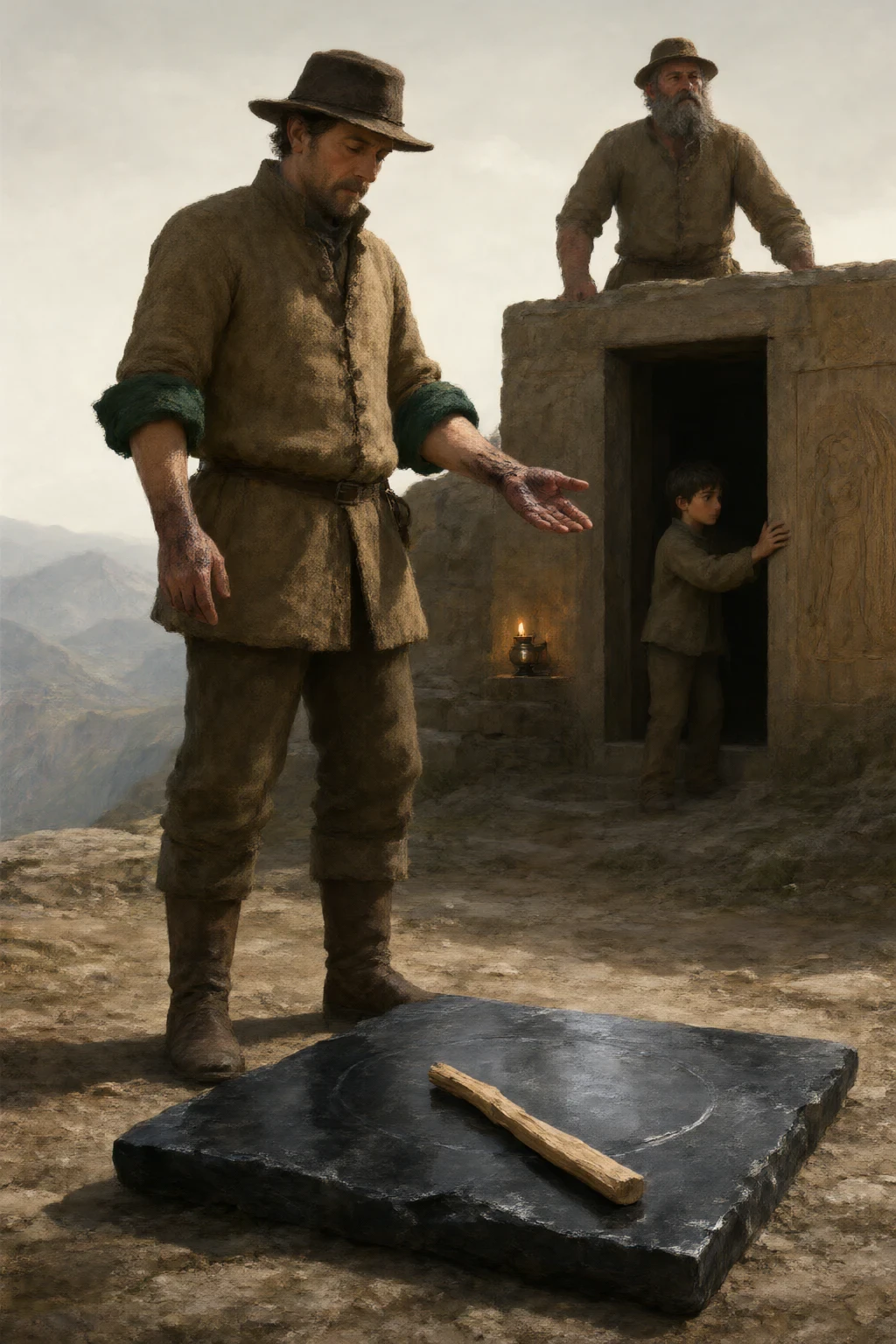
The Bureau’s schedule arrived on the second morning of the eighth month, in a leather case that a man had carried up the stair and would not give back, and Marda Osk read it standing up, because there was one stool and it was occupied. The schedule was eleven leaves of good paper. Each leaf carried a column of names, a column of terms, and a column of dates, and the dates were the reason the Bureau of Vowed Obligations had sent a clerk up four hundred miles of stair in a coat still clean at the shoulders. Four hundred names. Beside every name, a date in the eighth month of this year. Beside forty-one of them, the same week, which was the arithmetic the whole pass had been arguing about since the snow came off the Shutter-Stone. Marda read the last leaf twice and then said, “Forty-one in one week.” “Forty-three,” said Tovan Rell, from the lectern. “They have counted Brother Seat twice.”
The copy-desk was the only warm room on the mountain and it was warm because it was small. A slate shelf of ledgers took up one wall. Three stools, of which two were sound. A lectern with a page-weight of grey granite on it, worn to a smooth pillow on the top face. The smell was ink and tallow and old sheepskin, and it had been the same smell in that room since the first thing built on the pass was built, which was this room, and which had been the last thing repaired. Somebody had put a new slate into the roof in the year of the great thaw, badly, and on windy nights the new slate ticked. Ansel Dun had been in the doorway for some time. He had a blister on his heel and his hand was on the doorframe, because his hand was always already reaching for a wall, and he had been on the mountain three days and had slept two of them in the Mule Yard, where the animals had been warm on one side of him and the wind had been patient on the other. In the yard, at four in the morning, with the hay dust in his nose, he had decided that he was going to swear something.
Ilse Merrow turned her whole body to face him. She did that. Twenty-two years in the chair at the Ninth Step and she still turned her whole body to face whoever was speaking, as though a vow might come in from the side of the room. “Yes, right, yes,” Ansel said. “I only came to ask whether the room is free.” “Sit down,” said Marda, “and do not agree with anybody until they have finished.” Marda Osk had a way of asking a question twice. The first time was for the mountain. The second was for herself, and it was word for word, and she did it with the flat blue attention of a woman copying a line out of a book she will one day be held to. She had been on the mountain nine days and had already filled thirty-one sheets, and her right middle finger had gone the colour and hardness of a bad joint, and the sleeve of the grey coat still smelled of lamp oil, and would until she died.
Tovan Rell was sixty-eight. His cuffs were stained with ink to the elbow and had been for so long that the stain had a shape, a dark greenish rectangle on each forearm that stopped where the sleeve stopped. He carried a magnifying glass he no longer needed, and carried it anyway, in the left hand, the way a man carries a tool he no longer trusts anyone else to use. He had been the warden-copier on this pass for thirty-one years. “Tovan Rell,” Marda said. “What is the term length in the older hand?” He did not answer at once. He put the magnifying glass down on the lectern, which was the only gesture he had. “You want one number,” he said. “Yes.” “There is not one number.” “There is one number. The Bureau has a column for it.” “The Bureau has a column for a number that a man wrote out in a fair hand in the year of the great thaw, and that man had a good heart and a cold hand and no more than that, and every date on every leaf of your schedule is arithmetic on his arithmetic.” Marda looked at him for the length of one page. “Every date is a term added to a year,” she said. “That is not his arithmetic. That is addition.”
“Yes,” Tovan said. “That is what I have been saying for forty-one years, and I have been saying it in a voice nobody had to answer, because I have never once said the number.” “Then say the number.” “No.” Ilse had not moved. She said, flatly, before answering anything, “Never once said the number.” And then she waited, because that was what the last three words were for. She had been doing it since before Ansel was born. Whatever you said, she gave back the last three words of it, unaltered and without inflection, and then she went on as though the echo had been a formality and the sentence had been a door she was holding open. “The copy-desk stands inside the arc,” Tovan said. “You can see it from here. Six hundred years of feet have gone around that stone and made a shape that looks like a person standing aside. A number spoken inside the arc, on the flagstones, where a vow may be read — do you know what that is?” Marda said, “It is speech.”
“It is a term newly sworn. Plain sense. A year is a number, and this pass has never in six hundred years distinguished between a number a man is counting and a number a man is swearing. I have known that since I was thirty-seven years old and I have never once been able to prove it, because the only place I could say it aloud is the one place I would be overheard by the mountain.” The hail started. It came in sideways out of a clear sky, the way it did twice a day in September, and it struck the slate of the doorway and the sill and the back of Marda’s coat, and Ansel got up and put his shoulder against the door to keep it out, and the noise of it filled the room for ninety seconds and then stopped as though a tap had been shut. When the light came back the room had gone the colour of a second window and Tovan Rell was looking at the doorway. “Yes, right, yes,” Ansel said. “Nine.” Tovan turned.
“I only mean what you write on the sticks. Nine.” Ansel had a piece of slate in his hand and on it he had a number and beside the number a name. “I have been up here three days and everyone says nine means nine years, and I want nine years, and I thought — I thought I ought to know what a year is before I ask for nine of them, because I have never had nine of anything.” “You are fifteen.” “Yes, right, yes.” Marda Osk read the question back to herself in her own head and then, because she was that sort of person, out loud. “What is a year, on this pass?” “Come outside,” Tovan said.
The Shutter-Stone lay three paces of flat black slate off the north door, polished to the colour of a wet coin by six hundred years of feet going round it, and in the arc the hailstones that had blown into the hollows were lying an inch deep and had not melted, because the shade is cold even in the second month of sun. Beyond the arc the ground was bare grey rock and there was nothing at all on it, no stone, no wall, nothing for a number to be sheltered by. Tovan Rell stepped over the worn line and turned around and stood with his back to the open pass and the whole flat blue afternoon of it behind him, and Marda Osk stood on the flagstones inside the arc with a slate on a board and did not follow him out. “Now,” he said. “Twelve,” said Marda, from inside the arc. “There are twelve months. I was raised on twelve.” “There are twelve months in the low country. There are twelve months in the Bureau and in the copy-desk and in the printing house where they made your forms. Yes. Twelve. If I have it right — thirteen, on this mountain.” Ilse Merrow said, “If I have it right.”
Nobody spoke for a moment. The Registrar came over the ridge the way it did at night, in one long unbroken push, and stopped, and there was a silence with weight in it. “Since when,” Marda said. “Since the first shrine, which is the year the pass began to be counted at all. The pass does not take its year from the low country. A pass-year begins at the Feast of the Thaw, the first week of the eighth month, when the snow is off this stone and the mules can be got over the High Ladder without a man going ahead with a rope. Everything sworn before the Bureau existed is reckoned from the thaw, because the thaw is the only day in the year on which a person on this mountain can be certain of what he is doing.” “So a pass-year is thirteen months long.” “A pass-year is thirteen months long. A year of labour sworn on this stone in the eighth month runs thirteen months, and it runs thirteen months again, and it does not run twelve at any point in the term.” Marda wrote nothing. She stood with the slate on the board and she looked at the worn arc between them, and she said, in a voice that had gone very quiet and very exact, “Say the sentence again, and say it so that I can copy it exactly.” “I cannot. I can only say it here, once, off the stone, because I have already said it.” “Then I will write what I heard you say here, and I will initial it, and you will initial it, and we will both be responsible for it.” “Yes,” Tovan said. “That is the arrangement.”
The arithmetic came apart in the Reliquary under the top shrine, where the light does not reach and the cold has a grain to it, in a windowless cell cut into the rock and stacked to the ceiling with bundles of linden tied with waxed twine. Eleven thousand sticks, Marda had been told, and she had counted nine bundles on the top shelf alone and had stopped. They went up the High Ladder together at first light, because that is when the wind is not yet on the ridge, and they did not talk on the landing, because people drink water there and do not talk much. At the top the air was thin and bright and entirely without wind and the shade was colder than the sun by a long way, and the Reliquary door stood open because Tovan had a lamp and Marda had a schedule. The bundles were tied by year. That was the whole system: a bundle for each pass-year, in order, and each stick in a bundle in the order the vows had come due. It was beautiful. It was the only record on the mountain of when anything ended, and it had been cut and stacked and bundled by men who could not have read their own names in the low-country hand.
Tovan untied the twelfth bundle of the shelf and set it on the flag and went along the sticks, not fast, the way a man goes along a wall with his thumb on the plaster. “Here,” he said. “Sworn in the eighth month of one year. One notch. Due in the seventh month of the next year, if the year is twelve months. Second stick, sworn in the seventh month of the following year, one notch, due in the sixth month after that. The order is correct. Go on. Third stick, seventh month, one notch. Sixth, seventh month. Eighth, seventh month. And here, ninth, tenth, eleventh — and here, the twelfth stick, sworn in the eighth month, and it is placed before the ninth, tenth and eleventh.” Marda looked at it for a long time. “Because it comes due earlier.”
“Because it comes due earlier. By a month. Under twelve.” He put his finger on it. “And that happens in this bundle, and in the next, and in the next. Nine bundles out of the eleven I have looked at are in the wrong order in exactly the same place, and the wrongness is not a mistake, because a mistake is random. It is regular. A clerk sorting by the low-country date written on the head of the bundle, when the low-country date and the pass date drift apart as the years accumulate, would produce exactly this, at exactly this rate, in exactly this place.” “How far apart.” “In a hundred and eighty years, the two calendars have drifted by more than a month. In three hundred, by more than two. And the drift is not a flat error. It is a widening one.” He straightened up, which cost him something, and put the magnifying glass in his pocket, which he had not done in front of her before. “If I have it right — the errors are proportional. They are not a month on everything. They are a month on everything, and then an extra month for every year the vow has already run, and another for every year it has still to run.” Marda did the sum out loud, because that was how she thought, and Tovan Rell let her, because he liked anybody who counted.
“A one-year vow is out by thirteen days,” she said. “Nobody counts days on a one-year vow.” “A nineteen-year vow is out by one year and seven months,” he said. “Brother Seat’s nine years of labour is out by nine months. He came up here in the fourth month believing he had three left, and he has three and three-quarters, and there is no instrument on this mountain and no Bureau and no stick that will ever tell him otherwise, and the only person who can is the man who has just told you, and he has been waiting forty-one years to be asked.”
They did the arithmetic twice more that week, both times in the Mule Yard, which is the only flat piece of ground on the whole pass, shored up with a retaining wall and always in the lee of it, and which smells of animals. Brother Seat was doing sums on the retaining wall with a nail. He was doing them in ochre on the grey granite, and he had been doing them since the first hour, and he had done them in the same place for eight years, and the wall behind the sums was the colour of the sums. His left shoulder sat an inch higher than his right and had done for six of the nine years, and the surgeon's talk in the valley had been that it would go cold before it went stiff, and it had never gone cold, which Brother Seat had privately taken as evidence that the mountain had an interest in his comfort and that this was suspicious.
He had a tally-stick of his own and he kept it in the breast of his coat and he took it out perhaps four times an hour and counted the notches with his thumb and put it away again. Nine notches. Nine years of labour given to the pass, sworn at the Second Water where the mules are, and he was in the last of them, and the name on the stick was the one thing he had ever chosen, because names on the Register are not chosen, and he had chosen Brother Seat out of a list of eight and had been pleased with it for nine years. “Then it is three quarters of a year,” he said. “On top. I want to be certain that is what you are telling me.” “That is what I am telling you.” “—and you are certain.” “If I have it right.” Brother Seat stopped cutting ochre into the wall and stood with the nail in his hand and looked at Tovan Rell for a while. He had a full iron-grey beard, which he had grown for the first time in his life that year, and it was not vanity, it was the ninth year, and a man with one year left does not need to shave.
“Then say the other thing,” he said. “Say what it will feel like on the day, because you know, and I do not, and I have been going up the High Ladder in my own head for eight years and I do not know what is at the top of it.” “Nothing,” Tovan said. “It lifts. You will not know the day. You will be doing something ordinary and it will stop being there, and you will find out four days later, or six, from somebody else, and the thing you will notice is that there is some weight you had stopped noticing that is not there any more.” “That is the whole of it.” “That is the whole of it.” Brother Seat went back to the wall. After a while he said, “I would have got it wrong by the first of the month. I want you to understand that I would have got it exactly wrong, and that I would have got it wrong downwards, and I would have been wrong at the wrong end of it, and I would have stood on a flagstone in the low country being free for three quarters of a year that I was not free, and nobody would have ever known, because there is no way to know from outside, and the weight is not something you can see on a man.” He put the nail in his pocket. “Say the number again tomorrow,” he said. “Say it every day for a year and then say it every week for a year, and when I am the last one of the nine of us who is still here, do not tell me you were not sure.” “I will not be able to tell you that.” “Good,” said Brother Seat. “That is the first thing anybody has been able to promise me on this mountain in nine years.”
It was on the second afternoon, in the Copy-Desk, with the Registrar coming up the pass in an unbroken push and Marda Osk working through her thirty-first sheet, that she found the thing that undid her, and it was not the calendar. Forty-three people in the eighth month, the Bureau had said. Forty-one on the leaves, and Brother Seat twice. “Twenty-six of them should not be due,” Marda said. “Under your thirteen they are not due. They have years. The Bureau is about to release twenty-six people from vows they are still carrying.” “Yes.” “And they will walk off this mountain believing they are finished, and their bones will go on doing the work, and the Bureau will record that they were discharged on a date, and it will be a lie in a good hand on good paper.” “Yes.” “Seventeen people in your count are genuinely due this year. They are not on the schedule. They are not on any of the eleven leaves. They are due in the next eleven weeks.” Marda put her pen down. “And they do not know it. And nobody has to tell them, and nobody is going to be harmed by not telling them, and the binding simply lifts.” “Yes.”
“That is the whole result. Thirteen instead of twelve. Twenty-six people saved from a lie, and seventeen people freed of something by arithmetic, in a fortnight, while they are asleep, with no door opened and no witness and nobody in the world aware of it except four people in a warm room.” “That is the whole result,” Tovan Rell said. “If I have it right.” He had said it four times in two days, and each time it had cost him less, and Marda noticed that it did, and understood that it was not confidence. It was a man getting used to being the only person in the room who knew.
There was a girl in the upper room of the Ninth Step who had been in the cold hours of four nights running, with a lamp, in a room made of sheepskin and lamplight, going through a ledger that was not hers. Het Kalder was nine. She did the whole length of her plait herself and she had one knitted blue fingerless glove, on the left hand only, and she narrated what she was doing out loud in a soft third person while she did it. “She is going to the eleventh year,” Het said, to the ledger, or to the room, or to whoever was under the bed. “She is going to the eleventh year, and there is nothing in the eleventh year, and the man who did the eleventh year is dead, and his successor did it worse.” Nobody had sent her. That was the arrangement, because nobody had thought of it, because she was nine, and because the copy-desk key hung on a nail inside the frame of the door where a stool could reach it, and the Ninth Step was a house, and houses do not lock against a child reading. She came down in the middle of the afternoon with the ledger under her arm like a thing she had been asked to return and had not been.
“He has been through the ordering wrong,” Het said. “The twelfth year. She put the month before the year because the head of the bundle is wrong, and it is not wrong once. It is wrong the same way eleven times, and if you look at the head of the bundle it says a low-country month and a pass-year written out in full, and one of them is later than the other, and nobody ever looked at the head of the bundle, because who looks at the head of a bundle.” Tovan Rell sat down on the stool he had been keeping free all day, which was a thing he had not done in the thirty-one years Marda had known of him, and put the magnifying glass on the table and then took it up again and put it back. “How long have you been reading the Register,” Marda said. “She is going to answer the question,” Het said, “and she is going to answer it exactly.” The girl looked at the floor. Her right hand went to her left and turned the blue glove over and over. “Since the Feast,” she said. “Four nights. I did not take anything. I did not cut anything. I did not know that I was doing the wrong thing until I had already done it twice, and then I could not stop looking.” “That is correct,” Tovan said. “You were doing the wrong thing. I want you to understand that it was luck, and that next time it will not be luck.”
On the fourth day, in the flat blue light with the sun going down the length of the pass and every one of the eleven shrines reading as a silhouette against glare, they read the number aloud. They read it because Tovan Rell had been asked three times by a clerk and once by a child, and because on the fourth day Marda Osk said that a correction which existed only in the memory of one man was a correction of no kind, and would she be so good as to witness it, and where, and would the keeper put it in the book, because if it went in the book it was arithmetic and if it did not go in the book it was a rumour. So they went out to the Shutter-Stone, and it was near enough to dark, and the hail had come and gone twice, and the Registrar had started up the ridge, and they stood in a wide worn arc around a flat black square three paces across and Marda Osk read her own words back to herself before she said them, and Tovan Rell said the number again. “Thirteen,” he said. “Thirteen months, counted from the Feast of the Thaw, which is the first week of the eighth month, in every term written in the older hand upon this pass. If I have it right.” “Off the stone,” said Ilse Merrow.
“Off the stone,” he said. Marda wrote it on the back of the Bureau’s own schedule, in the margin, in her own hand, with the date, and read it aloud twice, and Ilse took the Register down from the shelf and wrote it in the margin of the page that faced the day, which is the page the keepers use for anything that is not a vow, which is a page that has been empty since the book was bound, six hundred years ago, and the first thing ever put on it was a number, and the second thing was Marda Osk’s name, and the third was a keeper’s flourish twenty-two years old and an inch and a half high. Then the Bureau replied. The reply came down with the mule on the second load, nine days later, and it was one line on the same good paper, and it said that the Bureau was not able to use a correction expressed in the pass’s own reckoning, and would Marda Osk be so good as to restate the dates in the low-country calendar, giving the day and the month. “Yes, right, yes,” said Ansel Dun, from the doorway. “I can do that. I have counted all summer. There are twelve, though. In the valley there are twelve.”
“There are twelve in the valley,” Tovan Rell said. “Yes. Twelve in the valley, thirteen on the pass, and a boy of fifteen standing in a doorway who has been the only person in three days who has said the number out loud without wanting something.” He took the magnifying glass out and looked at it. It was a good glass. It was the only one on the mountain and it had cost more than he had earned in a year, forty years ago, when he had bought it to read the older hand and had then found a way not to need it. “Say the number once more,” Marda said, “and then go and do something else for a year.” “There are eleven thousand sticks,” he said. “If I have it right, there are eleven thousand, and four hundred are this year, and there are no marks on them for the calendar at all, because the calendar was in the head of the bundle, and the heads of the bundles are not kept, and the woman who read them was nine.” “Then it is not recoverable.”
“It is recoverable,” Tovan Rell said. “It is only slow. I am the last man who can read the older hand, and I am sixty-eight, and I have just made myself the man who told the Bureau it was wrong, and the Bureau has written back that it cannot use what I told it, and there is no money on this mountain for a man with ink to his elbow to sit in a cold room for two years.” He put the glass in his pocket. He got the case under his arm. And at the north door, before he went in, he stopped, and stood still for a moment with his back to everybody, and it was not a performance, and nobody watching from inside could have told what he was doing, except that he turned his left hand out flat and open in the cold air, palm up, the way a man does when he is waiting to be given something, and he held it there a while, and then he went in.