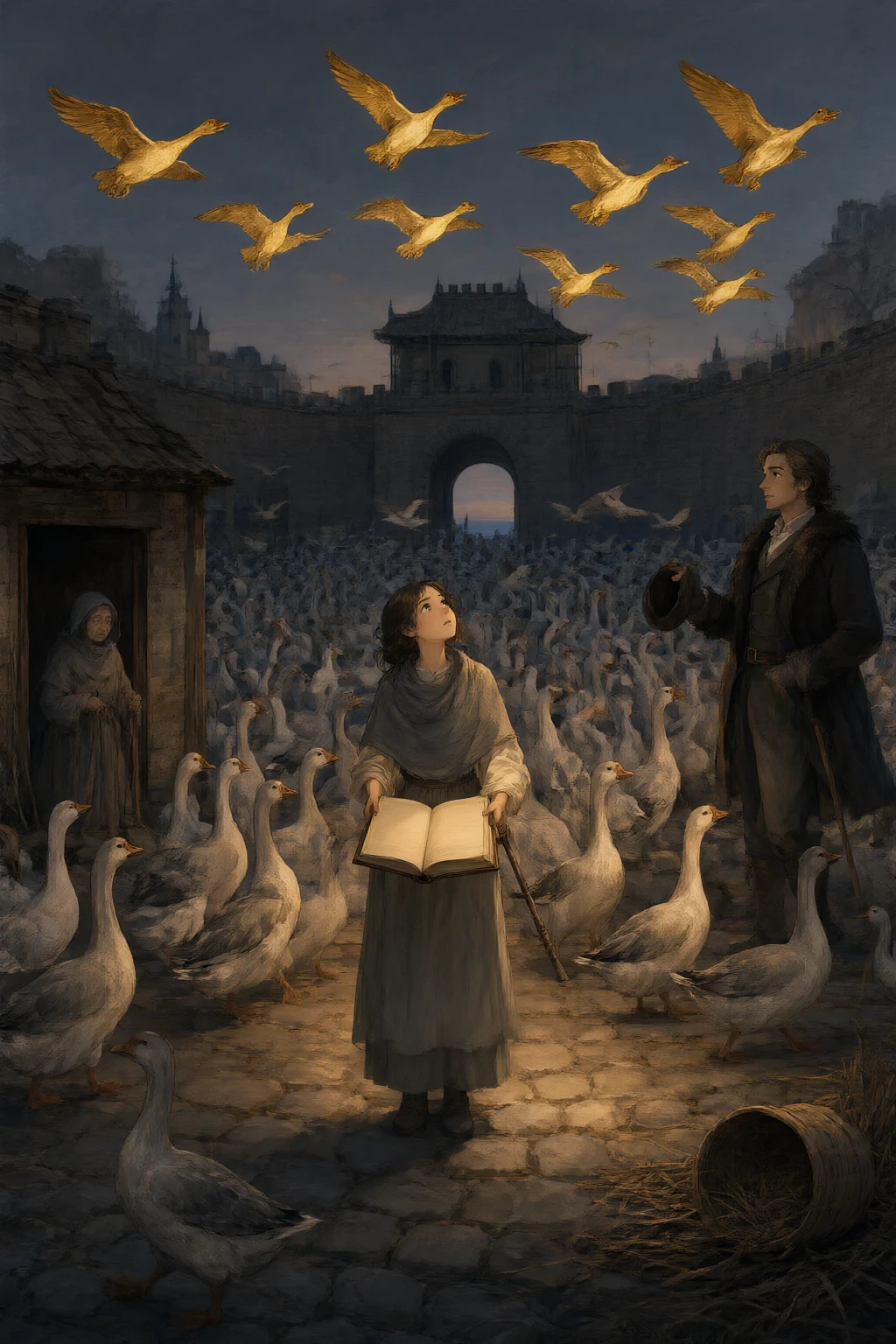
There were four of them in the party and one of them knew what was going to happen. The bride was to ride eleven days to a city on the western coast, to marry the count's son, a man of twenty-six whom she had met twice, both times at a table, both times for four hours, with a chancellor at each elbow. The party was the bride, her maid, an old nurse, and a mute boy from the kitchens called Bram, who was fourteen and had strong legs. The maid was called Kätchen and had been the bride's maid since the bride was six, and had known since she was eleven that she was going to be a countess.
On the ninth night they were at an inn called the Golden Stag, it rained until two in the morning, the wagon axle came off in the yard, and there were six other parties in the yard wanting horses at the same time. In the morning the wedding clothes were gone from the bride's travelling chest, the bride's own clothes were folded on the bed, the maid was already in the yard in a blue riding dress with silver thread at the shoulder, and the old nurse was standing in the doorway with the child in her arms and her mouth shut. "There is a column," the bride said. "There is a column," said the old nurse, "and it leaves at six, and there is a coach hired for it, and there is no other coach in this town until Thursday." "Then give me my clothes back."
Kätchen did not turn round. She said, over her shoulder, to the harness, "I shall not be back before Tuesday, so it does not matter in the least." The bride put her own clothes on, and took her bundle, and went out of the yard and down the road, and she did not call after anybody, and she did not go after the column. The old nurse knew. She had known since the third week, when Kätchen had asked her very quietly whether a lady going to her wedding would be missed if she got off the road for a day. The nurse had said yes, and Kätchen had said that was a pity, and the nurse had not said one word to the bride, and never did.
She walked eleven miles that day, and for the first two days she thought it was a theft and meant to ride after them. On the second evening she got as far as the last place the column had slept, and the ostler said two coaches and eleven riders had gone on at four in the morning, and the lady in the blue had been in a good mood. She stood in that yard a while with her hand on the well. On the third day she worked out what had actually happened, which was that nobody had done anything to her. There is a woman who wanted something very much and was asked to wait eleven days for it, and a rain, and an axle, and a door that was not locked.
So she let it stand, and the first reason was small. Kätchen had been her friend for nine years and had once, in a cold room in a house that was not hers, said the word countess out loud, once, in a voice she had clearly practised, and then had gone out of the room. And the bride had a wedding ahead of her with a man she had spoken to for eight hours in total, and discovered, standing at a well in the rain, that what she felt about it was relief. The other reason she did not examine then, and would examine a great deal later, in a shed, at dusk, with a book open on her knee.
The city had a west gate with a tower on it, and inside the gate, along the inside of the wall, two long sheds and a yard, and the sheds were the goose sheds and the yard was where the geese were counted. The flock came down out of the north every evening at the end of August and went south again in the morning. It was not a pretty sight. It was a working arrangement between the city and eleven thousand birds, and the terms of it were in a book. The old woman who kept the sheds had kept them for thirty-one years. She had a grey hood, a stick, and a way of looking at a goose that made the goose move. "You're the new one," she said. "Yes." "You'll have been the lady." "I'll have been on the road."
"Mm," said the old woman. "There's a post vacant since Candlemas. Wages are in the book. You start tomorrow on the yard, and the first thing you do every day is walk the wall and count the sheds, and you will do it wrong the first week, and I will not tell you."
Between six and eight the flock came in off the water meadows and onto the yard, and the girl stood in the gateway with a stick and counted. The count was written up at dusk in the goose book: the number in, the number out, the number that stayed to be fattened for the feast in November, and the number that had gone on. If the two did not match, the book said nine left or eleven over, in the old woman's hand, in a column with a heading, and the gate was the busiest place in the city until somebody found them.
"You will make mistakes," said the old woman. "Everybody does. What you must not do is round it. A bird that is not counted is a bird somebody will look for all winter. That's what the number is for. It isn't a sum. It's a promise to eleven thousand animals that are not asking you for anything." There were eleven birds in the flock that were not like the others. They were the gold ones, and they came in the last week of August, and they flew over the city rather than onto the yard, and the old woman had one rule about them and had never explained it.
"They come when the last one's in," she said. "Not when the count's right. When the last one's in. If a bird is anywhere in the fields at dusk and the book says eleven, then a man on the wall has counted wrong. It has happened twice in thirty-one years. Both times they came the next evening and there were twelve."
Bram, the mute boy from the kitchens, came to the gate in the fourth week to carry the refuse pails and stayed, and he said one thing, which was quack, and which she understood in her first week, and which neither of them ever referred to again.
The count's son came to the west gate four times a quarter, because the west gate took a toll and a toll has to be looked at. He had a house on the quay and no interest in geese. The first time, in the eighth month, he stood at the top of the ramp for ten minutes while eleven thousand birds came in through the gate, and then came down and asked the old woman for the book. She gave it to him, because refusing a count is not the same as refusing an idea. He read the previous fortnight and said, "Who is this." He was holding it open at the wage column. The name on the line was a pet name, in a careful hand, the only careful hand in eleven years of that book.
"That will be the girl," said the old woman. "She put herself down as she was named at home. I said she ought to put her proper name and she said it did not matter." "Where is she?" The old woman pointed with her stick, and the girl was at the far end of the fourth shed doing the wall walk, in a grey shawl, with a stick, in the last of the light. He did not go down the hill that evening. He came the next week and the week after, and stood in the gateway, and did not look at her, and she counted, and he watched the count. On the fourth visit he said, "It is wrong." "Which." "You are putting eleven out of the fourth shed and the fourth shed has ten. You have been doing it for three days."
He said, "I did not see that. I have been reading a book." He turned a page he had not read. "Write down that I was on the wall." "All of you are on the wall," said the old woman. The count looked at the floor, and the girl kept counting, and that was the whole of the first year.
The discovery was not made by anybody at the gate. It was made in the spring, in a cold room over the customs house, by a steward of the count's, because the marriage papers had been in the wrong bundle for eleven months. In one bundle was the bridal letter, good paper with a seal, and it described the bride: a hand taller than the maid, and a mark on her left wrist where she had burned herself on a kitchen pan at the age of five. The woman in the blue riding dress was the same height as the maid. The steward read the letter again.
He went to the notary first, because a notary is the man you take a document to when it does not agree with a person, and the notary went to the count, and the count came to the west gate on the third evening of April, alone, and it was raining.
The girl had finished at nine. She was in the fourth shed with the book on her knee and a candle, doing the day's last entry, and she heard him on the stones and did not need to turn round. He stood in the doorway. "I have a letter," he said, "that describes a person who is not the person I married." "No," said the girl. "You said no." "The letter does not say that about me. It says it about her. It is a true description of a person, and the person is upstairs asleep in the west tower, and the person is not you, and you have known that since the twelfth day of the journey, because you said a thing about the roast at the second sitting in March." He did not answer for a while. "Say something," he said at last. "I cannot," said the girl.
"You can. You have said four hundred words to me about a shed." "Not about that." "No. Not about that." He came into the shed and sat down on the feed bin, which was not what a count does. "Say why not."
And she said: "Because if I say it, there will be a woman in a blue dress put out of a house she has done nothing wrong in, in front of people, and a count who has to explain, and a wedding that was a treaty between two provinces. If the treaty is broken the harbour is closed to us in the spring and the wool goes to Bruges at a bad price, and there will be a bad year in the hill country that has nothing to do with me." She turned the page over and straightened it. "And because I did it. I was on the road with a bundle and eleven days, and I could have ridden after the column, and I did not, and I am not going to stand in a shed and be asked about it as if it was done to me."
He was quiet long enough that the candle got an inch lower. "Your name is in the letter." "Yes." "Then I will not ask you for it." "Thank you." "Not because I do not want it," he said. "Because I have just been handed a document that says a thing about you, and the reason I cannot use it is the reason you have not said it, and those are the same reason, and I am not going to make you carry it alone as well."
The countess was told, in the west tower, in the morning, by the notary, with the count present. She did not argue and she did not cry, and she asked the only question that was going to be asked, which was who was in the shed. "For eleven days and eleven years before that," said the bride.
There was a long silence in that room. Then the countess said, "I shall be very good at it, you know. I have the accounts of two houses and a cellar and the whole west tower, and I am better at it than the man who had it before me." She put her hands flat on the table. "You have made me a person who took a place that was not hers, and now I am that person forever, and there is no door in it I can go out of and be straight again."
The count did the last two things himself. The first was in June. He came at dusk, and he did not ask her anything. He asked for the book, and she gave him the book, and he went to the wage column, where there was one careful handwriting in eleven years, and he wrote the name in beside it, in his own hand, which was a bad hand, and drew a line through the old name so that both stayed legible, because he had a steward who would want it explained.
She watched him do it and said nothing at all, and he looked at the two names and said, "It is a very long one," and she said, "It is," and that was the entire conversation, and it was the first time in two years that either of them had said anything about it, and it was about the length of her name. The second was the ring. The story says he bought a golden ring and a necklace and went down to the sheds with them. He did. The ring was bad work and cost more than the sheds were worth, and the countess, who understood the whole of it in a second, said one thing about the necklace and never said anything else about either of them again. He brought the ring to the fourth shed on the last evening of June and put it on the book.
"You cannot marry me," he said. "I have thought about it at some length and come to the conclusion that you would, and that you would be perfectly good at it, and that neither of us would be any the better, and that I have already been married to a treaty and have the paperwork to prove it is possible." "I am the goose girl," said the bride. "You are the goose girl." He put the ring on the page, on its edge, half on and half off, to hold the corner down while the candle made the page lift, because there had been a wind up off the water all evening and he had seen her lose the same corner three times.
By the September of the following year the count came to the west gate most evenings, which is not one of the duties of a count, and which the city clerk entered in the gate book as inspection for eleven months running before anybody thought to object. The counting took longer with two people in it, and it did not need two people. So the girl asked, in the October, for a second goose girl. It was a formal request, written in the book in the column she used, with the reason given. The reason was that the gate was now visited most evenings by a man who asked the total, and the asking took a long time, and the wall walk took a long time, and the two of them together had taken eleven hours out of a working day since the previous March.
The girl who came in the March was seventeen and from the mill at Herda and had never seen the sea. The old woman taught her the wall in a morning and the count in an afternoon and told her the one thing about the eleven gold birds, and the girl said, "And if you get it wrong?" "You write it wrong," said the old woman. "In ink. And you go and look for it." On the second evening of May the gold came over the city, low, from the north, and the gate stopped, the way it does.
They counted. The girl from the mill did it and the count checked it and the old woman stood in the doorway with her stick, and the girl in the grey shawl was inside the fourth shed with the book open on her knee, and the number was written in at the top of the page, in two hands now, and the eleven were over the river and the last of the flock was in. "That is right," said the old woman, from the doorway. "Yes," said the girl. "It is right tonight."