The certificate went up on the last Friday of February with two names on it and went down again on the first of June without a third, and on the second of June, at the mill gate, at seven in the morning, in front of about forty people who had all come down Mill Bank to find out what a certificate was for, Corve Merrick read out the eleven lines of the finding and the fifty-first blank page and the sentence ask the mill for the rest, and then he said that the audit was finished and the mill was going idle until October, and that anybody who wished to look at the papers might look at them in the counting house between two and four on a Wednesday, and that there was one rule about the room at the top of the mill and the rule had not changed.
The wheel went round twice more and then it stopped, because a wheel in June is a fence-post, and the river went brown, and the valley emptied of men in the way it empties every year, and the water stopped working anything. By the end of June there were one hundred and forty men in Nether Combe against a thousand eight hundred and sixty-six in February, and the whole of the difference was on the roads to Bristol, to the navy, to the harvest, and to the pits, and every woman in the valley knew exactly which of the hundred and forty was hers and could have said it at the mill gate in an instant. And the roll lay on the long table in the counting house with a cloth over it, unlocked, for the first time in two hundred and thirty-five years. “You have read the finding,” Corve Merrick said, to the same people, on the Thursday, when they had all come back. “The roll cannot name the person holding it. The finding says that in two hundred and thirty-five years and eleven hundred and forty-two entries, no hand has ever written a lender. And it says the rest is everything that is not a book. And the book is finished, so from this month we have to do the part that has no method.” That was the June. It took the valley until the middle of July to admit that a thing being possible and a thing being available are not the same thing at all.
The first thing anybody tried was the obvious one, and it went wrong in a way that told everybody what they were up against for the next three months. The mill pays six hundred and eleven people in a winter. It has a book for them, a frame for them, and a Friday board, and a man comes down the yard and says a name and a number. That is the entire apparatus. It is very good, and it is the reason the town is solvent, and it has one property that the audit spent nine days establishing: it is complete for six hundred and eleven people and silent about the other thirteen hundred and ninety-five. “A name is a person,” Jory Vasc said, on the eighth of July, in the counting house, with his notebook open and his left hand black with the week’s sums and a question ready, because he could not help it and would have been disappointed not to. “And the mill has a book of six hundred and eleven persons. So the question is not where is the spinner. The question is what are the other thirteen hundred and ninety-five called. Because anybody in this valley can be produced in a minute if they are on a board, and there is a woman at this moment standing on that bank who cannot be produced in a minute by anything in this building, and she is sixty-eight and she is called Merewether and she is a weaver’s widow and she has a card in the parish box, and a card in the parish box is not a name anybody can call.” “Whose name would be called?” Corve Merrick said. “That is exactly the point and I have been getting to it for a fortnight,” said Jory Vasc.
So the second thing they tried was the Sunday, because the Sunday is the one instrument this valley owns outright and has never once thought to use. The Sunday is not a building. It is the road from the mill gate to the church and back, on which the entire population of the valley walks, in order, once a week, for six hours, and everybody sees everybody, and the order is fixed by where people live and not by anything anybody decides. Two hundred and thirty-five years of failed searches have ended where they always end, which is that on a Sunday you can see everybody in the valley except the one person you most want to see, and that is a known property of the Sunday and is the reason the Sunday is useless for this and the reason it took four hundred years of a valley to notice that it had been useless all along. They tried four things on it. They counted the road from the churchyard gate on the second Sunday of July, with four men and a slate each, and got two thousand and four, and had a good deal of confidence in the figure, and could not use it.
They walked it out of order on the third Sunday, in parties of nine going at the wrong speed, which is a thing that cannot be done in Nether Combe without being talked about at four kitchen tables before the first bell, and which produced, by the Thursday, the best conversation anybody had had in the valley in fifty years and no information whatever. They stood at the churchyard gate and watched the faces go by, which is what everybody already does, and which is why it has never worked, and which Aldis Prowse gave up on after one Sunday because a person’s face going past a gate at a quarter past ten is a face going past, and there are two thousand and four of them, and she is one of them. And on the fourth Sunday of July they did the thing that had not been done, which was to take the two that the count did not produce and to find out who they were.
“A count is a count,” Merrin Dole said, “and two thousand and four is a good count. It is better than the mill’s, which is six hundred and eleven for the winter and no summer figure at all. And the two that are not in the two thousand and four are the two who are not on the road, and I have had them both in this room, and they are not a mystery, and they are not a conspiracy, and they are the reason the Sunday has never once in two hundred and thirty-five years been any use to anybody.” The first was the woman who keeps the pound house at the top of Mill Bank. She is sixty-one and has kept it nineteen years and does not go to church, because the pound house has to be opened at eight and the church is a mile and a half down the road and the family that pays her goes at nine. The second was the woman who keeps the lock-up store at the mill end of Mill Bank, and she does not go to church for the same reason and she is fifty-four and she has done it twenty-six years.
“Servants,” said Nanny Rowe, from the top of the stairs, to nobody, when it was reported in the pound house on the Wednesday. “Two women out of two thousand and six who do not go to church because somebody else is going. And you have counted the road four times and you have found the two people who are never missed, and neither of them has been missed once in fifty years, because you cannot miss a person who is holding your house.” “A servant does not appear,” Aldis Prowse said, on the Thursday, in the counting house, and she was writing it down, because it was the first true thing anybody had said since June. “That is the whole of what the Sunday is. The Sunday finds everybody in the valley except the people who are holding the valley up, and it has been doing that for two hundred and thirty-five years without knowing it was doing it.” The third thing they tried was the tow shed, and it failed for a reason that is worth setting down, because the reason is a rule and the rule is absolute. The argument was sound. A lender may only spin with a name given freely. A name taken, overheard, repeated from a rumour, or written out of a parish register is not a name given, and the spindle will not turn for it. It follows that the spinner holds a great many names, because everybody in Nether Combe has needed a name at some point, and everybody who has needed a name has given one. It follows further that if you wish to know whether a particular person is the spinner, you have only to make that person need a name, and give it to them, and see.
The valley has no such power and never had. You cannot induce a gift, because a gift is the one thing in this valley that cannot be arranged: a name taken is not a name given, and the moment a person has an idea that you want a name off them the name is not given, and the spindle would not turn for it if you had it in your hand, and the whole protection of a poor person in Nether Combe is that the taking does not work. So the one test that would have settled the question in a week is the one test the rules forbid, and the rules were made by the people the test would be used on. Which left the second half of the argument, which is that spinning is spinning, and that there is exactly one place in this valley where a person of any age spins, and it is the tow shed, and there are forty frames in it. Innett Sly gave them the attendance herself, unasked, in quantities, standing at the frame at the top end nearest the door with her back to forty women and a number in her head.
“Forty out of forty, every day, for three years and four months, and I have the book, and the book is a book and you can have it. Sunday excepted, and on Sundays the shed is shut and I am in the church and I am in the fourteenth pew, and if anybody wants me on a working day they can come at the change and not before, because I am at the change at seven and I am spinning at seven.” “Forty,” said Aldis Prowse. “Forty. And forty-one frames.” Innett Sly turned round. “And the forty-first mark has been on the floor since the spring before I came and I have never found out who it is, and I have counted it three hundred times, and I am telling you because you have been in here four times this month looking at my floor and you would have found it in a week and told the whole valley, and I would rather it was a number than a story.” There was one other thing in the room where the four months were worked, and it was not an attempt anybody had authorised, and it was the reason the last week of September went the way it did. Aldis Prowse saw a face at the top of this mill on the third of March, four years ago, on a Tuesday, at about twenty past four in the afternoon, and she was fifteen, and she had gone up for a book the counting house wanted, and she was on the fourth step from the top with her hand on the rail when the door above those four steps opened and came to, and there was a person on the landing who was smaller than the story, and the light there in March is a low bar off the west window with the loom beams cutting it, and she got the face for about the length of a count of ten and then the person was through the door and it was shut and the stair was cold under her hand.
She has never told anybody in four years, and she has not told the four of them, and the reason is not modesty. It is that she cannot say one thing about it that would survive being said. She cannot say how tall the person was. She cannot say what they were wearing, and she has been asked by her own memory on about four hundred nights, and the memory gives her a sleeve and nothing else. She cannot say whether she was seen, and the not being seen is the only part of it she is certain of, because a person who has been seen on a mill stair in a mill where everybody knows everybody is a person with nothing left to be, and Aldis Prowse was on the pay board for another thirty-nine years and died with a name of her own, and she is the only person in this valley who can say so. What she has done instead, since the second of June, is lend.
That is the word for it and it is her own word and she does not use it. Since June she has put in a word for a woman at the carding room who wanted to know about the Saturday overtime. She has taken a boy’s turn at the weighbridge so that he could go to his mother’s funeral at Up Combe, and told the counter-clerk he was sick, which is a thing she is not entitled to say and had said. She has stood in a queue in her own person for a man whose cart was overweight. She has done it, in all of it, without taking anything, which is the part she cannot account for, because a thing lent in this valley is lent against a name and there is no other arrangement, and she does not own nine names, and she does not own one, and she has not offered one, and she is one entry short of a real lending every time she does it. Jory Vasc worked it out in the second week of August and put it to her in the counting house in the form of a question, at length, and he was not being clever, he was doing what he does.
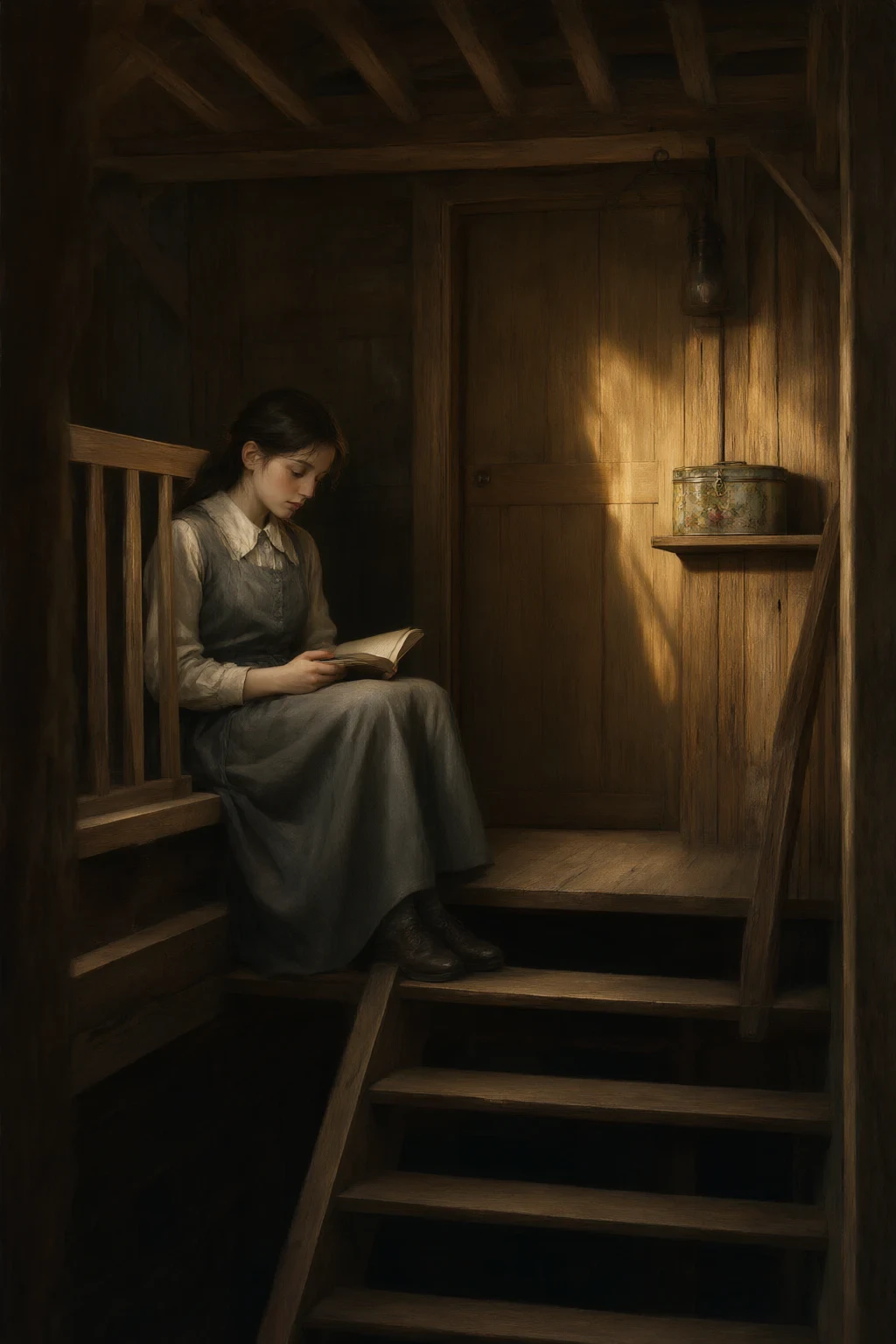
“If you are doing it for nothing,” he said, “then you are the only person in this valley who is doing it for nothing, and in four hundred years there has not been one, and that is not a good thing to be, and also it does not work, because the arrangement is the arrangement, and if you do a person a kindness and take nothing, then you have done a favour and not lent a name, and a favour does not hold, and it does not have to. Is that the rule. Is that why we cannot arrange it.” “That is not the rule,” Aldis Prowse said. “Then what is the rule.” “The rule is that you do not have to,” she said. “And I have not found out yet what I thought the rule was.” The fourth thing they tried was the room, and it was the first of the four that produced something anybody could put in a book, and what it produced was not a person. The room at the top of the mill is nine feet by eleven, and it has a stool and a wheel with a spindle and no drive and no belt and no bench, and a tin, and a lamp on an iron bracket, and a door. It is four steps colder than the loft under it in every month of the year. Nobody in this valley has been in it since 1974 and the audit had had it opened in the second week of November by two people who were frightened of it, and it had been found exactly as the last account of it described it, and then the door had been shut again and the key had gone back to the mill master’s pocket, because the key is in the room, and the room is locked from the inside, and it has been locked from the inside since 1791.
That rule is on the flyleaf, at the front, in the first hand, and it is the only sentence in the front of the roll about the room, and it is not part of the ninety words about entries, and it reads: the door is shut from within and the key stays within, and no one is to stand at it, and a person inside is not to be called upon to come out. “It was written in 1791,” Aldis said, in the counting house, in the last week of August, reading it out, because she reads everything out. “It is in the first hand, in the year of the first entry, and it is the only thing anybody has ever put in writing about the room, and it was put in by whoever kept the roll in 1791, which is to say by the person who has been answering for the room ever since, and they wrote it in the first year, when they were establishing the terms, and then they never wrote anything else about it. Not one line. In two hundred and thirty-five years.” “It is not a rule about a person,” Corve Merrick said. “It is a rule about a door.” “It is a rule about a person. It says a person inside is not to be called upon to come out. It does not say the room is empty, and it does not say the room is not to be swept, and a person who is in a room every day of the year has a room that is swept, and the sweepings go into the ash at the mill, and the ash is not weighed, and nobody has ever asked to see the ash.”
The broom was the second thing, and it was found by Fenn Creech at the bindery, and it took him a day and a half. A bindery handle is a length of ash with a head of beech, and the head is fixed with a lapping of tarred twine in a knot that is particular to the Great Bindery, and the knot is particular because a man taught it to a man in a shed a mile and a half downriver and it has not been done anywhere else in three counties. Every broom made in this valley for a hundred and forty years with a proper head on it has that knot on it, and the mill bought its brooms from the bindery until about the middle of the war, and bought them after the war from a man in Bristol who had never seen the knot, and the mill has had two brooms in seventy years that did not come from the bindery. There is one in the mill house, and it stands in the passage behind the door, and the head is bound with a tarred twine lapping, and the knot is the bindery’s knot. “There have been a great many people in this house,” Fenn Creech said. “I would not put it past the yard. I would not put it past a woman, neither, and I know how that sounds, and I have been in this trade thirty years and I would not put it past a woman.”
The third thing was the lamp, and it was the smallest thing anybody found in four months and it took three days. The mill buys its lamp chimneys by the gross out of Bristol, and they are tin, and they come in a crate with the mill’s name on it, and the crate is in the counting house against the wall under the window and has been since the mill was rebuilt. A tin chimney is dull, and it dents, and it is burned out and thrown away and bought again. The glass in the bracket at the top of this mill is cut. It is a plain cylinder, ground at the foot, with a band of small cut slots round the shoulder, and it is Bristol glass, and a piece of Bristol glass like that does not come into a valley in a crate with a mill’s name on it. It comes in a case with a glass man’s name on it, in a load of plate and window glass, and it costs about as much as a week’s pay. Aldis Prowse asked, in the counting house, in the last week of August, whether the mill had ever bought a cut lamp chimney.
Corve Merrick put his hand on the tally-board and said that the question was asked in 1871, and that the answer was in the quarter book for that year, under oil and light, at four shillings and sixpence a quarter, and that it had been four shillings and sixpence a quarter every quarter since, and that the quarter book carried it in the same hand in every year, and that he had never in nineteen years asked a second question about a line that did not change. “A fixed sum,” he said, “is a fixed quantity. It is not a price. A price is what a man pays. This is what a man uses.” And then the oil, which is where the four months ended and where they should have begun, because it is the plainest thing in the building and it has been entered in a ledger in the counting house every quarter since the year the room was made. Paraffin is bought by the firkin and stored in the counting-house press and drawn against a counterfoil. The storekeeper is a man off the floor, and he is changed about every year, and he does not keep a book of his own, because a storekeeper in a mill is not trusted with a book of his own. He writes a counterfoil, and the counterfoil is a slip of paper with a date, a quantity, and the person who drew it, and it is copied into the store book, and the store book is copied into the quarter book under the head of oil. Two hundred and thirty-five years of them. One every quarter. Nine hundred and forty of them, of which some are gone and most are not, because paper in a tin in a mill does not rot.
The first forty of them, out of curiosity, gave a name. A man in 1791 will not write his wife’s name on a slip of paper for a half-pint of paraffin, and the man in 1796 will not write the name of the cook, and the entries run: by the wife, by the girl, by the under-housemaid, by the nurse, by the cook, by the charwoman, by the under-housemaid, by the wife, and so on for two hundred and thirty-five years, in the hand of a succession of storekeepers who were each of them dead within nine years and none of whom ever asked anybody anything. “And that is the whole of two hundred and thirty-five years,” Merrin Dole said, on the Tuesday, in the counting house, with the counterfoils out on the long table in a bundle, “and it is worth saying out loud what it is, because nobody has ever said it. In nine hundred and forty quarters the person who draws the oil for the room at the top of this mill has been described in a ledger as the wife, or the girl, or the under-housemaid, or the nurse, or the cook, or the charwoman, and never once as a name. Not because the person had no name. Because a storekeeper does not ask a woman’s name for a half-pint of oil.”
The fifth thing they tried was the one thing nobody in the valley had tried, and it was tried in the first week of September, and it was tried because Pell Harrow came up from Bristol on the second and sat at the end of the table with his hand on a leather case for two days and then on the third day opened it. It is a list of every name the mill has ever lent, made at the rebinding in 1841, when the leather gave and a binder out of Bristol took the book away for nine weeks and came back with it ruled and re-backed and trimmed at the edge, and while he had it he thought, reasonably, that the whole of it ought to be written down somewhere outside the book, in case the book was lost. It is thirty-four years in a case in an office in Bristol. He bought it for a bolt of cloth from a man who was clearing a dead relation’s shelves, and he has carried it up to Nether Combe four times in thirty-four years and has never opened it, because as long as it is in a case it is a thing he owns, and a thing he owns is worth more than a thing he has used.
“Strictly,” he said, “for my part, I have not come up here to find a name. I have come up here to look at a list, because the audit says the roll cannot name the lender, and I have a document that cannot name the lender either, and I have had that for thirty-four years and I did not know it until the second of June.” It has six columns. Five of them are the roll’s five, and the sixth is at the right-hand end, and it is headed, in the binder’s own hand: LENT BY. The column is filled in for one year. One year, and then a line drawn down the page under it, and the binder’s note against the line, in the same hand: the column is kept no further, the book is not lent, and this is not to be copied. And it is filled in. Eleven names, for 1841, in the column headed LENT BY, and the eleven names are names the binder had heard, or had been told, or had copied out of the parish register across the water, or had taken off a piece of cloth, and beside each of the eleven, in the fourth column, in the column where the form of the call is entered, is the same four words. The wheel did not turn.
Eleven times, in one year, in one hand, in the hand of a binder out of Bristol with nine weeks and a good deal of money in a mill town and every reason in the world to be careful. Not once, out of eleven, did the spindle turn for a name that was not given. And the binder stopped, and ruled a line under the column, and wrote that the column was kept no further and that the book was not lent, and took the book home to Bristol in a cart with the re-backing done and the fore-edge trimmed, and put it back on a shelf in this building, and the shelf is the shelf it was on in 1971 when a seventeen-year-old girl asked to see page four hundred and six and was told no. “That is the only experiment,” Pell Harrow said. “In two hundred and thirty-five years, that is the only recorded attempt anybody has ever made to find out who the spinner is by doing something, and it is written in a document that is not the roll, and it was done by a man who was not in the valley and had no stake in it whatever, and he did it in a shed on the Bristol road with a wheel he had bought, and it did not work, and he wrote down that it did not work.” “Then somebody tried it and it failed,” Corve Merrick said. “Somebody tried it,” said Pell Harrow, “with a wheel he had bought. Nobody has ever tried it with the wheel.”
The wheel in the room at the top of the mill is the only one anybody knows of, and it is a spindle and a wheel and a stool, and it has no drive, and nobody in this valley has ever heard it turn, and the binder of 1841 established in writing that it does not turn for a name that is not given. The town has been carrying that about as a story about a strange little man for two hundred and thirty-five years, and there is no part of it that is a story. It is a condition. The wheel is not a mystery and it is not a machine. It is a test that has been standing in a cold room for two hundred and thirty-five years, waiting for somebody in this valley to bring it a name. The last week of September is when the four months came together, and they came together in the counting house, at ten in the evening, with the stove going and the pay board in the bar of light off the yard window, and there were five of them and one thing on the table.
Aldis Prowse laid it out in the order it had been arrived at, and she was careful about the order, because the order is the only part of it that is not evidence. The first was a piece of fine linen a yard and a quarter long with a rust-brown corner mark on it in iron-gall ink, and the mark was a name, written with a quill, in a hurry, in a small hand, and the A had a bar across it. The second was a sheet of paper with a rubbing on it, taken off page four hundred and sixty-three of the roll on the eleventh of February by Merrin Dole in front of two witnesses, and the rubbing had eleven words on it, and the letters stood two millimetres above the line and no more, and the A had a bar across it. The third was a counterfoil from the first quarter of 1841, and beside it a counterfoil from the first quarter of 1971, and the 1971 one said: half a pint, upper loft, by the under-housemaid, and the ink on it was iron-gall and the writing was the writing of a man who had been a storekeeper for a year.
“Same hand,” Merrin Dole said. “The cloth and the blank page. Eleven years apart, two completely different jobs, and I have had the cloth under a glass on this table for a fortnight and I have the rubbing beside it, and they are the same hand. The bar across the A is the thing. Nobody in this valley forms that bar except a person who was taught it or a person who has been taught the weekly pay.” “It is the fifth hand,” Aldis said. “The hand that has written the outcome of every loan since 1940. The hand that worked the press on the fourteenth of February 1971 in Bess Prowse’s name. The hand that wrote on the last written page of this roll on the fourth of March 1974 that the mill is paid to the first of the month and to ask the mill for the rest.” “It is the same hand,” Corve Merrick said. “It is a good hand and it is a small hand and I have had it in front of me in this room for nineteen years. But I am not going to be the man who says a hand is a person.”
“Why not,” said Jory Vasc. “Because a hand can be taught,” Corve Merrick said, and put his hand on the tally-board. “I have written the weekly pay in this room for twenty years, one hand, every Friday, and the pay goes out in that hand and the pay books are in that hand, and four people in this valley can write the weekly pay of this mill. Two of them I taught. I taught them in a fortnight each and I taught them the bar across the A, because I was taught it, and the man who taught me was taught it, and the bar across the A in this valley goes back further than the roll does. A hand is not a person. It is a way of doing a sum.” Nobody had an answer to that, and it was the only afternoon of the four months in which anybody in that room said something that was right and could not be got round. “Then the counterfoil,” Aldis said. “The counterfoil says the under-housemaid, and the under-housemaid in 1971 was Nanny Rowe, and Nanny Rowe is seventy-nine and has been in service at this mill since she was fourteen, and she was the only person in the mill house on the fourteenth of February 1971 except for the one who came, and I have never asked her a question about it in my life.”
“You have been in this house every day since March,” Jory Vasc said. “I have,” Corve Merrick said. “And I have not asked her, and you may put down why, and it is not because of the lamp. It is because she keeps this house and I am the master of this mill, and a man in my position may ask a servant anything at all, and she has never once given me a wrong answer, and if I ask her the wrong question she will give me a right one, and then I shall have it.” So the question went to the pound house on the Wednesday evening, at nine, and it was put in a form, and the form was the only work Aldis Prowse did that week, and it was this: not what did you do, and not what did you see, and not who came to the door, and not any of the eleven questions this valley has put to that room in fifty-five years, but a question with a unit in it, because Nanny Rowe has never once in her life answered a question that had no quantity in it and has answered every one that had. How long were you standing in that room. The lamp went down before she started, which it does. “From the light leaving the west window,” Nanny Rowe said, “to the last cart going down the bank. That is longer than the sermon and shorter than the psalms, and I know it because I heard the psalms start in the valley and the cart go down the bank after, and there is not a great deal between them in February.” “That is what you told me in March.”
“That is the eleventh answer,” said Nanny Rowe, “and it is the same as the other ten, and I told you on the first of them that they were not the same answer, and you may go and think about what I meant by that, and I am not going to say it for you.” “There is no drive on it,” Nanny Rowe said. “I have lain in this room fifty-five years with the mill under me, and the mill is the loudest thing in this valley in every month of the year, and I have never once heard that wheel go round, and there is no drive on it.” “Why did you say turn.” “Because there is nothing else it does,” said Nanny Rowe, in the present tense, and she was not joining anything to anything, and she was talking about a room she had never been in, and she did not know what she had handed over, and Aldis Prowse wrote it down in her own hand, both hands, and put the notebook away and walked back up Mill Bank in the dark.
The last Tuesday in September she counted the mill. She had it worked out in the counting house on the Friday, because a count that is arranged in advance is not a count, it is a trap, and she wanted a trap. The mill’s establishment for the winter is six hundred and eleven. The places a person can be in this building between two and five on a working afternoon are the scale house, the machine floor, the carding room, the flax store, the tow shed, the counting house, the yard, and the top of the mill. The counting house and the yard were done by a man sitting with his back to the yard window. The mill floor and the carding room were done by Corve Merrick, who knows every one of the six hundred and eleven by the sound of their feet, which is a thing he does and has never told anybody about. The tow shed was Innett Sly, who counted her own frames and gave the number without being asked. The flax store was Fenn Creech, who had come up for the week.
Six hundred and ten, at twenty past four, on the last Tuesday of September, out of six hundred and eleven, and the one that is not accounted for is at the top of this mill, in a room with a shut door, and there is no establishment line for that room, because a person in a room nobody has ever seen the inside of, doing nothing that appears in any book, is not an employee and is not a ratepayer and does not appear in the Sunday count, and there is nothing whatever in the four months to be done about one person out of two thousand and six. “The count does not work,” she wrote, in the notebook, on the Friday, and she wrote it in the plainest words she could find, because a thing that is put in a book has to be checkable by somebody in forty years. “We cannot count him. A count finds people in rooms. He is not in a room. He is in a building that is on the Sunday road and he is the one thing on the Sunday road that is not walked past, and we have counted the road four times and found two thousand and four and a servant keeping a house.”
On the last Tuesday she went up at four o’clock. She had no right to be there and no reason that anybody could put in a book, and she had told nobody, and she went up the sixty-one stairs past the scale house and along the loft, and the four steps down to the door she counted again because she has counted them four times this year, and she sat down on the top step with her back to the rail. The stair was warm. That is the whole of it, and it is the one thing in four months that nothing else accounted for. That room is four steps colder than the loft under it in every month of the year, and Aldis Prowse has sat in it in November with a lamp and has felt her hand stop working by the fourth step, and every person in this valley who has ever said the number of steps has said it because they have felt it. The step she was sitting on was warm, and it was warm at the top of it and not at the bottom, and the warmth was not the warmth of a stove, because there is no stove and there has been no fire in this mill in a hundred and forty years, and it was the warmth of an oil lamp on an iron bracket, behind a shut door, eleven feet away.
The lamp under the door did not move. It is a bracket lamp and the door has a gap under it the width of a knife and what comes through that gap is a line the width of a knife, and it did not move for fifty-one minutes, and she counted, and at four hundred and something the mill’s hour went on the scale house and the whole building heard it, and nothing came down the stairs. At the first of October the storekeeper will write the quarter’s counterfoil, and he will write the role and not the name, because he has written the role and not the name every quarter since 1791, and he will not know that there is a question.