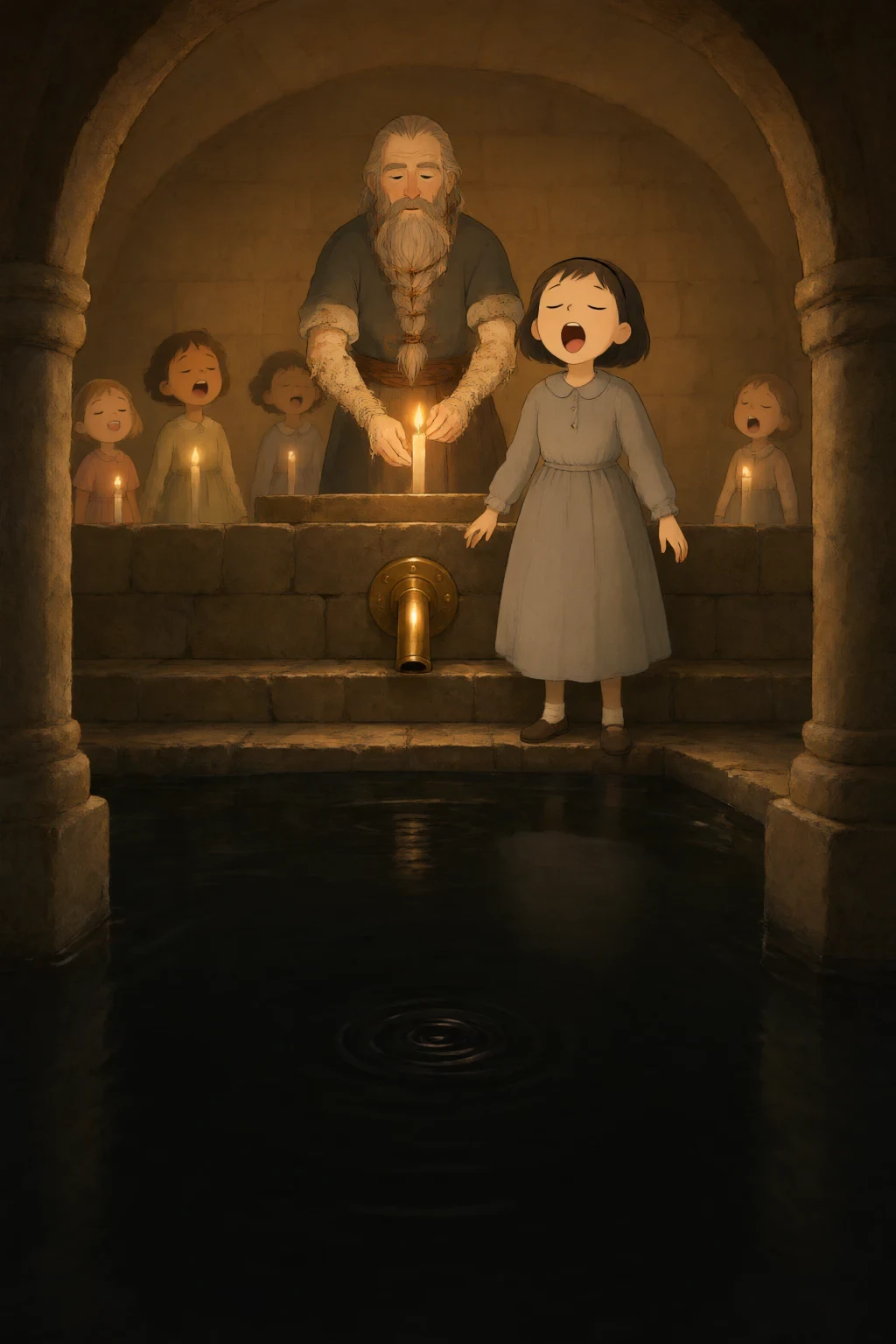
The water allocation was on a Friday, and on a Friday the schoolroom of Verrick had nothing to do, because every child in the village was either at the wellhead with a tally stick or in the bakery. So six of them went down the hundred and forty rungs at two in the afternoon, with the schoolmistress behind them carrying a coil of rope.
She was Mrs Quillet, and she stopped at the fourth rung and said forty-six was as far as she was going, because she was fifty-eight, had a knee like a bad hinge, and was not a singer, and the shaft is narrow. “Hesper is going down first,” said Hesper Vail, who was seventeen and the under-reader, with a brass-tipped hairpin in her hair and salt in white crescents under both her nails. “Hesper is going to count them and keep everybody off the ladder.”
The children were Ivet Sarrow, who read the whole time; Ned Caul, who could not sit still; Bess Ollery, who took a thing seriously once it was explained; Tam Verge, who wanted to be a cartwright; Prue Halstow, who did not talk much; and Rook Kelman, who had a brother in the bakery. That made six, and the cathedral wanted six, which is the sort of arithmetic that gets children into trouble.
They came out of the shaft into a temperature that never had been anything else, and the whole nave glowed from the inside like something asleep, and every one of them said the same thing at once, as children do. Then they stopped, because the sound arrived before they finished saying it. Six notes, coming from above and behind and underneath, through the crystal and the columns, before anybody in the choir had moved off the loft. “That is them singing,” said Ivet.
“That is them not moving,” said Hesper, “which is the same thing. One note each, and they do not stop for more than an hour.” “For how long?” “Since two hundred years ago, more or less.” Ned Caul looked up at the railed loft, where six brass-tipped choir stalls sat in a curve so that each singer could see the floor and not the others, worn to a mirror shine at the mouth of each seat. “Then who is tired?” said Ned.
Garrick Bole was at the foot of the stair with a slate and a look on his face. He was thirty-one, the ledger clerk and the second tenor, with a leather finger-cuff on his right forefinger, brass-shod and worn to a shine. He had six small squares of paper in his hand, and he was going to hand them out in a specific order, and everybody could tell. “Per the count, the choir is six,” he said, “and per the schedule its notes are these five, and this is the sixth order, which has no note at all.”
He gave the first slip to Tam. STILL, said the slip, in his small exact capitals. “It holds and it calms,” he said. “If your note wobbles, everything wobbles. Stand perfectly still and keep your face like a wall.” Tam Verge, who wanted to be a cartwright, said, “How long for?” “An hour.” He gave the second to Ned. DRIFT, it said, and that one moves and shapes, and Ned Caul had to be told twice that his job was to keep moving.
The third went to Bess. PLATE, it said, and that one sets the hard surfaces flat and level. “Flat and level,” said Bess, reading it twice. “So if a thing is wonky, I fix it?” “If a thing is wonky, you sing at it until it is not,” said Garrick Bole, “and that is harder than it sounds.” The fourth went to Ivet. SPIRE, it said, which sets the vertical: the columns and the arches and everything that stands up straight. Ivet went the colour of the candles.
The fifth went to Prue Halstow, and Garrick Bole held it a second longer than the others. “BRINE,” it said. “Canto. It keeps the water moving so that it does not lock.” “That is not a note for a column,” said Prue. “No,” he said. “Per the count, that one has no column. It belongs to the water.”
And the sixth slip was blank. Rook Kelman held it up. “I have not got a note.” “You have got the sixth order,” said Hesper. “It does not make a note. It holds the room’s own quiet in shape, so the other five can lean on it. Five people singing in a stone room with nothing holding the air are five people shouting.” “So I do not sing?” “You do not make a note. You keep everybody from being frightened,” said Hesper, and then, because she was seventeen, “Rook is going to be extremely good at that.”
Then Ilde Marrow came down. She was forty-seven and had led the six for twenty-two years. Above her upper lip was a white moustache of salt crust, kept to shape every morning with a three-inch file out of her breast pocket, and she was carrying it in her hand instead, which the choir noticed and nobody mentioned. She answered in a note first, because that is what she does. Strangers mistake her for strange until she drops to a speaking voice to be kind.
“So the schoolroom is here,” she said, in a low note that Prue felt in her teeth. Then, kindly, in an ordinary voice: “Yes. Ilde Marrow, and I sing the alto, and I have been singing for twenty-two years, and I would like to sit down.” “You have been going early,” said Garrick Bole. “I have been going early.” “For two years.” “For two years,” said Ilde Marrow, “and nobody has said anything, and I would like to stop now, thank you, and take up the whole hour again like a person.”
They practised in the sacristy, all six of them at once, with the choir singing underneath them. That is how you do it. The grown-ups take the note and the children put theirs on top, and after a while the children are louder, and salt crystal does not scold anybody for it. They were terrible. They were gloriously, confidently terrible.
Ned could not find his note twice and both times found a better one. Bess went flat on purpose, to see what would happen, and everything in the sacristy went flat with her, including a candlestick, which was not supposed to. Ivet’s spire note cracked in the middle, and Nissa Ashkel, twenty-two, with the front of her hair singed bone-white in a hard fringe, caught it and turned it into an arch. And through the whole of it, underneath everything, there was a hum.
Not from the choir. Lower than the choir, from under the floor and under the crossing, with a brass note in it, low and steady, like a big door being shut very far away. It had been going for years, and nobody down there had ever stopped hearing it. “That is the water,” said Hesper, when Bess asked. “That is the Wellmouth. It always does that.” “It is not in the book,” said Garrick Bole, from his slate. Then the hour began. One child to a stall. The brass tips of the six seats were cold and then were not, and the mouth of each seat was worn to a mirror shine by four hundred years of one singer leaning forward to listen.
The grown-ups sang underneath. Ilde Marrow under Tam, so the wall of his stillness had something to lean on. Garrick Bole under Ned. Nissa Ashkel under Ivet, singing the arch over her head. Ordin Brack under Bess with a bass so low you felt it in the water chest. Hesper Vail sang under Prue Halstow, who had the water’s note, and was the only one of the six singing to something that was not in the building. They sang for fifty minutes, and it was the loudest hour of the year in a building where a note is not supposed to be loud. At the fifty-first minute the note under the floor changed key.
It did not get louder. It got quieter, and then it stopped, and the whole cathedral noticed at the same moment, the way a room notices when a clock stops. The tap under the crossing dripped into the black pool. Somebody’s boot slid on the wet floor. It was the loudest thing that had ever happened in the Wellmouth Cistern. “What has it stopped for?” whispered Bess. Nobody answered, because everybody was thinking the same sentence, and the sentence was: the sixth voice.
Prue was still singing, because an hour is an hour, and Prue was nine, and nine-year-olds do not stop an hour early. Her eyes were shut, and she was singing the water’s note into a cistern that had gone completely silent, and they could hear their own voices come back off the water, which you are not supposed to be able to do. Then the water answered. Not loudly. It came up out of the black pool from the middle, where it is deepest, a fifth lower than the hum that had stopped, and warm, in the way the note was warm. It was a note nobody in that building had ever sung, and no column in four hundred and eleven pages answered it.
“Stop,” said Ilde Marrow. Nobody stopped. “That is not a note we have,” she said, louder. “If we answer a note no column answers, we are singing a debt, and a debt is how the bay grows half an inch a week, and it is not a game. Stop now, please.” But six children from the schoolroom of Verrick were standing in six brass-tipped stalls four hundred feet under a salt pan, and a warm note was coming up out of the water, and what children do with a note is the one true thing about children.
They hummed it back. Badly. All six of them at once, with no note written down anywhere and no idea what they were doing, and Prue Halstow led it because Prue had heard it first, and Mrs Quillet’s voice came all the way down the stair shouting the words, one word in and one word out, the way a schoolroom does. For about four seconds the whole cathedral held still, because every singer in the loft knew exactly what an unentered note was worth. And then Ilde Marrow, who had been taking forty minutes of her hour for two years to keep the book from noticing, sang the thing her children were singing at the top of her lungs, in the alto, and the crack that went across her salt moustache that night was heard in the second gallery.
The rest of the night was loud and warm and badly organised. Ordin Brack came up out of the cistern with water running off the copper wire in his beard and said, to nobody in particular, “Closer. The floor carries. Closer.” Nissa Ashkel sang over six children for fifty-one minutes and then had to sit down on the loft step, laughing, and she has never been so glad to be tired in a different way. Garrick Bole stood in the middle of the nave with his slate and his finger-cuff shining, trying twice to work out what to write down, and could not.
Hesper Vail read the whole hour out loud from the top of the stair, which nobody had asked her to do, and which is the only reason the note is a note and not a rumour: a note is only sung if another living person hears it sung. By the end there were eleven of them listening, and one was fifty-eight years old at the top of a ladder with a coil of rope round her arm, shouting, “Again. All of you. Again.”
In the morning, the water was still humming. That was the thing nobody had expected. Everyone had expected a cistern that went quiet and stayed quiet, and instead the Wellmouth held the new note the way a floor holds a table, low and warm and without effort, a fifth below where it had been before, so low that you did not hear it unless the building went quiet. The gallery in the north aisle still hums a fifth above the choir. It always has, and it is why nobody has slept properly in a year.
From that night the Wellmouth answered it from underneath, a fifth below, and the two hums met in the middle and cancelled each other out, the way two notes do, and the whole enormous building went quiet at about three in the morning for the first time in eleven months. Ilde Marrow slept for nine hours. She cried a bit about it and then blamed the salt. And on the Friday after that, Garrick Bole went to the Ledger Room with his slate under his arm and a request. “It should be entered,” he said. “Per the law, a note is only sung if another living person hears it sung. Eleven heard it. Per the entry, it has been entered into the world, and the world is a book as far as the salt is concerned.”
“It has no column,” said Lida Trask. She was thirty-nine and forty years in the book, with a black ribbon on her left wrist renewed every twelfth month. “The book has four hundred and eleven pages and no more, and every one of them has a column on it, and there is no column anywhere in this building for a note that belongs to the water. If I put it in, I am inventing a page.”
“Then it is a debt,” said Garrick Bole. “Per the schedule, an unentered thing is a debt, and debts accrue, and I will not have the cathedral accrue a debt to a schoolroom.” “Then what would you have me do?” He took off the finger-cuff and turned it over, the way he did when he was thinking about arithmetic. From the doorway, so quietly that everybody had to walk closer to hear him, Ordin Brack said, “Closer. The floor carries.” They walked closer.
“The water has been singing that note for a hundred years,” he said, “and it is not in the book, and no choir has ever leaned on it, and no one has ever written it down, and it has cost that pool one drop of water. It has been free for a hundred years. It is the only free thing in this building.” So Lida Trask wrote nothing down. She sat in the too-warm room with the one candle and the brass-cornered lectern and the stool nobody is allowed to sit on, and she closed the book, and she said out loud, to nobody, that there are things which are only done, and that a book with four hundred and eleven pages is not a worse book for having one thing in it that is not written.
Which is not a sentence anybody would expect from the Reader, and which she said in a very small voice, and which she did not write down either. The six children were not allowed back into the cathedral. That was the end of it, and there was no argument. The Cantrix is the Cantrix, and a note with no column is exactly the sort of thing the whole book exists to stop. Mrs Quillet said she agreed and meant it. What they were allowed to do was sing on Fridays.
They sing it now on the way down to the market, all six of them, badly, at the top of the road where the wind over the Flats makes the sound of a room being swept, and nobody in Verrick has ever asked where they learned it, because nobody here asks where a thing comes from if it is obviously good. Underneath them, a fifth below, four hundred feet down, the Wellmouth hums along, and holds the note, and does not need it written down.
Hesper Vail reads the cancelled pages on Fridays, all nineteen of them, in order, out loud. And if you stand in the north aisle on a still evening, with your ear to the column at the sixth place, you can hear it: the bay, humming up above, and the water, humming down below, and the whole enormous quiet thing of the cathedral, holding perfectly still in the middle where nothing is written at all.