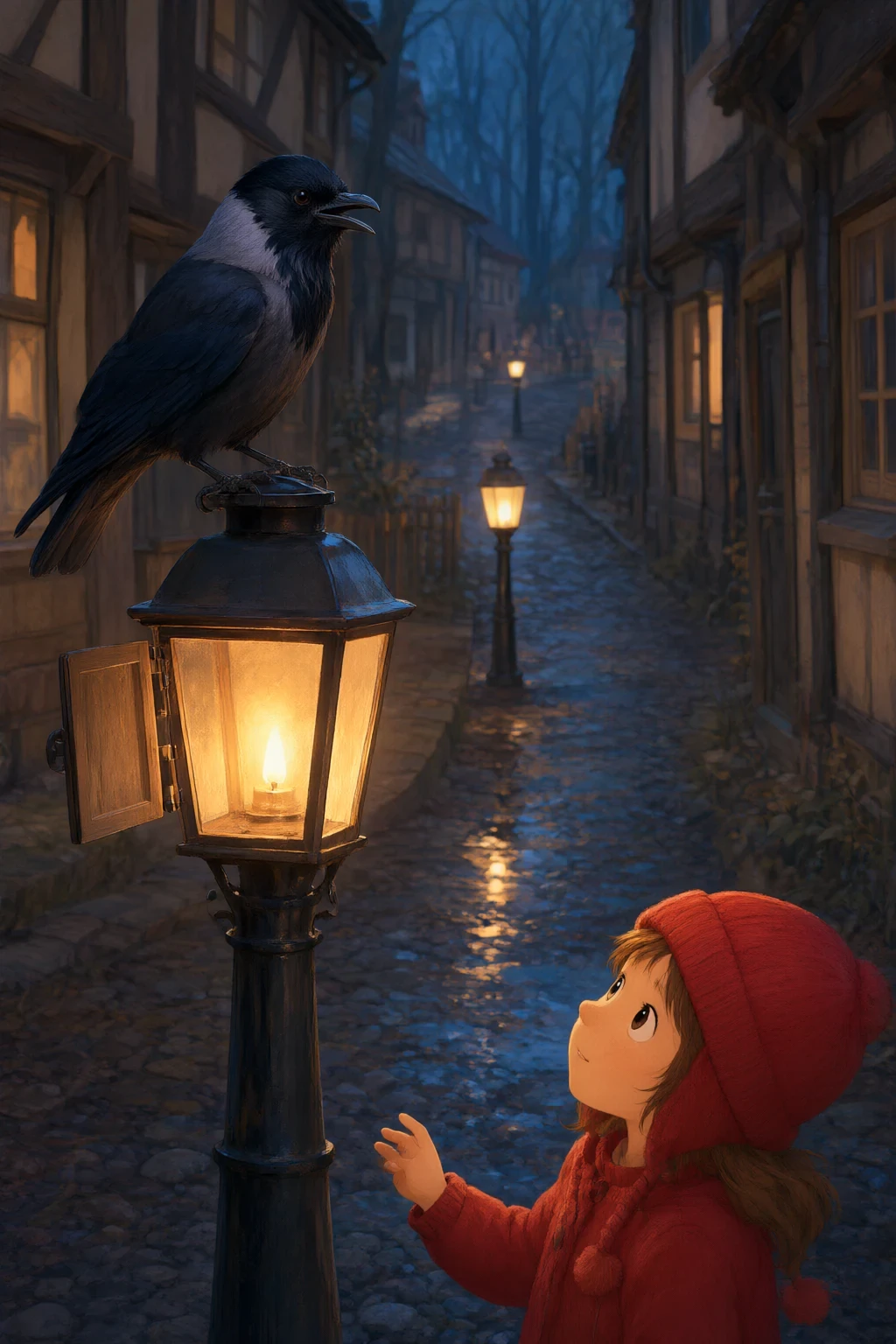
Dusk on Lamplighter Row is a light like watered pewter, and then it is not. Nessa Brack was fourteen and third season, and she could have been signed off as a full wick-watcher before the first frost if there had been any justice in the world. Tonight was the last round before the Warden’s frost-day. She had the eastern stretch, forty-one lamps, a slate, and two fingers of her left hand stained green-black with sap, which she did not hide, and which made the brass handle of her lamp tin quite beautiful.
The bird was on the first lamp-post before she was. He was a hooded crow, black as a wet slate, the hood down his neck like a collar, and he sat on the cap of the post with his wings folded and his head cocked over to one side. The top third of his left beak was gone, so every sound he made came out with a whistle in it. “Sixpence,” Nessa said. “Lights, then,” said Sixpence.
That was the wick-call. Every wick-watcher in Nettlefold had it: two words, said at the door of a lamp, meaning this one, and I am here. Nessa said it eleven times a night. “Sixpence, that is my job.” “Count it,” said the crow.
So she did what any watcher does. She opened the little hinged door, and put her hand in, and lit the wick, and the wick took, and lamp one was burning. “Lights, then,” said Sixpence, from the next post.
The trouble was that he was early. He was always early, and he was always first, and after a week Nessa stopped pretending to be surprised about it. He did the whole Row before the light had finished going. He sat on each cap in turn and sang the wick-call at the little door, and the sound of a voice arriving at your lamp is the sound that rouses you, so that week the lamps came up at dusk with nobody hurrying.
At the top of the Row there is a slate, and on the slate the tally: a hundred and one lit windows, checked twice a night. Nessa had been chalking those numbers for three seasons, and she knew exactly what her own handwriting looked like when she was tired. At the small hours that week the tally came up short. Not by much. By one. Then by two. And then, on the Thursday, the crow did a round in front of her.
He went up the Row in the proper order, cap by cap, wick-call, wick-call, wick-call, all the way to the end. He did it an hour before dark, which was not possible, and he did it in order, and he missed nothing. Nessa followed him up the Row with the chalk. At the end of it she stood in the rain with the slate in her hand and a number she had not once written.
The village split, and it split along the join in the ground. The weavers left him bread on the post-caps. The oil-renderer’s boy left him a dish of fat. Old people said a crow that knows the wick-call is a crow that has been taught, and a crow that has been taught is a crow with a reason, and they left him more. Tace Aldren left him a lump of forge fat and swore at him fondly.
“Look at the beak on him,” she said, with her goggles pushed up into untidy hair. “Somebody’s gran lost a fight with something. Slag luck, Sixpence.” “Sixpence,” said the crow. “That’s not slag luck, that’s your name.” Others were not charmed.
The charcoal seller at the Cross said a crow does not learn a call, a crow takes one, and the only thing worth copying out here is charcoal. He said the wardens had let a bird into the wards. He said if a crow can work a lamp, what is a wick-watcher for, and half the Cross agreed with him, which is what made it dangerous.
A crow working a lamp is a funny thing for a week. Then it is a question. Then it is a reason to reach for the notice-slate and ask for two fewer lamps on the eastern stretch. Two fewer lamps. And the sap on the pact-board already drying in patches. And every lamp paid for with a spoon of the trees’ sap, a season. That was how it got frightening. Not the bird. The arithmetic.
But here is what the village did not know yet, and what turned out to matter more than the arithmetic. The last lamp on the Row stands at the top of the slope. Past it there is no lamp at all. Sixpence went out past it. Not once. Twice that week, on a dark night, on his own, an hour before the Row was lit, and Nessa found the round prints of his feet in the chalk of the boundary mark and the prints going out, into the dark, toward the Barren Ring.
The wick-call goes with a watcher. You say it at a lamp you are going to light, because somebody is inside that door and is going to answer. Sixpence was going out past the last lamp and saying it to nothing.
They took it up to the Scriptorium, because that is where questions go when they will not sit still. Elder Sable Ashdown stood at the oak reading stand with her hand flat on the pact-board. Forty-one lines of sap script in glossy dark letters, pinned by a square black nail of cold iron through the last line, and never warm. She read a line in a soft sing-song, then stopped and said it again, slower. “A bird is not a hand,” she said. “A crow’s a bird,” said Tace.
“A crow is a bird, and a bird is not a hand, and no living hand may be a signature. Blood is forgery. Sap and cold iron are what the Wood will take, and it takes them once.” She looked along the board. “So when Sixpence says a word of this, he is not agreeing to it. He is saying a word he has heard. That is all a mimic is. That is all a mimic is for.” “Then he can’t be one of us,” said the charcoal seller, from the door, pleased.
“He cannot be a party,” said Elder Ashdown. “But he is not nothing, either, and I would ask you to be careful, because you are about to make a mistake that everybody in this room is also about to make.” She turned her good eye on Nessa.
“The lamp needs two things. Oil, and a watcher who is awake and meaning it. A crow can carry oil in a bird that is not even a crow, if somebody foolish enough teaches him. A crow cannot mean it. A lamp lit by nobody goes out.” She put one finger on the board. “So the bird can keep a lamp. The bird cannot keep the line. The line is a thing that two parties say out loud, and one of them has to mean it, or the words stop being true and nobody strikes them out. They just stop.”
Nessa thought about the wood. The birdsong in the Walking Wood always stops in the same place. Merrin had told her so a hundred times, that the birds never finish a phrase, and Merrin had never once been believed. A call with nobody in it to answer. That was all it was. Sixpence was not a monster. He was a bird standing in the dark being the end of a sentence, and nothing was coming back.
Oren Vall nailed up the order on the Thursday, at the Cross, where everybody could be angry at it on schedule. It was three lines long. The bird keeps a round. The bird works past the last lamp, to the boundary mark and no further, and he calls the wick-call there, once, and then he waits. And every wick-watcher on the Row, on passing that mark, stops and answers him. The Cross was quiet. “He is to have a job,” the Warden said. “He is a crow,” said the charcoal seller.
“He is the only one of us who goes out there, and he goes out there before dark, and he comes back.” Oren Vall turned the staff so that the brass cap went down on the gravel with a small flat sound, and his left knee clicked, and he waited until it was finished. “Aye. Aye, but—” He stopped there, and the pause went on much too long, and the whole Cross waited with him. “Then write his name on the brass plate,” he said. “A plate nobody reads is not a plate. It is a lid.”
And then it was Nessa’s turn, and she had known for a week that it would be, and she had been putting it off the way you put off a step in the dark. The tally slate was up on its post. The Cross was there. Oren Vall and the three weavers and Tace with her sleeves shoved up and the charcoal seller with his hat in his hands. “I have to say a thing,” Nessa said, “or I am not going to be able to do my round properly tonight.” “Go on,” said Oren Vall. “The crow is better than we are.”
She got it out in the plainest words she could find. “He does the Row an hour before dark, in order, and he does not miss one. My tally has been short by one, and by two, because I am tired at the small hours and I chalk what I expect to see. He does not miss one because he is not expecting anything.” She held the slate up. “When he called at the post, I answered, and the lamp came up clean. When a tired woman calls at a lamp, the lamp comes up crooked.
He does the round better than the grown wick-watchers of this village, and he is four years old, and he does it because nobody ever told him to.” Nobody said anything at all. “I am saying it out loud so it is true,” Nessa said. “And I know what it sounds like. It sounds like I am asking for a smaller Row.” “No,” said Oren Vall. He was standing very straight, and he was gripping the staff with both hands, and he was not looking at her. He was looking at the slate.
“No,” he said. “I have been the Warden for nineteen years, and I have signed off eleven wick-watchers, and I can tell you the thing that is true about this job, and it is not the flame. Nobody’s job is the flame. A flame is oil and a wick and it will go out on its own if you let it.” He turned the slate over and looked at the back of it, which was blank. “A wick-watcher is the one who comes back.
A wick-watcher is the one who is awake, and meaning it, when somebody calls out in the dark and the answer has to come from a person.” He put the slate down on its post. “Eleven lamps, and the twelfth is out on the boundary mark, and the twelfth one is a crow who will never know whether you answered.” He nodded at her. “Which is exactly why it has to be you, and not him, and not the oil. Signed off, Nessa Brack. Before the frost, as you wanted it.”
On the Thursday night after, Nessa did the whole round with the crow. Lamp one to lamp forty, down the Row, eleven paces apart, the little hinged doors, the chalked numbers, the brass plates with the watchers’ names on them, and the smell of everybody’s cooking and the smell of oil, and the dark coming in from both sides of the lane like water. And then past the last lamp, up the slope, out to the boundary mark where the gravel turns into bracken and you can see the join. Sixpence was already there.
He had his wings folded. He had his head cocked over. Out past him there was the Barren Ring, bare, and the Walking Wood standing up out of the ground on the far side of it, forty feet of iron-barked tree on slow root-fists, moving, not one step in ten minutes. “Lights, then,” said the crow. And Nessa Brack stopped on the boundary mark in the rain, fourteen years old, with a hundred and one windows chalked on a slate behind her and a name on a brass plate in a line of other names, and she answered him. “Count it,” said Sixpence.