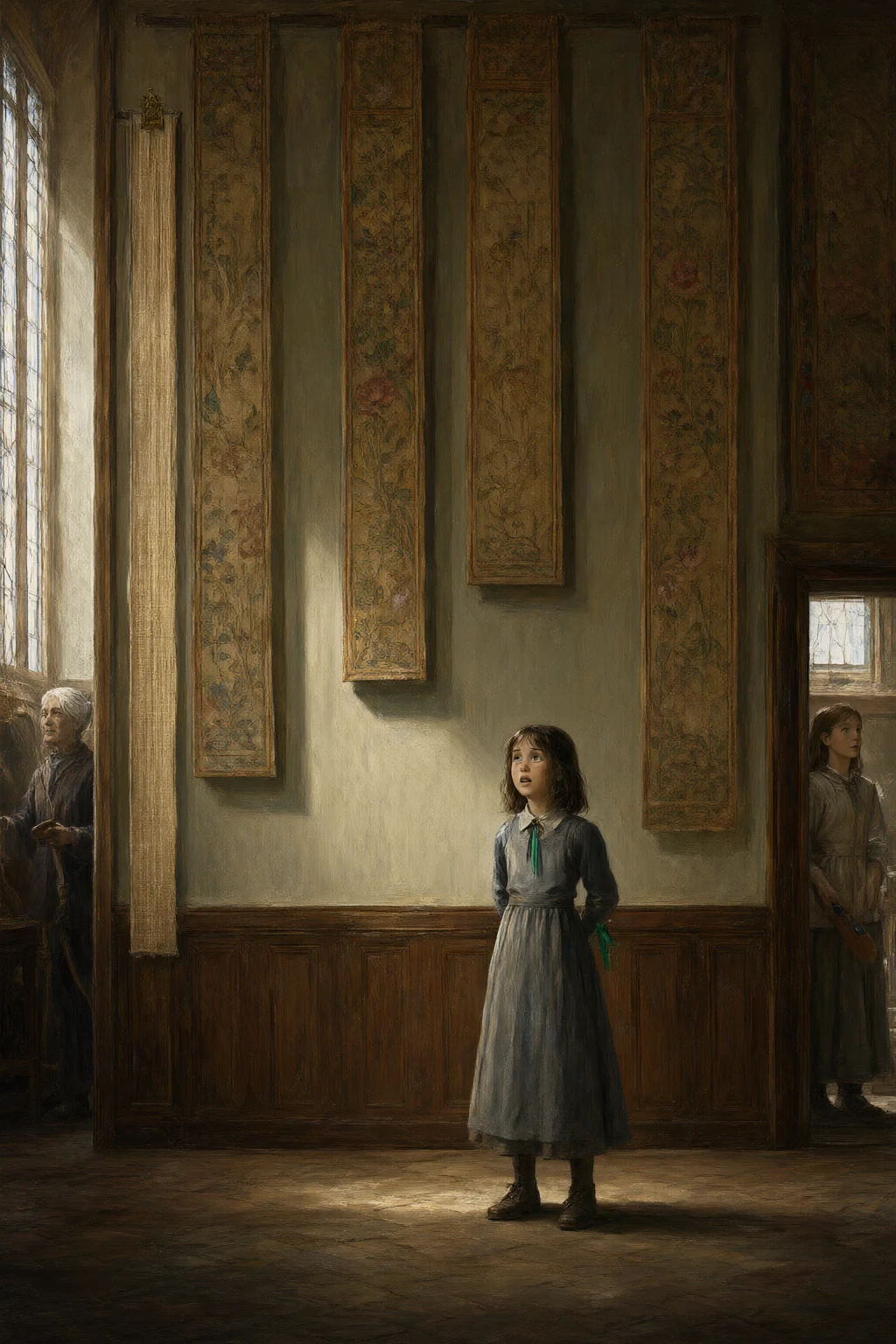
The commission was opened on the eleventh of September, at the guild meeting, by the commoner, and it was opened in the ordinary way and took four minutes. The commission book is leather and it is ruled in columns and it is the second oldest book in Sparable, and the columns are: number, date, goods, of what, in the negative, weaver, buyer, threads, finished. Every line of it for two hundred and two years is a line on which something has been left out, because the guild does not record goods, it records decisions, and a decision is a hole with an owner. The minute for the eleventh of September reads that the commoner proposed that a ninth panel be provided for the north wall of the Great Hall, between the fifth and the sixth, and that the question was referred to the commission book, and it was entered there and then, in the meeting, because the guild has never in its history waited for anything.
There was one reason given for it, and the reason was given by the commoner, and it was that people ask. He said it plainly, in the way he said everything. The hall is the finest room in the county and there is a space in the middle of its best wall, and it is where the eyes go, and schoolmasters bring classes to the hall and stand them in front of the north wall at eleven o’clock on a Tuesday, and the class sees eight cloths and a space, and the class is nine or ten years old, and nine or ten is exactly the age at which a person can see the whole thing and say so. Nobody in the room contradicted him. Corin Slee wrote it into the minute as the question of the space is raised, which is the guild’s way of writing down a thing nobody wants to be the first to have said out loud.
The part of the book that caused the trouble was the eighth column, which is headed threads, and which is where a commission of two is entered. A cloth with one omission in it is a weaver’s own business. It is invisible to everybody except the person who left the thing out, who can look at it every day of her life and see exactly what is not there, and there is no way of asking her about it and no way of checking her, and the guild has made peace with that by never asking, and by calling it a private decision, and by having four hundred a year of it coming out of the shed.
A cloth with an omission agreed by two people is a different animal. It is gone. It cannot be looked at by the two of them together, or apart, or at any remove, or by anybody else ever again, and the reason is not a matter of trust. It simply is not there any more, in the way a road is not there after a flood. It is the only irreversible thing this town makes, and the guild allows about four a year because four a year is what the shed can be got to swear to, and because a town that made twenty would be a town where nothing anybody agreed to could ever be found again.
The book for 1893 had three lines in it. One in January, a lining for a house that is not in Sparable and was not in Sparable, and the buyer was a man from the flats and the weaver was on the ninth loom and the entry says the goods are not to be described to the buyer or to anybody. The second was in February and was a lining also, and the third was on the sixth of March, and it was a coat, and Corin Slee entered it himself and wrote third of four in the margin, because the allowance had been six in another year.
So the ninth panel would be the fourth of four, and the fourth of four was the last of the year, and it would be spent on a length of wall between the fifth and the sixth, and Corin Slee said so at the meeting, and the commoner said that was very well, and Old Mab Ostry, who was at the back with her hands in her sleeves, said nothing at all, which was how the room learned that she had been in it from the start.
They went up to the hall on the Wednesday to look at the space, which is a thing a commission does at the start and has no need to do at all. It is five yards by three yards six inches. It is the same size as the other eight, because it was set out with the others, and the rail is continuous through it, and the two iron hooks that hold a panel of that weight are drilled into the same beam as the eight pairs, and they are not rusty, because the hall is dry and the hall is swept and there is a boy in this town whose business it is.
What is on the rail between them is a length of unhemmed raw warp, five yards and four inches, and it is the colour of weak tea, and it has been in the light of eight north windows for two hundred and two years, and it is the only thing on that wall that has ever been touched by the sun’s whole length of the day. “It is undyed,” said Wenna Pike. “It is the colour of the wool before anything is done to it, and it was undyed when it was new, and it has faded from a cream to that in about a hundred and forty years, which is slow, because it has never been wet and it has never been moved.” “Is it a good warp?” said the commoner. “It is a good warp,” said Wenna Pike. “Forty threads to the inch, and I would put my name to the spinning. That is the best cloth in this room and it is the only one here that is not cloth.”
The child was brought up because the child is always brought up. Ilse Barrowe came in with the green ribbon on her wrist and stood in front of the space and looked at it, and then she told them what it was, and she told them for four minutes without stopping, and nobody stopped her, because there was nothing in the room she could kill. That is the thing about the ninth. It is the one object in the Great Hall that can be talked about. The eight are not talkable. Ask an adult what the third of them has left out and you get a silence, or a joke, or a change of subject, and no adult in Sparable can see whole cloth and never has. The ninth is a length of bare warp and a brass label, and describing a length of bare warp supplies nothing, because there is nothing in it to supply, and so the child stood in front of the gap and gave the room the finest description any of them had ever had of anything on that wall.
“It is not a hole,” she said. “Everybody thinks it is a hole. It is a rectangle that is five yards and four inches long and it is thinner than the ones either side of it and it is not hanging, it is nailed, and it has four nails and one of them is a long way in from the end. It is the colour of a cup of tea with milk in it. It has got a lot of little holes in it, in lines, all the way along, and that is the loom. It has not got a hem, and the ones either side have got hems, and the hem is the thick bit at the bottom where the threads turn round. And there is a label.” “The label is brass,” said Corin Slee.
“The label is brass and it is small and it has got a hole in the top for a nail and it is nailed on with a nail that does not match the other four, and it has got a date on it, and it does not have got anything else on it, and that is all, and I have read it a hundred times and it is just the date.”
On the Friday, the commission tried to write itself, and could not, and the reason it could not turned out to be the whole of the story. A commission in Sparable is written in the negative, all the way down. Not this cloth, but no second border. Not this cloth, but without a name in the corner. All the way down, until what is left on the page is a set of refusals with nothing in them, and the guild’s standing orders say that a commission which cannot be written in the negative is not a commission but a wish. The ninth panel had nothing to refuse. That was the difficulty and it took the whole morning to say it out loud properly, and it was said by Corin Slee with a pencil, on a clean sheet, in six lines.
You can refuse a thing on purpose, because on purpose is the only kind this town makes, and a refusal says: here is where it would have gone, and that is a decision and it is the only kind worth the yarn. A panel on the north wall with no selvedge would be a ninth omission in the series and would be worth what the weaver said it was worth, which might be a great deal, and the guild would have entered it in the book and stamped nothing and sold nothing and got on with the winter. But the ninth is a replacement. The word on the form is to supply the ninth, and a replacement is a thing that stands in for another thing, and to stand in for another thing you must know what that other thing was, because otherwise you are not replacing it, you are occupying it, and those are different, and the difference is the difference between the ninth omission and a ninth hole.
Lysa Ferrant, who was seventeen and who was in the room because she was the only weaver in Sparable young enough to be sent for, put it in one sentence, which she did afterwards claim to have said in front of a commission and which Corin Slee entered in the minute as having been said by the weaver on the second loom. “If we write the form,” she said, “we are writing down what we think the ninth was going to have. And whatever we write will be true of the cloth we make, and it will be a decision made in this room in September, and it will be dated September, and the wall will have eight decisions from the seventeenth century and one from a Tuesday.”
The argument for filling it was made properly, over three evenings, by people who were not being sentimental about it. The case was that the guild exists to keep decisions. The town sells nothing else. Everything a weaving town is for is the making of a thing with a hole in it on purpose, and the keeping of the record of the hole, and the whole of Sparable’s trade and its name and its eight hundred years of charter is a bet that a decision is worth more than an accident. And the ninth is the one place in the building where there is an accident, and old is not a reason, it is a date, and a date is not a decision.
Fenn Roke put the numbers to it. Eight omissions in a row are a series. Eight is a number and a number is a figure and a figure can be counted, and a thing that can be counted can be described, and this is the point at which every person in the room should have become uncomfortable and about a third of them did. Nine is a series that closes. A closed series is a collection. A collection is a set of goods, and a set of goods is what the Assay Room exists to enter, and the Assay Room enters a set by describing it, item by item, and a description of the nine is a description of the eight, and the eighth is worth more than the roof of the Warp House. “So the argument,” said Corin Slee, “is that putting up the ninth would cost us the other eight.” “The argument,” said Fenn Roke, “is that we cannot prove that, and that the man who says it has been eating his own stamps.”
The loom was asked on the Monday, in the shed, on the second loom, with the shutters shut and the warp under tension like a held breath, and the eleven looms were in the dark in a row going away from the door. The Warp House admits visitors on Thursdays and gives them three minutes, and this was not a visitor, and the rule about the three minutes is kept for visitors. Lysa Ferrant warped a length fourteen inches by two and set it up herself, and she took a warp of forty to the inch and a weft of thirty-eight, and she did not tell anybody what she was leaving out, and she worked from eleven in the morning until the light outside the shutter-slats went from white to yellow, and the shed is quiet, and the four silences a day are when the town finds out what it has agreed not to notice.
The commoner came down at four and stood at the end of the beam and did not come further in, because people do not, and he looked at what was on the cloth beam for a while. “That is a cloth,” he said. “That is a cloth,” said Lysa Ferrant. “It has got something out of it. You can see that it has. I can see what it is and I will not tell you, and you will not be able to see it, and that is not a trick and it is not rudeness, and in four hundred years nobody has found a way round it and there is not going to be one in my time.”
Corin Slee came down at half past four and put the commission form on the bench and wrote on it, in the column headed finished, the date and the word begun, and then he wrote in the margin what the guild writes in the margin when a two-inch thing has been begun, which is fourth of four, and put the pencil down and stood looking at the four marks in the margin of the 1893 page, and the fourth of four was fourteen inches of cloth and two inches wide and had cost the guild the last of that year’s allowance.
They found, in the end, that the loom had never been the difficulty. That is the sentence the minute is built on. Ten days were spent on it, and six of those on a question nobody thought to ask in the first week, which was whether the ninth had ever been a thing, and whether a thing can be given back. Old Mab Ostry had been asked, early, whether she could weave it, and had said no in four words. Then, on the second Wednesday, she was asked what her ninth had been, because the commission had run out of other people to ask, and she was the only person in Sparable who had woven nine omissions and was still alive.
She said what she had left out of the first eight, and it is the only time in the history of this guild that the particulars of eight omissions were given aloud in a room with the maker in it, and she gave them flatly, one after another, without a word about any of them, exactly as she gives everything. Nobody asked her about the ninth. Corin Slee had the form in his hand and the ninth column open and it was the ninth of September in a book that had a ruled space for it, and the whole room waited, and she looked at him, and he shut the book. That is in the minute too. The 1893 return has a column that was not in the 1892 return, headed not stated, and it was added in September, and there is one entry in it against the seventh loom, and the clerk who wrote it was Corin Slee, and the return went to the capital with a form of the Board of Description on it that had two words in five boxes in the same handwriting.
The label is four inches long and a half an inch high, and it is nailed to the top of the raw warp with a nail that does not match the other four, and it has a hole in the top for a nail and an even smaller hole in the bottom which is not for a nail and which nobody has ever accounted for. It gives a date, and nothing else. It gives a year and it gives the year in figures, 1691, and the figures are cut into brass with a graver and filled with a black wax that is still in them and still black. The commission went and looked at it on the ninth day, all six of them, and stood in front of it in a cold room for the length of a cigarette. “It is not a note of an accident,” said Fenn Roke.
“It is a record,” said Corin Slee. “It is the only record of the ninth in the world, and it is the correct form of record for a thing that is not to be described, and it is four inches long. Item four of the standing orders says a commission is written in the negative, all the way down, and the negative is the only contract this town honours. Somebody in 1691 wrote the ninth in the negative, all the way down, and the bottom of it was as far as he could go without naming a thing, and he stopped at a year.” “Then the ninth is not missing,” said the commoner.
“The ninth is not missing,” said Corin Slee. “The ninth is the only thing on that wall that anybody in the history of this town wrote down on purpose, and you cannot put a cloth over a record without taking the record off the wall first, and there is no clause anywhere in this guild that lets a man take a record off a wall.” Nobody argued with that, and the reason is this: if the label came off the wall, then the ninth would be an absence, and an absence that has been written down and then rubbed out is a thing this town has four of, and the guild does not make a fifth lightly, and there is a name for it, and the name is gap, and a gap cannot be filled, and so the alternative to leaving the label up was to put a permanent hole in the Great Hall.
The commission met on the twenty-ninth of September and did not finish. There was no vote, because the guild does not vote on commissions, and the minute is written in the negative because the minute is a record of the commission. It took Corin Slee three quarters of an hour with a ruler and a straight edge and it came out at the foot of a page, and it says, in full, that the ninth is not begun, not completed, not stopped, not given up, not entered in the Register of Manufactures, not described, and not withdrawn, and the commission remains open. The last two clauses are the ones that matter and Corin Slee could not get either of them out of the book, and he left them in.
A commission of two cannot be un-begun. That is the whole of the second standing order and there is no page after it. You can stop the cloth, and a stopped cloth goes to the Mending House and is recorded as a change, and there are four people there whose whole job is putting a thing back that cannot be put back. But you cannot return the threads. The buyer held one and the weaver held one, and the cloth was begun at eleven o’clock in the morning on the second loom, and the guild’s own book says the threads are cut when the commission is opened and tied to the card, and there is no clause for untying them, and there is a box in the Assay Room with a lid on it where the cards go, and the lid is the only safety this town has ever owned.
So the threads stayed tied. The commoner had his half in his coat pocket in a twist of paper, and Corin Slee wrote the word out for him on a card and gave it to him, and the word is I stop, and he could have said it on any day in October. He was asked why he had not, and said that he was the commoner of a guild and it was not his cloth to stop, and that he had been the commoner for eleven years and had never once said I see about anything and did not propose to begin on a length of bare warp on a Tuesday. And the buyer not stopping is not the same as the buyer agreeing, and the guild’s book does not say that it is, and Corin Slee wrote a note on the card, in the margin, in pencil, which said that a commission of two is a weave of two, and that the buyer holding a thread is not a decision.
They printed the form. That was the last thing the commission did and it was done in the guildhall by a man from the stationers in the market, and it is a sheet of good paper with a heading and nine ruled lines and a foot line for the buyer, and the heading says Ninth Schedule, and the column in the negative is ruled twice because Fenn Roke insisted, and the form cost twopence each and they had two hundred of them, and the commission is not going to be raised again this year, or the next, or for a long time, and a blank form that is never filled is not a wasted thing in a town like this one. They put them in the pigeonhole of the commission desk, which is the third pigeonhole, and behind the returns, and with the two hundred forms in it they made a soft sound when the door shut.
In the front of the top form, in a twist of paper, is a length of cloth fourteen inches by two inches, woven on the second loom on the twenty-first of September, 1893, fourth of four. On the twist of paper, in pencil, in a hand that is not the clerk’s, somebody has written Wen. It is not of the Wen. It is undyed wool off the downland, and Wenna Pike has been naming every bolt she is given after a river since she was eighteen, and the guild’s file has no column for a name, so she wrote it on the paper, and the paper went into the file, and the name of the ninth panel of Sparable is four inches of unhemmed bare warp on a north wall and the word Wen in a dyer’s pencil, and the two of them are in the same drawer and have been since the twenty-first of September, 1893. The margin of the 1893 page says fourth of four, begun, not completed.
Every year since, somebody in the guild takes the file out of the third pigeonhole and writes two words under the date, and the two words are not raised, and the date is the year, and the file goes back, and the drawer is shut. The brass label is the only bright thing on that wall. Nobody has polished it. It has been polished by two hundred and two years of cloths and hands.