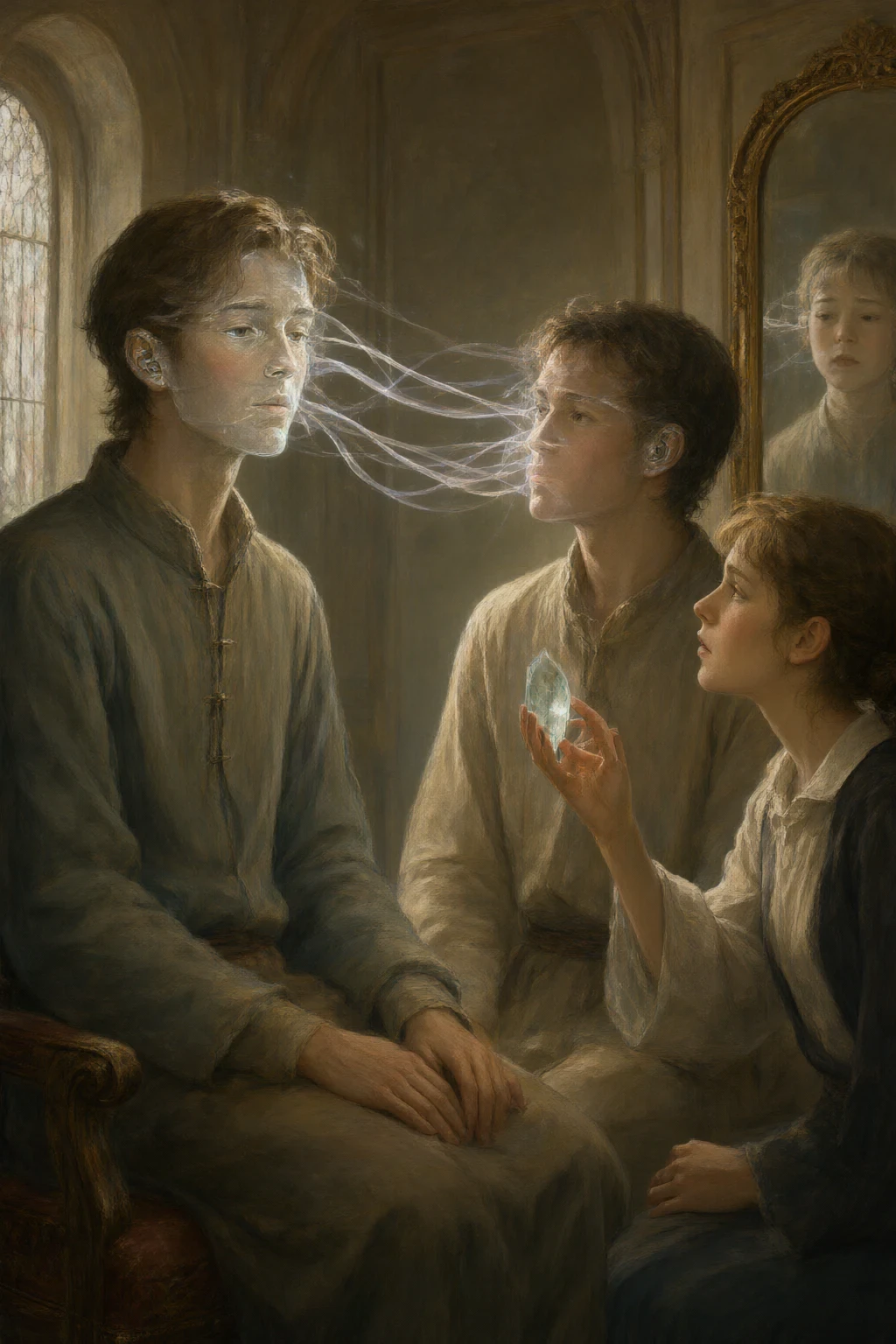
On the morning Sera was told the Healwing procedure might work, rain tapped a rhythm on the infirmary skylight. She was sixteen, small enough that the medical gown gathered at her shoulders like a sail, and tired in a way sleep had stopped repairing. Since the fever at eleven, some days arrived in bright pieces: the taste of pear, her mother calling from the kitchen, the warmth of sunlight on one cheek.
On other days the world pulled tight as a closing hand. The neurologist, Dr. Arun, placed a glass model of a human head on the desk between them. A golden bird hovered inside the skull, wings folded. “Your immune system has learned the wrong shape of itself,” he said. “Healwing borrows a healthy sense of identity so the body can recognize safety without destroying what is already there. It has a high success rate.” “Whose sense?”
He turned the model. A small human figure moved through the network of borrowed pathways. “A donor can lend forty-eight hours of their embodied self. During that time, your body uses their memories and habits to guide recovery. Afterward, most return to themselves with no lasting change.” “Most?”
“In the first trial, two people had difficulty remembering a year. One could no longer recognise a sister. Both improved physically.” He said the last sentence before he said the first names, as if improvement might cover them. Sera’s mother, Leena, leaned forward. “Will my daughter be herself?” “She will be more fully herself, if the treatment succeeds.” “That is not an answer.” Dr. Arun set down the model. “It is the best answer medicine can give.”
Sera looked at the golden bird. She wanted more than facts. She wanted the nerves in her hands to stop sending urgent messages about nothing, the fever to feel like a distant bad dream, the world to stop narrowing to a bright circle she had to chase. But she also wanted to know what Dr. Arun meant by herself. The illness had changed her routines, her memory, the way her family spoke around her. If Healwing filled in the missing pieces, which pieces would count as borrowed?
On the first screening day, a woman named Daro met them in the recovery garden. Daro was twenty-two, broad-shouldered and calm, with burn marks climbing the left side of her neck. She used a cane, though her balance was excellent, and introduced herself as a volunteer donor. “I heard Sera’s case,” Daro said. “My body is healthy. I can spare two days.”
Leena immediately began asking about the testing, recovery time, and whether Daro had family nearby. Sera noticed that Daro answered every question except one. “Have you volunteered before?” Sera asked. Daro folded the edge of her sleeve over one scar. “Once.” “How was it afterward?”
“They call it echo loss. Small things go missing. A birthday song. The route to a familiar shop. My left knee used to know rain.” She glanced at the cane. “This is not because of the donation, in case you are wondering.” “No,” Sera said. “I was trying to picture what two days would cost you.” Daro’s eyes narrowed, not unkindly. “Does knowing the cost change your answer?” “It changes what kind of answer I am allowed to give.”
At home, Leena made Sera’s favourite soup, though the smell made her queasy. Oren played a trumpet solo badly and then sat beside her bed. “You could borrow being well,” he said. “Just for a weekend.” “That is not how it works.” “I heard Dr. Arun say identity is a pattern. Couldn’t you give her a better pattern?” Sera turned the spoon in the bowl. “And after Sunday, would she want her pattern back?” Oren frowned. “It would be her pattern.” “It would be a person with her memories and a new self. That is not the same thing.” “You would be the same.” “Would I?”
The night before the spell, Daro came to the garden alone. Rain had left the leaves shining, and the greenhouse windows reflected two small figures in different coats. “I have a condition,” Daro said. “After the procedure, I don’t want anyone to tell me what I used to enjoy. I don’t want my sister arranging my life around recovering it. If I lose a piece, I need to meet the person I am without a guide.”
“I can promise I won’t decide for you.” “You can promise you won’t use me as an excuse. If I become difficult, if I say the spell was wrong, you’ll have to hear that.” “What if I say the spell was wrong?” “Then we listen to that too.”
They stood beside the rain gauge until the nurse called Daro for the final assessment. Neither of them promised the treatment would make things better. Daro asked whether Sera wanted to stop. Sera said no, then asked whether Daro wanted to stop. Daro took long enough to answer that the greenhouse fan clicked twice. “I want to know what happens if I say no,” Daro said. “That’s not the same as wanting no.”
The morning of the procedure, Sera’s family crowded into the preparation room. Leena held one of Sera’s hands while her father adjusted the blanket. Oren stood at the foot of the bed, solemn and useless with worry. Daro arrived on a separate trolley, wearing a white cap and a green hospital gown. Their hands were connected by a braided silver cord, not a leash, the nurse insisted, but a visible reminder that the bond was real.
The golden bird entered the ward through a sigil in the ceiling. Sera felt heat move from her chest to her fingertips. Daro’s face tightened. Then Sera closed her eyes and smelled rain on warm pavement.
The first sensation was not her own. She felt a staircase with three missing steps. She heard a woman laugh in another room and knew the woman was Daro’s neighbour, Mrs. Vale. The certainty arrived with Daro’s memory: a Saturday, a red scarf, a joke about the landlord. Sera’s body opened to the memory as if it were a door. Keep it, Daro’s feeling whispered. Not in words. Please keep it.
Sera tried to answer, but her throat was her own. The ward filled with a sound like wind inside a bell. Someone was calling her Sera, and someone else was calling her Daro. The distinction had been obvious when the bond began. Now it felt like a coat with two sets of pockets.
Hours—or perhaps minutes—passed. Sera saw the recovery room from above, saw her mother’s worried face, and felt Daro’s terror that the body would choose the life that hurt less. Then she saw Daro’s childhood room, the north window, the scar on her neck. A memory of burning. Not the current wound, but the old heat of it.
Daro had been trapped in a stairwell while smoke poured down; she had survived, but part of her had remained in that heat. Sera could have taken the memory as proof of pain, but that would have made Daro’s life a lesson about pain. Instead she held it without naming it. The ward was still full of fear, but fear was not the only thing present. The spell began to unwind.
For a moment, Sera felt every choice in reverse: the school corridor she had wanted to cross, the pear she could no longer taste, the brother who remembered a joke she had never heard. Daro felt the return of her own body, the weight of her feet on the floor, the hand she could not see.
When Sera opened her eyes, Daro was sitting up and asking for water. Someone had to help her drink. Sera reached toward the cup, then stopped. Daro’s hand was not hers. Her own hand trembled against the blanket. The nurse asked each of them to name three things that belonged to them.
Sera said her room, her mother’s laugh, and the taste of pear. The third answer was a memory she had lost, and saying it made her cry. Daro named her sister, the north window, and a song. The song was one she had loved before the procedure, but she did not know when she had learned it. Her face narrowed with suspicion. They had exchanged pieces. Nothing had vanished cleanly. It had settled into the spaces between them.
A week later, the council recommended that Healwing be suspended. Several patients had improved, but reports described donors remembering borrowed children, patients fearing their own preferences, and families treating the procedure as a cure because the body improved. Dr. Arun defended the treatment. He had not promised certainty, he said, and uncertainty was not proof of harm.
Sera attended the hearing with Daro and Oren. She told them about the missing steps, the red scarf, the way she had felt Daro’s fear as her own. She said, “The person who came back is not a defective version of the person who went in. We need to ask what happens to both of them.” The council asked whether she would have chosen the treatment again. She thought for a long time.
“I would not choose it the same way,” she said. “I would ask for less time, a better stopping plan, and a way to refuse the memories I was offered. But I cannot say I would rather stay ill. The treatment gave me a body I can use. It also put someone else’s life in my hands. Both things are true.”
Daro spoke after her. She had not regained the song, and her sister kept asking when it would return. “I am tired of being treated as a container for a cure,” Daro said. “The successful patients should not make us disappear.” Her sister looked down. “I am afraid to lose you.” “I know,” Daro said. “But your fear does not get to speak for me.”
The council changed the rules: donor and patient would meet separately with an advocate, the spell would record every borrowed impression, and either person could halt it without needing to prove the other was suffering. Donors would receive long-term care chosen by them, not by the hospital that benefited from their participation. Existing cases could choose to continue, but no new Healwing trials would begin until a different method was tested.
Sera’s body stayed stronger. That made recovery slower, because strength was not the same as certainty. She learned to identify her own hunger, anger, and tiredness through lists made with Daro. Sometimes Daro called to ask whether a sensation was hers. Sometimes Sera admitted she could not tell. They kept separate notebooks and agreed not to use each other’s memories as evidence of a decision.
Oren learned a new piece of music on the trumpet. He played it badly at dinner, then waited while Sera listened. “Do you want to hear it again?” he asked. “Ask me after I tell you whether I want to hear it,” she said. He asked. She said yes.
Months later, the doctors announced a new procedure: a shield that might let the body borrow only physiological patterns, without importing identity. It had been tested in machines, not people. Sera volunteered to review the data because she understood the temptation and the danger. She did not volunteer to be the first patient. Daro came to her room with a repaired cane. “I am going to learn a different song,” she said. “Not the one I lost. A new one.”
“Do you want me to help you?” “Only if you can leave the old song alone.” Sera nodded. They listened to a melody neither of them had owned before. It did not restore anything. It made a place where neither loss had to be the most important fact.